Index to this series | Text of Chapman’s Homer’s Iliad
Book VI of the Iliad may illustrate or test what I have also been reading, whose second title is Man, Society, Civilization and Barbarism. For the Greeks, the Trojan war is a fight for civilization, against the barbarism of stealing the wife of the man who has played host to you. In Book VI is the great exemplar of civilization: the meeting of Diomedes with Glaucus. Discovering that the grandfather of his Trojan enemy had once been a guest of his own grandfather, Diomedes urges that he and Glaucus must exchange gifts, be friends, and avoid meeting on the battlefield; and Glaucus agrees.
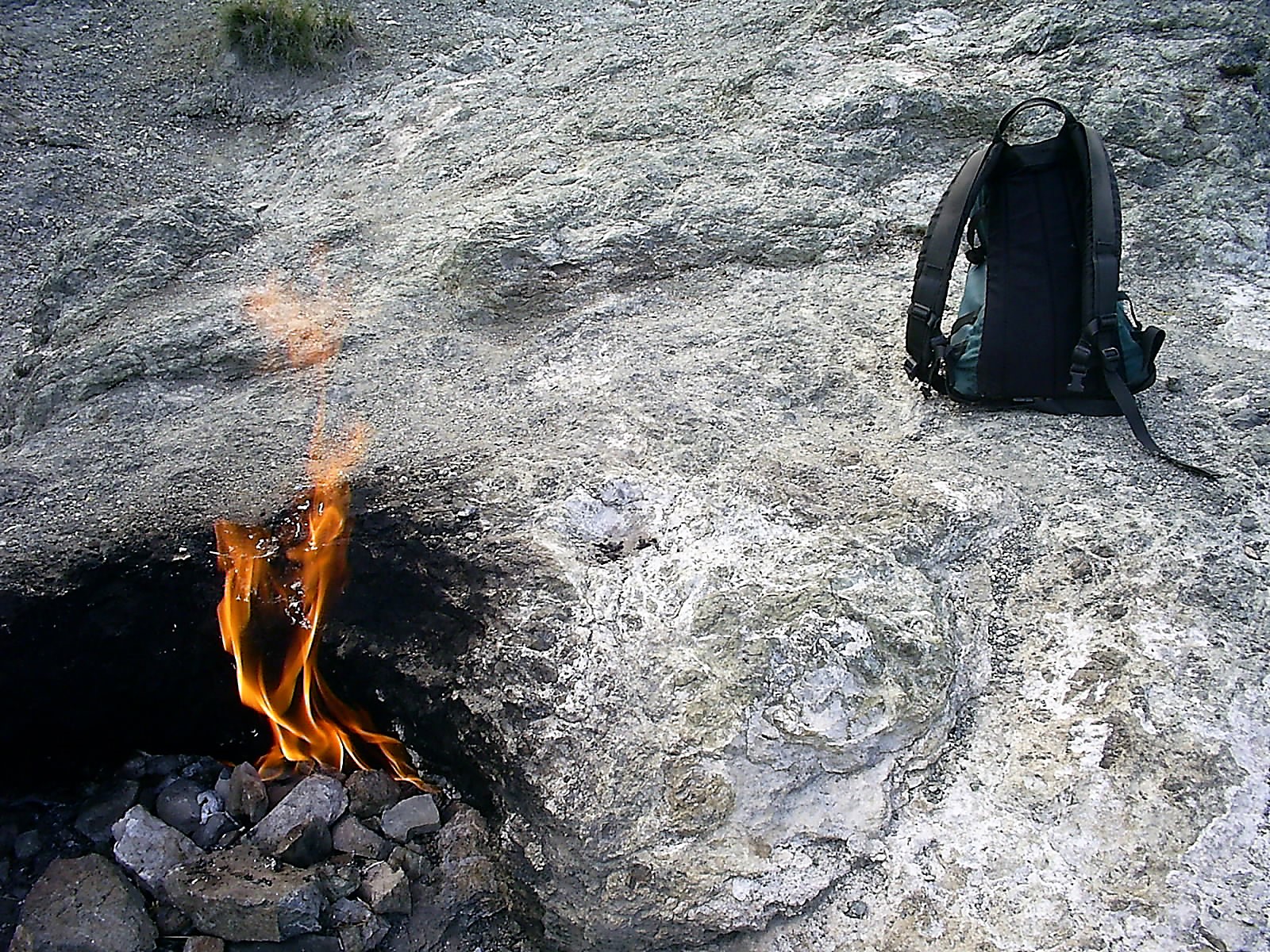
One flame of the Chimera, with my backpack, 2009
The Greeks are still some ways from civilization. For Collingwood in New Leviathan,
35. 41. Behaving ‘civilly’ to a man means respecting his feelings: abstaining from shocking him, annoying him, frightening him, or (briefly) arousing in him any passion or desire which might diminish his self-respect (13. 31); that is, threaten his consciousness of freedom by making him feel that his power of choice is in danger of breaking down and the passion or desire likely to take charge (13. 67).
In Book VI, Menelaus is about to behave civilly in a fundamental way, by granting the plea of a man not to be killed. Agamemnon arouses the passion of his brother, telling him that, down to the babe in the womb, all Trojans must suffer his vengeance. Collingwood will address this:
35. 66. Strangers (i.e. foreigners not sharing our communal home) are in fact often treated with the utmost incivility; often, for example, murdered with impunity and a clear conscience even by peoples who enjoy a relatively high civilization.
35. 67. This happens in spite of a conviction that all human beings ought to be civilly treated; all that is lacking is a conviction that strangers are human beings.
At the end of Book VI comes the meeting of Hector with Andromache, whose brothers and father were once slaughtered by Achilles, and whose mother lived not much longer (lines 464–7):
Gaue her a Lance, and tooke her life; Yet all these gone from me
Thou amply renderst all: thy life makes still my father be,
My mother; brothers: and besides, thou art my husband too;
Most lou’d, most worthy. Pitie then (deare loue) and do not go.
I have known two men who were failures by their own standards, though they were not likely to admit it; but they were resentful of the success of their children. Hector prays that his son may be more successful than he has been.
This prayer may be Hector’s only way of passing along anything to his son. He himself expects to be dead when some Greek warrior drags Andromache away into slavery. Still may Hector have the spirit of civilization that Collingwood finds suggested at the beginning of the Republic. A sailor himself, Collingwood has been talking about knots, which cannot be appreciated and used unless the knowledge of how to tie them is handed down. He then quotes Socrates:
36. 44. ‘Will they hold torches, and pass them from hand to hand as they ride the race?’
36. 45. The gradual building-up and storing of all this knowledge of which the bowline is an infinitesimal fraction is the gradual building-up and garnering of human civilization relatively to the natural world.
Not every tradition is worthy of passing along. A tradition of critically reading the Iliad would seem to be worthy.
In Book VI we meet the Chimera, whose flames still burn, west of Antalya, near the Lycian Olympus.
Blow by Blow
We left the previous book with the gods, who had withdrawn to the original Thessalian Olympus. Since Homer himself will not have been announcing each new book as such, he needs a few transitional verses as we return to earth (lines 1–4):
THe stern fight freed of al the Gods; conquest, with doubtful wings
Flew on their lances; euerie way, the restlesse field she flings,
Betwixt the floods of Symois, and Xanthus, that confin’d
All their affaires at Ilion, and round about them shin’d.
Ajax son of Telemon now kills Eussorian Acamas, the strongest man of Thrace. Let us note then that, as is Lycia, which is in Asia Minor, so is Thrace, which is in Europe, allied with Troy.
Teuthranides Axylus of Arisbe has welcomed all travellers to be his guest, but none can stand between him and death at the hands of Tydides (namely Diomedes); his charioteer Calesius also dies.
Note added August 22, 2024: Welcome guests, and you may be bereft of your spouse, like Menelaus, or you may die alone, like Axylus. It is no reason not to be a good host, or for that matter a good guest. In any case, not everything in life can be a transaction. People like Sarpedon do try to pay back what they have received, at least by his own account in Book V:
And yet Sarpedon seconds him, with this particular taunt
Of noble Hector; Hector? where, is thy vnthanfull vaunt,
And that huge strength on which it built? that thou, and thy allies,
With all thy brothers (without aid of vs or our supplies,
And troubling not a citizen) the Citie safe would hold:
In all which, friends, and brothers helps, I see not, nor am told
Of any one of their exploits; but (all held in dismay
Of Diomed; like a sort of dogs, that at a Lion bay,
And entertaine no spirit to pinch;) we (your assistants here)
Fight for the towne, as you helpt vs: and I (an aiding Peere,
No Citizen, euen out of care, that doth become a man,
For men and childrens liberties) adde all the aide I can.
Euryalus kills first Opheltius and Dresus, then the twins Aesepus and Pedesus, whom Bucolion son of Laomedon begot on the nymph Nais Arbarea as she tended her flocks.
A string of deaths at the hands of the Greeks is more tersely described, before Menelaus takes Adrestus, apparently after his chariot breaks among the tamarisk trees as the frightened horse flee. The charioteer apparently gets away too, but Adrestus takes the knees of Menelaus and pleads for his life, in return for a ransom that his father will surely pay. Menelaus is of a mind to accept, until Agamemnon sees (lines 53–62),
And came in threatning, crying out; O soft heart? whats the cause
Thou spar’st these men thus? haue not they, obseru’d these gentle lawes
Of mild humanitie to thee, with mightie argument,
Why thou shouldst deale thus? In thy house? and with all president
Of honord guest rites entertaind? not one of them shall flie
A bitter end for it, from heauen; and much lesse (dotingly)
Scape our reuengefull fingers; all, euen th’infant in the wombe
Shall tast of what they merited, and haue no other tombe,
Then razed Ilion; nor their race, haue more fruite, then the dust.
This iust cause turnd his brothers mind, who violently thrust
Agamemnon’s rhetorical question about how the Trojans have treated him is negative, where today we would make it positive: “Have they observed these gentle laws of mild humanity to thee? No they haven’t, so kill them all!” This counts for logic at war. Menelaus pushes away Adrestus, and Agamemnon spills his guts.
Nestor calls on all the Greeks to kill first and despoil the bodies later. On the Trojan side, Helenus tells Hector and Aeneas to make sure nobody retreats to the city.
Helenus does advise Hector to go to town, to ask “our Queene mother” to pray in the Palladium, namely the temple of Athena, and donate to her “the richest robe she hath” (lines 89–91),
And vow to her (besides the gift) a sacrificing stroke
Of twelue fat Heifers of a yeare, that neuer felt the yoke:
(Most answering to her maiden state) if she will pittie vs.
First, Hector turns the tide, making his comrades “fear to fear,” and making the Greeks think a god is against them again (lines 98–102):
Hector intends his brothers will; but first through all his bands,
He made quicke way, encouraging, and all (to feare) affraide:
All turnd their heads and made Greece turne. Slaughter stood still dismaid,
On their parts; for they thought some God, falne from the vault of starres,
Was rusht into the Ilions aide, they made such dreadfull warres.
Note added August 22, 2024: The advice of Nestor and of Helenus is the same:
- Be not penny wise and pound foolish.
- Do not lose the big picture.
What Helenus says includes (lines 75–80),
For counsell, strength of hand, and apt, to take chance at her best,
In euery turne she makes) stand fast, and suffer not the rest
(By any way searcht out for scape) to come within the ports:
Lest (fled into their wiues kind armes) they there be made the sports
Of the pursuing enemie: exhort and force your bands
To turne their faces: and while we, employ our ventur’d hands …
Hector himself will be seduced by no woman:
- not his mother, who will invite him to stay and drink wine;
- not his wife, who will suggest that he stay within the walls to defend their weakest part.
As for Nestor’s specific advice, it is given also by Cyrus the Great, by the account of Xenophon in Cyropedia IV.ii.25:
And if we win the battle, we must be on our guard against an error which has lost the day for many in the hour of victory – turning aside to plunder. For the man who does this is no longer a soldier but a camp-follower; and any one who will is free to treat him as a slave.
Napoleon’s army thus became camp-followers in Moscow, by Tolstoy’s account in War and Peace (Maude translation, Oxford World’s Classics, page 962):
Though tattered, hungry, worn out, and reduced to a third of their original number, the French entered Moscow in good marching order … When five weeks later these same men left Moscow, they no longer formed an army. They were a mob of marauders, each carrying a quantity of articles which seemed to him valuable or useful … Like a monkey which puts its paw into the narrow neck of a jug, and having seized a handful of nuts will not open its fist for fear of losing what it holds, and therefore perishes, the French when they left Moscow had inevitably to perish because they carried their loot with them, yet to abandon what they had stolen was as impossible for them as it is for the monkey to open its paw and let go of its nuts.
By the way, I don’t know whether Robert Pirsig got his “old South Indian Monkey Trap” from Tolstoy. In the account in Zen and the Art of Motorcycle Maintenance (chapter 26), the trap is a coconut shell with rice inside, chained to a stake. Pirsig asks,
What general advice – not specific advice – but what general advice would you give the poor monkey in circumstances like this?
You would advise the monkey to open its paw, but this is specific advice. Is there something helpful the monkey could have learned in a “critical thinking” course in school?
When Hector does run to Troy, we are given a fascinating tactile vignette (lines 109–12).
Then faire-helm’d Hector turnd to Troy, and (as he trode the field)
The blacke Buls hide, that at his backe, he wore about his shield,
(In the extreme circumference) was with his gate so rockt,
That (being large) it (both at once) his necke and ankles knockt.
Meanwhile, Diomedes encounters Glaucus, son of Hippolochus, and tells him that, if he is a man, he will be killed; if a god, left alone. Diomedes explains further, not by recalling his previous tangles with Venus and Mars on the battlefield, but with a story that we did not hear then. Jove killed Lycurgus, son of Dryas, after Thetis warned Saturn’s son that on the hill called Nyseius, Dryas’s son had been harrassing the Maenads, here called both frows and the nurses of Nisaeus, who is Bacchus. Glaucus replies (lines 139–46):
Come neare, that thou maist soone arriue, on that life-bounding shore,
To which I see thee hoise such saile. Why dost thou so explore,
(Said Glaucus) of what race I am? when like the race of leaues
The race of man is, that deserues, no question; nor receiues
My being any other breath: The wind in Autumne strowes
The earth with old leaues; then the Spring, the woods with new endowes:
And so death scatters men on earth: so life puts out againe
Mans leauie issue: but my race, if (like the course of men)
Note added August 22, 2024: the race of leaves has no history, while the race of man does, as Glaucus himself betrays by telling some of it. I talk more about this in the later post on Book VI, and a week later in “Biological History,” a post on the theme that not only is biology not destiny, but destiny is not biology. I take examples of people confused about this from stories of Somerset Maugham.
Diomedes has asked only whether Glaucus be divine or human, but Glaucus replies with the story of his grandfather, begot of Glaucus son of Sisyphus, wise man (or wise guy) of Ephyre in Argos.

Rembrandt Workshop, Joseph Accused by Potiphar’s Wife, 1655
oil on canvas transferred to canvas
Andrew W. Mellon Collection, National Gallery of Art, Washington
Like Joseph, Bellerophon rejects the advances of the wife of the king. Anteia accuses Bellerophon of trying to rape her, and so Proetus sends him off to visit Anteia’s father, king of Lycia.
Note added August 23, 2024: Chapman gives us a little essay on moral virtue (lines 155–64):
The vertue of the one, Ioue plac’t, beneath the others powre.
His exile grew, since he denied, to be the Paramour
Of faire Anteia, Proetus wife; who felt a raging fire
Of secret loue to him: but he, whom wisedome did inspire
As well as prudence (one of them, aduising him to shunne
The danger of a Princesse loue: the other, not to runne
Within the danger of the Gods: the act being simply ill)
Still entertaining thoughts diuine, subdu’d the earthly still.
She (rul’d by neither of his wits) preferd her lust to both;
And (false to Proetus) would seeme true, with this abhorr’d vntroth.
Is the distinction between avoiding human and divine retribution? It is not clear to me which of these would be prudent, and which wise. In any case, Chapman has enlarged on Homer’s lines 160–3:
τῷ δὲ γυνὴ Προίτου ἐπεμήνατο, δῖ’ Ἄντεια,
κρυπταδίῃ φιλότητι μιγήνεναι ἀλλὰ τὸν οὔ τι
πεῖθ’ ἀγαθὰ φρονέοντα, δαΐφρονα Βελλεροφόντην.
ἡ δὲ ψευσαμένη Προῖτον βασιλῆα προσηύδα.
In Murray’s version,
Now the wife of Proetus, fair Anteia, lusted madly for Bellerophon, to be with him in secret love, but could in no wise prevail upon wise-hearted Bellerophon, for that his heart was upright. So she made a tale of lies, and spake to king Proetus.
Homer gives the king no name, but Chapman calls him Rheuns, for an unknown reason, unless it be from the last word in verse 172,
ἀλλ᾽ ὅτε δὴ Λυκίην ἷξε Ξάνθόν τε ῥέοντα,
but when he had come to Lycia and the flowing Xanthus.
Bellerophon carries a letter, telling Rheuns to kill him. Too busy welcoming his guest with a slaughtered ox every day, Rheuns does not even open the letter till the tenth. He sends Bellerophon off to contend first with the Chimaera, next with the Solymi, and third with the Amazons. As Bellerophon is victor in each contest, and finally survives the ambush set for him on his way back, Rheuns recognizes him as divine and gives him half his kingdom, along with his daughter.
The princess gives Bellerophon three children, Isander, Hippolochus, and Laodamy. Jupiter begets Sarpedon on the last. But then Mars kills the first when he too contends with the Solymi; and (lines 211–3),
Laodamia (being enuied, of all the Goddesses)
The golden-bridle-handling Queene, the maiden Patronesse,
Slue with an arrow …
This leaves Bellerophon with one child (lines 217–20):
Hippolochus, the root of me: who sent me here, with charge,
That I should alwaies beare me well, and my deserts enlarge
Beyond the vulgar: lest I sham’d, my race, that farre exceld
All that Ephyras famous towres, or ample Lycia held.
Diomedes recalls that Oeneus, evidently his grandfather, entertained Bellerophon as a guest for twenty days and give him a purple Phoenician girdle, receiving in return a golden amphora, which Diomedes keeps back at home. Having been a child when Tydeus died at the seige of Thebes, Diomedes does not know whether his father and Hippolochus knew one another – but how then, I ask, does he know about the visit of Bellerophon with Oeneus, even down to what the latter gave the former to take away? Diomedes says he and Glaucus must visit one another, and avoid one another meanwhile on the battlefield, and exchange gifts of arms (lines 242–7).
Ioyne hands, giue faith, and take; and then, did Iupiter elate
The mind of Glaucus: who to shew, his reuerence to the state
Of vertue in his grandsires heart, and gratulate beside
The offer of so great a friend: exchang’d (in that good pride)
Curets of gold for those of brasse, that did on Diomed shine:
One of a hundred Oxens price, the other but of nine.
By now, Hector has reached Troy, and all the wives, children, and paramours of Troy ask about their fathers, brothers, and loves. Hector just tells them to pray. He visits the court, with its lodgings for Priam’s fifty sons and their wives, and twelve daughters and their husbands.
As an excuse, no doubt, to keep him at home, the mother of Hector tries to ply him with wine, which he should offer first to Jupiter (lines 274–6):
But wine will something comfort thee: for to a man dismaid,
With carefull spirits; or too much, with labour ouerlaid,
Wine brings much rescue, strengthning much, the bodie and the mind.
Hector prudently and piously declines (lines 277–83):
The great Helme-mouer thus receiu’d, the authresse of his kind;
My royall mother, bring no wine, lest rather it impaire,
Then helpe my strength; and make my mind, forgetfull of th’affaire
Committed to it. And (to poure, it out in sacrifice)
I feare, with vnwasht hands to serue, the pure-liu’d Deities;
Nor is it lawfull, thus imbrew’d, with blood, and dust; to proue
The will of heauen: or offer vowes, to clowd-compelling Ioue.
Before cursing his brother Paris, whom he is about to visit, Hector passes along Helenus’s request for prayers, which Hecuba goes to fulfil. Her richest robe is one made by the women of Sidonia, whence Paris brought it back to Troy on the same voyage in which he brought Helen back. Hector’s sister Theano, wife of Antenor and priestess of Minerva, prays that the goddess will break the spear of Diomedes. Pallas will not grant this.
Alexander has grand lodgings, where Hector finds him among the women, though arming himself to go out among the men. Hector decides to chastise him
- not for his cowardice,
- but for having caused the war in the first place.
Helen also curses him, along with herself, and tries to tempt Hector as his mother did (lines 391–7):
But he is senslesse, nor conceiues, what any manhood is;
Nor now, nor euer after will: and therefore hangs, I feare,
A plague aboue him. But come neare; good brother, rest you here,
Who (of the world of men) stands charg’d, with most vnrest for me,
(Vile wretch) and for my Louers wrong; on whom a destinie
So bitter is imposde by Ioue, that all succeeding times
Will put (to our vn-ended shames) in all mens mouthes our crimes.
Hector will not stay, but tells Helen to goad Paris onto the battlefield. Hector finds Andromache not at home, and he is told she has gone out distraught, though not to pray with the other women. Hector makes to go back out through the ports of the city, so that Andromache may see him. She is the last of the race of King Eëtion of Theban Hypoplace of Cilicia. She sees Hector, and (line 440–3):
Thus wept forth her affection: O noblest in desire;
Thy mind, inflam’d with others good, will set thy selfe on fire:
Nor pitiest thou thy sonne, nor wife, who must thy widdow be,
If now thou issue: all the field, will onely run on thee.
She tells the story of her being orphaned. She urges Hector stay in the city, defending the weakest part of the walls.
Hector will not stay. Andromache should rest assured that he has considered her concern; but he loved her less, loved he not honor more (lines 478–85):
But what a shame, and feare it is, to thinke how Troy would scorne
(Both in her husbands and her wiues, whom long-traind gownes adorne)
That I should cowardly flie off? The spirit I first did breath,
Did neuer teach me that; much lesse, since the contempt of death
Was settl’d in me; and my mind, knew what a Worthy was;
Whose office is, to leade in fight, and giue no danger passe
Without improuement. In this fire, must Hectors triall shine;
Here must his country, father, friends, be (in him) made diuine.
The city will fall, and Andromache be enslaved, but Hector will be dead by then. The infant Astyanax, called by his father Scamandrius, clings to his nurse in fear of Hector’s horse-hair plume. Hector laughs, removes his helmet, takes and kisses his son, and prays for his superiority, as I mentioned.
Andromache goes home. Paris comes out like a steed long tied up. Hector tells him (lines 560–1),
Thy strength too readily flies off: enough will is not put
To thy abilitie …
Thus the responsible sibling to the irresponsible.
Edited August 22, 23, and 24, 2024
 Polytropy
16 Trackbacks
[…] the Greek seige of Troy. While considering the treatment by Menelaus of his prisoner Adrestus in Book VI, I cited Collingwood in describing civil behavior as abstention from arousing a passion that would […]
[…] Book VI, Hector prays that his son will be superior to himself. Achilles is not like that with Patroclus, […]
[…] 365): that’s Cilician Thebes, Eetion being the father of Andromache, whom we shall meet in Book VI. Perhaps Chrysa should be understood as a village attached to Thebes, which is in turn attached to, […]
[…] would try to prove the Law of Contradiction. I recall noting the conflict within Hector, seen in Book VI of the Iliad: there was a hope that his son would be known as the better man, along with the […]
[…] quote is apparently from Book VI of the Iliad, at the end of the speech of Glaucus (Γλαῦκος) to Diomedes. This is the speech […]
[…] one can believe this from a thorough reading of the Iliad, I do not know. I take an example from Book VI (in Chapman’s translation in an 1887 edition from Routledge in London), where Athena denies the […]
[…] became insane, while the latter sought out habitations in desert places; wherefore Homer writes [Book VI, lines […]
[…] wrote about Book VI, later in 2017, where I am now, in Altınova, Ayvalık, Balıkesir, Turkey, on the beach opposite […]
[…] particular simile that Glaucus will tell to Diomedes in Book VI (lines […]
[…] may not be a bad thing, if done in the spirit of Glaucus, who tells his nominal enemy Diomedes in Book VI (lines […]
[…] Dione’s examples of gods injured by men do not include the Maenads whom Diomedes will recall in Book VI when meeting […]
[…] mentioned a different Lycurgus in Book VI, but the one now recalled by Nestor tricked Areithous and got his arms, which, when he was old, he […]
[…] Sarpedon, Asteropaeus (perhaps the ambidextrous Thracian killed by Achilles in Book XXIII), Glaucus (befriended under questionable terms by Diomedes in Book VI). […]
[…] warning might have been useful when Napoleon took Moscow; I added these examples to what I wrote “On Chapman’s Homer’s Iliad Book VI” […]
[…] thinking may explain the specificity of people’s prayers, as in the Iliad. In Book VI for example, Theano prays Athena, not that the whole Greek effort collapse, but only that the spear […]
[…] what is in which post – for example, Collingwood’s notion of civilization, taken up in the post on Book VI of the Iliad in Chapman’s translation. If I have planned ahead, I may be able to recover such information by means of the “tags” and […]