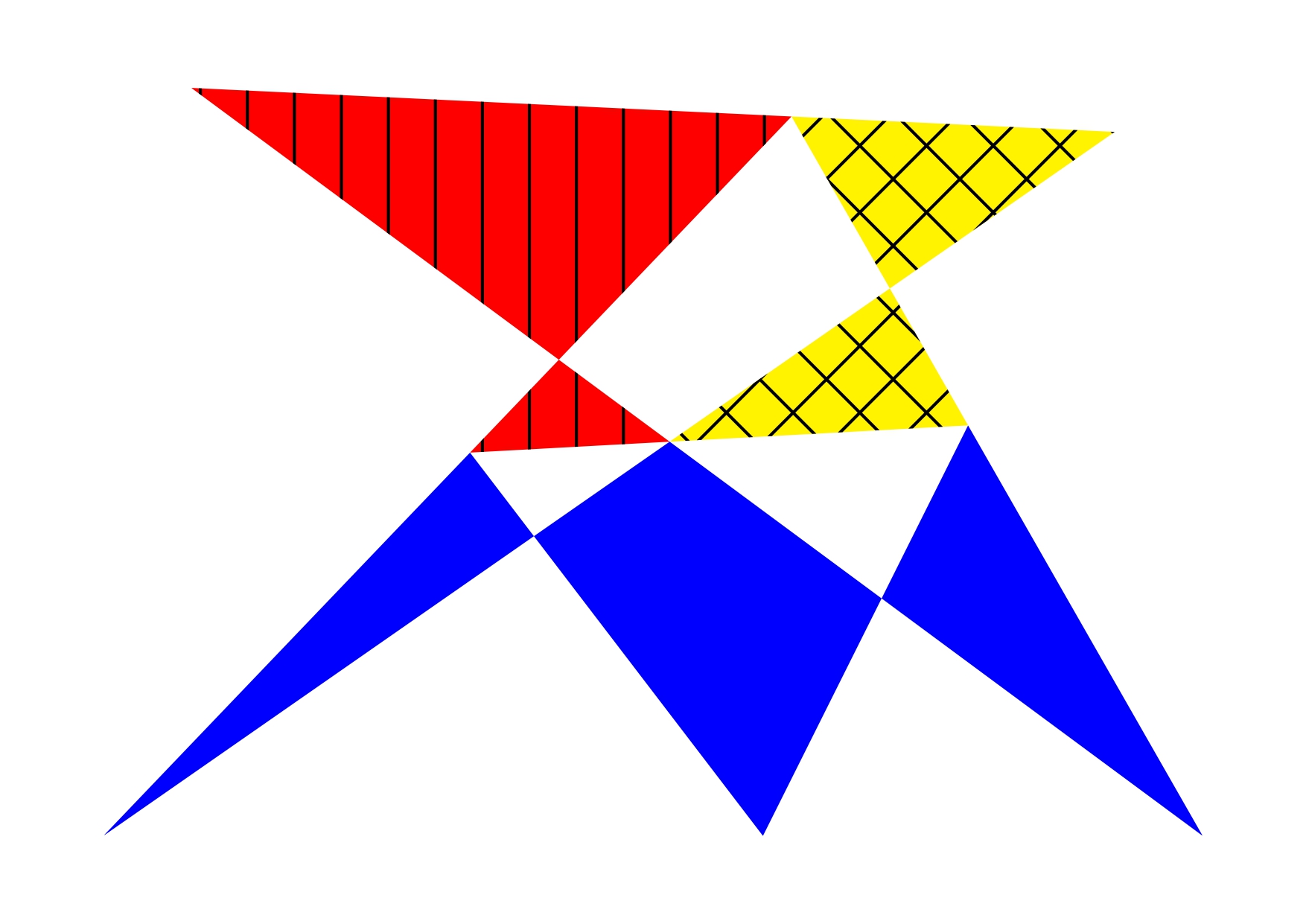
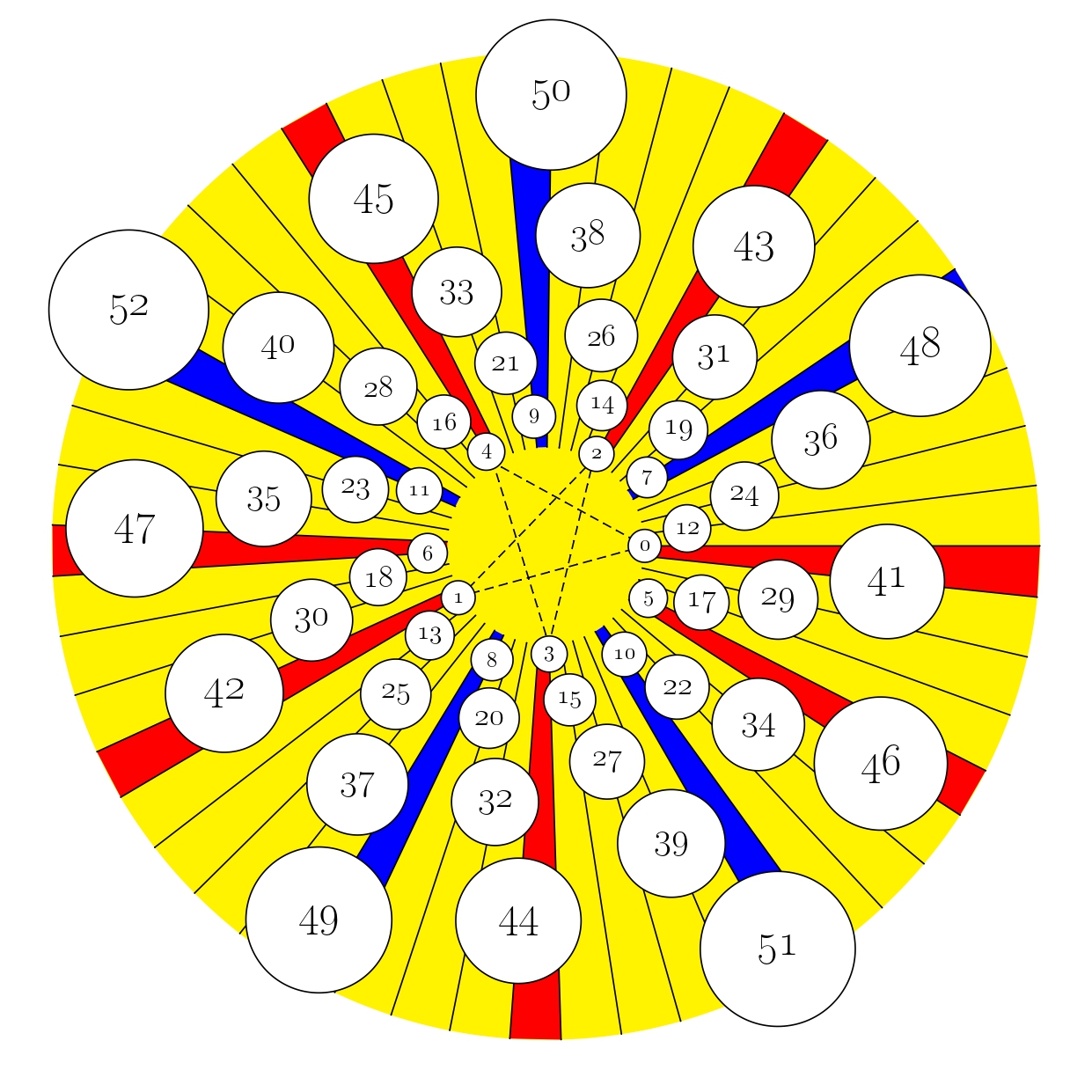
Pappus’s Hexagon Theorem is that, if six straight lines form a hexagon whose vertices lie alternately on a seventh and an eighth straight line, then the intersection points of the pairs of opposite sides of the hexagon lie on a ninth straight line. The theorem can be depicted as just below, in a way that I shall try to verbalize presently.

-
-
Meta
-
Archives
-
Categories
- Art (187)
- Music (4)
- Poetry (108)
- Homer (76)
- Sylvia Plath (4)
- T. S. Eliot (12)
- Prose (71)
- Visual Art (26)
- Film (5)
- Education (54)
- Facebook (14)
- History (66)
- Archeology (6)
- Tourism (30)
- Language (36)
- Fowler (6)
- Grammar (12)
- Strunk and White (9)
- Turkish (8)
- Logic (12)
- Mathematics (81)
- Exposition (21)
- Mathematical Topics (10)
- Calculus (4)
- Conic Sections (6)
- Mathematicians (31)
- Archimedes (8)
- Euclid (23)
- G. H. Hardy (7)
- Philosophy of Mathematics (18)
- Nature (28)
- Philosophy (300)
- “God is a circle …” (5)
- Categorical Thinking (6)
- Causation (12)
- Contradiction (8)
- Criteriological Science (8)
- dialectic (28)
- Freedom (23)
- Ontological Proof (6)
- Pacifism (9)
- Persons (247)
- Aristotle (59)
- Collingwood (166)
- absolute presuppositions (18)
- “ceases to be a mind” (5)
- New Leviathan (70)
- overlap of classes (11)
- Principles of Art (46)
- question and answer (5)
- Descartes (18)
- Leo Strauss (11)
- Midgley (13)
- Pirsig (39)
- Plato (101)
- Philosophy of History (27)
- Sex and Gender (12)
- Stoicism (2)
- Psychology (19)
- Science (30)
- Galileo (7)
- Turkey (98)
- coup (3)
- Istanbul (59)
- Bosphorus (5)
- Gezi (8)
- The Islands (3)
- Tophane (3)
- Nesin Mathematics Village (27)
- Uncategorized (8)
- West Virginia (16)
- Art (187)
-
Recent Posts

