Category Archives: Mathematics

Nine Straight Lines

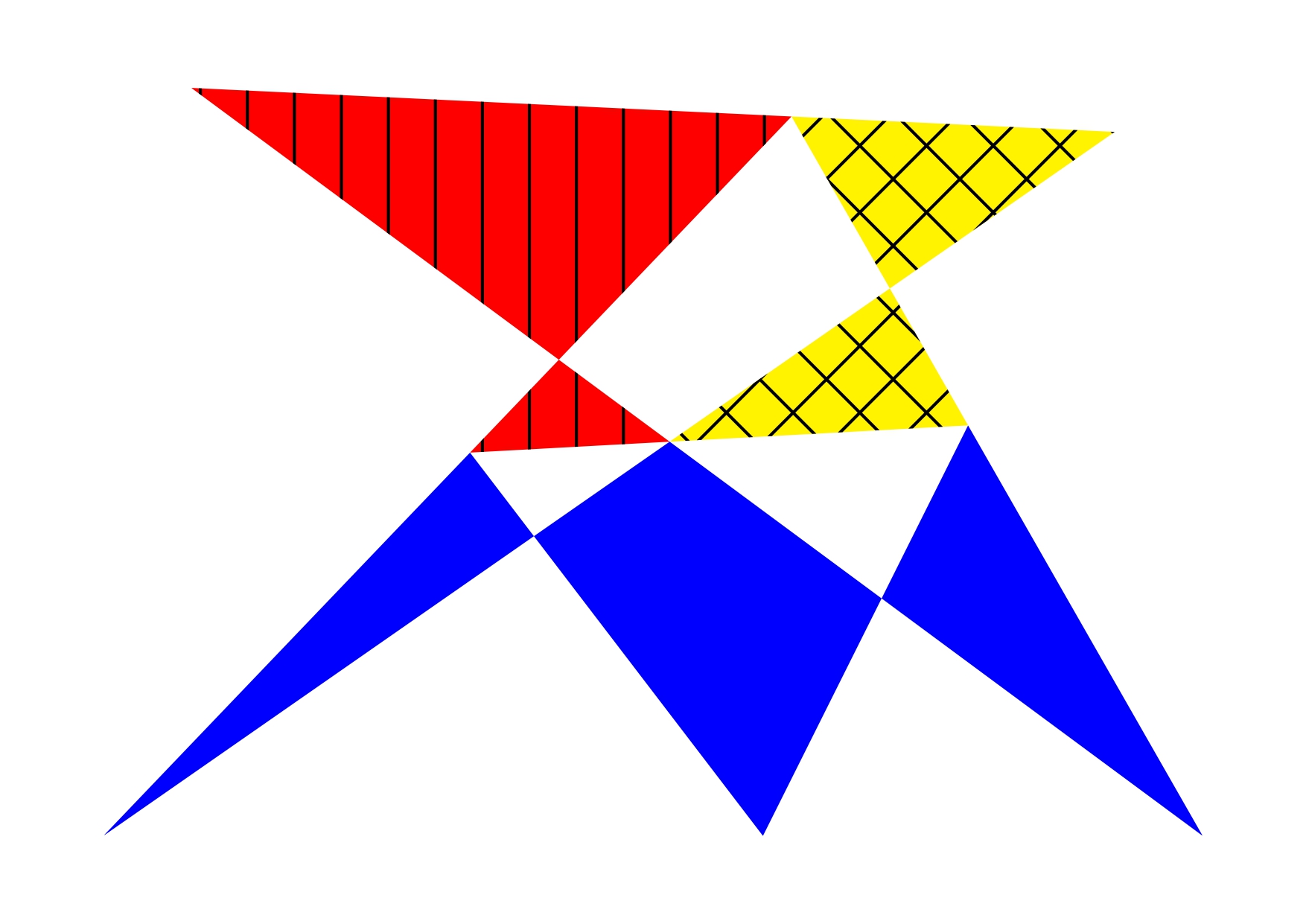
Pappus’s Hexagon Theorem is that, if six straight lines form a hexagon whose vertices lie alternately on a seventh and an eighth straight line, then the intersection points of the pairs of opposite sides of the hexagon lie on a ninth straight line. The theorem can be depicted as just below, in a way that I shall try to verbalize presently.
Fifty-Three Notes

As I understand Western music, there’s a diatonic scale, whose notes correspond to seven consecutive white keys of a piano. The eighth white key (from the left) is an octave above the first. The terminology makes some sense, since an octopus has eight arms, and an octagon has eight sides.

Between two white piano-keys that are an octave apart, there are five black keys. When their notes are added to the diatonic scale, the chromatic scale results.

Perhaps I was given some such understanding in school. It was never quite satisfactory. In part to remedy this problem, I have drafted a paper, “Numbers and Notes in Plato and Euclid,” for which this blog post is now a repository. (The pdf file just linked to has 103 pages, but they are small, size B6; the date is September 22, 2026.)

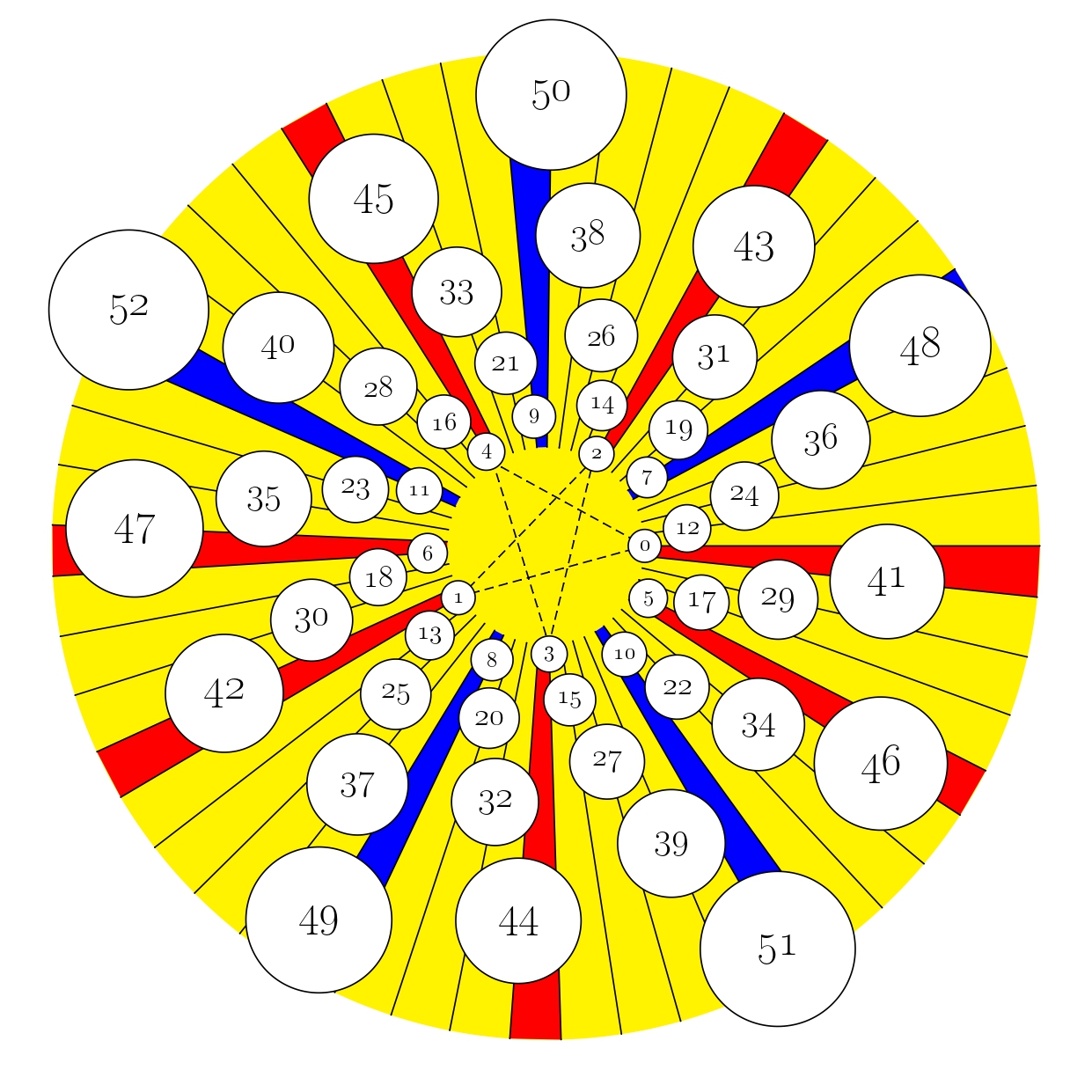
The draft paper may explain itself, sufficiently well. Its most interesting element may be a black-and-white version of the following diagram, which I am also going to say more about in this post.

Computer Math

My title is on the pattern of “Computer Love” (1981), by Kraftwerk, a song enchanting and tragic.

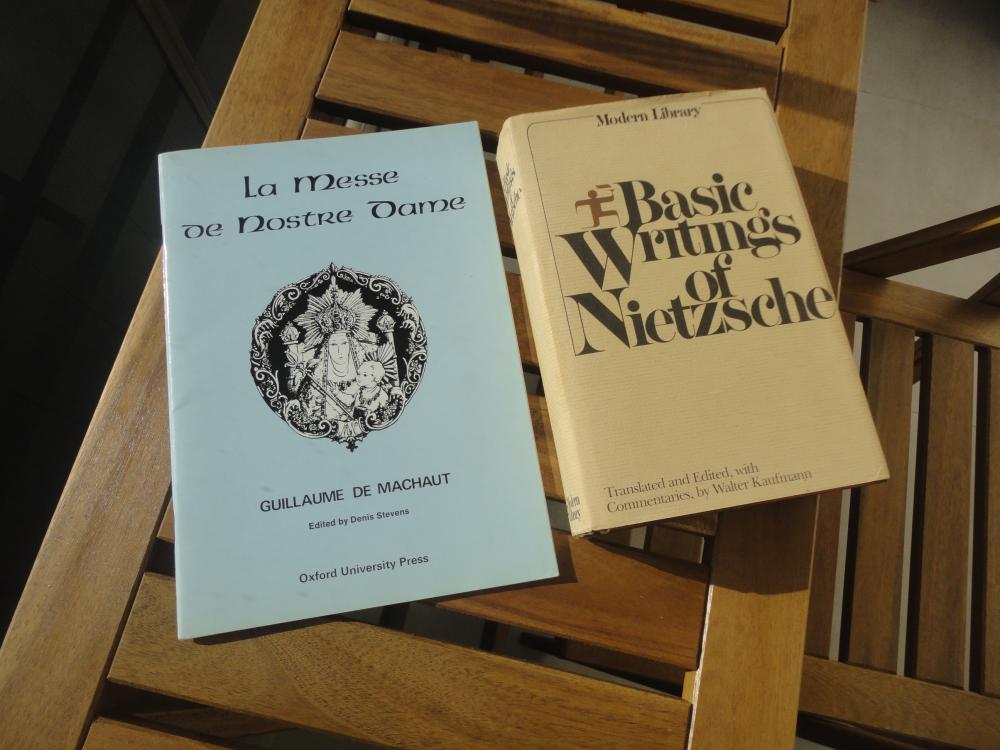
La Messe de Nostre Dame (saddle-bound paperback) and The Basic Writings of Nietzsche (perfect-bound hardback) on slatted wooden table next to slatted wooden chair
Perhaps the “Kyrie” of the Machaut Mass
is enchanting but not tragic
though it literally begs for mercy
or at least the singers do

As of August 1 of this year (2026), the company called OpenAI claim to have made “Ten advances in mathematics and theoretical computer science.” The claim has the appearance of being documented by two pdf files:

Continue reading →

Seventeen Sides

Here are my slides on the construction of the heptakaidecagon. I have referred to them before, as detailed below, but I have edited them (slightly) since, and I wanted to have a fixed home for them. That will be this post.

I call them slides, because the page size is A6, in landscape orientation, and most pages are self-contained, except for the six pages of the Introduction. There are 80 pages, all told, last edited June 13 of this year (2026). A circle is divided into seventeen equal arcs, with ruler and compass alone, and then a proof that the circle has been so divided is given in Euclidean terms.

One purpose then is to contemplate why the Ancients did not discover the construction.

Geometry and Algebra

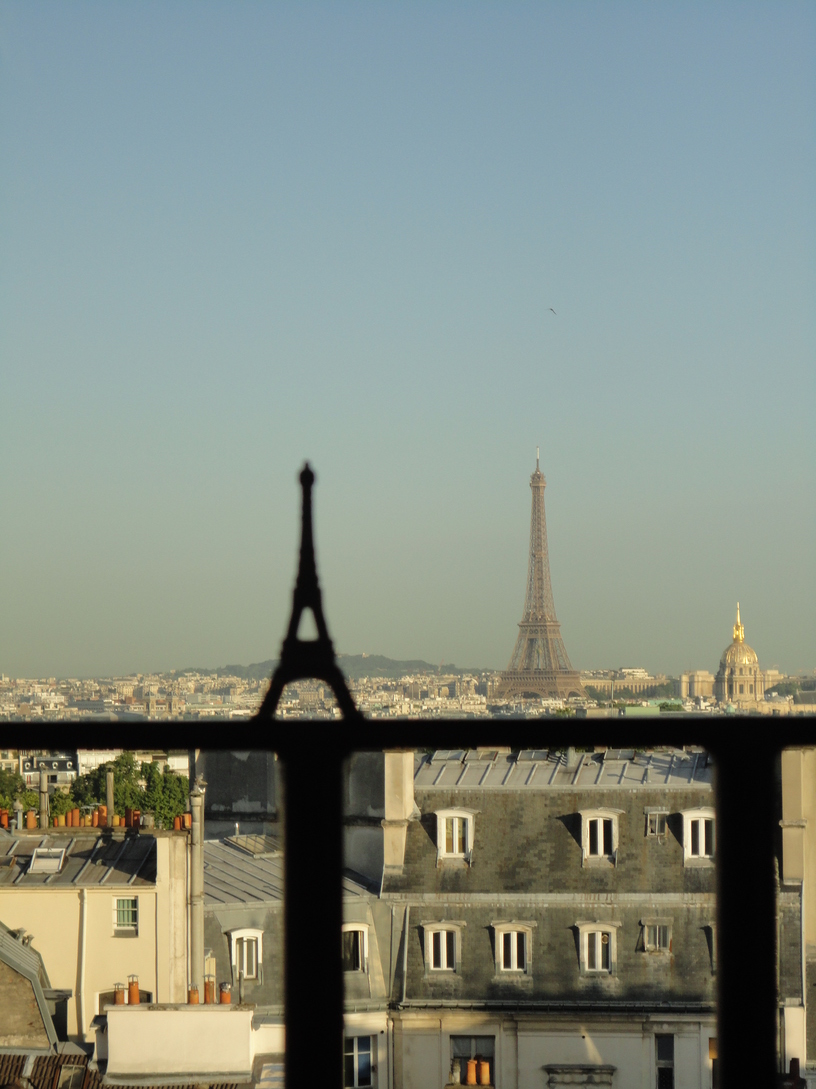
Photo: Appearing the same size are the Eiffel Tower in the distance and a model in the foreground, standing on the railing of a window that overlooks other buildings

From a flat on the rue Saint-Jacques, Paris
Thursday, June 4, 2015


What René Descartes says here does not make a lot of sense to me:

it is far better never to contemplate investigating the truth about any matter than to do so without a method. For it is quite certain that such haphazard studies and obscure reflections blur the natural light and blind our intelligence.

Continue reading →

Ethics of Mathematics

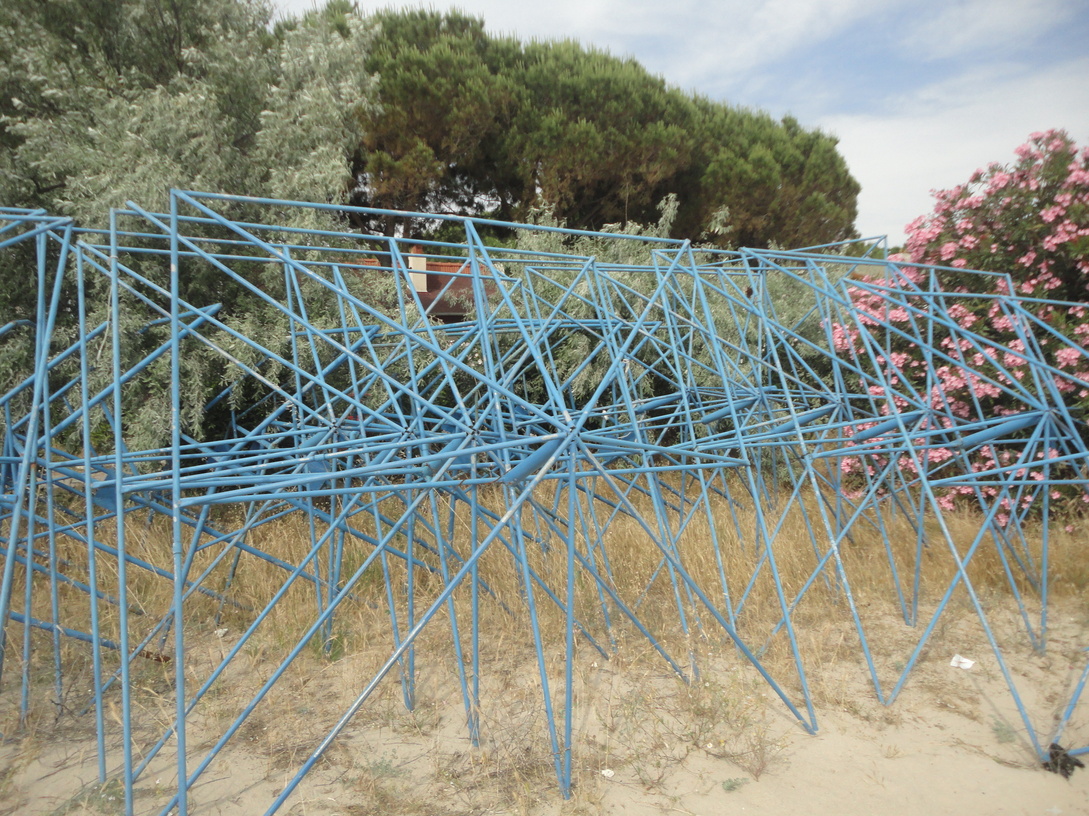
The 12 blue edges of a cube and the 12 green edges of an octahedron respectively bisect one another at right angles

Zometool construction, Ankara, November 20, 2010

The main point of this post is to share a passage from an essay by the late William Thurston:

1 What is it that mathematicians accomplish?

… We are not trying to meet some abstract production quota of definitions, theorems and proofs. The measure of our success is whether what we do enables people to understand and think more clearly and effectively about mathematics.

Therefore, we need to ask ourselves:

2 How do people understand mathematics?

This is a very hard question. Understanding is an individual and internal matter that is hard to be fully aware of, hard to understand and often hard to communicate …

Continue reading →

Astronomy Anomaly

Aristotle was the subject of the last three posts on this blog:

“Perception Deception”
The Philosopher asserts in De Anima that the eyes cannot be in error about color; Josef Albers contradicts this.
“Imitation Limitation”
In the Poetics, Aristotle seems to use mimêsis as a differentia of poiêsis among the technai. Arts not poetry are nonetheless imitative, but perhaps artists are to be distinguished for imitating themselves.
“Purity Obscurity”
Does catharsis clean the emotions, or wash them away?

Two more posts might have taken up the latter half of the Poetics, but they never materialized.

I turn now to the work held under the arm of Aristotle’s teacher, at the center of Raphael’s School of Athens.


Small book atop a pile of rubble on a beach, sea beyond

Altınova, Balıkesir, Monday, June 16, 2025

Continue reading →

Perception Deception


John Donne, Holy Sonnet XIX
(on the last line, “make” should be “ſhake”)

This post involves:

  • “the” philosopher –
    • Aristotle;
  • two mathematicians –
    • Euclid,
    • David Hilbert;
  • three persons associated with Black Mountain College –
    • Josef Albers,
    • Dorothea Rockburne,
    • Max Dehn;
  • one person (in addition to myself and Dehn) associated with St John’s College –
    • David Bolotin.

Continue reading →

A Five Line Locus

In high school, if not sooner, one learns theorems established more than two millenia ago by Euclid and Archimedes. I am thinking of the theorems expressed today by the equations

𝐶 = 2π𝑟,
𝐴 = π𝑟²

for the circumference and area of a circle whose radius is 𝑟, and

𝐴 = 4π𝑟²,
𝑉 = (4/3)π𝑟³

for the surface area and volume of a sphere whose radius is 𝑟. Continue reading →

Free Groups and Topology

My title alludes to some notes for the layperson that I rediscovered recently. I have reviewed and edited them, and they are below, in the following sections (linked to by the titles after the three main bullets; other links are to Wikipedia).

  • “Quasicrystals,” based on an email of mine sent to a group of alumni of St John’s College on October 8, 2011. This was my contribution to a thread in which somebody said that
    • Dan Schechtman (whom she called Danny) was a worthy recipient of that year’s Nobel Prize in Chemistry for the discovery of quasicrystals, but
    • John Cahn deserved credit, even the prize itself, as the real discoverer.

    My wife and I had recently moved to Istanbul, and the Istanbul Model Theory Seminar had just got going. The Nobel Prize and quasicrystals had been mentioned there too.

  • “Free Groups,” based on an email of October 10, 2011. I tried to describe free groups to somebody who expressed interest, but who also called himself the world’s worst mathematician.
  • “Topology” – a draft of an attempt to describe that subject. In graduate school, I got excited about the definition of a topological space when I first encountered it. Here I try to motivate the definition by abstracting from the properties of the Cartesian plane as a metric space. I give the example of the Zariski topology on the same plane. I start to talk about the topology derived from the Gromov–Hausdorff metric on the space of groups with n generators, but then I stop.

A green landscape
Vegetable plot in Yeniköy (where Cavafy lived a while), Istanbul, Saturday, September 28, 2024

Continue reading →