Monthly Archives: September 2020

Why It Works

The last post, “Knottedness,” constructed Alexander’s Horned Sphere and proved, or sketched the proof, that

  • the horned sphere itself is topologically a sphere, and in particular is simply connected, meaning

    • it’s path-connected: there’s a path from every point to every other point;

    • loops contract to points—are null-homotopic;

  • the space outside of the horned sphere is not simply connected.

This is paradoxical. You would think that if any loop sitting on the horned sphere can be drawn to a point, and any loop outside the horned sphere can be made to sit on the sphere and then drawn to a point, then we ought to be able to get the loop really close to the horned sphere, and let it contract it to a point, just the way it could, if it were actually on the horned sphere.

You would think that, but you would be wrong. Continue reading
Knottedness

If you roll out a lump of clay into a snake, then tie a string loosely around it, can you contort the ends of the snake, without actually pressing them together, so that you cannot get the string off?

You can stretch the clay into a Medusa’s head of snakes, and tangle them as you like, again without letting them touch. If you are allowed to rest the string on the surface of the clay, then you can get it off: you just slide it around and over what was an end of the original snake.

Continue reading

More of What It Is

I say that mathematics is the deductive science; and yet there would seem to be mathematicians who disagree. I take up two cases here.

Page of Greek text with diagram
From Archimedes, De Planorum Aequilibriis,
in Heiberg’s edition (Leipzig: Teubner, 1881)

Continue reading

What Mathematics Is

Mathematics “has no generally accepted definition,” according to Wikipedia on September 15, 2020, with two references. On September 14, 2023, the assertion is, “There is no general consensus among mathematicians about a common definition for their academic discipline”; this time, there are no references.

I suggest that what really has no generally accepted definition is the subject of mathematics: the object of study, what mathematics is about. Mathematics itself can be defined by its method. As Wikipedia says also (as of either date given above),

it has become customary to view mathematical research as establishing truth by rigorous deduction from appropriately chosen axioms and definitions.

I would put it more simply. Mathematics is the science whose findings are proved by deduction.

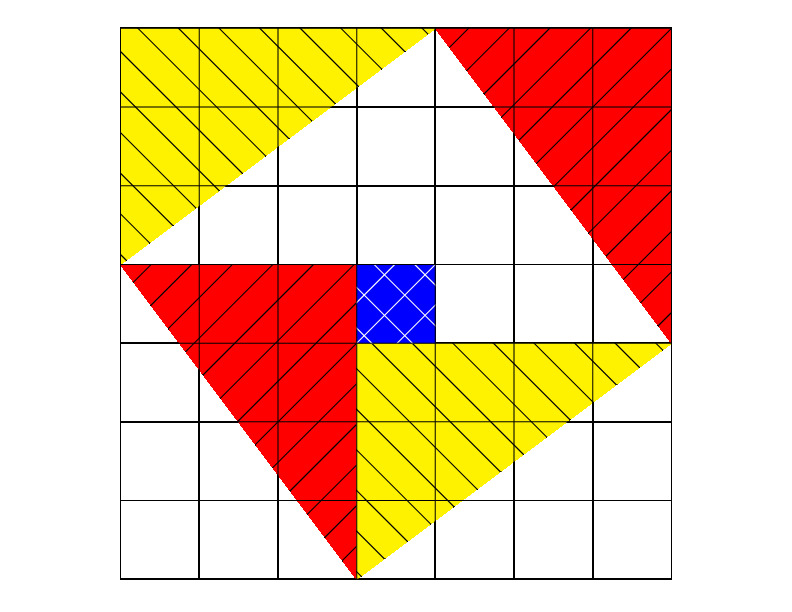
A 7×7 grid of squares, divided into four 3×4 rectangles arranged symmetrically about one square; the rectangles are divided in two by diagonals, which themselves describe a square
The right triangle whose legs are 3 and 4 has hypotenuse 5, because the square on it is
(4 − 3)2 + 2 ⋅ (4 ⋅ 3),
which is indeed 25 or 52. This is also
42 + 32.

Continue reading

LaTeX to HTML

This is a little about mathematics, and a little about writing for the web, but mostly about the nuts and bolts of putting mathematics on the web. I want to record how, mainly with the pandoc program, I have converted some mathematics from a LaTeX file into html. Like “Computer Recovery” then, this post is a laboratory notebook.

A stack of books of and about mathematics: The Princeton Companion to Mathematics at the bottom, volume 2 of Heath’s edition of The Elements of Euclid at the top

Continue reading

Map of Art

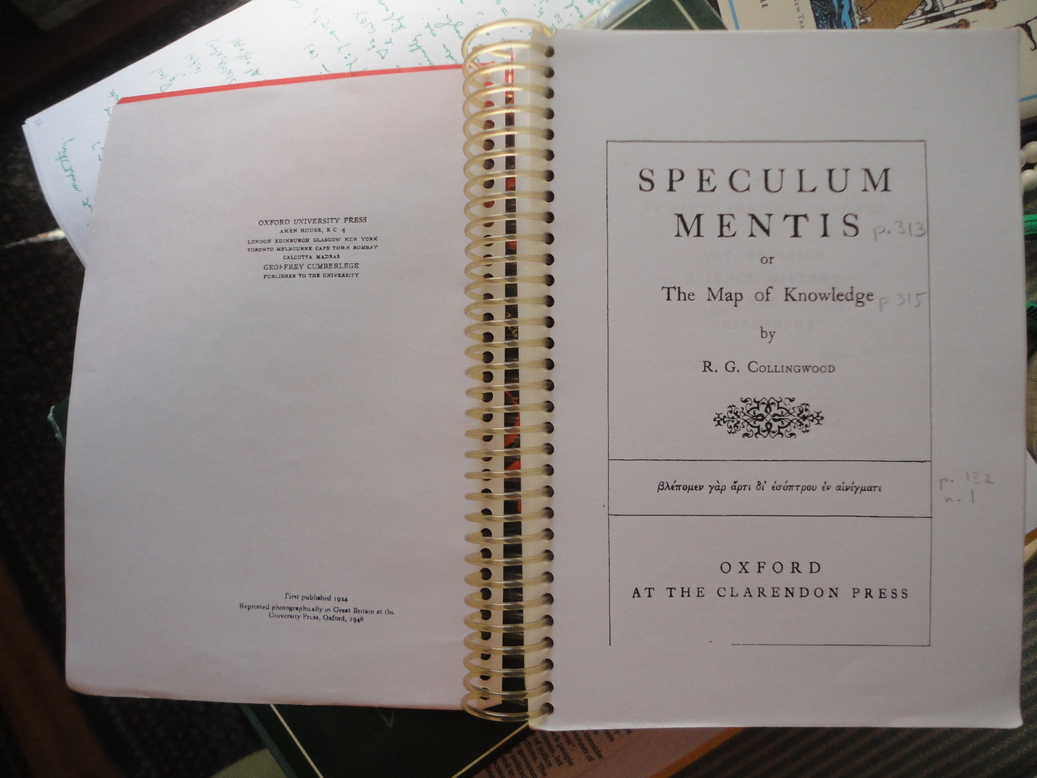
The bulk of this post is a summary of the chapter on art in Collingwood’s Speculum Mentis: or The Map of Knowledge (1924). The motto of the book is the first clause of I Corinthians 13:12:

Βλέπομεν γὰρ ἄρτι δι’ ἐσόπτρου ἐν αἰνίγματι

For now we see through a glass, darkly

The chapter “Art” has eight sections:

Continue reading