Why did Plato write the Republic? I give here not an answer, but elaborations on the question. I drafted these during the latter of two readings of the Republic, engaged in with two different groups of people in the last two years with the Catherine Project.

Village whose name I don’t know
between Yeniköy and Tarabya, Sarıyer, Istanbul
Behind me is a gated community
where every house has a swimming pool
Tuesday, May 23, 2023
Through Book VII, the Republic has three parts:
-
Preliminary dialogue on justice (Book I).
-
Description of the just city and citizen (Books II–IV).
-
Detailed constitution of that city (Books V–VII), where philosophers shall be kings—and queens too (540c, in Bloom’s translation):
“Just like a sculptor, Socrates,” he said, “you have produced ruling men (ἄρχοντας) who are wholly fair.”
“And ruling women (ἀρχούσας), too, Glaucon,” I said. “Don’t suppose that what I have said applies any more to men than to women, all those who are born among them with adequate natures.”
There is a more detailed summary below. Meanwhile, to ordain and establish the constitution of the new polity, the philosophers will have to take over an existing city and send away everybody over the age of ten (540d–1a). What does that tell us about
- Socrates’s aim in talking with Plato’s brothers (with others listening in);
- Plato’s aim in giving us the resulting dialogue (as recounted by Socrates in a monologue)?
Importance of the question
Possibly the listener or reader of the Republic is supposed to understand that
- we can’t meet the conditions for founding the perfectly just city;
- we shouldn’t even try.
This would seem to be Bloom’s understanding; you can look it up, if you’ve got his translation, on page 409 of his Interpretive Essay. According to Bloom, “Socrates blandly announces” the condition “for the actualization of the best regime,”
as though the renunciation of all they live for by the whole citizen body were easy to accomplish. And it would have to be a voluntary renunciation … The perfect city is revealed to be a perfect impossibility.
What then was the use of spending so much time and effort on a city that is impossible? Precisely to show its impossibility.
However, Socrates says (540d),
(Bloom) What then? Do you agree that the things we have said about the city and the regime are not in every way prayers; that they are hard but in a way possible …
(Shorey) Well, then, do you admit that our notion of the state and its polity is not altogether a day-dream, but that though it is difficult, it is in a way possible …?
I have a note below on “prayers/day-dream.” Meanwhile, Socrates is echoing what he says in Book VI (502a–c):
(Bloom) will anyone argue that there is no chance that children of kings, or of men who hold power, could be born philosophers by their natures? … Now, then, as it seems, it turns out for us that what we are saying about lawgiving is best if it could come to be, and that it is hard for it to come to be; not, however, impossible.
(Shorey) Will anyone contend that there is no chance that the offspring of kings and rulers should be born with the philosophic nature? … Our present opinion, then, about this legislation is that our plan would be best if it could be realized and that this realization is difficult yet not impossible.
Revolutionaries have agreed with this. I think particularly of the Khmer Rouge, who took control of Phnom Penh in 1975 and proceeded to drive all residents out into the countryside.
A teacher of mine called Jack Lincoln suggested the Cambodia connection in 1985, but I didn’t know the history then. I’ve since read a couple of memoirs of escape from Democratic Kampuchea. Now I find the following by Jacob Howland:
Cambodia’s Khmer Rouge, led by a Marxist who was radicalized while studying in Paris, appear to have followed almost to the letter Socrates’ advice to purify the old regime and initiate the new one by sending everyone over the age of ten to the country.
If Howland is saying Pol Pot was consciously following Plato, I have found confirmation not of this, but of what he says about Iran:
Ayatollah Khomeini looked to the Republic in founding his revolutionary theocracy, in which power is concentrated in a Supreme Leader and a Council of Guardians.
This is corroborated by Khomeini’s 1989 obituary in The Washington Post:
Khomeini became an authority on Islamic law, but he also delved into Islamic mysticism, and his fascination with Western philosophy led him to claim that Plato’s “Republic” was part of his model for an Islamic republic.
In the Introduction to Persecution and the Art of Writing, Bloom’s teacher Leo Strauss goes into the fascination of Alpharabius for the Republic; I myself may go into this in a later post. Meanwhile, a website in Iran has some poorly translated words about Khomeini’s fascination:
In total both Imam Khomeini’s (peace be upon him) thought and Plato’s thought basically have justice at their axis …
When I visited Iran in 2012, I encountered a few examples of contempt for the regime:
- In Tabriz, a young woman at the airport asked me why I was coming and said, “It’s not our country anymore; they have destroyed it.”
- In Isfahan,
- concerning the display of images of Khomeini and Khamenei in the courtyard of the Friday Mosque, an old man giving tours agreed, “It is not good”;
- on the street, when I pointed out that, in 1953, the US had overthrown the elected Iranian government, a young man said, “I pray for this to happen!” (presumably he meant, “again”).
- In Shiraz, when an Australian woman (originally American) observed that the shah’s picture had been everywhere, during her visit in 1974, but now it was Khomeini’s picture, a nearby Iranian said, “We just changed dictators.”
As for Plato, I see a couple of practical options. If the Republic is
- a manifesto, we should implement it better than Pol Pot and Ruholla Khomeini did;
- not a manifesto, but perhaps a code for something else, we should clarify this to those who think otherwise.
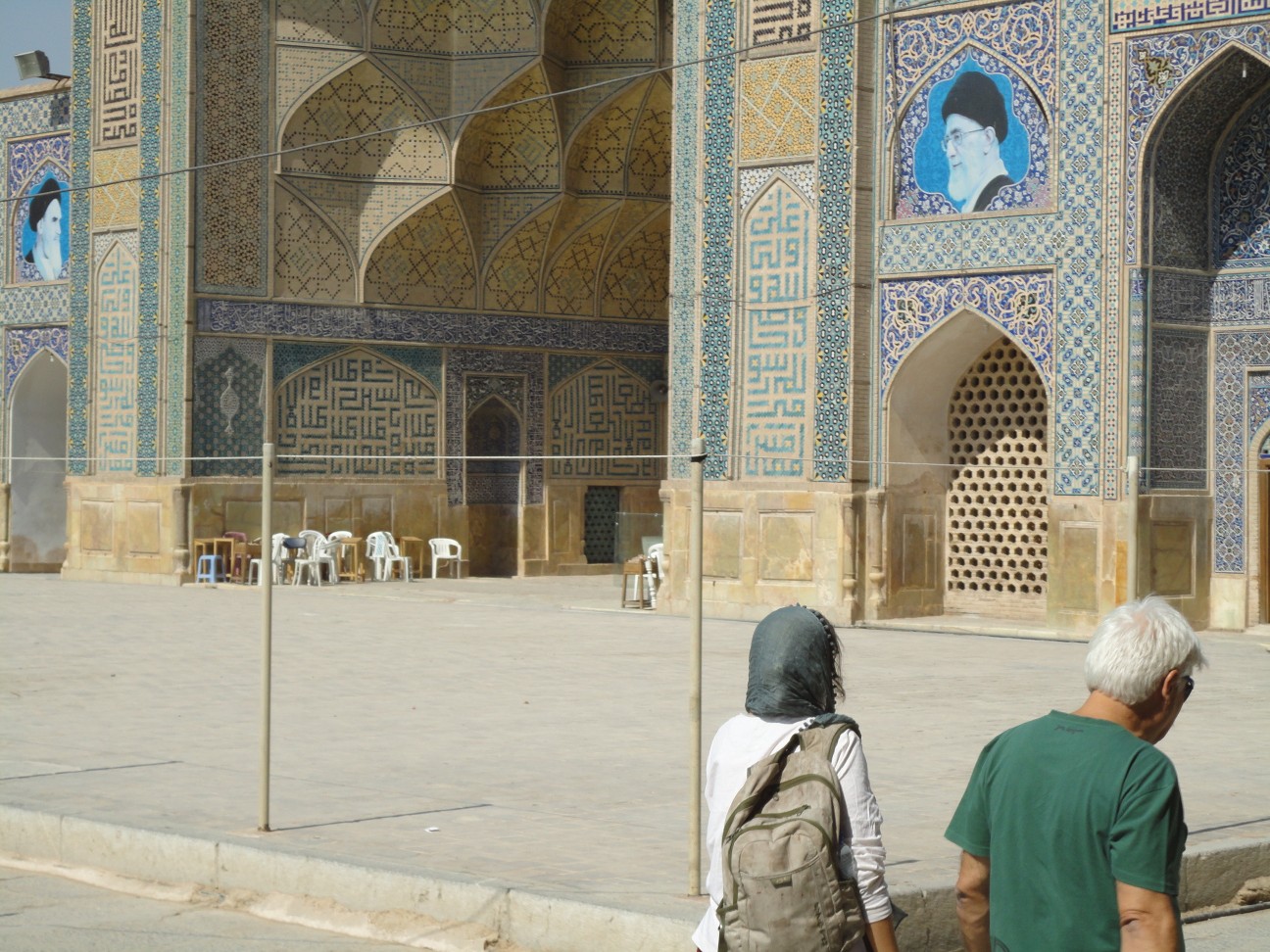
Isfahan, Iran
September 1, 2021
On prayers and day-dreams
In 540d, Bloom’s “prayer” and Shorey’s “day-dream” translate euchê (ἡ εὐχή), from the verb eὔχομαι, whose original meaning seems to be “proclaim,” and which shares the Indo-European root *wegwh- (or *eu̯egu̯h-) with English words such as vote, vow, and devout.
Shorey’s notes (in the Loeb edition) point to other instances of the concept of daydream. Bloom’s Index of Subjects does the same thing for the broader concept of prayer (that is, euchê), which we see at the very beginning of the whole story, when Socrates and Glaucon go down in the Piraeus to pray.
This brings to my mind an old song that may be a code for how to get free of enslavement: “Down in the River to Pray.”
Detailed summary (or list of reminders)
-
Book I. The dialectic of Socrates “destroys the hypotheses” (in the terminology of 511b in Book VI and especially 533c in Book VII) that justice is
- telling the truth and paying debts (Cephalus);
- doing good to friends and harm to enemies (Polemarchus);
- the advantage of the stronger (Thrasymachus);
- less profitable than perfect injustice (also Thrasymachus).
-
Book II.
- Glaucon: the ring of Gyges shows nobody is willingly just.
- Adeimantus: justice is praised, only for the reputation it brings.
- Socrates: let us found a city in speech, to see how justice arises.
- The fevered city of relishes that Glaucon desires will need guardians, who are to be like dogs and given a traditional education, although with none of the traditional stories.
- The lie that is
- true is hated by gods and humans (382a),
- spoken may be useful to humans (382c).
-
Book III.
- Any poet “who is able by wisdom to become every sort of thing and to imitate all things” (398a) shall be deported.
- Doctors shall cure only those who deserve it (409e–10a).
- The Noble Lie shall be taught.
-
Book IV.
- Adeimantus: the guardians will not be happy.
- “Friends have all things in common” (424a).
- Glaucon: help us find justice.
- Found are the virtues of
- wisdom in the rulers;
- courage in the soldiers, who have been brainwashed (429d) to serve the city;
- moderation in everybody;
- justice in everybody’s minding their own business.
- The three classes of citizens have their correlates in the individual citizen.
- The forms of injustice are to be next (but will be postponed till Book VIII).
-
Book V.
- Polemarchus: tell us about the community of women and children.
- Thrasymachus: I agree.
- Three waves:
- Women shall serve the city alongside men.
- Women shall be bred with men like animals.
- Philosophers shall rule.
-
Book VI. The third wave continues. Metaphors:
- The ship of state.
- The sun.
- The divided line.
-
Book VII. The third wave continues.
- Another metaphor: the cave.
- The training of the rulers in
- mathematics, where a synopsis will be wanted of
- arithmetic,
- plane geometry,
- solid geometry,
- astronomy,
- harmonics;
- dialectics.
- mathematics, where a synopsis will be wanted of
- Suffer little children to come unto the philosophers (540e–1a).
The Rest
In Books VIII, IX, and X of the Republic come
-
a review of unjust regimes and souls, under four heads:
- timocratic,
- oligarchic,
- democratic,
- tyrannic;
-
reasons to ban all imitative poetry;
-
the Myth of Er.
What is the moral of the myth? I can think of several possibilities, which are exclusive neither of one another nor of any others that you may come up with:
-
Just (or moral) human beings have more fun, later (614a).
-
“You’re gonna hafta serve somebody,” as Bob Dylan sang; or as Nina Simone and others sang, “Oh, Sinnerman, where you gonna run to? All along dem day”; for there will indeed be a day of judgment (614c).
-
Study astronomy (Book VII, 528e), so that you can hear the music of the spheres (617b).
-
Find the best teacher of how you should live your life (618c). But then who is going to teach you how to do that?
-
Choose the middle way (619a), as the Buddha also taught. But then how come (unless my memory fails) we didn’t hear about this earlier in the dialogue?
-
Odysseus makes the best choice of next life, since it is a life of minding his own business (620c), and this is what we have found justice to be (Book IV, 433b and 443c). But then how would you even know about Odysseus, if you had grown up in the city that Socrates has designed (607a)?
-
Believe that your soul is immortal, so that you can be dear to, or friend to, both the gods and yourself (621c). But what is the connection here?
I also return to the original question: What does Plato want to accomplish in writing the Republic?
Insofar as he is a poet, I think the answer is, Nothing. It may turn out that a work of art does accomplish something; however, the artist could not have said what that was going to be, before actually creating the artwork.
If Plato were simply a poet, it might be only natural that he saw Homer as a rival to be vanquished; but I think Plato is not simply a poet.
Imagine Homer, setting out to compose the Iliad. He may have pre-existing stories to work with, but he is free to do with him as he likes; and again, as a poet, he will not know what this is, not exactly, until he actually does it.
By contrast, I used to go to a shoemaker in Ankara, pick out a sample on display, say I wanted something like that, then come back on a later day to collect my new shoes.
Plato is not a shoemaker either.
If Homer could tell you what he was going to write in the Iliad, this would mean he already possessed the epic, before its actual composition. Picasso was like that, according to Françoise Gilot (who is apparently now 101):
He doesn’t know what he wants. No wonder his style is so ambiguous. It’s like God’s, God is really only another artist. He invented the giraffe, the elephant, and the cat. He has no real style. He just keeps on trying other things. The same with this sculptor. First he works from nature; then he tries abstraction.
If an artist does develop a style, or perhaps a technique, he or she may put that to some use. It may be the use of a dictator, as Socrates suggests in Book VIII (568b, Bloom translation):
“And (Euripides) and the other poets,” (Adeimantus) said, “extol tyranny as a condition ‘equal to that of a god’ and add much else, too.”
“Therefore,” I said, “because the tragic poets are wise, they pardon us, and all those who have regimes resembling ours, for not admitting them into the regime on the ground that they make hymns to tyranny.”
Concerning who or what deserves hymns, Socrates tell Glaucon in Book X (607a),
only so much of poetry as is hymns to gods or celebration of good men should be admitted into a city.
I pointed out earlier that the Republic inspired the tyranny in Iran; is this the kind of thing that Plato hoped to accomplish?
 Polytropy
4 Trackbacks
[…] « Why the Polity […]
[…] “Why the Polity” (on the question of why Plato wrote the Republic in the first place) and […]
[…] “Why the Polity” […]
[…] Probably the writers of the new NSS have not spent quality time with the Republic, even if this work did inspire their fellow authoritarian, the Ayotollah Khomeini (as I wrote in “Why the Polity”). […]