The scholarship is uncertain, but the Greek word ἀρετή, which we translate as virtue, may not be etymologically related to either of
- ἀνήρ, ἀνδρός, he-man;
- Ἄρης, Ἄρεως, the god of war.
However,
- “virtue” is related to the first part of “werewolf,” were being the old English word for a he-man (as wife was the word for a “she-man,” that is, a she-human, a woman; see “Math, Maugham, and Man”; the Wikipedia article “Indo-European vocabulary” currently gives ἱέραξ “hawk, falcon” as sharing the root of “virtue” and were, but Beekes gives a different root, uncertainly);
- ἀνήρ yields the adjective ἀνδρεῖος, α, ον and the abstract noun ἀνδρεία (which like many abstract nouns is feminine), denoting respectively the person who has, and that which is, the virtue that in English is called bravery or courage.
This post is the sequel of the previous one, “Eudemony” (now extensively revised), which was on and of the first book of Aristotle’s Nicomachean Ethics. The present post is on and of the second book, whose theme is moral virtue in general.
I do wonder to what extent Aristotle thinks of ἀρετή as manliness. Homer may have done so in the Iliad, as in one of the passages (Book XV, lines 641–3) cited in the lexicon of Liddell, Scott, and Jones. This concerns a man slain by Hector, namely Periphetes, son of Copreus:
τοῦ γένετ᾽ ἐκ πατρὸς πολὺ χείρονος υἱὸς ἀμείνων
παντοίας ἀρετάς, ἠμὲν πόδας ἠδὲ μάχεσθαι,
καὶ νόον ἐν πρώτοισι Μυκηναίων ἐτέτυκτο.Of him, a father baser by far, was begotten a son goodlier in all manner of excellence, both in fleetness of foot and in fight, and in mind he was among the first of the men of Mycenae.
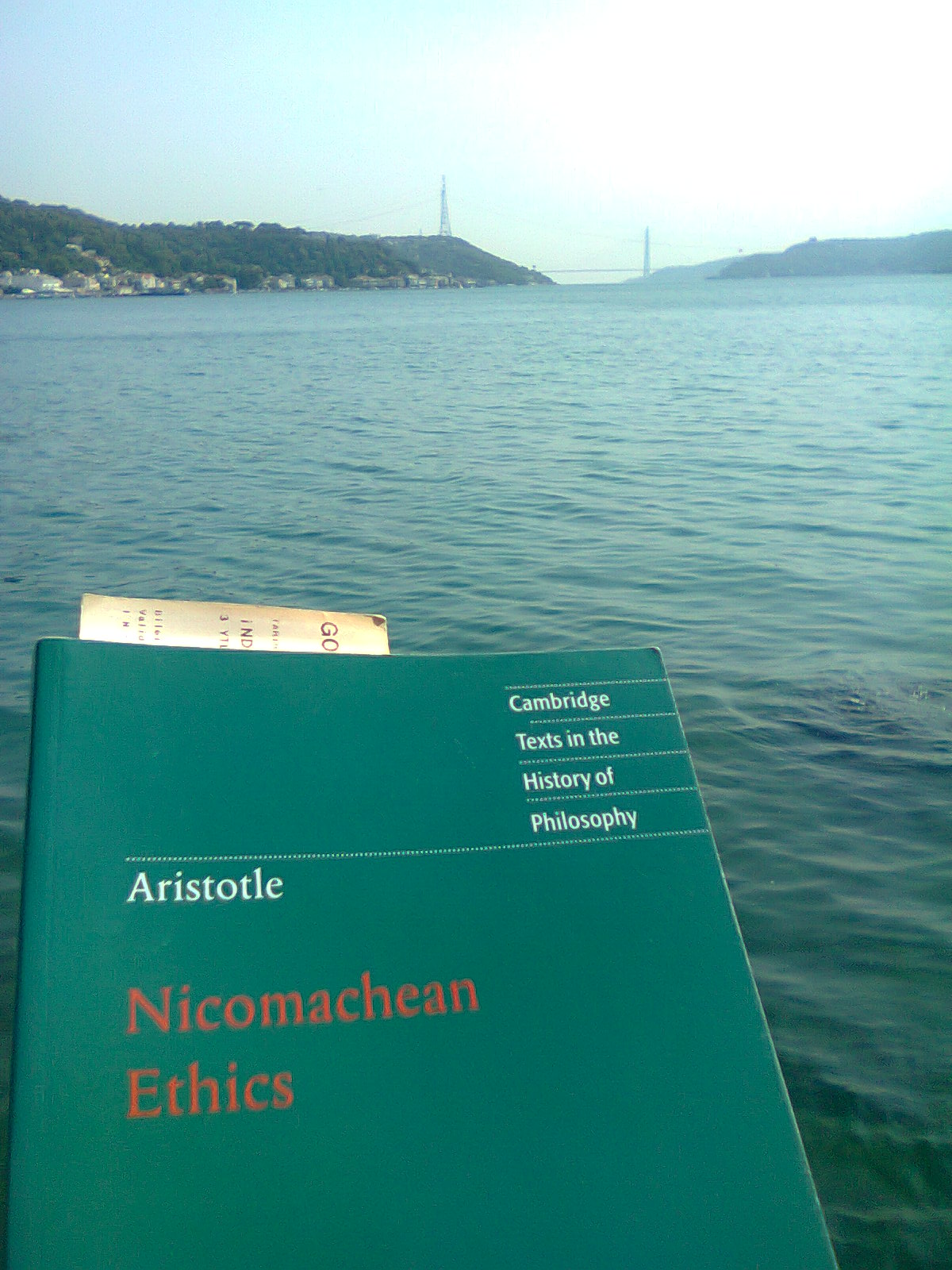
Lock and Key of the Bosphorus
opening to the Black Sea
Tuesday, July 11, 2023
Wifeliness
On the other hand, in the Odyssey (Book II, lines 205–7), Homer allows Penelope to have virtue in the eyes of the suitors. On their behalf, Eurymachus tells Telemachus:
ἡμεῖς δ᾽ αὖ ποτιδέγμενοι ἤματα πάντα
εἵνεκα τῆς ἀρετῆς ἐριδαίνομεν, οὐδὲ μετ᾽ ἄλλας
ἐρχόμεθ᾽, ἃς ἐπιεικὲς ὀπυιέμεν ἐστὶν ἑκάστῳ.And we on our part waiting here day after day are rivals by reason of her excellence, and go not after other women, whom each one might fitly wed.
So far in the Ethics though, Aristotle says almost nothing about women as such. In the Politics Book III, 1277b, as the LSJ points out under ἀνδρεῖος, he will use the feminine form of that adjective, in a condescending way:
δόξαι γὰρ ἂν εἶναι δειλὸς ἀνήρ,
εἰ οὕτως ἀνδρεῖος εἴη ὥσπερ γυνὴ ἀνδρεία …For a man would be thought a coward
if he were only as brave as a brave woman …
In Ethics Book II now, § vi.18, referring to adultery, theft, and murder, Aristotle will say what Bartlett and Collins render as,
it is not possible to do what concerns such things well or not well – by committing adultery with the woman one ought and when and as one ought.
However, the Greek is just,
οὐδ᾽ ἔστι τὸ εὖ ἢ μὴ εὖ περὶ τὰ τοιαῦτα ἐν τῷ ἣν δεῖ καὶ ὅτε καὶ ὡς μοιχεύειν.
Thus, “with the woman” takes the place of the feminine accusative singular relative pronoun ἣν; in particular, “with the woman one ought” could be “with her with whom one ought,” if not just “with whom one ought.”
Moral Virtue
As for virtues generally, we distinguish those called
- moral (ἠθικός “ethic”) and
- intellectual (διανοητικός “dianoëtic”),
just as we distinguish, in the soul,
- what can only listen to reason (the way one would listen to one’s father) and
- what actually has reason.
Such is the doctrine of the final chapter, xiii, of Book I of the Ethics. There is a third kind of virtue, not of interest to us now, because it is common to everything that has soul at all. Thus we have a division of soul into three, as in Plato’s Republic. However, the parts of the soul that Glaucon agrees to in Book IV (as in 441e–2a) are
- appetitive (or desiring, ἐπιθυμητικός),
- spirited (or irascible, θυμοειδής),
- rational (or logical, λογιστικός).
Aristotle’s parts are different:
- vegetative or nutritive (φυτικός)
- appetitive (ἐπιθυμητικός),
- properly rational, or having reason (λόγον ἔχων).
The first two parts here can be counted as non-rational, but also the last two parts can be counted as rational, because, again, they listen to and have reason, respectively.
Habit
Ethics Book I closes with the definition or observation,
τῶν ἕξεων δὲ
τὰς ἐπαινετὰς
ἀρετὰς λέγομεν,Of the habits, too,
the praiseworthy ones
we call virtues.
One can use “disposition” or “characteristic,” but I’m using “habit” for ἕξις, as I use “happiness” for εὐδαιμονία; I gave reason for the latter choice in the previous post. In the key passage of Ethics I.viii.9 that I look at on the page called “Hexis,” Sachs uses “actively maintained condition” for ἕξις, having said in his own voice (as in “Three Little Words”),
the Latin habitus is a perfectly good translation of hexis … every implication of the English word [“habit”] is wrong. A hexis is not only not the same as a habit, but is almost exactly its opposite.
I don’t know about that. Despite the disclaimer “I can’t help it,” the habit sung of in “Echo Beach” (1980) by Martha and the Muffins would seem to be an actively maintained condition:
I know it’s out of fashion
And a trifle uncool
But I can’t help it
I’m a romantic fool
It’s a habit of mine
To watch the sun go down
On Echo Beach, I watch the sun go downFrom nine to five, I have to spend my time at work
My job is very boring, I’m an office clerk
The only thing that helps me pass the time away
Is knowing I’ll be back at Echo Beach someday
I compare dictionary definitions of habitus and “habit” and see a lot of overlap. Moreover, mentioning contemporary scholars, Freud suggested,
in the oldest languages opposites … were expressed by the same root word.
Thus for example the Latin sacer can mean both sacred and accursed. I quoted more of Freud in “Automatia,” where I looked especially at how, even in the single work called the Iliad, “automatic” can mean both voluntary and involuntary.
That would seem to be what a habit is. Probably Sachs does not want Aristotle readers to think that hexis can mean, like “habit,”
an acquired mode of behavior that has become nearly or completely involuntary.
Indeed, because of the three criteria for virtue that Aristotle gives below in § iv.3, Sachs concludes,
one may see that Aristotle cannot mean by “virtue” what we call “habit.” Habitual action need not be chosen knowingly, and it does not have a flexible constancy but a mindless uniformity.
We may think of habit loosely in this way. The question for the reader of Aristotle is whether his audience could have thought of ἕξις that way. I don’t know why not. He himself is going to say in an apparent definition, in § vi.15, below, that virtue is the kind of habit that is involved with choice, as if there could be another kind.
At any rate, in Book III, Aristotle is going to investigate
- the voluntary and the involuntary (τὸ ἑκούσιον καὶ τὸ ἀκούσιον) in chapter i;
- choice (ἡ προαίρεσις, εως) in chapter ii.
Meanwhile, I am trying to read him as bringing out possible or implicit meanings of common expressions, such as “habit.”
If you have a bad knee, it means the knee that you were born with has gone bad, quite possibly through no fault of your own. Maybe you could make it better, or could have a surgeon make it better, but this is not implied. If you have a bad habit, probably you can make it better, or rather replace it with a good habit, if you put in the effort.
Charlotte Brontë would seem to suggest that in Shirley, Volume I, Chapter X (“Old Maids”), albeit while denying that the good habit must bring happiness:
… Mr. Hall, the vicar of Nunnely … said, and said truly, that her life came nearer the life of Christ than that of any other human being he had ever met with …
Miss Helstone studied well the mind and heart now revealed to her … she discovered so much goodness, so much usefulness, so much mildness, patience, truth, that she bent her own mind before Miss Ainley’s in reverence …
It is true she still felt with pain that the life which made Miss Ainley happy could not make her happy. Pure and active as it was, in her heart she deemed it deeply dreary, because it was so loveless – to her ideas, so forlorn. Yet, doubtless, she reflected, it needed only habit to make it practicable and agreeable to any one.
I have included other passages from Shirley in some comments on Aristotle’s text.
Praiseworthiness
If you did replace a bad habit with a good one, that would be praiseworthy. For Aristotle in I.xiii, as we saw, virtues are praiseworthy, and the Greek word for this is ἐπαινετός. There is a corresponding verb ἐπαινέω, meaning to approve or praise. Strip off the prefix and you get αἰνέω, which can mean just to speak of; it comes from the first of the following three words, which without diacritics would be spelled the same:
- αἶνος, ὁ tale, praise;
- αἰνός, ή, όν terrible;
- ἄϊνος, ον without fibres.
The first two are of unknown etymology. Aristotle will contrast ἐπαινέω with ψέγω, to blame.
Housekeeping
Book II of the Ethics has nine chapters in two ways, numbered with roman and arabic numerals respectively. Our group read and discussed it, three roman books at a time, on the following schedule (at 6–8 PM, Turkish time).
| Date in August, 2023 | | | Chapters in Book II |
|---|---|---|
| 7 | I–III | |
| 14 | IV–VI | |
| 21 | VII–IX | |
| 28 | review |
In the Greek text below I highlight
- some key passages in khaki with green broken underline;
- pleasure and pain in chapter iii in pink with red broken underline;
- the fifteen instances of ἕξις, and the four of διάθεσις, in lavender with purple broken underline;
- metaphors or references, in yellow with blue broken underline;
- my own comments, in light gray (the letters themselves being blue).
A key reminder comes at the head of chapter ii, that what we are doing is not theoretical, and our aim is
- not to know what virtue is, but
- to get it, that is, become good.
What audience wants to hear this – senior citizens like Cephalus, worried about Judgment Day? The immature were excluded in §§ I.iii.5–7.
Contents
-
Chapter I = Chapter 1: Like art, moral virtue is not by nature and not first potential like sight, but we must habituate ourselves to it.
-
- Chapter II: Practice makes perfect (and more able to continue) – or perfectly bad. The practice must be neither excessive nor deficient. We can account for this only in outline.
- Chapter III: Ultimately we are going to have to find pleasure in the right activities. Both virtue and art concern what is difficult.
-
Chapter IV = Chapter 3. We become virtuous by acting as if we already were virtuous. This is not impossible, because, unlike art, virtue is not in the result.
-
Chapter V = Chapter 4: We confirm, or use, what was said in
- § I.xiii.20 (virtue is a praiseworthy habit),
- § II.i.4 (virtue is not potential).
Virtue is
- not a passion (πάθος, something that happens to you),
- not a capacity (δύναμις, something you can do),
- but a habit (ἕξις, something you possess),
because passions and capacities are never praiseworthy.
-
Chapter VII = Chapter 7: We confirm the foregoing by looking at how virtue sits in the middle of several spectra of habits.
-
Chapter VIII = Chapter 8: With virtue, the mean is not exact.
-
Chapter IX = Chapter 9: How to find the mean:
- Avoid the extreme that is more opposed to it.
- Avoid the errors that we are prone to.
- Watch out for pleasure.
We start on Bekker page (or more precisely column) 1103a.
Chapter I
Chapter 1
§ i.1
διττῆς δὴ τῆς ἀρετῆς οὔσης,
- τῆς μὲν διανοητικῆς
- τῆς δὲ ἠθικῆς,
-
ἡ μὲν διανοητικὴ
τὸ πλεῖον ἐκ διδασκαλίας ἔχει- καὶ τὴν γένεσιν
- καὶ τὴν αὔξησιν,
διόπερ
- ἐμπειρίας δεῖται καὶ
- χρόνου,
-
ἡ δ᾽ ἠθικὴ
ἐξ ἔθους περιγίνεται,ὅθεν καὶ τοὔνομα ἔσχηκε
μικρὸν παρεκκλῖνον
ἀπὸ τοῦ ἔθους.
Intellectual excellence is by education; moral (ἠθικός), habituation (ἔθος). Each would seem to be some kind of training. What’s the difference?
I note that “habituation” is not actually one of the translations of ἔθος offered by the LSJ; “habit” and “custom” are. However, the Greek word here evidently denotes some kind of activity. See the next §.
§ i.2
ἐξ οὗ καὶ δῆλον ὅτι
οὐδεμία τῶν ἠθικῶν ἀρετῶν
φύσει ἡμῖν ἐγγίνεται·
οὐθὲν γὰρ τῶν φύσει ὄντων
ἄλλως ἐθίζεται,
οἷον
- ὁ λίθος φύσει κάτω φερόμενος
οὐκ ἂν ἐθισθείη ἄνω φέρεσθαι,
οὐδ᾽ ἂν μυριάκις αὐτὸν ἐθίζῃ τις ἄνω ῥιπτῶν, - οὐδὲ τὸ πῦρ κάτω,
- οὐδ᾽ ἄλλο οὐδὲν τῶν ἄλλως πεφυκότων
ἄλλως ἂν ἐθισθείη.
Here is the difference between physics and ethics. The object of the former is things that cannot be trained to be other than they are.
We now have the verb ἐθίζω “to accustom”; in § 1, ἔθος seems to mean the passive of ἐθίζω.
During a drive from Santa Fe to Washington in 1985, when we took a break after many hours of driving, it caused my friend some amusement when I observed that his car was like Aristotle’s stone: you couldn’t train it to keep running, but when you turned the key, it stopped.
§ i.3
- οὔτ᾽ ἄρα φύσει
- οὔτε παρὰ φύσιν
ἐγγίνονται αἱ ἀρεταί, ἀλλὰ
- πεφυκόσι μὲν ἡμῖν δέξασθαι αὐτάς,
- τελειουμένοις δὲ διὰ τοῦ ἔθους.
Virtue is offered to everybody, so to speak. Goodness always has to be possible. Presently we shall clarify what this means.
§ i.4
ἔτι
- ὅσα μὲν φύσει ἡμῖν παραγίνεται,
- τὰς δυνάμεις τούτων πρότερον κομιζόμεθα,
- ὕστερον δὲ τὰς ἐνεργείας ἀποδίδομεν
(ὅπερ ἐπὶ τῶν αἰσθήσεων δῆλον·
οὐ γὰρ ἐκ τοῦ- πολλάκις ἰδεῖν ἢ
- πολλάκις ἀκοῦσαι
τὰς αἰσθήσεις ἐλάβομεν,
ἀλλ᾽ ἀνάπαλιν- ἔχοντες ἐχρησάμεθα,
- οὐ χρησάμενοι ἔσχομεν)·
-
τὰς δ᾽ ἀρετὰς λαμβάνομεν
ἐνεργήσαντες πρότερον,
ὥσπερ καὶ ἐπὶ τῶν ἄλλων τεχνῶν·- ἃ γὰρ δεῖ μαθόντας ποιεῖν,
- ταῦτα ποιοῦντες μανθάνομεν,
οἷον- οἰκοδομοῦντες οἰκοδόμοι γίνονται καὶ
- κιθαρίζοντες κιθαρισταί·
οὕτω δὴ καὶ [1103b]
- τὰ μὲν δίκαια πράττοντες δίκαιοι γινόμεθα,
- τὰ δὲ σώφρονα σώφρονες,
- τὰ δ᾽ ἀνδρεῖα ἀνδρεῖοι.
If you buy a new microwave oven, it will probably do what it is supposed to, even if that particular one has not been tested. But there is no telling what we can do, until we do it, whether we are talking about virtues or arts.
Is virtue an art? Is there an art of virtue? When Aristotle says we acquire virtues by enacting them, ὥσπερ καὶ ἐπὶ τῶν ἄλλων τεχνῶν, this seems to say literally, “just as also in the other arts.” Reeve has “as is also true in the case of the various crafts,” saying in a note:
An illogical but common use of allos (for example, Plato, Grg. 473d1, Phd. 62a2–3) not to mean “other,” since this would carry the false suggestion that virtues are themselves crafts, but to mean “various.” Also II 4 1105b1.
As for Aristotle’s chiastic
ἃ … δεῖ μαθόντας ποιεῖν, \ / / \ ταῦτα ποιοῦντες μανθάνομεν,
which we can render neatly as
- “What we must learn to do, we learn by doing,”
- “By doing what we must learn to do, we learn it,”
- “We learn what we must learn to do by doing it,”
Some published translations are below. There seems to be some disagreement as to whether Aristotle is talking about practices themselves or their end results – if there are any, and there might not be, as noted in I.i.2.
- Reeve (2014)
- “The things we cannot produce without learning to do so are the very ones we learn to produce by producing them.”
- Bartlett and Collins (2011)
- “As regards those things we must learn how to do, we learn by doing them.”
- Crisp (2000)
- “What we need to learn before doing, we learn by doing.”
- Apostle (1980)
- “That which we are to perform by art after learning, we first learn by performing.”
- Rackham (1934)
- “We learn an art or craft by doing the things that we shall have to do when we have learnt it.”
Or possibly [he says in a note],
“… things that we have to learn to do [in contrast with things that we do by nature], we learn by doing them.” - Ross (1925)
- “The things we have to learn before we can do them, we learn by doing them.”
§ i.5
μαρτυρεῖ δὲ καὶ τὸ γινόμενον ἐν ταῖς πόλεσιν·
οἱ γὰρ νομοθέται
τοὺς πολίτας ἐθίζοντες
ποιοῦσιν ἀγαθούς, καὶ
- τὸ μὲν βούλημα παντὸς νομοθέτου
τοῦτ᾽ ἐστίν, - ὅσοι δὲ μὴ εὖ αὐτὸ ποιοῦσιν
ἁμαρτάνουσιν,
καὶ διαφέρει τούτῳ
πολιτεία πολιτείας
ἀγαθὴ φαύλης.
Another reminder to Thrasymachus?
We are supposed to be proving that we learn by doing. Different cities have different characters. Lawgivers must be causing the difference, through what their laws have people doing.
Can the difference not be by nature? In a post “On the Idea of History,” I quoted Collingwood as saying of Johann Gottfried Herder that he “was the first thinker to recognize in a systematic way that there are differences between different kinds of men, and that human nature is not uniform but diversified”; the problem was, Herder thought those differences were themselves natural.
§ i.6
ἔτι
-
ἐκ τῶν αὐτῶν καὶ διὰ τῶν αὐτῶν
- καὶ γίνεται
πᾶσα ἀρετὴ
- καὶ φθείρεται,
-
ὁμοίως δὲ καὶ τέχνη·
ἐκ γὰρ τοῦ κιθαρίζειν
- καὶ οἱ ἀγαθοὶ
- καὶ κακοὶ
γίνονται κιθαρισταί.
ἀνάλογον δὲ
- καὶ οἰκοδόμοι
- καὶ οἱ λοιποὶ πάντες·
- ἐκ μὲν γὰρ τοῦ εὖ οἰκοδομεῖν
ἀγαθοὶ οἰκοδόμοι ἔσονται, - ἐκ δὲ τοῦ κακῶς κακοί.
Again, as with art, so with virtue, as only practice can make you good, so it makes you bad.
You can’t be bad at something you’ve never tried.
As for the verb for (in the middle-passive voice) being destroyed, or going bad, Roberto Calasso mentions it in The Marriage of Cadmus and Harmony (1994), Chapter I:
the darkness was rent by a dazzling crown. Fiery gold and Indian jewels. Dionysus offered Ariadne the crown as a gift on the occasion of this, their first embrace. Sign of perfection, “herald of propitious silence,” the crown was a circle of seduction. But to seduce also means “to destroy” in Greek: phtheírein. The crown is the perfection of deceit, it is the deceit that circles in on itself, it is that perfection which includes deceit within it.
Next we make a sort of argument.
§ i.7
εἰ γὰρ μὴ οὕτως εἶχεν,
οὐδὲν ἂν ἔδει τοῦ διδάξοντος,
ἀλλὰ πάντες ἂν ἐγίνοντο
- ἀγαθοὶ ἢ
- κακοί.
οὕτω δὴ καὶ ἐπὶ τῶν ἀρετῶν ἔχει·
-
πράττοντες γὰρ
τὰ ἐν τοῖς συναλλάγμασι τοῖς πρὸς τοὺς ἀνθρώπους
γινόμεθα- οἳ μὲν δίκαιοι
- οἳ δὲ ἄδικοι,
-
πράττοντες δὲ
τὰ ἐν τοῖς δεινοῖς καὶ
ἐθιζόμενοι- φοβεῖσθαι ἢ
- θαρρεῖν
- οἳ μὲν ἀνδρεῖοι
- οἳ δὲ δειλοί.
ὁμοίως δὲ
- καὶ τὰ περὶ τὰς ἐπιθυμίας
ἔχει
- καὶ τὰ περὶ τὰς ὀργάς·
- οἳ μὲν γὰρ
- σώφρονες καὶ
- πρᾶοι
γίνονται,
- οἳ δ᾽
- ἀκόλαστοι καὶ
- ὀργίλοι,
- οἳ μὲν ἐκ τοῦ οὑτωσὶ
ἐν αὐτοῖς ἀναστρέφεσθαι, - οἳ δὲ ἐκ τοῦ οὑτωσί.
καὶ ἑνὶ δὴ λόγῳ
ἐκ τῶν ὁμοίων ἐνεργειῶν
αἱ ἕξεις γίνονται.
We have teachers! Teachers exist for the arts; so then we can expect them to be possible for the virtues.
The word ἀκόλαστος “unrestrained” is related to κόλος “hornless, with stunted horns,” this yielding κολάζω “punish” and κολούω “mutilate.”
§ i.8
διὸ
δεῖ
τὰς ἐνεργείας
ποιὰς ἀποδιδόναι·
κατὰ γὰρ τὰς τούτων διαφορὰς
ἀκολουθοῦσιν αἱ ἕξεις.
- οὐ μικρὸν οὖν
διαφέρει
τὸ οὕτως ἢ οὕτως
εὐθὺς ἐκ νέων
ἐθίζεσθαι,
- ἀλλὰ πάμπολυ,
- μᾶλλον δὲ τὸ πᾶν.
Chapter II
Chapter 2
§ ii.1
ἐπεὶ οὖν ἡ παροῦσα πραγματεία
οὐ θεωρίας ἕνεκά ἐστιν
ὥσπερ αἱ ἄλλαι
- (οὐ γὰρ ἵνα εἰδῶμεν
τί ἐστιν ἡ ἀρετὴ
σκεπτόμεθα,
- ἀλλ᾽ ἵν᾽ ἀγαθοὶ γενώμεθα,
ἐπεὶ οὐδὲν ἂν ἦν ὄφελος αὐτῆς),
ἀναγκαῖον ἐπισκέψασθαι
- τὰ περὶ τὰς πράξεις,
- πῶς πρακτέον αὐτάς·
αὗται γάρ εἰσι κύριαι καὶ
τοῦ ποιὰς γενέσθαι τὰς ἕξεις,
καθάπερ εἰρήκαμεν.
§ ii.2
-
τὸ μὲν οὖν κατὰ τὸν ὀρθὸν λόγον πράττειν
- κοινὸν καὶ
- ὑποκείσθω –
- ῥηθήσεται δ᾽ ὕστερον περὶ αὐτοῦ,
- καὶ τί ἐστιν ὁ ὀρθὸς λόγος,
- καὶ πῶς ἔχει πρὸς τὰς ἄλλας ἀρετάς. [1104a]
§ ii.3
ἐκεῖνο δὲ προδιομολογείσθω,
ὅτι πᾶς ὁ περὶ τῶν πρακτῶν λόγος
- τύπῳ καὶ
- οὐκ ἀκριβῶς ὀφείλει
λέγεσθαι,
ὥσπερ καὶ κατ᾽ ἀρχὰς εἴπομεν
ὅτι κατὰ τὴν ὕλην οἱ λόγοι ἀπαιτητέοι·
- τὰ δ᾽ ἐν ταῖς πράξεσι καὶ
- τὰ συμφέροντα
οὐδὲν ἑστηκὸς ἔχει,
ὥσπερ οὐδὲ τὰ ὑγιεινά.
§ ii.4
τοιούτου δ᾽ ὄντος τοῦ καθόλου λόγου,
ἔτι μᾶλλον
ὁ περὶ τῶν καθ᾽ ἕκαστα λόγος
οὐκ ἔχει τἀκριβές·
- οὔτε γὰρ ὑπὸ τέχνην
- οὔθ᾽ ὑπὸ παραγγελίαν οὐδεμίαν
πίπτει,
δεῖ δ᾽ αὐτοὺς ἀεὶ τοὺς πράττοντας
τὰ πρὸς τὸν καιρὸν
σκοπεῖν,
ὥσπερ καὶ ἐπὶ
- τῆς ἰατρικῆς
ἔχει καὶ - τῆς κυβερνητικῆς.
§ ii.5
ἀλλὰ καίπερ ὄντος τοιούτου τοῦ παρόντος λόγου
πειρατέον βοηθεῖν.
§ ii.6
πρῶτον οὖν τοῦτο θεωρητέον,
ὅτι
τὰ τοιαῦτα πέφυκεν
ὑπ᾽ – ἐνδείας καὶ – ὑπερβολῆς
φθείρεσθαι,
(δεῖ γὰρ
ὑπὲρ τῶν ἀφανῶν
τοῖς φανεροῖς μαρτυρίοις
χρῆσθαι)
ὥσπερ ἐπὶ
- τῆς ἰσχύος καὶ
- τῆς ὑγιείας
ὁρῶμεν·
- τά τε γὰρ ὑπερβάλλοντα
γυμνάσια καὶ
- τὰ ἐλλείποντα
φθείρει τὴν ἰσχύν,
ὁμοίως δὲ
- καὶ τὰ ποτὰ
- καὶ τὰ σιτία
- πλείω καὶ
- ἐλάττω
γινόμενα
φθείρει τὴν ὑγίειαν,
τὰ δὲ σύμμετρα
- καὶ ποιεῖ
- καὶ αὔξει
- καὶ σῴζει.
Hyperbole is opposed not to ellipsis, but to ἐνδεία “want, need.”
§ ii.7
οὕτως οὖν
- καὶ ἐπὶ σωφροσύνης
- καὶ ἀνδρείας
ἔχει - καὶ τῶν ἄλλων ἀρετῶν.
ὅ τε γὰρ
- πάντα φεύγων καὶ
- φοβούμενος καὶ
- μηδὲν ὑπομένων
δειλὸς γίνεται,
ὅ τε
- μηδὲν ὅλως φοβούμενος ἀλλὰ
- πρὸς πάντα βαδίζων
θρασύς·
ὁμοίως δὲ καὶ
-
ὁ μὲν
- πάσης ἡδονῆς ἀπολαύων καὶ
- μηδεμιᾶς ἀπεχόμενος
ἀκόλαστος,
-
ὁ δὲ πᾶσαν φεύγων,
ὥσπερ οἱ ἄγροικοι,
ἀναίσθητός τις·
- φθείρεται δὴ
- σωφροσύνη καὶ ἡ
- ἀνδρεία
ὑπὸ
- τῆς ὑπερβολῆς καὶ
- τῆς ἐλλείψεως,
- ὑπὸ δὲ τῆς μεσότητος
σῴζεται.
Such reasoning is behind the Laffer Curve. We shall get a lot more on the mean in chapter vi.
§ ii.8
ἀλλ᾽
- οὐ μόνον
- αἱ
- γενέσεις καὶ
- αὐξήσεις καὶ
- αἱ
- φθοραὶ
- φθοραὶ
- ἐκ τῶν αὐτῶν καὶ
- ὑπὸ τῶν αὐτῶν
γίνονται,
- αἱ
- ἀλλὰ καὶ
- αἱ
- ἐνέργειαι
- ἐν τοῖς αὐτοῖς
ἔσονται·
- αἱ
καὶ γὰρ
ἐπὶ τῶν ἄλλων τῶν φανερωτέρων
οὕτως ἔχει,
οἷον ἐπὶ τῆς ἰσχύος·
γίνεται γὰρ
ἐκ τοῦ
- πολλὴν τροφὴν λαμβάνειν καὶ
- πολλοὺς πόνους ὑπομένειν,
καὶ μάλιστα ἂν δύναιτ᾽ αὐτὰ ποιεῖν
ὁ ἰσχυρός.
Isn’t this a restatement of what we saw in i.4 (what we learn to do, we learn by doing) and i.6 (practice makes perfect or the reverse)?
§ ii.9
οὕτω δ᾽ ἔχει καὶ ἐπὶ τῶν ἀρετῶν·
-
- ἔκ τε γὰρ τοῦ ἀπέχεσθαι τῶν ἡδονῶν
γινόμεθα σώφρονες,
καὶ - γενόμενοι
μάλιστα δυνάμεθα
ἀπέχεσθαι αὐτῶν·
[1104b]
- ἔκ τε γὰρ τοῦ ἀπέχεσθαι τῶν ἡδονῶν
-
ὁμοίως δὲ καὶ ἐπὶ τῆς ἀνδρείας·
- ἐθιζόμενοι γὰρ
- καταφρονεῖν τῶν φοβερῶν καὶ
- ὑπομένειν αὐτὰ
γινόμεθα ἀνδρεῖοι, καὶ
- γενόμενοι
μάλιστα δυνησόμεθα
ὑπομένειν τὰ φοβερά.
- ἐθιζόμενοι γὰρ
Here perhaps there is more of a suggestion of working step by step.
Chapter III
§ iii.1
σημεῖον δὲ δεῖ ποιεῖσθαι
τῶν ἕξεων
τὴν ἐπιγινομένην
- ἡδονὴν ἢ
- λύπην
τοῖς ἔργοις·
- ὁ μὲν γὰρ
- ἀπεχόμενος τῶν σωματικῶν ἡδονῶν καὶ
- αὐτῷ τούτῳ χαίρων
σώφρων,
- ὁ δ᾽
- ἀχθόμενος
ἀκόλαστος, καὶ
- ὁ μὲν
- ὑπομένων τὰ δεινὰ καὶ
- χαίρων ἢ
- μὴ λυπούμενός γε
ἀνδρεῖος,
- ὁ δὲ
- λυπούμενος
δειλός.
περὶ
- ἡδονὰς γὰρ καὶ
- λύπας
ἐστὶν ἡ ἠθικὴ ἀρετή·
- διὰ μὲν γὰρ τὴν ἡδονὴν
τὰ φαῦλα πράττομεν, - διὰ δὲ τὴν λύπην
τῶν καλῶν ἀπεχόμεθα.
Is the verb ἐπιγίγνομαι “come into being after, supervene” synonymous with ἕπομαι “follow” in § 3? “The pleasure or pain that supervene on things ought to be made a sign of [one’s] habits.”
This chapter being all about pleasure and pain, I have given a pink background to all mentions of these (including χαίρω “take pleasure in”).
This first § perhaps summarizes the whole chapter. It is pleasure and pain that lead us or drive us from the path of virtue. We may stay on the path for a while, in spite of them; but we have to be pleased to be on the path. Unlike Plato’s Socrates, Aristotle omits to discuss a thumos or thymus that can keep our pleasures or rather desires in line.
§ iii.2
διὸ
δεῖ ἦχθαί πως εὐθὺς ἐκ νέων,
ὡς ὁ Πλάτων φησίν,
ὥστε
- χαίρειν τε καὶ
- λυπεῖσθαι
οἷς δεῖ·
ἡ γὰρ ὀρθὴ παιδεία
αὕτη ἐστίν.
§ iii.3
ἔτι δ᾽ εἰ αἱ ἀρεταί εἰσι περὶ
- πράξεις καὶ
- πάθη,
- παντὶ δὲ πάθει καὶ
- πάσῃ πράξει
ἕπεται
- ἡδονὴ καὶ
- λύπη,
καὶ διὰ τοῦτ᾽ ἂν εἴη ἡ ἀρετὴ περὶ
- ἡδονὰς καὶ
- λύπας.
Oddly enough, having the Indo-European root *sekw- “follow,” the verb ἕπομαι is cognate, through Latin, with “sequel, sequester, second, intrinsic, sign,” and “social.” Another IE root with the same spelling meant “see” and became (through Germanic) that word in English. Beekes suggests the roots may be the same, if seeing is following with the eyes.
The Greek verb will be used again, in chapter v, § 2, for what pleasure and pain do with respect to passion.
§ iii.4
μηνύουσι δὲ καὶ αἱ κολάσεις
γινόμεναι διὰ τούτων·
ἰατρεῖαι γάρ τινές εἰσιν,
αἱ δὲ ἰατρεῖαι
διὰ τῶν ἐναντίων
πεφύκασι γίνεσθαι.
§ iii.5
ἔτι,
ὡς καὶ πρῴην εἴπομεν,
πᾶσα ψυχῆς ἕξις,
ὑφ᾽ οἵων πέφυκε γίνεσθαι
- χείρων καὶ
- βελτίων,
- πρὸς ταῦτα καὶ
- περὶ ταῦτα
τὴν φύσιν ἔχει·
δι᾽
- ἡδονὰς δὲ καὶ
- λύπας
φαῦλοι γίνονται,
τῷ
- διώκειν ταύτας καὶ
- φεύγειν,
- ἢ ἃς μὴ δεῖ
- ἢ ὅτε οὐ δεῖ
- ἢ ὡς οὐ δεῖ
- ἢ ὁσαχῶς ἄλλως
ὑπὸ τοῦ λόγου διορίζεται
τὰ τοιαῦτα.
διὸ καὶ ὁρίζονται τὰς ἀρετὰς
- ἀπαθείας τινὰς καὶ
- ἠρεμίας·
οὐκ εὖ δέ,
ὅτι
- ἁπλῶς
λέγουσιν, ἀλλ᾽ - οὐχ
- ὡς δεῖ καὶ
- ὡς οὐ δεῖ καὶ
- ὅτε, καὶ
- ὅσα ἄλλα προστίθεται.
As does I.iii.3, this recalls the observation of Socrates (Republic Book VI, 505c), that there are bad pleasures. Like good and bad, virtue and vice cannot really be defined in terms of other things.
§ iii.6
ὑπόκειται ἄρα
-
ἡ ἀρετὴ εἶναι ἡ τοιαύτη περὶ
- ἡδονὰς καὶ
- λύπας
τῶν βελτίστων πρακτική,
-
ἡ δὲ κακία τοὐναντίον.
§ iii.7
γένοιτο δ᾽ ἂν ἡμῖν καὶ ἐκ τούτων φανερὸν
ὅτι περὶ τῶν αὐτῶν.
- τριῶν γὰρ ὄντων τῶν εἰς τὰς αἱρέσεις καὶ
- τριῶν τῶν εἰς τὰς φυγάς,
-
- καλοῦ
- συμφέροντος
- ἡδέος, καὶ
-
τριῶν τῶν ἐναντίων,
- αἰσχροῦ
- βλαβεροῦ
- λυπηροῦ,
περὶ ταῦτα μὲν πάντα
- ὁ ἀγαθὸς κατορθωτικός ἐστιν
- ὁ δὲ κακὸς ἁμαρτητικός,
μάλιστα δὲ περὶ τὴν ἡδονήν·
- κοινή τε γὰρ αὕτη τοῖς ζῴοις, καὶ
- πᾶσι τοῖς ὑπὸ τὴν αἵρεσιν παρακολουθεῖ· [1105a]
καὶ γὰρ
- τὸ καλὸν καὶ
- τὸ συμφέρον
ἡδὺ φαίνεται.
§ iii.8
ἔτι δ᾽ ἐκ νηπίου πᾶσιν ἡμῖν συντέθραπται·
διὸ χαλεπὸν ἀποτρίψασθαι τοῦτο τὸ πάθος
ἐγκεχρωσμένον τῷ βίῳ.
κανονίζομεν δὲ καὶ τὰς πράξεις,
- οἳ μὲν μᾶλλον
- οἳ δ᾽ ἧττον,
- ἡδονῇ καὶ
- λύπῃ.
§ iii.9
διὰ τοῦτ᾽ οὖν ἀναγκαῖον εἶναι
περὶ ταῦτα τὴν πᾶσαν πραγματείαν·
οὐ γὰρ μικρὸν εἰς τὰς πράξεις
- εὖ ἢ
- κακῶς
- χαίρειν καὶ
- λυπεῖσθαι.
§ iii.10
ἔτι δὲ χαλεπώτερον
ἡδονῇ μάχεσθαι
ἢ θυμῷ,
καθάπερ φησὶν Ἡράκλειτος,
περὶ δὲ τὸ χαλεπώτερον ἀεὶ
- καὶ τέχνη γίνεται
- καὶ ἀρετή·
καὶ γὰρ τὸ εὖ βέλτιον ἐν τούτῳ.
ὥστε καὶ διὰ τοῦτο περὶ
- ἡδονὰς καὶ
- λύπας
πᾶσα ἡ πραγματεία
- καὶ τῇ ἀρετῇ
- καὶ τῇ πολιτικῇ·
- ὁ μὲν γὰρ εὖ
τούτοις χρώμενος
ἀγαθὸς ἔσται, - ὁ δὲ κακῶς
κακός.
This § has the first mention of θυμός, according to my memory and Bywater’s index; the next mention will be in III.i.21, where Aristotle will deny that θυμός and ἐπιθυμία are incompatible with voluntary action.
The following information about the Heraclitus reference may be especially useful then. The fragment is
- CV of Bywater,
- B85 of Diels and Kranz,
- D116 of Laks and Most:
θυμῷ μάχεσθαι χαλεπόν·
ὃ γὰρ ἃν θέλῃ,
ψυχῆς ὠνεῖται.To fight against an ardor (thumos) is hard:
for whatever it wants,
it purchases it at the price of the soul [i.e. of life].
According to Laks and Most,
Aristotle quotes this aphorism with approval several times (EN 2.2 1105a7–8; EE 2.7 1223b22–24) but interprets thumos (ardor, passion) restrictively as referring only to anger.
There’s an edition of Heraclitus around the web by William Harris, late of Middlebury College, who numbers this fragment as 51 and translates and comments:
It is hard to fight against impulsive desire.
Whatever it wants
it will buy at the cost of the soul.Here is probably the earliest statement of the power of advertising in a market economy. The phrase “purchasing at the cost of soul (genitive of price!)” is a curious phrase, something parallel to making large credit card purchases at the cost of solvency and financial integrity!
§ iii.11
-
ὅτι μὲν οὖν ἐστὶν ἡ ἀρετὴ περὶ
- ἡδονὰς καὶ
- λύπας,
καὶ
-
ὅτι
- ἐξ ὧν γίνεται, ὑπὸ τούτων
καὶ αὔξεται - καὶ φθείρεται
μὴ ὡσαύτως γινομένων,
καὶ
- ἐξ ὧν γίνεται, ὑπὸ τούτων
-
ὅτι ἐξ ὧν ἐγένετο,
περὶ ταῦτα καὶ ἐνεργεῖ,
εἰρήσθω.
That § summarizes Book II so far. Virtue is
- Concerned with pleasure and pain.
- Increased or destroyed by what produces it.
- Active in what produced it.
Chapter IV
Chapter 3
§ iv.1
ἀπορήσειε δ᾽ ἄν τις
πῶς λέγομεν ὅτι
δεῖ
- τὰ μὲν δίκαια πράττοντας
δικαίους γίνεσθαι, - τὰ δὲ σώφρονα
σώφρονας·
εἰ γὰρ πράττουσι τὰ
- δίκαια καὶ
- σώφρονα,
ἤδη εἰσὶ
- δίκαιοι καὶ
- σώφρονες,
ὥσπερ
εἰ
- τὰ γραμματικὰ καὶ
- τὰ μουσικά,
- γραμματικοὶ καὶ
- μουσικοί.
Objection: How can you become virtuous by virtuous deeds?
- Skilled work requires skill already.
- Virtuous deeds are like skilled work.
§ iv.2
ἢ οὐδ᾽ ἐπὶ τῶν τεχνῶν οὕτως ἔχει;
ἐνδέχεται γὰρ γραμματικόν τι ποιῆσαι
- καὶ ἀπὸ τύχης
- καὶ ἄλλου ὑποθεμένου.
τότε οὖν ἔσται γραμματικός,
ἐὰν
- καὶ γραμματικόν
τι ποιήσῃ
- καὶ γραμματικῶς·
τοῦτο δ᾽ ἐστὶ τὸ κατὰ τὴν ἐν αὑτῷ γραμματικήν.
Reply:
- You can do skilled work by chance or imitation.
§ iv.3
ἔτι
οὐδ᾽ ὅμοιόν ἐστιν ἐπί τε
- τῶν τεχνῶν καὶ
- τῶν ἀρετῶν·
-
τὰ μὲν γὰρ ὑπὸ τῶν τεχνῶν γινόμενα
τὸ εὖ ἔχει ἐν αὑτοῖς·ἀρκεῖ οὖν ταῦτά πως ἔχοντα γενέσθαι·
-
τὰ δὲ κατὰ τὰς ἀρετὰς γινόμενα
- οὐκ ἐὰν αὐτά πως ἔχῃ,
- δικαίως ἢ
- σωφρόνως
πράττεται,
- ἀλλὰ καὶ ἐὰν ὁ πράττων πῶς ἔχων
πράττῃ,- πρῶτον μὲν ἐὰν εἰδώς,
- ἔπειτ᾽ ἐὰν
- προαιρούμενος, καὶ
- προαιρούμενος δι᾽ αὐτά,
- τὸ δὲ τρίτον ἐὰν
- καὶ βεβαίως
- καὶ ἀμετακινήτως
ἔχων πράττῃ. [1105b]
- οὐκ ἐὰν αὐτά πως ἔχῃ,
ταῦτα δὲ
- πρὸς μὲν τὸ τὰς ἄλλας τέχνας ἔχειν
οὐ συναριθμεῖται,
πλὴν αὐτὸ τὸ εἰδέναι· - πρὸς δὲ τὸ τὰς ἀρετὰς
- τὸ μὲν εἰδέναι
- οὐδὲν ἢ
- μικρὸν
ἰσχύει,
- τὰ δ᾽ ἄλλα
- οὐ μικρὸν
- ἀλλὰ τὸ πᾶν
δύναται,
ἅπερ ἐκ τοῦ πολλάκις πράττειν τὰ- δίκαια καὶ
- σώφρονα
περιγίνεται.
- τὸ μὲν εἰδέναι
Reply:
- The analogy itself is not good.
- The criterion of
- skill is in the result;
- virtue is in the doer.
- Knowledge is
- important for skilled work,
- less so for virtuous deeds.
- The criterion of
Actually there are three criteria for virtue:
- Knowingly
- choosing it for itself
- consistently.
My “consistently” summarizes two adverbs:
-
βεβαίως is from the adjective βέβαιος α ον “firm” from βαίνω “walk”;
-
ἀμετακινήτως is itself rare, and the positive form μετακινήτως does not seem to occur, though there are other words like μετακινέω “shift.”
Here is Sachs’s account, from “Three Little Words” (I’m adding the numbers):
How must one hold oneself, if one’s act is to be worthy of the name virtue? Aristotle’s first and most general description of this active state is that one [3] holds oneself in a stable equilibrium of the soul, in order to [2] choose the action [1] knowingly and [2] for its own sake. I am translating as “in a stable equilibrium” the pair of adverbs bebaiôs kai ametakinêtôs.
See also “Habit” above.
Note the importance of choosing virtue for itself; the verb is the middle form of προαιρέω. That virtue must be chosen will be part of
- the argument for why it is not a passion, in v.4;
- the definition of it, in vi.15.
The whole concept of προαίρεσις will be the subject of Book III, chapter ii, having been mentioned in III.i.15.
Here are some other translations of the third condition of the virtuous actor.
- Ross
- “his action must proceed from a firm and unchangeable character”
- Rackham
- “the act must spring from a fixed and permanent disposition of character”
- Bartlett and Collins
- “if he acts while being in a steady and unwavering state”
- Apostle
- “when he acts with certainty and firmness”
§ iv.4
-
τὰ μὲν οὖν πράγματα
- δίκαια καὶ
- σώφρονα
λέγεται,
ὅταν ᾖ τοιαῦτα οἷα ἂν- ὁ δίκαιος ἢ
- ὁ σώφρων
πράξειεν·
-
- δίκαιος δὲ καὶ
- σώφρων
ἐστὶν
- οὐχ ὁ ταῦτα πράττων,
- ἀλλὰ καὶ ὁ οὕτω πράττων
ὡς οἱ- δίκαιοι καὶ
- σώφρονες
πράττουσιν.
Compare Charlotte Brontë, Shirley, Volume I, Chapter X (“Old Maids”), on men who look virtuous (in a Christian sense, at least), but aren’t:
All men, taken singly, are more or less selfish; and taken in bodies, they are intensely so … the mercantile classes illustrate it strikingly … A land ruled by them alone would too often make ignominious submission – not at all from the motives Christ teaches, but rather from those Mammon instils. During the late war, the tradesmen of England would have endured buffets from the French on the right cheek and on the left; their cloak they would have given to Napoleon, and then have politely offered him their coat also, nor would they have withheld their waistcoat if urged; they would have prayed permission only to retain their one other garment, for the sake of the purse in its pocket.
§ iv.5
εὖ οὖν λέγεται ὅτι
- ἐκ τοῦ τὰ δίκαια πράττειν
ὁ δίκαιος γίνεται καὶ - ἐκ τοῦ τὰ σώφρονα
ὁ σώφρων·
- ἐκ δὲ τοῦ μὴ πράττειν ταῦτα
οὐδεὶς ἂν οὐδὲ μελλήσειε
γίνεσθαι ἀγαθός.
A necessary condition of virtue is doing virtuous things.
§ iv.6
ἀλλ᾽ οἱ πολλοὶ
- ταῦτα μὲν οὐ πράττουσιν,
- ἐπὶ δὲ τὸν λόγον καταφεύγοντες
οἴονται- φιλοσοφεῖν καὶ οὕτως
- ἔσεσθαι σπουδαῖοι,
ὅμοιόν τι ποιοῦντες τοῖς κάμνουσιν,
οἳ
- τῶν ἰατρῶν ἀκούουσι μὲν ἐπιμελῶς,
- ποιοῦσι δ᾽ οὐδὲν τῶν προσταττομένων.
- ὥσπερ οὖν οὐδ᾽ ἐκεῖνοι εὖ ἕξουσι τὸ σῶμα
οὕτω θεραπευόμενοι, - οὐδ᾽ οὗτοι τὴν ψυχὴν
οὕτω φιλοσοφοῦντες.
This could be the kind of passage from which we get our notion of the “hoi polloi.” The point now seems to be that doing virtuous things is not sufficient for virtue, although people love to argue that it is, or perhaps just that they are already virtuous.
Chapter V
Chapter 4
§ v.1
μετὰ δὲ ταῦτα τί ἐστιν ἡ ἀρετὴ σκεπτέον.
ἐπεὶ οὖν τὰ ἐν τῇ ψυχῇ γινόμενα τρία ἐστί,
- πάθη
- δυνάμεις
- ἕξεις,
τούτων ἄν τι εἴη ἡ ἀρετή.
These “things in the soul” (τὰ ἐν τῇ ψυχῇ) – passion, power, habit – are not the parts or aspects (vegetative, appetitive, rational) distinguished in I.xiii and discussed above under “Moral Virtue.”
§ v.2
λέγω δὲ
-
πάθη μὲν
- ἐπιθυμίαν
- ὀργὴν
- φόβον
- θάρσος
- φθόνον
- χαρὰν
- φιλίαν
- μῖσος
- πόθον
- ζῆλον
- ἔλεον,
ὅλως οἷς ἕπεται ἡδονὴ ἢ λύπη·
-
δυνάμεις δὲ καθ᾽ ἃς παθητικοὶ τούτων λεγόμεθα,
οἷον καθ᾽ ἃς δυνατοὶ
- ὀργισθῆναι ἢ
- λυπηθῆναι ἢ
- ἐλεῆσαι·
-
ἕξεις δὲ καθ᾽ ἃς πρὸς τὰ πάθη ἔχομεν
- εὖ ἢ
- κακῶς,
οἷον- πρὸς τὸ ὀργισθῆναι,
- εἰ μὲν
- σφοδρῶς ἢ
- ἀνειμένως,
κακῶς ἔχομεν,
- εἰ δὲ
- μέσως,
εὖ·
- εἰ μὲν
- ὁμοίως δὲ καὶ πρὸς τἆλλα.
In chapter iii, § 3, the verb ἕπομαι “follow” is used for what pleasure and pain do with respect to passion and action.
§ v.3
πάθη μὲν οὖν οὐκ εἰσὶν
- οὔθ᾽ αἱ ἀρεταὶ
- οὔθ᾽ αἱ κακίαι,
- ὅτι
- οὐ λεγόμεθα κατὰ τὰ πάθη
- σπουδαῖοι ἢ
- φαῦλοι,
- κατὰ δὲ
- τὰς ἀρετὰς καὶ
- τὰς κακίας
λεγόμεθα, καὶ
- οὐ λεγόμεθα κατὰ τὰ πάθη
- ὅτι
-
κατὰ μὲν τὰ πάθη
- οὔτ᾽ ἐπαινούμεθα
- οὔτε ψεγόμεθα
- (οὐ γὰρ ἐπαινεῖται
- ὁ φοβούμενος οὐδὲ
- ὁ ὀργιζόμενος,
- οὐδὲ ψέγεται
- ὁ ἁπλῶς ὀργιζόμενος
- ἀλλ᾽ ὁ πῶς), [1106a]
-
κατὰ δὲ
- τὰς ἀρετὰς καὶ
- τὰς κακίας
- ἐπαινούμεθα ἢ
- ψεγόμεθα.
-
§ v.4
ἔτι
-
- ὀργιζόμεθα μὲν καὶ
- φοβούμεθα
ἀπροαιρέτως,
-
αἱ δ᾽ ἀρεταὶ
- προαιρέσεις τινὲς ἢ
- οὐκ ἄνευ προαιρέσεως.
πρὸς δὲ τούτοις
- κατὰ μὲν τὰ πάθη κινεῖσθαι λεγόμεθα,
- κατὰ δὲ
- τὰς ἀρετὰς καὶ
- τὰς κακίας
- οὐ κινεῖσθαι
- ἀλλὰ διακεῖσθαί πως.
Both being moved (κινεῖσθαι) and being disposed (διακεῖσθαί) are passive; is the point that, once you are disposed, you stay put?
§ v.5
διὰ ταῦτα δὲ
οὐδὲ δυνάμεις εἰσίν·
- οὔτε γὰρ ἀγαθοὶ
λεγόμεθα τῷ δύνασθαι πάσχειν ἁπλῶς
- οὔτε κακοί,
- οὔτ᾽ ἐπαινούμεθα
- οὔτε ψεγόμεθα·
ἔτι δυνατοὶ μέν ἐσμεν φύσει,
- ἀγαθοὶ δὲ ἢ
- κακοὶ
οὐ γινόμεθα φύσει·
εἴπομεν δὲ περὶ τούτου πρότερον.
§ v.6
εἰ οὖν
- μήτε πάθη
εἰσὶν αἱ ἀρεταὶ
- μήτε δυνάμεις,
λείπεται ἕξεις αὐτὰς εἶναι.
ὅ τι μὲν οὖν ἐστὶ τῷ γένει ἡ ἀρετή,
εἴρηται.
Chapter VI
Chapter 5
§ vi.1
δεῖ δὲ μὴ μόνον οὕτως εἰπεῖν,
- ὅτι ἕξις, ἀλλὰ καὶ
- ποία τις.
There are habits or dispositions that are not virtues.
§ vi.2
ῥητέον οὖν ὅτι
πᾶσα ἀρετή, οὗ ἂν ᾖ ἀρετή,
- αὐτό τε εὖ ἔχον ἀποτελεῖ καὶ
- τὸ ἔργον αὐτοῦ εὖ ἀποδίδωσιν,
οἷον ἡ τοῦ ὀφθαλμοῦ ἀρετὴ
- τόν τε ὀφθαλμὸν
σπουδαῖον ποιεῖ καὶ
- τὸ ἔργον αὐτοῦ·
τῇ γὰρ τοῦ ὀφθαλμοῦ ἀρετῇ
εὖ ὁρῶμεν.
ὁμοίως ἡ τοῦ ἵππου ἀρετὴ ἵππον τε
- σπουδαῖον
ποιεῖ καὶ
- ἀγαθὸν
- δραμεῖν καὶ
- ἐνεγκεῖν τὸν ἐπιβάτην καὶ
- μεῖναι τοὺς πολεμίους.
§ vi.3
εἰ δὴ τοῦτ᾽ ἐπὶ πάντων οὕτως ἔχει,
καὶ ἡ τοῦ ἀνθρώπου ἀρετὴ εἴη ἂν ἡ ἕξις
- ἀφ᾽ ἧς ἀγαθὸς ἄνθρωπος γίνεται καὶ
- ἀφ᾽ ἧς εὖ τὸ ἑαυτοῦ ἔργον ἀποδώσει.
§ vi.4
πῶς δὲ τοῦτ᾽ ἔσται,
- ἤδη μὲν εἰρήκαμεν,
- ἔτι δὲ καὶ ὧδ᾽ ἔσται φανερόν,
ἐὰν θεωρήσωμεν ποία τίς ἐστιν ἡ φύσις αὐτῆς.
ἐν παντὶ δὴ
- συνεχεῖ καὶ
- διαιρετῷ
ἔστι λαβεῖν
- τὸ μὲν πλεῖον
- τὸ δ᾽ ἔλαττον
- τὸ δ᾽ ἴσον,
καὶ ταῦτα
- ἢ κατ᾽ αὐτὸ τὸ πρᾶγμα
- ἢ πρὸς ἡμᾶς·
τὸ δ᾽ ἴσον μέσον τι
- ὑπερβολῆς καὶ
- ἐλλείψεως.
The reference is supposedly to ii.8–9.
§ vi.5
λέγω δὲ
- τοῦ μὲν πράγματος μέσον
τὸ ἴσον ἀπέχον ἀφ᾽ ἑκατέρου τῶν ἄκρων,
ὅπερ ἐστὶν- ἓν καὶ
- τὸ αὐτὸ
πᾶσιν,
- πρὸς ἡμᾶς δὲ ὃ
- μήτε πλεονάζει
- μήτε ἐλλείπει·
τοῦτο δ᾽
- οὐχ ἕν,
- οὐδὲ ταὐτὸν
πᾶσιν.
§ vi.6
οἷον εἰ
- τὰ δέκα πολλὰ
- τὰ δὲ δύο ὀλίγα,
τὰ ἓξ μέσα λαμβάνουσι κατὰ τὸ πρᾶγμα·
ἴσῳ γὰρ
- ὑπερέχει τε καὶ
- ὑπερέχεται·
§ vi.7
τοῦτο δὲ μέσον ἐστὶ
κατὰ τὴν ἀριθμητικὴν ἀναλογίαν.
τὸ δὲ πρὸς ἡμᾶς οὐχ οὕτω ληπτέον· [1106b]
οὐ γὰρ εἴ τῳ
- δέκα μναῖ φαγεῖν πολὺ
- δύο δὲ ὀλίγον,
ὁ ἀλείπτης ἓξ μνᾶς προστάξει·
ἔστι γὰρ ἴσως καὶ τοῦτο
- πολὺ τῷ ληψομένῳ ἢ
- ὀλίγον·
- Μίλωνι μὲν γὰρ ὀλίγον,
- τῷ δὲ ἀρχομένῳ τῶν γυμνασίων πολύ.
§ vi.8
ὁμοίως ἐπὶ
- δρόμου καὶ
- πάλης.
οὕτω δὴ πᾶς ἐπιστήμων
-
- τὴν ὑπερβολὴν μὲν καὶ
- τὴν ἔλλειψιν
φεύγει,
-
- τὸ δὲ μέσον ζητεῖ καὶ
- τοῦθ᾽ αἱρεῖται,
μέσον δὲ
- οὐ τὸ τοῦ πράγματος
- ἀλλὰ τὸ πρὸς ἡμᾶς.
§ vi.9
εἰ δὴ πᾶσα ἐπιστήμη οὕτω τὸ ἔργον εὖ ἐπιτελεῖ,
- πρὸς τὸ μέσον βλέπουσα καὶ
- εἰς τοῦτο ἄγουσα τὰ ἔργα
(ὅθεν εἰώθασιν ἐπιλέγειν τοῖς εὖ ἔχουσιν ἔργοις ὅτι
- οὔτ᾽ ἀφελεῖν ἔστιν
- οὔτε προσθεῖναι,
ὡς
-
- τῆς μὲν ὑπερβολῆς καὶ
- τῆς ἐλλείψεως
φθειρούσης τὸ εὖ,
-
τῆς δὲ μεσότητος σῳζούσης,
οἱ δ᾽ ἀγαθοὶ τεχνῖται,
ὡς λέγομεν,
πρὸς τοῦτο βλέποντες ἐργάζονται)·
ἡ δ᾽ ἀρετὴ πάσης τέχνης
- ἀκριβεστέρα καὶ
- ἀμείνων
ἐστὶν
ὥσπερ καὶ ἡ φύσις,
τοῦ μέσου ἂν εἴη στοχαστική.
§ vi.10
λέγω δὲ τὴν ἠθικήν·
αὕτη γάρ ἐστι περὶ
- πάθη καὶ
- πράξεις,
ἐν δὲ τούτοις ἔστιν
- ὑπερβολὴ καὶ
- ἔλλειψις καὶ
- τὸ μέσον.
οἷον
- καὶ φοβηθῆναι
- καὶ θαρρῆσαι
- καὶ ἐπιθυμῆσαι
- καὶ ὀργισθῆναι
- καὶ ἐλεῆσαι
- καὶ ὅλως
- ἡσθῆναι καὶ
- λυπηθῆναι
ἔστι
- καὶ μᾶλλον
- καὶ ἧττον,
καὶ ἀμφότερα οὐκ εὖ·
§ vi.11
τὸ δ᾽
- ὅτε δεῖ καὶ
- ἐφ᾽ οἷς καὶ
- πρὸς οὓς καὶ
- οὗ ἕνεκα καὶ
- ὡς δεῖ,
- μέσον τε καὶ
- ἄριστον,
ὅπερ ἐστὶ τῆς ἀρετῆς.
Is moral virtue really subject to measurement? No, and that is somehow the whole point. What we have just said about passions will next be said of actions. The mean is determined by where we ought to be, and not the other way around.
§ vi.12
ὁμοίως δὲ καὶ περὶ τὰς πράξεις ἔστιν
- ὑπερβολὴ καὶ
- ἔλλειψις καὶ
- τὸ μέσον.
ἡ δ᾽ ἀρετὴ περὶ
- πάθη καὶ
- πράξεις
ἐστίν, ἐν οἷς
- ἡ μὲν ὑπερβολὴ ἁμαρτάνεται καὶ
- ἡ ἔλλειψις ψέγεται,
τὸ δὲ μέσον
- ἐπαινεῖται καὶ
- κατορθοῦται·
ταῦτα δ᾽ ἄμφω τῆς ἀρετῆς.
§ vi.13
μεσότης τις ἄρα ἐστὶν ἡ ἀρετή,
στοχαστική γε οὖσα τοῦ μέσου.
§ vi.14
ἔτι
-
τὸ μὲν ἁμαρτάνειν πολλαχῶς ἔστιν
- (τὸ γὰρ κακὸν τοῦ ἀπείρου,
ὡς οἱ Πυθαγόρειοι εἴκαζον, - τὸ δ᾽ ἀγαθὸν τοῦ πεπερασμένου),
- (τὸ γὰρ κακὸν τοῦ ἀπείρου,
-
τὸ δὲ κατορθοῦν μοναχῶς
(διὸ καὶ- τὸ μὲν ῥᾴδιον
- τὸ δὲ χαλεπόν,
- ῥᾴδιον μὲν τὸ ἀποτυχεῖν τοῦ σκοποῦ,
- χαλεπὸν δὲ τὸ ἐπιτυχεῖν)·
καὶ διὰ ταῦτ᾽ οὖν
- τῆς μὲν κακίας
- ἡ ὑπερβολὴ καὶ
- ἡ ἔλλειψις,
- τῆς δ᾽ ἀρετῆς
ἡ μεσότης·
- ἐσθλοὶ μὲν γὰρ ἁπλῶς,
- παντοδαπῶς δὲ κακοί.
Chapter 6
§ vi.15
ἔστιν ἄρα ἡ ἀρετὴ
ἕξις
- προαιρετική,
- ἐν μεσότητι οὖσα
- τῇ πρὸς ἡμᾶς, [1107a]
- ὡρισμένῃ
- λόγῳ καὶ
- ᾧ ἂν ὁ φρόνιμος ὁρίσειεν.
μεσότης δὲ δύο κακιῶν,
- τῆς μὲν καθ᾽ ὑπερβολὴν
- τῆς δὲ κατ᾽ ἔλλειψιν·
This is supposedly the definition of virtue.
As I understand the scholarship, the manuscripts differ in two places, reading thus:
ὡρισμένη λόγῳ καὶ ὡς ἂν ὁ φρόνιμος ὁρίσειεν.
The edited version is preferred by
- Aspasius (around 80–150 ce),
- Alexander of Aphrodisias (flourished 200 ce).
What difference does it make?
- The first change corrects what doesn’t make a lot of sense.
- ὡρισμένη would pair with προαιρετική in modifying ἀρετή;
- ὡρισμένῃ agrees with (thus modifying) μεσότητι.
- I don’t think ὡς or ᾧ makes much difference, but the latter seems to pair more clearly with λόγῳ, as if the phrase is “by reason, namely what a prudent person would do.”
I analyze the whole edited text as follows.
-
Virtue is a habit (ἕξις) that meets two conditions.
- The habit is chosen – and this could belie Sachs’s assertion that, unlike “habit” in English, ἕξις is inherently chosen; on the other hand, strictly speaking, the adjective here is
- προαιρετικός, choosing (or involved with making choices),
- not προαιρετός, chosen.
- The habit is somehow in the middle (μεσότης).
- The habit is chosen – and this could belie Sachs’s assertion that, unlike “habit” in English, ἕξις is inherently chosen; on the other hand, strictly speaking, the adjective here is
-
The being in the middle itself must meet two conditions.
- It is with respect to us (not things “out there”).
- It is somehow defined.
-
The being defined must meet two conditions, which perhaps are really only one.
- It is done by reason.
- It is done by what the reasonable or prudent (φρόνιμος) person would do.
-
A third qualification of the middle here is that what it lies between are two vices:
- Excess (“hyperbole”).
- Deficiency (“ellipsis”).
Now, what is the difference between
- knowing what a prudent person who do,
- being prudent oneself?
This is like the question whether you can know it’s a god who is speaking to you, without being a god yourself. There are people who think they do have this power:
For years I spent time with Christians who sought to hear God speak to them. When they were new to the church they’d be daunted by the idea. Then their fellow congregants – along with sermons, retreats, and hundreds of manuals – would teach them how to pick out the words in their mind that might be God’s. They’d look for thoughts that stood out in some way – louder, more spontaneous – and they’d ask themselves whether those were the kinds of things God might want to say to them.
Thus T. M. Luhrmann, “Voice Lessons: How coaches get in athletes’ heads” (Harper’s, March, 2022). The main theme is how people achieve the virtue of an athlete: they learn to reproduce in their own mind their coach’s voice.
I wonder if Homer is telling us this kind of thing when he has Achilles or Odysseus receiving instructions from Athena. Julian Jaynes thought Homer was indeed reporting on an actual experience, in which one side of the brain talked to the other: see The Origin of Consciousness in the Breakdown of the Bicameral Mind (1976).
§ vi.16
καὶ ἔτι τῷ
- τὰς μὲν ἐλλείπειν
- τὰς δ᾽ ὑπερβάλλειν
τοῦ δέοντος
- ἔν τε τοῖς πάθεσι καὶ
- ἐν ταῖς πράξεσι,
τὴν δ᾽ ἀρετὴν τὸ μέσον
- καὶ εὑρίσκειν
- καὶ αἱρεῖσθαι.
§ vi.17
διὸ
- κατὰ μὲν
- τὴν οὐσίαν καὶ
- τὸν λόγον τὸν τὸ τί ἦν εἶναι λέγοντα
μεσότης
ἐστὶν ἡ ἀρετή,
- κατὰ δὲ
- τὸ ἄριστον καὶ
- τὸ εὖ
ἀκρότης.
These three sections – a summary (15, 16) and a conclusion (17) – could have made their own chapter. I think the last is alluded to in Will Wilkinson, “On the Saying that ‘Extremism in Defense of Liberty is No Vice’” (Niskanen Center – a “moderate” think tank; I mentioned the essay in “Dawn (Iliad XXIV)”).
The saying of Wilkinson’s title was spoken and defended by Barry Goldwater, having been given him by his speechwriter, Karl Hess; but it
is widely believed to have come from a memo written by Harry Jaffa, a disciple of the political philosopher Leo Strauss.
As I understand Wilkinson’s argument, the saying obviously contradicts Aristotle, but we don’t need Aristotle to see what’s wrong with it.
That the saying justifies violence, even killing, was understood by
- Malcolm X,
- Timothy McVeigh,
- Goldwater himself, who “cited … the Allied invasion on D-Day as an example of the principle in action.”
… it would seem that the senator’s own example cuts against the sensible, charitable interpretation … that, when liberty is at stake, a certain principled inflexibility is called for. According to this line of thinking, all Goldwater had in mind were hardball political tactics …
Wilkinson seems ultimately (though not explicitly) to trace the Goldwater maxim to a wilful misinterpretation of Nicomachean Ethics II.vi.17, 1107a6–8 (here in the translation of Bartlett and Collins):
Thus, with respect to its being and the definition that states what it is, virtue is a mean; but with respect to what is best and the doing of something well, it is an extreme.
§ vi.18
- οὐ πᾶσα δ᾽
ἐπιδέχεται
πρᾶξις - οὐδὲ πᾶν πάθος
τὴν μεσότητα·
ἔνια γὰρ εὐθὺς ὠνόμασται συνειλημμένα μετὰ τῆς φαυλότητος,
οἷον
- ἐπιχαιρεκακία
- ἀναισχυντία
- φθόνος,
καὶ ἐπὶ τῶν πράξεων
- μοιχεία
- κλοπὴ
- ἀνδροφονία·
πάντα γὰρ ταῦτα καὶ τὰ τοιαῦτα
λέγεται τῷ αὐτὰ φαῦλα εἶναι,
ἀλλ᾽
- οὐχ αἱ ὑπερβολαὶ αὐτῶν
- οὐδ᾽ αἱ ἐλλείψεις.
- οὐκ ἔστιν οὖν οὐδέποτε περὶ αὐτὰ κατορθοῦν,
- ἀλλ᾽ ἀεὶ ἁμαρτάνειν·
οὐδ᾽ ἔστι τὸ
- εὖ ἢ
- μὴ εὖ
περὶ τὰ τοιαῦτα
ἐν τῷ
- ἣν δεῖ καὶ
- ὅτε καὶ
- ὡς
μοιχεύειν,
ἀλλ᾽ ἁπλῶς τὸ ποιεῖν ὁτιοῦν τούτων ἁμαρτάνειν ἐστίν.
§ vi.19
ὅμοιον οὖν τὸ ἀξιοῦν καὶ περὶ τὸ
- ἀδικεῖν καὶ
- δειλαίνειν καὶ
- ἀκολασταίνειν
εἶναι
- μεσότητα καὶ
- ὑπερβολὴν καὶ
- ἔλλειψιν·
ἔσται γὰρ οὕτω γε
-
- ὑπερβολῆς καὶ
- ἐλλείψεως
μεσότης καὶ
-
ὑπερβολῆς
ὑπερβολὴ καὶ -
ἔλλειψις
ἐλλείψεως.
§ vi.20
ὥσπερ δὲ
- σωφροσύνης καὶ
- ἀνδρείας
οὐκ ἔστιν
- ὑπερβολὴ καὶ
- ἔλλειψις
διὰ τὸ τὸ μέσον εἶναί πως ἄκρον,
οὕτως
- οὐδ᾽ ἐκείνων μεσότης
- οὐδ᾽
- ὑπερβολὴ καὶ
- ἔλλειψις,
ἀλλ᾽ ὡς ἂν πράττηται ἁμαρτάνεται·
ὅλως γὰρ
- οὔθ᾽
- ὑπερβολῆς καὶ
- ἐλλείψεως
μεσότης ἔστιν,
- οὔτε μεσότητος
- ὑπερβολὴ καὶ
- ἔλλειψις.
Chapter VII
Chapter 7
§ vii.1
δεῖ δὲ τοῦτο
- μὴ μόνον καθόλου λέγεσθαι,
- ἀλλὰ καὶ τοῖς καθ᾽ ἕκαστα ἐφαρμόττειν.
ἐν γὰρ τοῖς περὶ τὰς πράξεις λόγοις
- οἱ μὲν καθόλου κοινότεροί εἰσιν,
- οἱ δ᾽ ἐπὶ μέρους ἀληθινώτεροι·
- περὶ γὰρ τὰ καθ᾽ ἕκαστα αἱ πράξεις,
- δέον δ᾽ ἐπὶ τούτων συμφωνεῖν.
ληπτέον οὖν ταῦτα ἐκ τῆς διαγραφῆς.
Some translators refer to a chart in the Eudemian Ethics, and Reeves reproduces it in his Note 185:
| excess | deficiency | mean |
|---|---|---|
| irascibility | insensitivity to pain | mild-mannerdness [sic] |
| rashness | cowardice | courage |
| shamelessness | bashfulness | sense of shame |
| intemperance | insensibility | temperance |
| enviousness | nameless | indignation |
| profit | loss | justice |
| wastefulness | acquisitiveness | generosity |
| boastfulness | self-deprecation | truthfulness |
| flattery | surliness | friendliness |
| ingratiation | churlishness | dignity |
| luxuriousness | toughness | resilience |
| conceit | smallness of soul | greatness of soul |
| extravagance | niggardliness | magnificence |
| unscrupulousness | unworldliness | practical wisdom |
Not having found anybody else’s tabulation of the dispositions in the present chapter, and of the people who have them, I attempt my own. Aristotle gives sometimes an adjective, sometimes the corresponding abstract noun. If a term is not actually given in the section indicated in the left-hand column, but is used in a later section, I name that. The example of αἰδώς, at least, shows that not every disposition that is a mean is a virtue.
| § | regarding | excess | mean | deficiency |
|---|---|---|---|---|
| 2 | φόβος, | θρασύτης (viii.5) | ἀνδρεία | δειλία (viii.6) |
| θάρσος | ||||
| φοβεῖσθαι | δειλός | |||
| ἀφοβία | ἀνώνυμος | |||
| θαρρεῖν | θρασύς | ἀνδρεῖος (viii.2) | δειλός | |
| 3 | ἡδονή, | ἀκόλαστος (viii.2) | σώφρων (viii.2) | ἀναίσθητος |
| λύπη | ἀκολασία | σωφροσύνη | ἀναισθησία (viii.6) | |
| 4 | χρημάτων | ἄσωτος | ἐλευθέριος (§6) | ἀνελεύθερος |
| δόσις, | ἀσωτία | ἐλευθεριότης | ἀνελευθερία | |
| ληψις | ||||
| 5 | ||||
| 6 | “ | μεγαλοπρεπής | ||
| ἀπειροκαλία | μεγαλοπρέπεια | μικροπρέπεια | ||
| βαναυσία | ||||
| 7 | τιμή, | χαυνότης | μεγαλοψυχία | μικροψυχία |
| ἀτιμία | ||||
| 8 | “ | φιλότιμος | ἀνώνυμος | ἀφιλότιμος |
| φιλοτιμία | ἀνώνυμος | ἀνώνυμος | ||
| 9 | ||||
| 10 | ὀργή | ὀργίλος | πρᾶος | ἀόργητός |
| ὀργιλότης | (πραότης) | ἀοργησία | ||
| 11 | ||||
| 12 | τὸ ἀληθὲς | ἀλαζών | ἀληθής | εἴρων |
| ἀλαζονεία | ἀλήθεια | εἰρωνεία | ||
| 13 | τὸ ἡδὺ τὸ | βωμολόχος | εὐτράπελος | ἄγροικός |
| ἐν παιδιᾷ | βωμολοχία | εὐτραπελία | ἀγροικία | |
| “ | τὸ ἡδὺ τὸ | ἄρεσκος | φίλος | δύσερίς |
| ἐν τῷ βίῳ | κόλαξ | δύσκολος | ||
| φιλία | ||||
| 14 | τὰ πάθη | καταπλήξ | αἰδήμων | ἀναίσχυντος |
| αἰδώς | ||||
| 15 | λύπη, ἡδονή | φθονερός | νεμεσητικός | ἐπιχαιρέκακος |
| ἐπὶ τοῖς | φξόνος | νέμεσις | ἐπιχαιρεκακία | |
| συμβαίνουσι | ||||
| τοῖς πέλας | ||||
| 16 | δικαιοσύνη |
Sometimes dispositions regard one of the passions or emotions from the list in v.2:
| ἐπιθυμία | ὀργή | φόβος | θάρσος | φθόνος | χαρά | φιλία | μῖσος | πόθος | ζῆλος | ἔλεος |
§ vii.2
-
περὶ μὲν οὖν
- φόβους καὶ
- θάρρη
ἀνδρεία μεσότης· [1107b]
τῶν δ᾽ ὑπερβαλλόντων
- ὁ μὲν τῇ ἀφοβίᾳ ἀνώνυμος (πολλὰ δ᾽ ἐστὶν ἀνώνυμα),
- ὁ δ᾽ ἐν τῷ θαρρεῖν ὑπερβάλλων θρασύς,
- ὁ δ᾽ ἐν
- τῷ μὲν φοβεῖσθαι ὑπερβάλλων
- τῷ δὲ θαρρεῖν ἐλλείπων
δειλός.
As presented here, the example of courage seems to show that, while a virtue is a mean between two extremes,
- these two are not unambiguously distinguished as excess and deficiency (since an excess of fear is a deficiency of confidence);
- there may be more than one extreme on one side (since apparently having no fear is different from suppressing it – this distinction comes up in the Republic).
However, in viii.6, cowardice is going to be described as a vice of deficiency.
§ vii.3
-
περὶ
- ἡδονὰς δὲ καὶ
- λύπας –
- οὐ πάσας,
- ἧττον δὲ †καὶ† περὶ τὰς λύπας –
- μεσότης μὲν σωφροσύνη,
- ὑπερβολὴ δὲ ἀκολασία.
- ἐλλείποντες δὲ περὶ τὰς ἡδονὰς οὐ πάνυ γίνονται·
διόπερ- οὐδ᾽ ὀνόματος τετυχήκασιν
- οὐδ᾽ οἱ τοιοῦτοι,
- ἔστωσαν δὲ ἀναίσθητοι.
Why is pain de-emphasized – should we consider it as something to be feared, and thus already covered? In any case, avoidance of pain (as may be found in bodily exertion, or spicy food, or cold sea water, or the heat of a summer day) would seem to be different from licentiousness.
Is that person insensible or “anaesthetic”
- who avoids pleasure, or
- who has little or no response to what others consider pleasure?
We may have answers in III.x–xii. Meanwhile, I wonder whether two brothers whom Charlotte Brontë describes in Shirley, Volume I, Chapter IX (“Briarmains”) are anaesthetic and intemperate respectively:
Mark … is too still, unmoved, phlegmatic, to be happy. Life will never have much joy in it for Mark. By the time he is five-and-twenty he will wonder why people ever laugh, and think all fools who seem merry. Poetry will not exist for Mark, either in literature or in life; its best effusions will sound to him mere rant and jargon. Enthusiasm will be his aversion and contempt. Mark will have no youth …
Martin … will be vain, probably a downright puppy, eager for pleasure and desirous of admiration, athirst, too, for knowledge. He will want all that the world can give him, both of enjoyment and lore; he will, perhaps, take deep draughts at each fount. That thirst satisfied, what next? I know not.
§ vii.4
- περὶ δὲ
- δόσιν
χρημάτων καὶ
-
λῆψιν
-
μεσότης μὲν ἐλευθεριότης,
-
- ὑπερβολὴ δὲ καὶ
- ἔλλειψις
- ἀσωτία καὶ
- ἀνελευθερία.
ἐναντίως δ᾽ ἐν αὐταῖς
- ὑπερβάλλουσι καὶ
- ἐλλείπουσιν·
- ὁ μὲν γὰρ ἄσωτος
- ἐν μὲν προέσει ὑπερβάλλει
- ἐν δὲ λήψει ἐλλείπει,
- ὁ δ᾽ ἀνελεύθερος
- ἐν μὲν λήψει ὑπερβάλλει
- ἐν δὲ προέσει ἐλλείπει.
Getting and spending are like fear and confidence then.
§ vii.5
- νῦν μὲν οὖν τύπῳ καὶ ἐπὶ κεφαλαίου λέγομεν,
ἀρκούμενοι αὐτῷ τούτῳ· - ὕστερον δὲ ἀκριβέστερον περὶ αὐτῶν διορισθήσεται.
§ vii.6
- περὶ δὲ χρήματα καὶ ἄλλαι διαθέσεις εἰσί,
- μεσότης μὲν μεγαλοπρέπεια
(ὁ γὰρ μεγαλοπρεπὴς διαφέρει ἐλευθερίου·- ὃ μὲν γὰρ περὶ μεγάλα,
- ὃ δὲ περὶ μικρά),
- ὑπερβολὴ δὲ ἀπειροκαλία καὶ βαναυσία,
- ἔλλειψις δὲ μικροπρέπεια·
διαφέρουσι δ᾽ αὗται τῶν περὶ τὴν ἐλευθεριότητα,
πῇ δὲ διαφέρουσιν, ὕστερον ῥηθήσεται. - μεσότης μὲν μεγαλοπρέπεια
Here is the first use of διάθεσις; the others are in §§ 8 and 13, and 1 of viii. According to Joe Sachs in “Three Little Words,”
Most translators do not make the mistake of turning virtues into habits, but instead translate hexis as “disposition” … The general word for disposition, diathesis, Aristotle uses only for the passive and shallow ones; for the deep and active ones he reserves the word hexis.
§ vii.7
- περὶ δὲ τιμὴν καὶ ἀτιμίαν
- μεσότης μὲν μεγαλοψυχία,
- ὑπερβολὴ δὲ χαυνότης τις λεγομένη,
- ἔλλειψις δὲ μικροψυχία·
Each of §§ 2, 3, 4, 6, and 7 gets a bullet point, because they all begin respectively,
- περὶ μὲν οὖν φόβους καὶ θάρρη,
- περὶ ἡδονὰς δὲ καὶ λύπας,
- περὶ δὲ δόσιν χρημάτων καὶ λῆψιν,
- περὶ δὲ χρήματα,
- περὶ δὲ τιμὴν καὶ ἀτιμίαν.
§ 5 is missing, because it just says details will come later. Possibly the list continues (and concludes) with § 10, which begins, ἔστι δὲ καὶ περὶ τὴν ὀργὴν. Meanwhile, §§ 8 and 9 are to 7 as 4 is to 6.
§ vii.8
- ὡς δ᾽ ἐλέγομεν ἔχειν
πρὸς τὴν μεγαλοπρέπειαν
τὴν ἐλευθεριότητα,
τῷ περὶ μικρὰ διαφέρουσαν, - οὕτως ἔχει τις καὶ
πρὸς τὴν μεγαλοψυχίαν,
περὶ τιμὴν οὖσαν μεγάλην,
αὐτὴ περὶ μικρὰν οὖσα·
ἔστι γὰρ
- ὡς δεῖ
ὀρέγεσθαι τιμῆς καὶ
- μᾶλλον ἢ δεῖ καὶ
- ἧττον,
λέγεται δ᾽
- ὁ μὲν ὑπερβάλλων ταῖς ὀρέξεσι φιλότιμος,
- ὁ δ᾽ ἐλλείπων ἀφιλότιμος,
- ὁ δὲ μέσος ἀνώνυμος.
ἀνώνυμοι δὲ καὶ αἱ διαθέσεις,
πλὴν ἡ τοῦ φιλοτίμου φιλοτιμία.
ὅθεν ἐπιδικάζονται οἱ ἄκροι τῆς μέσης χώρας·
καὶ ἡμεῖς δὲ
- ἔστι μὲν ὅτε τὸν μέσον φιλότιμον καλοῦμεν
- ἔστι δ᾽ ὅτε ἀφιλότιμον, [1108a] καὶ
- ἔστι μὲν ὅτε ἐπαινοῦμεν τὸν φιλότιμον
- ἔστι δ᾽ ὅτε τὸν ἀφιλότιμον.
§ vii.9
διὰ τίνα δ᾽ αἰτίαν τοῦτο ποιοῦμεν, ἐν τοῖς ἑξῆς ῥηθήσεται·
νῦν δὲ περὶ τῶν λοιπῶν λέγωμεν κατὰ τὸν ὑφηγημένον τρόπον.
§ vii.10
ἔστι δὲ καὶ περὶ τὴν ὀργὴν
- ὑπερβολὴ καὶ
- ἔλλειψις καὶ
- μεσότης,
σχεδὸν δὲ ἀνωνύμων ὄντων αὐτῶν
τὸν μέσον πρᾶον λέγοντες
τὴν μεσότητα πραότητα καλέσωμεν·
τῶν δ᾽ ἄκρων
- ὁ μὲν ὑπερβάλλων ὀργίλος ἔστω,
- ἡ δὲ κακία ὀργιλότης,
- ὁ δ᾽ ἐλλείπων ἀόργητός τις,
- ἡ δ᾽ ἔλλειψις ἀοργησία.
So far, we have these virtues:
| translator | § 2 | § 3 | § 4 | § 6 | §7 | § 10 |
|---|---|---|---|---|---|---|
| ἀνδρεία | σωφροσύνη | ἐλευθεριότης | μεγαλοπρέπεια | μεγαλοψυχία | πραότης | |
| Ross | courage | temperance | liberality | magnificence | proper pride | good temper |
| Rackham | courage | temperance | liberality | magnificence | greatness of soul | gentleness |
| Apostle | bravery | temperance | generosity | munificence | high-mindedness | good temper |
| Crisp | courage | temperance | generosity | magnificence | greatness of soul | even temper |
| Bar. & Col. | courage | moderation | liberality | magnificence | greatness of soul | gentleness |
| Reeve | courage | temperance | generosity | magnificence | greatness of soul | “mild-mannerdness” |
An anonymous mean corresponding to the extreme of φιλοτιμία was mentioned in § 8.
§ vii.11
εἰσὶ δὲ καὶ ἄλλαι τρεῖς μεσότητες,
- ἔχουσαι μέν τινα ὁμοιότητα πρὸς ἀλλήλας,
- διαφέρουσαι δ᾽ ἀλλήλων·
- πᾶσαι μὲν γάρ εἰσι περὶ λόγων καὶ πράξεων κοινωνίαν,
- διαφέρουσι δὲ ὅτι
- ἣ μέν ἐστι περὶ τἀληθὲς τὸ ἐν αὐτοῖς,
- αἳ δὲ περὶ τὸ ἡδύ·
τούτου δὲ- τὸ μὲν ἐν παιδιᾷ
- τὸ δ᾽ ἐν πᾶσι τοῖς κατὰ τὸν βίον.
ῥητέον οὖν καὶ περὶ τούτων, ἵνα μᾶλλον κατίδωμεν ὅτι
ἐν πᾶσιν
- ἡ μεσότης
- ἐπαινετόν,
- τὰ δ᾽ ἄκρα
- οὔτ᾽ ἐπαινετὰ
- οὔτ᾽ ὀρθὰ
- ἀλλὰ ψεκτά.
- εἰσὶ μὲν οὖν καὶ τούτων τὰ πλείω ἀνώνυμα,
- πειρατέον δ᾽,
ὥσπερ καὶ ἐπὶ τῶν ἄλλων,
αὐτοὺς ὀνοματοποιεῖν- σαφηνείας ἕνεκα καὶ
- τοῦ εὐπαρακολουθήτου.
We may not be talking about virtue as such. The point is to hew to the mean in everything, except that this should still be the right mean: see the next two chapters.
§ vii.12
- περὶ μὲν οὖν τὸ ἀληθὲς
- ὁ μὲν μέσος ἀληθής τις καὶ
- ἡ μεσότης ἀλήθεια λεγέσθω,
- ἡ δὲ προσποίησις
-
- ἡ μὲν ἐπὶ τὸ μεῖζον ἀλαζονεία καὶ
- ὁ ἔχων αὐτὴν ἀλαζών,
-
- ἡ δ᾽ ἐπὶ τὸ ἔλαττον εἰρωνεία καὶ
- εἴρων ὁ ἔχων.
-
§ vii.13
- περὶ δὲ τὸ ἡδὺ
- τὸ μὲν ἐν παιδιᾷ
- ὁ μὲν μέσος εὐτράπελος καὶ ἡ διάθεσις εὐτραπελία,
- ἡ δ᾽ ὑπερβολὴ βωμολοχία καὶ ὁ ἔχων αὐτὴν βωμολόχος,
- ὁ δ᾽ ἐλλείπων ἄγροικός τις καὶ ἡ ἕξις ἀγροικία·
- περὶ δὲ τὸ λοιπὸν ἡδὺ τὸ ἐν τῷ βίῳ
- ὁ μὲν ὡς δεῖ ἡδὺς ὢν φίλος καὶ ἡ μεσότης φιλία,
- ὁ δ᾽ ὑπερβάλλων,
- εἰ μὲν οὐδενὸς ἕνεκα, ἄρεσκος,
- εἰ δ᾽ ὠφελείας τῆς αὑτοῦ, κόλαξ,
- ὁ δ᾽ ἐλλείπων καὶ ἐν πᾶσιν ἀηδὴς
- δύσερίς τις καὶ
- δύσκολος.
- τὸ μὲν ἐν παιδιᾷ
The word κόλαξ “flatterer” is apparently pre-Greek, but unrelated to κόλος “hornless,” as in ἀκόλαστος “unrestrained,” first used in i.7 above.
Three new virtues, or at least means:
| § 12 | § 13 | § 13 |
|---|---|---|
| ἀλήθεια | εὐτραπελία | φιλία |
| truthfulness | wittiness | friendliness |
§ vii.14
εἰσὶ δὲ
- καὶ ἐν τοῖς παθήμασι
- καὶ περὶ τὰ πάθη
μεσότητες·
-
ἡ γὰρ αἰδὼς
- ἀρετὴ μὲν οὐκ ἔστιν,
- ἐπαινεῖται δὲ καὶ ὁ αἰδήμων.
καὶ γὰρ ἐν τούτοις
- ὃ μὲν λέγεται μέσος,
- ὃ δ᾽ ὑπερβάλλων,
ὡς ὁ καταπλὴξ ὁ πάντα αἰδούμενος· - ὁ δ᾽ ἐλλείπων ἢ μηδὲν ὅλως ἀναίσχυντος,
- ὁ δὲ μέσος αἰδήμων. [1108b]
Some translators interchange the latter two of the three sentences of this section.
Surely more comment is needed on the idea that shame is not a virtue! Perhaps it is not, because of the ambiguity that Homer has Apollo mention in Iliad Book XXIV (lines 39–45):
Nay, it is the ruthless Achilles, O ye gods, that ye are fain to succour, him whose mind is nowise right, neither the purpose in his breast one that may be bent; but his heart is set on cruelty, even as a lion that at the bidding of his great might and lordly spirit goeth forth against the flocks of men to win him a feast; even so hath Achilles lost all pity, neither is shame in his heart, the which harmeth men greatly and profiteth them withal.
ἀλλ᾽ ὀλοῷ Ἀχιλῆϊ θεοὶ βούλεσθ᾽ ἐπαρήγειν,
ᾧ οὔτ᾽ ἂρ φρένες εἰσὶν ἐναίσιμοι οὔτε νόημα
γναμπτὸν ἐνὶ στήθεσσι, λέων δ᾽ ὣς ἄγρια οἶδεν,
ὅς τ᾽ ἐπεὶ ἂρ μεγάλῃ τε βίῃ καὶ ἀγήνορι θυμῷ
εἴξας εἶσ᾽ ἐπὶ μῆλα βροτῶν ἵνα δαῖτα λάβῃσιν:
ὣς Ἀχιλεὺς ἔλεον μὲν ἀπώλεσεν, οὐδέ οἱ αἰδὼς
γίγνεται, ἥ τ᾽ ἄνδρας μέγα σίνεται ἠδ᾽ ὀνίνησι.
The ambiguity is taken up in the Hippolytus of Euripides, as I noted in my own article about Book XXIV (now updated with reference to the Ethics). Aristotle himself will take up our subject again in IV.ix, starting out by saying shame is more a passion than a habit:
περὶ δὲ αἰδοῦς
ὥς τινος ἀρετῆς
οὐ προσήκει λέγειν·
- πάθει γὰρ
μᾶλλον ἔοικεν
- ἢ ἕξει.
He has already put pity (ἔλεος) on the list of passions in § v.2 (I repeated the list after § vii.1).
§ vii.15
-
νέμεσις δὲ μεσότης
- φθόνου καὶ
- ἐπιχαιρεκακίας,
εἰσὶ δὲ περὶ
- λύπην καὶ
- ἡδονὴν
τὰς ἐπὶ τοῖς συμβαίνουσι τοῖς πέλας γινομένας·
- ὁ μὲν γὰρ νεμεσητικὸς λυπεῖται ἐπὶ τοῖς ἀναξίως εὖ πράττουσιν,
- ὁ δὲ φθονερὸς ὑπερβάλλων τοῦτον ἐπὶ πᾶσι λυπεῖται,
- ὁ δ᾽ ἐπιχαιρέκακος τοσοῦτον ἐλλείπει τοῦ λυπεῖσθαι ὥστε καὶ χαίρειν.
The last means to be discussed for now:
| translator | § 14 | § 15 |
|---|---|---|
| αἰδὼς | νέμεσις | |
| Ross | shame | righteous indignation |
| Rackham | modesty | righteous indignation |
| Apostle | sense of shame | righteous indignation |
| Crisp | shame | appropriate indignation |
| Bartlett & Collins | sense of shame | indignation |
| Reeve | shame | indignation |
§ vii.16
ἀλλὰ περὶ μὲν τούτων καὶ ἄλλοθι καιρὸς ἔσται·
περὶ δὲ δικαιοσύνης,
ἐπεὶ οὐχ ἁπλῶς λέγεται,
μετὰ ταῦτα διελόμενοι περὶ ἑκατέρας ἐροῦμεν πῶς μεσότητές εἰσιν·
ὁμοίως δὲ καὶ περὶ τῶν λογικῶν ἀρετῶν.
There are various lists of virtues – see Wikipedia. Here are some discussions of virtue that have come up in my other reading.
-
The Roman virtues of Barack Obama, from “Readers react to Christine Emba’s essay on masculinity” (Washington Post, August 14, 2023):
Barack Obama … has the ancient Roman virtues of honesty, fortitude, grace, strength, protectiveness, respect, vision, individuality, self-confidence, persistence, focus, and fidelity to law and custom. He is also very, very funny – David Nelson, 76, Miami and Asunción, Paraguay
-
“Toleration is an impressive virtue that’s worth reviving” (Psyche 6 July 2022), by Daniel Callcut, using work of Bernard Williams:
Toleration involves putting up with something that you would rather not be the case …
… You might think that toleration is entirely passive, but as Williams shows, it is both active and passive. You have to actively sustain your moral beliefs at the same time as you actively resist acting on them. If you stop caring, you’d no longer be tolerant, merely indifferent.
-
Self-knowledge from literature, by Charlotte Brontë, Shirley (1849) Chapter VI, “Coriolanus”:
“I must read Shakspeare?”
“You must have his spirit before you: you must hear his voice with your mind’s ear: you must take some of his soul into yours.”
“With a view to making me better; is it to operate like a sermon?”
“It is to stir you; to give you new sensations. It is to make you feel your life strongly, not only your virtues, but your vicious, perverse points.”
-
Chastity and other virtues, by Edward Gibbon, The History of the Decline and Fall of the Roman Empire, Volume I (1776):
-
Chapter VI, on the wife of Severus:
She possessed, even in advanced age, the attractions of beauty, and united to a lively imagination a firmness of mind, and strength of judgment, seldom bestowed on her sex … in her son’s reign, she administered the principal affairs of the empire, with a prudence that supported his authority, and with a moderation that sometimes corrected his wild extravagancies … The grateful flattery of the learned has celebrated her virtues; but, if we may credit the scandal of ancient history, chastity was very far from being the most conspicuous virtue of the empress Julia.
-
Chapter IX, on the Germans:
“In the days of chivalry, or more properly of romance, all the men were brave and all the women were chaste;” and notwithstanding the latter of these virtues is acquired and preserved with much more difficulty than the former, it is ascribed, almost without exception, to the wives of the ancient Germans …
Although the progress of civilization has undoubtedly contributed to assuage the fiercer passions of human nature, it seems to have been less favorable to the virtue of chastity, whose most dangerous enemy is the softness of the mind. The refinements of life corrupt while they polish the intercourse of the sexes.
-
On shame and moderation, again, see “Dawn (Iliad XXIV).”
Chapter VIII
Chapter 8
§ viii.1
τριῶν δὴ διαθέσεων οὐσῶν,
- δύο μὲν κακιῶν,
- τῆς μὲν καθ᾽ ὑπερβολὴν
- τῆς δὲ κατ᾽ ἔλλειψιν,
- μιᾶς δ᾽ ἀρετῆς τῆς μεσότητος,
πᾶσαι πάσαις ἀντίκεινταί πως·
- αἱ μὲν γὰρ ἄκραι
- καὶ τῇ μέσῃ
- καὶ ἀλλήλαις
ἐναντίαι εἰσίν,
- ἡ δὲ μέση ταῖς ἄκραις·
Despite the example of shame, modesty, or awe (αἰδὼς) in vii.14, we are saying dispositions come in threes:
- two extremes, which are vices,
- one mean, which is a virtue.
§ viii.2
-
ὥσπερ γὰρ τὸ ἴσον
- πρὸς μὲν τὸ ἔλαττον μεῖζον
- πρὸς δὲ τὸ μεῖζον ἔλαττον,
-
οὕτως αἱ μέσαι ἕξεις
- πρὸς μὲν τὰς ἐλλείψεις ὑπερβάλλουσι
- πρὸς δὲ τὰς ὑπερβολὰς ἐλλείπουσιν
ἔν τε
- τοῖς πάθεσι καὶ
- ταῖς πράξεσιν.
- ὁ γὰρ ἀνδρεῖος
- πρὸς μὲν τὸν δειλὸν θρασὺς φαίνεται,
- πρὸς δὲ τὸν θρασὺν δειλός·
- ὁμοίως δὲ καὶ ὁ σώφρων
- πρὸς μὲν τὸν ἀναίσθητον ἀκόλαστος,
- πρὸς δὲ τὸν ἀκόλαστον ἀναίσθητος,
- ὁ δ᾽ ἐλευθέριος
- πρὸς μὲν τὸν ἀνελεύθερον ἄσωτος,
- πρὸς δὲ τὸν ἄσωτον ἀνελεύθερος.
The examples involve the first three virtues described in the previous chapter, vii.
§ viii.3
διὸ καὶ ἀπωθοῦνται τὸν μέσον οἱ ἄκροι ἑκάτερος πρὸς ἑκάτερον,
καὶ καλοῦσι τὸν ἀνδρεῖον
- ὁ μὲν δειλὸς θρασὺν
- ὁ δὲ θρασὺς δειλόν,
καὶ ἐπὶ τῶν ἄλλων ἀνάλογον.
Is this about how vicious people try to excuse themselves?
§ viii.4
οὕτω δ᾽ ἀντικειμένων ἀλλήλοις τούτων,
πλείστη ἐναντιότης ἐστὶ τοῖς ἄκροις
- πρὸς ἄλληλα
- ἢ πρὸς τὸ μέσον·
πορρωτέρω γὰρ ταῦτα ἀφέστηκεν ἀλλήλων ἢ τοῦ μέσου,
ὥσπερ
- τὸ μέγα τοῦ μικροῦ καὶ
- τὸ μικρὸν τοῦ μεγάλου
ἢ ἄμφω τοῦ ἴσου.
§ viii.5
ἔτι
-
πρὸς μὲν τὸ μέσον ἐνίοις ἄκροις ὁμοιότης τις φαίνεται,
ὡς- τῇ θρασύτητι πρὸς τὴν ἀνδρείαν καὶ
- τῇ ἀσωτίᾳ πρὸς τὴν ἐλευθεριότητα·
τοῖς δὲ ἄκροις πρὸς ἄλληλα πλείστη ἀνομοιότης·
τὰ δὲ πλεῖστον ἀπέχοντα ἀπ᾽ ἀλλήλων ἐναντία ὁρίζονται,
ὥστε καὶ μᾶλλον ἐναντία τὰ πλεῖον ἀπέχοντα.
§ viii.6
-
πρὸς δὲ τὸ μέσον [1109a] ἀντίκειται μᾶλλον
- ἐφ᾽ ὧν μὲν ἡ ἔλλειψις
- ἐφ᾽ ὧν δὲ ἡ ὑπερβολή,
οἷον
- ἀνδρείᾳ μὲν
- οὐχ ἡ θρασύτης ὑπερβολὴ οὖσα,
- ἀλλ᾽ ἡ δειλία ἔλλειψις οὖσα,
- τῇ δὲ σωφροσύνῃ
- οὐχ ἡ ἀναισθησία ἔνδεια οὖσα,
- ἀλλ᾽ ἡ ἀκολασία ὑπερβολὴ οὖσα.
Are similarity and opposition to be understood as complementary?
§ viii.7
διὰ δύο δ᾽ αἰτίας τοῦτο συμβαίνει,
-
μίαν μὲν τὴν ἐξ αὐτοῦ τοῦ πράγματος·
τῷ γὰρ
- ἐγγύτερον
εἶναι καὶ
- ὁμοιότερον
τὸ ἕτερον ἄκρον τῷ μέσῳ,
- οὐ τοῦτο
- ἀλλὰ τοὐναντίον
ἀντιτίθεμεν μᾶλλον·
οἷον ἐπεὶ
-
- ὁμοιότερον
εἶναι δοκεῖ τῇ ἀνδρείᾳ ἡ θρασύτης καὶ
- ἐγγύτερον,
- ἀνομοιότερον δ᾽ ἡ δειλία,
ταύτην μᾶλλον ἀντιτίθεμεν·
τὰ γὰρ ἀπέχοντα πλεῖον τοῦ μέσου
ἐναντιώτερα δοκεῖ εἶναι.
§ viii.8
-
μία μὲν οὖν αἰτία αὕτη, ἐξ αὐτοῦ τοῦ πράγματος·
-
ἑτέρα δὲ ἐξ ἡμῶν αὐτῶν·
πρὸς ἃ γὰρ αὐτοὶ μᾶλλον πεφύκαμέν πως,
ταῦτα μᾶλλον ἐναντία τῷ μέσῳ φαίνεται.οἷον αὐτοὶ μᾶλλον πεφύκαμεν πρὸς τὰς ἡδονάς,
διὸ εὐκαταφορώτεροί ἐσμεν- πρὸς ἀκολασίαν
- [ἢ πρὸς κοσμιότητα].
ταῦτ᾽ οὖν μᾶλλον ἐναντία λέγομεν,
πρὸς ἃ ἡ ἐπίδοσις μᾶλλον γίνεται·καὶ διὰ τοῦτο ἡ ἀκολασία ὑπερβολὴ οὖσα
ἐναντιωτέρα ἐστὶ
τῇ σωφροσύνῃ.
I’m not sure Aristotle has a clear distinction here, but the point may be something like the following.
- The brave man is
- like the reckless in not being dominated by fear;
- like the timid man in avoiding some dangers, but he doesn’t do it for the same reason.
- The moderate man has no more resemblance to the indulgent than to the ascetic in this way: he
- accepts some pleasures, like the indulgent;
- avoids others, like the ascetic.
We find it easier to indulge than to abstain.
Chapter IX
Chapter 9
§ ix.1
- ὅτι μὲν οὖν ἐστὶν ἡ ἀρετὴ ἡ ἠθικὴ
- μεσότης, καὶ
- πῶς, καὶ
- ὅτι μεσότης δύο κακιῶν,
- τῆς μὲν καθ᾽ ὑπερβολὴν
- τῆς δὲ κατ᾽ ἔλλειψιν, καὶ
- ὅτι τοιαύτη ἐστὶ διὰ τὸ στοχαστικὴ τοῦ μέσου εἶναι τοῦ
- ἐν τοῖς πάθεσι καὶ
- ἐν ταῖς πράξεσιν,
ἱκανῶς εἴρηται.
§ ix.2
διὸ καὶ
ἔργον ἐστὶ σπουδαῖον εἶναι.
ἐν ἑκάστῳ γὰρ τὸ μέσον λαβεῖν ἔργον,
οἷον κύκλου τὸ μέσον
- οὐ παντὸς
- ἀλλὰ τοῦ εἰδότος·
οὕτω δὲ καὶ
-
- τὸ μὲν ὀργισθῆναι
- παντὸς καὶ
- ῥᾴδιον, καὶ
- τὸ
- δοῦναι
ἀργύριον καὶ
- δαπανῆσαι·
- τὸ μὲν ὀργισθῆναι
-
τὸ δ᾽
- ᾧ καὶ
- ὅσον καὶ
- ὅτε καὶ
- οὗ ἕνεκα καὶ
- ὥς,
- οὐκέτι παντὸς
- οὐδὲ ῥᾴδιον·
διόπερ τὸ εὖ
- καὶ σπάνιον
- καὶ ἐπαινετὸν
- καὶ καλόν.
§ ix.3
διὸ
δεῖ τὸν στοχαζόμενον τοῦ μέσου
πρῶτον μὲν ἀποχωρεῖν τοῦ μᾶλλον ἐναντίου,
καθάπερ καὶ ἡ Καλυψὼ παραινεῖ
τούτου μὲν καπνοῦ καὶ κύματος
ἐκτὸς ἔεργε νῆα.
τῶν γὰρ ἄκρων
- τὸ μέν ἐστιν ἁμαρτωλότερον
- τὸ δ᾽ ἧττον·
The quotation is from Odyssey XII 219–20, but Odysseus is speaking to his men, passing along the advice of Circe (not Calypso), while omitting the part about how Scylla is going to eat six of the men.
§ ix.4
ἐπεὶ οὖν τοῦ μέσου τυχεῖν ἄκρως χαλεπόν,
κατὰ τὸν δεύτερον,
φασί,
πλοῦν τὰ ἐλάχιστα ληπτέον τῶν κακῶν·
τοῦτο δ᾽ ἔσται μάλιστα
τοῦτον τὸν τρόπον
ὃν λέγομεν. [1109b]
σκοπεῖν δὲ δεῖ πρὸς ἃ καὶ αὐτοὶ εὐκατάφοροί ἐσμεν·
ἄλλοι γὰρ πρὸς ἄλλα πεφύκαμεν·
τοῦτο δ᾽ ἔσται γνώριμον ἐκ
- τῆς ἡδονῆς καὶ
- τῆς λύπης
τῆς γινομένης περὶ ἡμᾶς.
§ ix.5
εἰς τοὐναντίον δ᾽ ἑαυτοὺς ἀφέλκειν δεῖ·
πολὺ γὰρ ἀπάγοντες τοῦ ἁμαρτάνειν εἰς τὸ μέσον ἥξομεν,
ὅπερ οἱ τὰ διεστραμμένα τῶν ξύλων ὀρθοῦντες ποιοῦσιν.
§ ix.6
ἐν παντὶ δὲ μάλιστα φυλακτέον
- τὸ ἡδὺ καὶ
- τὴν ἡδονήν·
οὐ γὰρ ἀδέκαστοι κρίνομεν αὐτήν.
ὅπερ οὖν οἱ δημογέροντες ἔπαθον πρὸς τὴν Ἑλένην,
τοῦτο δεῖ παθεῖν καὶ ἡμᾶς πρὸς τὴν ἡδονήν,
καὶ ἐν πᾶσι τὴν ἐκείνων ἐπιλέγειν φωνήν·
οὕτω γὰρ αὐτὴν ἀποπεμπόμενοι
ἧττον ἁμαρτησόμεθα.
§ ix.7
ταῦτ᾽ οὖν ποιοῦντες,
ὡς ἐν κεφαλαίῳ εἰπεῖν,
μάλιστα δυνησόμεθα τοῦ μέσου τυγχάνειν.
χαλεπὸν δ᾽ ἴσως τοῦτο,
καὶ μάλιστ᾽ ἐν τοῖς καθ᾽ ἕκαστον·
οὐ γὰρ ῥᾴδιον διορίσαι
- καὶ πῶς
- καὶ τίσι
- καὶ ἐπὶ ποίοις
- καὶ πόσον χρόνον
ὀργιστέον·
καὶ γὰρ ἡμεῖς
- ὁτὲ μὲν τοὺς ἐλλείποντας
- ἐπαινοῦμεν καὶ
- πράους φαμέν,
- ὁτὲ δὲ τοὺς χαλεπαίνοντας
- ἀνδρώδεις ἀποκαλοῦντες.
§ ix.8
ἀλλ᾽
- ὁ μὲν μικρὸν τοῦ εὖ παρεκβαίνων οὐ ψέγεται,
- οὔτ᾽ ἐπὶ τὸ μᾶλλον
- οὔτ᾽ ἐπὶ τὸ ἧττον,
- ὁ δὲ πλέον·
οὗτος γὰρ οὐ λανθάνει.
-
ὁ δὲ
- μέχρι τίνος καὶ
- ἐπὶ πόσον
ψεκτὸς
οὐ ῥᾴδιον τῷ λόγῳ ἀφορίσαι· -
οὐδὲ γὰρ ἄλλο οὐδὲν τῶν αἰσθητῶν·
τὰ δὲ τοιαῦτα ἐν τοῖς καθ᾽ ἕκαστα,
καὶ ἐν τῇ αἰσθήσει ἡ κρίσις.
§ ix.9
- τὸ μὲν ἄρα τοσοῦτο δηλοῖ ὅτι
ἡ μέση ἕξις ἐν πᾶσιν ἐπαινετή, - ἀποκλίνειν δὲ δεῖ
- ὁτὲ μὲν ἐπὶ τὴν ὑπερβολὴν
- ὁτὲ δ᾽ ἐπὶ τὴν ἔλλειψιν·
οὕτω γὰρ ῥᾷστα
- τοῦ μέσου καὶ
- τοῦ εὖ
τευξόμεθα.
Discussion of Heraclitus fragment under iii.10 added September 4, 2023.
More editing through October 3, 2023.
 Polytropy
12 Trackbacks
[…] « Manliness […]
[…] am continuing what I have done with Book I and Book II of the Ethics. While reading Book III, I have revised the posts on the earlier books. I am likely […]
[…] Manliness: Book II, on virtue in general as a habit (hexis) that […]
[…] listing it among a number of means, most of which are virtues, in § II.vii.14; […]
[…] I have already found reason to mention the Hippolytus and the Iliad in the context of Book II, § vii.14, where Aristotle observes that shame is not a virtue, apparently because of something like the […]
[…] 12–15 by the arabic. The last of the chapters backs up an assertion that we saw in Book II (§ vii.14): shame or modesty (ἡ αἰδώς) is not a […]
[…] Manliness […]
[…] Book II, § vi.15, that ethical virtue is a habit (ἕξις) that is προαιρετική “involved with […]
[…] Aristotle, again, virtue is a mean, as in §vi.15 of Book II (translation by Bartlett and […]
[…] attribute their interpretation to Aspasius, the ancient commentator who came up back in “Manliness” (on Book II). In a footnote, they give a translation according with what “more recent […]
[…] also a few times earlier, but not as a name for an object of study itself. Here is Book II, § ii.1, with Sachs’s […]
[…] besides trying to be virtuous? Reeve and Sachs have notes on this passage, mainly to refer us to Book II, § ii.1 (here with Reeve’s […]