When I was ten, I learned the adjective “magnanimous” from Star Trek. I learn now from Wikipedia that the episode called “Whom Gods Destroy” was unseen in the UK until 1994, and one reason was the scene that preceded the following dialogue:
- Garth of Izar
- She’s yours if you wish, Captain.
- Kirk
- Thank you, that’s – very magnanimous of you.
- Garth
- You will find that I am magnanimous – to my friends, and merciless to my enemies.
The woman referred to is called Marta. Garth styles himself Lord Garth, Master of the Universe, but he is mad. For Lee Erwin then, the writer of the episode, magnanimity would seem to be generosity exhibited by the powerful, or the deserving of power, at least in their own minds. This understanding is supported by definitions in the Concise Oxford Dictionary (sixth edition, 1976):
- magnanimous
- Noble, generous, not petty, in feelings or conduct.
- generous
- Magnanimous, noble-minded; not mean or prejudiced; free in giving, munificent.
Generosity is one word for the main subject of our previous reading. Etymologically, the word refers to birth, so that generosity is literally being of good family.
Nobility, by contrast, is being “in the know”: the letters “no” show the relation, while the K of “know” corresponds to a letter missing in “noble,” but retained in “ignoble.”
In its Latin parts, “magnanimity” is being of “great soul.” The word seems to be a calque of Aristotle’s μεγαλοψυχία, which is our main subject now.
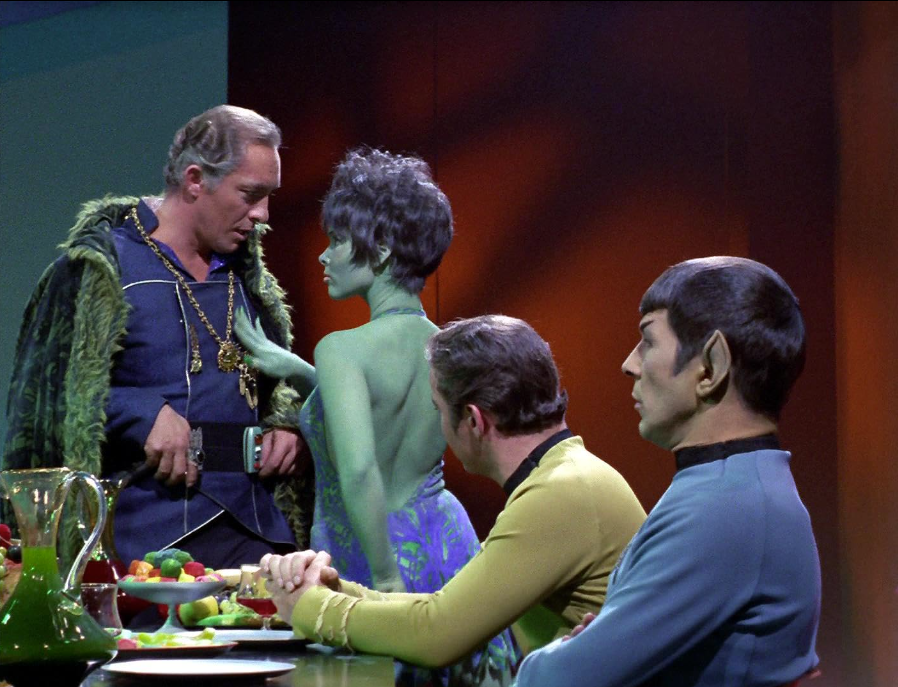
From “Whom Gods Destroy”
Garth, Marta, Kirk, Spock
Screenshot from IMDb
I learned Star Trek
on a black-and-white TV
The effect
of Marta’s green skin
was lost on me
Our reading is of three chapters, each on a different virtue, in Book IV of the Nicomachean Ethics:
- Magnanimity, “greatness of soul.”
- The innominate virtue that is to magnanimity as liberality is to magnificence.
- The virtue regarding anger – called gentleness for lack of a better term.
Because “magnanimity” is supposed to means something different now, translators avoid using it for megalopsychia. I am going to use it still, because
- the original OED
- recognizes Aristotle’s sense of the Greek word as a meaning of “magnanimity,” but
- does not recognize generosity as a meaning;
- today
- we don’t use “magnanimity” much, but
- when we do, we may mean
- not a particular virtue on a list,
- but whichever virtue we think is best – and for Aristotle, megalopsychia is best.
More precisely, Aristotle takes μεγαλοψυχία to be the “cosmic” virtue, “a cosmos of the virtues” (§ iii.16). The Greek word here is indeed κόσμος, which can mean any of “order, embellishment, ruler, universe.”
More precisely still, Aristotle uses kosmos for what the virtue in question seems to be. Sometimes the seeming is not the being. For example, it may seem as if magnanimity comes with wealth or good birth (§ iii.19), but it really doesn’t (§ iii.20).
The magnanimous man is described (§ iii.3) in a clever formula, which uses the same root in a verb and an adjective:
δοκεῖ δὴ μεγαλόψυχος εἶναι
ὁ μεγάλων αὑτὸν ἀξιῶν ἄξιος ὤν·
Last time I compared the adjectives ἄξιος and τίμιος, which mean things like “valuable” and “worthy.” The related noun τιμή “honor” will be important this time, as what the magnanimous person is most worthy of. Meanwhile, according to the formula, that person seems to be one to whom two participial phrases apply:
| μεγάλων | αὑτὸν | ἀξιῶν | | | ἄξιος | ὤν |
| of-great-things | himself | worthy-deeming | | | worthy | being |
As magnificence concerns what one’s money is worth, so magnanimity concerns what oneself is worth. In each case, the worth should be high; however, the virtue resides, not in the worth itself, but in one’s judgment of this worth and of what to do with it. Still, the greatness of the worth is what makes the virtue be
- magnificence and not just liberality, in the case of one’s money’s worth;
- magnanimity and not just the innominate virtue of chapter iv, in the case of self-worth.
Giving that innominate virtue the name right aspiration, we have an analogy:
liberality : magnificence :: right aspiration : magnanimity.
The analogy is bound to be imperfect, like all analogies outside of mathematics (as I argued in writing lengthily “On Commensurability and Symmetry,” Journal of Humanistic Mathematics, Volume 7, Issue 2 [July 2017], pages 90–148, DOI). I shall suggest an alternative analogy, taking the four virtues in Aristotle’s order:
liberality : magnificence :: magnanimity : right aspiration.
The magnificent person does not seem to be worthier, as a human being, than the liberal; however, the magnanimous person is worthier than everybody else, by definition. When the subject was money, Aristotle told us about the liberal person before the magnificent, because liberality is something that we can all aspire to. Now that the subject is personal worth, we are told first of magnanimity, perhaps because, in principle, we can all aspire to that. We may well fail. Aristotle gives us the personal characteristics of the magnanimous person, such as haughtiness, but warns us that these will not make us magnanimous. Chapter iv provides the consolation prize: there is virtue in knowing our own worth, whatever that may be.
There was a time,
when peace was on the earth
And joy and happiness did reign
and each man knew his worth.
In my heart how I yearn
for that spirit’s return
and I cry,
as time flies.– Leon Thomas, Pharoah Sanders,
“The Creator Has a Master Plan”
Myself, I have avoided giving a sex to the magnanimous person. Aristotle describes this person’s physical features, and they would seem to be a man’s, unless the Philosopher has some deep-voiced women in mind.
It’s not even clear which magnanimous men he may have in mind, unless perhaps they are Zeus and the Laconians mentioned in § iii.25. I have learned that I am not the only person to see Mr Darcy of Pride and Prejudice as magnanimous. However, Jane Austen’s creation gives us another example of a love that may not interest Aristotle. Last time I mentioned charity; Austen gives us romantic love.
Aristotle may have this love in mind when he gives, as one necessary feature of magnanimous man,
πρὸς ἄλλον μὴ δύνασθαι ζῆν ἀλλ᾽ ἢ φίλον,
[being] incapable of living with a view to another – except a friend (Bartlett and Collins),
[being] incapable of living at the will of another, unless a friend (Rackham).
I believe he will tell us more about friendship later.
The only thing I remembered from college about the great-souled man was that he remembered doing good deeds, but not having them done to him. It seemed to me then and now that the reverse is admirable.
The liberal and the magnanimous are similar for their indifference. They don’t care, whether about being rich or about what other people think. I remember nothing of what Aristotle is going to say about the contemplative life, which so far he has mentioned only briefly, in Book I, chapter v; however, I think of an example of this life from the 101 Zen Stories of Reps and Senzaki:
The Zen master Hakuin was praised by his neighbors as one living a pure life.
A beautiful Japanese girl whose parents owned a food store lived near him. Suddenly, without any warning, her parents discovered she was with child.
This made her parents angry. She would not confess who the man was, but after much harassment at last named Hakuin.
In great anger the parents went to the master. “Is that so?” was all he would say.
After the child was born it was brought to Hakuin. By this time he had lost his reputation, which did not trouble him, but he took very good care of the child. He obtained milk from his neighbors and everything else the little one needed.
A year later the girl-mother could stand it no longer. She told her parents the truth – that the real father of the child was a young man who worked in the fishmarket.
The mother and father of the girl at once went to Hakuin to ask forgiveness, to apologize at length, and to get the child back.
Hakuin was willing. In yielding the child, all he said was: “Is that so?”
Contents and Summary
- Chapter III. MAGNANIMITY (ΜΕΓΑΛΟΨΥΧΙΑ).
- Chapter 7. GENERALITIES.
- Magnanimity, a.k.a. greatness of soul,
- obviously concerns something great (§ iii.1);
- is judging yourself
- correctly,
- as being great;
- is distinct from deeming yourself
- worthy of more than you are – this is foolish (ἠλίθιος, § iii.3);
- unworthy, and being right – this is modest (σώφρων, § iii.4);
- worthy, not just of more than you are, but greatness – this is vain (χαῦνος, § iii.6);
- unworthy, and being wrong – this is pusillanimous, small-souled (μικρόψυχος, § iii.7).
- The magnanimous one is
- extreme in greatness,
- medial in recognizing it (§ iii.8).
- Magnanimity must concern
- Of the three types,
- Magnanimity
- makes the other virtues better,
- cannot exist without them (§ iii.16).
- Being largely indifferent to
- honor,
- wealth,
- power,
the magnanimous man
- Magnanimity, a.k.a. greatness of soul,
- Chapter 8. SPECIFICS.
- Despite what some think,
makes you magnanimous, although some with the former adopt the latter.
- The magnanimous man
- is contemptuous (καταφρονέω) justly (§ iii.22);
- seeks not dangers, but will face a great one (§ iii.23);
- does good, but is ashamed to be done it (§ iii.24);
- remembers the former, not the latter (§ iii.25);
- needs little or no help, but gladly gives it;
- is great with the great, measured with the middling (§ iii.26)
- is a lazy procrastinator, unless a great honor or work is concerned (§ iii.27);
- is open about his likes and dislikes (§ iii.28);
- can live with nobody but a friend (§ iii.29);
- is neither easily impressed nor begrudging (§ iii.30);
- is not given to
- favors beautiful useless possessions (§ iii.33);
- in person, is
- slow of gait,
- deep of voice,
- steady of speech (§ iii.34).
- Despite what some think,
- Chapter 9. EXTREMES.
- Chapter IV = Chapter 10. HONOR (ΤΙΜΗ)
- Some virtue is to magnanimity as liberality is to magnificence (§ iv.1).
- There is excess, deficiency, and mean
- as with money,
- so with honor – one can crave this
- more or less than, or
- when and as,
one ought (§ iv.2).
- Both
- ambitious (φιλότιμος) and
- unambitious (ἀφιλότιμος)
persons can be
- praised (§ iv.3 and
- blamed,
because we have no name for the mean, which however
- Chapter V = Chapter 11. ANGER (ΌΡΓΗ).
- The mean and defect have no name.
- We call the former gentleness (πραότης), but
- it tends to the latter (§ v.1).
- The excess is an irascibility (ὀργιλότης, § v.2).
- Gentle (πρᾶος)
- Defect of anger – call it ἀοργησία – is blamed as
- One can be angry
- at the wrong people,
- for the wrong reason,
- too much,
- too quickly,
- at the wrong time,
but the same person cannot do all of these, since evil destroys itself (§ v.7).
- The irascible (οἱ ὀργίλοι)
- get angry too quickly (etc.),
- get over it quickly too, which is good (§ v.8).
- The passionate (οἱ ἀκρόχολοι) get angry
- always
- at everything (§ v.9).
- The bitter (οἱ πικροί)
- never get over their anger, because they
- do not retaliate, and therefore
- are the worst (§ v.10).
- The harsh (οἱ χαλεποί)
- get angry at the wrong things, too much, too long;
- insist on redress or revenge (§ v.11).
- The excess is more opposed – being
- more common,
- more difficult to deal with –
to the mean, gentleness, than is the defect (§ v.12).
- It’s hard to tell the best way to be angry (§ v.13), but there must be
- a mean habit (ἡ μέση ἕξις) to be praised and pursued,
- excess and defect to be blamed (§ v.14).
That’s it for the habits of anger (§ v.15).
- The mean and defect have no name.
[1123a]
Chapter III
Chapter 7
§ iii.1
ἡ δὲ μεγαλοψυχία
- περὶ μεγάλα μὲν καὶ ἐκ τοῦ ὀνόματος ἔοικεν εἶναι,
- περὶ ποῖα δ᾽ ἐστὶ πρῶτον λάβωμεν· [1123b]
§ iii.2
διαφέρει δ᾽ οὐδὲν
- τὴν ἕξιν ἢ
- τὸν κατὰ τὴν ἕξιν
σκοπεῖν.
Translators think the alternative is between the habit and the person who acts according to it; cannot the action itself be referred to?
§ iii.3
δοκεῖ δὴ μεγαλόψυχος εἶναι ὁ
- μεγάλων αὑτὸν ἀξιῶν
- ἄξιος ὤν·
- ὁ γὰρ μὴ κατ᾽ ἀξίαν αὐτὸ ποιῶν ἠλίθιος,
- τῶν δὲ κατ᾽ ἀρετὴν οὐδεὶς
- ἠλίθιος οὐδ᾽
- ἀνόητος.
μεγαλόψυχος μὲν οὖν ὁ εἰρημένος.
We are dealing with three related words, and later with a fourth:
- the verb ἀξιόω “to deem worthy,”
- the adjective ἄξιος, -ία, -ιον “counterbalancing, worthy,”
- the noun ἡ ἀξία “worth, value,”
- the noun τὸ ἀξίωμα, -ατος “what one may be thought worthy of.”
There is some comment in the notes on the previous reading, § IV.ii.10.
§ iii.4
ὁ γὰρ
- μικρῶν ἄξιος καὶ
- τούτων ἀξιῶν ἑαυτὸν
- σώφρων,
- μεγαλόψυχος δ᾽ οὔ·
§ iii.5
- ἐν μεγέθει γὰρ ἡ μεγαλοψυχία, ὥσπερ καὶ
- τὸ κάλλος ἐν μεγάλῳ σώματι,
οἱ μικροὶ δ᾽
- ἀστεῖοι καὶ
- σύμμετροι,
- καλοὶ δ᾽ οὔ.
§ iii.6
ὁ δὲ
- μεγάλων ἑαυτὸν ἀξιῶν
- ἀνάξιος ὢν
χαῦνος·
ὁ δὲ μειζόνων ἢ ἄξιος οὐ πᾶς χαῦνος.
There are two quantities:
- what you think you are worth, A.
- what you are worth, B.
For the vain man,
- A is great,
- B is not great.
It is possible to have A > B, even though
- A is not great, or
- B is great.
Nonetheless, by the next section, the condition for being pusillanimous is simply A < B, except § 12 may condition this slightly, albeit incompatibly with § 7 itself.
§ iii.7
ὁ δ᾽ ἐλαττόνων ἢ ἄξιος μικρόψυχος,
- ἐάν τε μεγάλων
- ἐάν τε μετρίων,
- ἐάν τε καὶ μικρῶν
- ἄξιος ὢν
- ἔτι ἐλαττόνων αὑτὸν ἀξιοῖ.
καὶ μάλιστ᾽ ἂν δόξειεν ὁ μεγάλων ἄξιος·
τί γὰρ ἂν ἐποίει,
εἰ μὴ τοσούτων ἦν ἄξιος;
Is the answer supposed to be obvious? I can understand this to be so, if the man in question would do less if he weren’t so worthy. As he is, he does a lot, wrongly. This understanding would seem to be corroborated by the question in § iii.15, “For the sake of what will he for whom nothing is great do something shameful?” For the pusillanimous, other things are great.
§ iii.8
ἔστι δὴ ὁ μεγαλόψυχος
- τῷ μὲν μεγέθει ἄκρος,
- τῷ δὲ ὡς δεῖ μέσος·
τοῦ γὰρ κατ᾽ ἀξίαν αὑτὸν ἀξιοῖ·
οἳ δ᾽
- ὑπερβάλλουσι καὶ
- ἐλλείπουσιν.
§ iii.9
εἰ δὴ
- μεγάλων ἑαυτὸν ἀξιοῖ
- ἄξιος ὤν, καὶ
- μάλιστα τῶν μεγίστων,
περὶ ἓν μάλιστ᾽ ἂν εἴη.
§ iii.10
ἡ δ᾽ ἀξία λέγεται πρὸς τὰ ἐκτὸς ἀγαθά·
μέγιστον δὲ τοῦτ᾽ ἂν θείημεν
- ὃ τοῖς θεοῖς ἀπονέμομεν, καὶ
- οὗ μάλιστ᾽ ἐφίενται οἱ ἐν ἀξιώματι, καὶ
- τὸ ἐπὶ τοῖς καλλίστοις ἆθλον·
τοιοῦτον δ᾽ ἡ τιμή·
μέγιστον γὰρ δὴ τοῦτο τῶν ἐκτὸς ἀγαθῶν·
περὶ
- τιμὰς δὴ καὶ
- ἀτιμίας
ὁ μεγαλόψυχός ἐστιν ὡς δεῖ.
§ iii.11
καὶ ἄνευ δὲ λόγου
φαίνονται οἱ μεγαλόψυχοι περὶ τιμὴν εἶναι·
τιμῆς γὰρ μάλιστα οἱ μεγάλοι
- ἀξιοῦσιν ἑαυτούς,
- κατ᾽ ἀξίαν δέ.
Though ἀξίαν could be the feminine accusative of ἄξιος, we seem to have here the noun
- ἀξία “worth.”
§ iii.12
ὁ δὲ μικρόψυχος ἐλλείπει
- καὶ πρὸς ἑαυτὸν
- καὶ πρὸς τὸ τοῦ μεγαλοψύχου ἀξίωμα.
The subject of this § and the next seems to be the self-estimate as an abstract quantity:
- in the pusillanimous it is
- less than he deserves,
- less than the magnanimous man’s;
- in the vain it is
- greater than he deserves,
- not greater than the magnanimous man’s.
§ iii.13
ὁ δὲ χαῦνος πρὸς
- ἑαυτὸν μὲν ὑπερβάλλει, οὐ μὴν
- τόν γε μεγαλόψυχον.
§ iii.14
ὁ δὲ μεγαλόψυχος,
εἴπερ τῶν μεγίστων ἄξιος,
ἄριστος ἂν εἴη·
- μείζονος γὰρ ἀεὶ ὁ βελτίων ἄξιος, καὶ
- μεγίστων ὁ ἄριστος.
- τὸν ὡς ἀληθῶς ἄρα μεγαλόψυχον
δεῖ ἀγαθὸν εἶναι. - καὶ δόξειεν ἂν εἶναι μεγαλοψύχου
τὸ ἐν ἑκάστῃ ἀρετῇ μέγα.
§ iii.15
οὐδαμῶς τ᾽ ἂν ἁρμόζοι μεγαλοψύχῳ
- φεύγειν παρασείσαντι, οὐδ᾽
- ἀδικεῖν·
τίνος γὰρ ἕνεκα πράξει αἰσχρὰ ᾧ γ᾽ οὐδὲν μέγα;
καθ᾽ ἕκαστα δ᾽ ἐπισκοποῦντι πάμπαν
γελοῖος φαίνοιτ᾽
ἂν ὁ μεγαλόψυχος
μὴ ἀγαθὸς ὤν.
οὐκ εἴη δ᾽ ἂν οὐδὲ τιμῆς ἄξιος
φαῦλος ὤν·
- τῆς ἀρετῆς γὰρ ἆθλον
ἡ τιμή, καὶ
- ἀπονέμεται τοῖς ἀγαθοῖς. [1124a]
Compare the question to the one above in § 7. Bartlett and Collins have a note on it:
Aristotle repeats this phrase at 1125a3 and 15. Compare Plato, Republic 486a8-10, for a similar remark in reference to the philosopher.
The phrase meant is “he to whom nothing is great,” ᾧ γ᾽ οὐδὲν μέγα. The other versions are
The Republic reference is to Book VI, the Third Wave (Bloom translation):
“And you too must of course also consider something else when you’re going to judge whether a nature is philosophic or not.”
“What?”
“You mustn’t let its partaking in illiberality (ἀνελευθερία) get by you unnoticed. For petty speech is of course most opposite to a soul that is always going to reach out for the whole and for everything divine and human.”
“Very true,” he said.
“To an understanding endowed with magnificence (μεγαλοπρέπεια) and the contemplation of all time and all being, do you think it possible that human life seem anything great (μέγα τι δοκεῖν εἶναι τὸν ανθρῶπινον βίον)?”
“Impossible,” he said.
“Won’t such a man also believe that death is not something terrible?”
“Not in the least.”
“So, a cowardly (δειλός) and illiberal nature would not, as it seems, participate in true philosophy.”
§ iii.16
ἔοικε μὲν οὖν ἡ μεγαλοψυχία
οἷον κόσμος τις εἶναι τῶν ἀρετῶν·
- μείζους γὰρ αὐτὰς ποιεῖ, καὶ
- οὐ γίνεται ἄνευ ἐκείνων.
διὰ τοῦτο χαλεπὸν τῇ ἀληθείᾳ μεγαλόψυχον εἶναι·
οὐ γὰρ οἷόν τε ἄνευ καλοκαγαθίας.
§ iii.17
μάλιστα μὲν οὖν περὶ
- τιμὰς καὶ
- ἀτιμίας
ὁ μεγαλόψυχός ἐστι· καὶ
-
ἐπὶ μὲν
- ταῖς μεγάλαις καὶ
- ὑπὸ τῶν σπουδαίων
μετρίως ἡσθήσεται, ὡς τῶν
- οἰκείων τυγχάνων ἢ καὶ
- ἐλαττόνων·
ἀρετῆς γὰρ παντελοῦς οὐκ ἂν γένοιτο ἀξία τιμή,
οὐ μὴν ἀλλ᾽ ἀποδέξεταί γε
τῷ μὴ ἔχειν αὐτοὺς μείζω αὐτῷ ἀπονέμειν· -
τῆς δὲ
- παρὰ τῶν τυχόντων καὶ
- ἐπὶ μικροῖς
πάμπαν ὀλιγωρήσει·
οὐ γὰρ τούτων ἄξιος·
ὁμοίως δὲ καὶ ἀτιμίας·
οὐ γὰρ ἔσται δικαίως περὶ αὐτόν.
§ iii.18
μάλιστα μὲν οὖν ἐστίν,
ὥσπερ εἴρηται,
ὁ μεγαλόψυχος περὶ τιμάς,
οὐ μὴν ἀλλὰ καὶ περὶ
- πλοῦτον καὶ
- δυναστείαν καὶ
- πᾶσαν
- εὐτυχίαν καὶ
- ἀτυχίαν
μετρίως ἕξει,
ὅπως ἂν γίνηται,
καὶ
- οὔτ᾽ εὐτυχῶν περιχαρὴς ἔσται
- οὔτ᾽ ἀτυχῶν περίλυπος.
οὐδὲ γὰρ περὶ τιμὴν οὕτως ἔχει ὡς μέγιστον ὄν.
- αἱ γὰρ δυναστεῖαι καὶ
- ὁ πλοῦτος
διὰ τὴν τιμήν ἐστιν αἱρετά·
οἱ γοῦν ἔχοντες αὐτὰ τιμᾶσθαι δι᾽ αὐτῶν βούλονται·
ᾧ δὲ καὶ ἡ τιμὴ μικρόν ἐστι,
τούτῳ καὶ τἆλλα.
διὸ ὑπερόπται δοκοῦσιν εἶναι.
- ὑπερόπτης “contemner, disdainer,” from ὑπερόψομαι, that is, ὑπεροράω “look down on”
Chapter 8
§ iii.19
δοκεῖ δὲ καὶ τὰ εὐτυχήματα συμβάλλεσθαι πρὸς μεγαλοψυχίαν.
- οἱ γὰρ εὐγενεῖς
ἀξιοῦνται τιμῆς καὶ
- οἱ
- δυναστεύοντες ἢ
- πλουτοῦντες·
- ἐν ὑπεροχῇ γάρ,
- τὸ δ᾽ ἀγαθῷ ὑπερέχον πᾶν
ἐντιμότερον.
διὸ καὶ τὰ τοιαῦτα μεγαλοψυχοτέρους ποιεῖ·
τιμῶνται γὰρ ὑπὸ τινῶν·
Emphasis on the seeming here, but see the next §. Where in Plato is the accusation that somebody’s fame is due to his birth, the retort being that if roles were reversed, neither would be famous?
§ iii.20
κατ᾽ ἀλήθειαν δ᾽ ὁ ἀγαθὸς μόνος τιμητός·
ᾧ δ᾽ ἄμφω ὑπάρχει,
μᾶλλον ἀξιοῦται τιμῆς.
οἱ δ᾽ ἄνευ ἀρετῆς τὰ τοιαῦτα ἀγαθὰ ἔχοντες
- οὔτε δικαίως ἑαυτοὺς μεγάλων ἀξιοῦσιν
- οὔτε ὀρθῶς μεγαλόψυχοι λέγονται·
ἄνευ γὰρ ἀρετῆς παντελοῦς οὐκ ἔστι ταῦτα.
§ iii.21
- ὑπερόπται δὲ καὶ
- ὑβρισταὶ καὶ
οἱ τὰ τοιαῦτα ἔχοντες ἀγαθὰ γίνονται.
ἄνευ γὰρ ἀρετῆς οὐ ῥᾴδιον φέρειν ἐμμελῶς τὰ εὐτυχήματα· [1124b]
- οὐ δυνάμενοι δὲφέρειν καὶ
- οἰόμενοι τῶν ἄλλων ὑπερέχειν
- ἐκείνων μὲν καταφρονοῦσιν,
- αὐτοὶ δ᾽ ὅ τι ἂν τύχωσι πράττουσιν.
- μιμοῦνται γὰρ τὸν μεγαλόψυχον
οὐχ ὅμοιοι ὄντες, - τοῦτο δὲ δρῶσιν
ἐν οἷς δύνανται·
- τὰ μὲν οὖν κατ᾽ ἀρετὴν οὐ πράττουσι,
- καταφρονοῦσι δὲ τῶν ἄλλων.
§ iii.22
- ὁ μὲν γὰρ μεγαλόψυχος δικαίως καταφρονεῖ
(δοξάζει γὰρ ἀληθῶς), - οἱ δὲ πολλοὶ τυχόντως.
§ iii.23
- οὐκ ἔστι δὲ μικροκίνδυνος
- οὐδὲ φιλοκίνδυνος
διὰ τὸ ὀλίγα τιμᾶν,
- μεγαλοκίνδυνος δέ,
καὶ ὅταν κινδυνεύῃ,
ἀφειδὴς τοῦ βίου
ὡς οὐκ ἄξιον ὂν πάντως ζῆν.
§ iii.24
καὶ
- οἷος εὖ ποιεῖν,
- εὐεργετούμενος δ᾽ αἰσχύνεται·
- τὸ μὲν γὰρ ὑπερέχοντος,
- τὸ δ᾽ ὑπερεχομένου.
καὶ ἀντευεργετικὸς πλειόνων·
οὕτω γάρ
- οἱ προσοφλήσει ὁ ὑπάρξας καὶ
- ἔσται εὖ πεπονθώς.
§ iii.25
δοκοῦσι δὲ καὶ μνημονεύειν
- οὗ ἂν ποιήσωσιν εὖ,
- ὧν δ᾽ ἂν πάθωσιν οὔ
(ἐλάττων γὰρ ὁ παθὼν εὖ τοῦ ποιήσαντος,
βούλεται δ᾽ ὑπερέχειν), καὶ
- τὰ μὲν ἡδέως ἀκούειν,
- τὰ δ᾽ ἀηδῶς·
διὸ καὶ
- τὴν Θέτιν οὐ λέγειν τὰς εὐεργεσίας τῷ Διί,
- οὐδ᾽ οἱ Λάκωνες πρὸς τοὺς Ἀθηναίους,
ἀλλ᾽ ἃ πεπόνθεσαν εὖ.
§ iii.26
μεγαλοψύχου δὲ
-
καὶ τὸ
- μηδενὸς δεῖσθαι ἢ μόλις,
- ὑπηρετεῖν δὲ προθύμως,
-
καὶ
- πρὸς μὲν τοὺς
- ἐν ἀξιώματι καὶ
- εὐτυχίαις
μέγαν εἶναι,
- πρὸς δὲ τοὺς μέσους μέτριον·
- πρὸς μὲν τοὺς
-
τῶν μὲν γὰρ ὑπερέχειν
- χαλεπὸν καὶ
- σεμνόν,
-
τῶν δὲ ῥᾴδιον, καὶ
- ἐπ᾽ ἐκείνοις μὲν σεμνύνεσθαι οὐκ ἀγεννές,
- ἐν δὲ τοῖς ταπεινοῖς φορτικόν,
ὥσπερ εἰς τοὺς ἀσθενεῖς ἰσχυρίζεσθαι·
§ iii.27
καὶ εἰς
- τὰ ἔντιμα
μὴ ἰέναι, ἢ
- οὗ πρωτεύουσιν ἄλλοι·
καὶ
- ἀργὸν
εἶναι καὶ
- μελλητὴν
ἀλλ᾽ ἢ ὅπου
- τιμὴ
μεγάλη ἢ
- ἔργον,
καὶ
- ὀλίγων μὲν
πρακτικόν,
- μεγάλων δὲ καὶ
- ὀνομαστῶν.
§ iii.28
ἀναγκαῖον δὲ
- καὶ φανερομισῆ εἶναι
- καὶ φανερόφιλον
(τὸ γὰρ λανθάνειν φοβουμένου,
καὶ ἀμελεῖν τῆς ἀληθείας
μᾶλλον ἢ τῆς δόξης),
καὶ
- λέγειν καὶ
- πράττειν
φανερῶς
- (παρρησιαστὴς γὰρ
διὰ τὸ καταφρονητικὸς εἶναι, καὶ - ἀληθευτικός,
πλὴν ὅσα μὴ δι᾽ εἰρωνείαν [εἰρωνεία δὲ] πρὸς τοὺς πολλούς),
§ iii.29
καὶ πρὸς ἄλλον μὴ δύνασθαι ζῆν
ἀλλ᾽ ἢ φίλον· [1125a]
δουλικὸν γάρ·
διὸ
- καὶ πάντες οἱ κόλακες θητικοὶ
- καὶ οἱ ταπεινοὶ κόλακες.
§ iii.30
-
οὐδὲ θαυμαστικός·
οὐδὲν γὰρ μέγα αὐτῷ ἐστίν. -
οὐδὲ μνησίκακος·
οὐ γὰρ μεγαλοψύχου τὸ ἀπομνημονεύειν,
ἄλλως τε καὶ κακά,
ἀλλὰ μᾶλλον παρορᾶν.
§ iii.31
- οὐδ᾽ ἀνθρωπολόγος·
- οὔτε γὰρ περὶ αὑτοῦ ἐρεῖ
- οὔτε περὶ ἑτέρου·
- οὔτε γὰρ ἵνα ἐπαινῆται μέλει αὐτῷ
- οὔθ᾽ ὅπως οἱ ἄλλοι ψέγωνται·
- οὐδ᾽ αὖ ἐπαινετικός ἐστιν·
διόπερ
- οὐδὲ κακολόγος,
- οὐδὲ τῶν ἐχθρῶν,
εἰ μὴ δι᾽ ὕβριν.
§ iii.32
καὶ
περὶ
- ἀναγκαίων ἢ
- μικρῶν
ἥκιστα
- ὀλοφυρτικὸς καὶ
- δεητικός·
σπουδάζοντος γὰρ οὕτως ἔχειν περὶ ταῦτα.
The
- unnecessary (unforced) and
- great
things are left out.
§ iii.33
καὶ
οἷος κεκτῆσθαι
μᾶλλον τὰ
- καλὰ καὶ
- ἄκαρπα
τῶν
- καρπίμων καὶ
- ὠφελίμων·
αὐτάρκους γὰρ μᾶλλον.
§ iii.34
καὶ
- κίνησις δὲ βραδεῖα
τοῦ μεγαλοψύχου δοκεῖ εἶναι, καὶ
- φωνὴ βαρεῖα, καὶ
- λέξις στάσιμος·
- οὐ γὰρ σπευστικὸς ὁ περὶ ὀλίγα σπουδάζων,
- οὐδὲ σύντονος ὁ μηδὲν μέγα οἰόμενος·
- ἡ δ᾽ ὀξυφωνία καὶ
- ἡ ταχυτὴς
διὰ τούτων.
Chapter 9
τοιοῦτος μὲν οὖν ὁ μεγαλόψυχος·
§ iii.35
- ὁ δ᾽ ἐλλείπων μικρόψυχος,
- ὁ δ᾽ ὑπερβάλλων χαῦνος.
- οὐ κακοὶ μὲν οὖν δοκοῦσιν εἶναι
- οὐδ᾽ οὗτοι
(οὐ γὰρ κακοποιοί εἰσιν), - ἡμαρτημένοι δέ.
ὁ μὲν γὰρ μικρόψυχος
ἄξιος ὢν ἀγαθῶν
ἑαυτὸν ἀποστερεῖ
ὧν ἄξιός ἐστι, καὶ
ἔοικε κακὸν ἔχειν τι ἐκ τοῦ
- μὴ ἀξιοῦν ἑαυτὸν τῶν ἀγαθῶν, καὶ
- ἀγνοεῖν δ᾽ ἑαυτόν·
ὠρέγετο γὰρ ἂν ὧν ἄξιος ἦν,
ἀγαθῶν γε ὄντων.
- οὐ μὴν ἠλίθιοί γε
οἱ τοιοῦτοι δοκοῦσιν εἶναι,
- ἀλλὰ μᾶλλον ὀκνηροί.
ἡ τοιαύτη δὲ δόξα δοκεῖ καὶ χείρους ποιεῖν·
ἕκαστοι γὰρ ἐφίενται τῶν κατ᾽ ἀξίαν,
ἀφίστανται δὲ
- καὶ τῶν πράξεων τῶν καλῶν
- καὶ τῶν ἐπιτηδευμάτων
ὡς ἀνάξιοι ὄντες,
ὁμοίως δὲ
- καὶ τῶν ἐκτὸς ἀγαθῶν.
§ iii.36
οἱ δὲ χαῦνοι
- ἠλίθιοι καὶ
- ἑαυτοὺς ἀγνοοῦντες, καὶ
- ταῦτ᾽ ἐπιφανῶς·
οὐ γὰρ ἄξιοι ὄντες
τοῖς ἐντίμοις ἐπιχειροῦσιν,
εἶτα ἐξελέγχονται·
- καὶ ἐσθῆτι κοσμοῦνται καὶ σχήματι καὶ τοῖς τοιούτοις,
- καὶ βούλονται τὰ εὐτυχήματα καὶ φανερὰ εἶναι αὑτῶν,
- καὶ λέγουσι περὶ αὐτῶν
ὡς διὰ τούτων τιμηθησόμενοι.
§ iii.37
ἀντιτίθεται δὲ τῇ μεγαλοψυχίᾳ
ἡ μικροψυχία
μᾶλλον τῆς χαυνότητος·
καὶ γὰρ
- γίνεται μᾶλλον καὶ
- χεῖρόν ἐστιν.
§ iii.38
ἡ μὲν οὖν μεγαλοψυχία περὶ τιμήν ἐστι μεγάλην,
ὥσπερ εἴρηται. [1125b]
Chapter IV
Chapter 10
§ iv.1
ἔοικε δὲ καὶ περὶ ταύτην εἶναι ἀρετή τις,
καθάπερ ἐν τοῖς πρώτοις ἐλέχθη,
- ἣ δόξειεν ἂν παραπλησίως ἔχειν πρὸς τὴν μεγαλοψυχίαν
- ὥσπερ καὶ ἡ ἐλευθεριότης πρὸς τὴν μεγαλοπρέπειαν.
ἄμφω γὰρ αὗται
- τοῦ μὲν μεγάλου ἀφεστᾶσι,
- περὶ δὲ τὰ
- μέτρια καὶ
- μικρὰ
διατιθέασιν ἡμᾶς ὡς δεῖ·
§ iv.2
-
ὥσπερ δ᾽ ἐν
- λήψει καὶ
- δόσει
χρημάτων μεσότης ἔστι
- καὶ ὑπερβολή τε
- καὶ ἔλλειψις,
-
οὕτω καὶ ἐν τιμῆς ὀρέξει
- τὸ
- μᾶλλον ἢ δεῖ καὶ
- ἧττον, καὶ
- τὸ
- ὅθεν δεῖ καὶ
- ὡς δεῖ.
- τὸ
We seem to be talking about
- not assessing merit, as with magnanimity,
- but craving it.
§ iv.3
- τόν τε γὰρ φιλότιμον ψέγομεν ὡς
- μᾶλλον ἢ δεῖ καὶ
- ὅθεν οὐ δεῖ
τῆς τιμῆς ἐφιέμενον,
- τόν τε ἀφιλότιμον ὡς
οὐδ᾽ ἐπὶ τοῖς καλοῖς προαιρούμενον τιμᾶσθαι.
§ iv.4
ἔστι δ᾽ ὅτε
- τὸν φιλότιμον ἐπαινοῦμεν ὡς
- ἀνδρώδη καὶ
- φιλόκαλον,
- τὸν δ᾽ ἀφιλότιμον ὡς
- μέτριον καὶ
- σώφρονα,
ὥσπερ καὶ ἐν τοῖς πρώτοις εἴπομεν.
δῆλον δ᾽ ὅτι
πλεοναχῶς τοῦ φιλοτοιούτου λεγομένου
οὐκ ἐπὶ τὸ αὐτὸ φέρομεν ἀεὶ τὸ φιλότιμον,
ἀλλ᾽
- ἐπαινοῦντες μὲν ἐπὶ τὸ μᾶλλον ἢ οἱ πολλοί,
- ψέγοντες δ᾽ ἐπὶ τὸ μᾶλλον ἢ δεῖ.
ἀνωνύμου δ᾽ οὔσης τῆς μεσότητος,
ὡς ἐρήμης ἔοικεν ἀμφισβητεῖν τὰ ἄκρα.
ἐν οἷς δ᾽ ἔστιν
- ὑπερβολὴ καὶ
- ἔλλειψις,
καὶ τὸ
- μέσον·
If we can both praise and blame a person for something, this must mean, respectively,
- others have a defect;
- that person has an excess.
If thus there are extremes, there must be a mean – this is the lesson of “Goldilocks and the Three Bears.”
§ iv.5
ὀρέγονται δὲ τῆς τιμῆς
- καὶ μᾶλλον ἢ δεῖ
- καὶ ἧττον·
ἔστι δὴ
- καὶ ὡς δεῖ·
ἐπαινεῖται δ᾽ οὖν ἡ ἕξις αὕτη,
μεσότης οὖσα περὶ τιμὴν ἀνώνυμος.
φαίνεται δὲ
- πρὸς μὲν τὴν φιλοτιμίαν ἀφιλοτιμία,
- πρὸς δὲ τὴν ἀφιλοτιμίαν φιλοτιμία,
- πρὸς ἀμφότερα δὲ ἀμφότερά πως.
§ iv.6
ἔοικε δὲ τοῦτ᾽ εἶναι καὶ περὶ τὰς ἄλλας ἀρετάς.
ἀντικεῖσθαι δ᾽ ἐνταῦθ᾽ οἱ ἄκροι φαίνονται
διὰ τὸ μὴ ὠνομάσθαι τὸν μέσον.
Chapter V
Chapter 11
§ v.1
πραότης δ᾽ ἐστὶ μεσότης περὶ ὀργάς·
ἀνωνύμου δ᾽ ὄντος τοῦ μέσου,
σχεδὸν δὲ καὶ τῶν ἄκρων,
ἐπὶ τὸ μέσον τὴν πραότητα φέρομεν,
πρὸς τὴν ἔλλειψιν ἀποκλίνουσαν,
ἀνώνυμον οὖσαν.
As with the previous virtue, so now, the lack of a name causes confusion.
§ v.2
ἡ δ᾽ ὑπερβολὴ ὀργιλότης τις λέγοιτ᾽ ἄν.
- τὸ μὲν γὰρ πάθος ἐστὶν ὀργή,
- τὰ δ᾽ ἐμποιοῦντα πολλὰ καὶ διαφέροντα.
§ v.3
- ὁ μὲν οὖν
- ἐφ᾽ οἷς δεῖ καὶ
- οἷς δεῖ
ὀργιζόμενος,
- ἔτι δὲ καὶ
- ὡς δεῖ καὶ
- ὅτε καὶ
- ὅσον χρόνον,
ἐπαινεῖται·
πρᾶος δὴ οὗτος ἂν εἴη,
εἴπερ ἡ πραότης ἐπαινεῖται.
βούλεται γὰρ ὁ πρᾶος
- ἀτάραχος εἶναι καὶ
- μὴ ἄγεσθαι
- ὑπὸ τοῦ πάθους,
- ἀλλ᾽ ὡς ἂν ὁ λόγος τάξῃ,
- οὕτω
- καὶ ἐπὶ τούτοις
- καὶ ἐπὶ τοσοῦτον χρόνον
χαλεπαίνειν· [1126a]
§ v.4
ἁμαρτάνειν δὲ δοκεῖ μᾶλλον ἐπὶ τὴν ἔλλειψιν·
- οὐ γὰρ τιμωρητικὸς
ὁ πρᾶος,
- ἀλλὰ μᾶλλον συγγνωμονικός.
§ v.5
ἡ δ᾽ ἔλλειψις,
- εἴτ᾽ ἀοργησία τίς ἐστιν
- εἴθ᾽ ὅ τι δή ποτε,
ψέγεται.
- οἱ γὰρ μὴ ὀργιζόμενοι ἐφ᾽ οἷς δεῖ
ἠλίθιοι δοκοῦσιν εἶναι, καὶ
- οἱ
- μὴ ὡς δεῖ
- μηδ᾽ ὅτε
- μηδ᾽ οἷς δεῖ·
§ v.6
δοκεῖ γὰρ
- οὐκ αἰσθάνεσθαι
- οὐδὲ λυπεῖσθαι,
μὴ ὀργιζόμενός τε οὐκ εἶναι ἀμυντικός,
τὸ δὲ
- προπηλακιζόμενον ἀνέχεσθαι καὶ
- τοὺς οἰκείους περιορᾶν
ἀνδραποδῶδες.
§ v.7
ἡ δ᾽ ὑπερβολὴ κατὰ πάντα μὲν γίνεται
- (καὶ γὰρ οἷς οὐ δεῖ,
- καὶ ἐφ᾽ οἷς οὐ δεῖ,
- καὶ μᾶλλον ἢ δεῖ,
- καὶ θᾶττον,
- καὶ πλείω χρόνον),
οὐ μὴν ἅπαντά γε τῷ αὐτῷ ὑπάρχει.
οὐ γὰρ ἂν δύναιτ᾽ εἶναι·
τὸ γὰρ κακὸν
- καὶ ἑαυτὸ ἀπόλλυσι,
- κἂν ὁλόκληρον ᾖ,
ἀφόρητον γίνεται.
§ v.8
οἱ μὲν οὖν ὀργίλοι
- ταχέως μὲν ὀργίζονται
- καὶ οἷς οὐ δεῖ
- καὶ ἐφ᾽ οἷς οὐ δεῖ
- καὶ μᾶλλον ἢ δεῖ,
- παύονται δὲ ταχέως·
ὃ καὶ βέλτιστον ἔχουσιν.
συμβαίνει δ᾽ αὐτοῖς τοῦτο,
ὅτι
- οὐ κατέχουσι τὴν ὀργὴν
- ἀλλ᾽ ἀνταποδιδόασιν ᾗ φανεροί εἰσι διὰ τὴν ὀξύτητα,
- εἶτ᾽ ἀποπαύονται.
§ v.9
ὑπερβολῇ δ᾽ εἰσὶν οἱ ἀκρόχολοι ὀξεῖς
- καὶ πρὸς πᾶν ὀργίλοι
- καὶ ἐπὶ παντί·
ὅθεν καὶ τοὔνομα.
§ v.10
οἱ δὲ πικροὶ
- δυσδιάλυτοι, καὶ
- πολὺν χρόνον ὀργίζονται·
κατέχουσι γὰρ τὸν θυμόν.
παῦλα δὲ γίνεται ὅταν ἀνταποδιδῷ·
ἡ γὰρ τιμωρία παύει τῆς ὀργῆς,
ἡδονὴν ἀντὶ τῆς λύπης ἐμποιοῦσα.
τούτου δὲ μὴ γινομένου τὸ βάρος ἔχουσιν·
διὰ γὰρ τὸ μὴ ἐπιφανὲς εἶναι
οὐδὲ συμπείθει αὐτοὺς οὐδείς,
ἐν αὑτῷ δὲ πέψαι τὴν ὀργὴν χρόνου δεῖ.
εἰσὶ δ᾽ οἱ τοιοῦτοι
- ἑαυτοῖς ὀχληρότατοι καὶ
- τοῖς μάλιστα φίλοις.
§ v.11
χαλεποὺς δὲ λέγομεν τοὺς
-
- ἐφ᾽ οἷς τε μὴ δεῖ
χαλεπαίνοντας καὶ
- μᾶλλον ἢ δεῖ καὶ
- πλείω χρόνον, καὶ
- μὴ διαλλαττομένους ἄνευ
- τιμωρίας ἢ
- κολάσεως.
§ v.12
τῇ πραότητι δὲ μᾶλλον τὴν ὑπερβολὴν ἀντιτίθεμεν·
καὶ γὰρ μᾶλλον γίνεται·
- ἀνθρωπικώτερον γὰρ τὸ τιμωρεῖσθαι· καὶ
- πρὸς τὸ συμβιοῦν οἱ χαλεποὶ χείρους.
§ v.13
ὃ δὲ καὶ ἐν τοῖς πρότερον εἴρηται,
καὶ ἐκ τῶν λεγομένων δῆλον·
οὐ γὰρ ῥᾴδιον διορίσαι τὸ
- πῶς καὶ
- τίσι καὶ
- ἐπὶ ποίοις καὶ
- πόσον χρόνον
ὀργιστέον, καὶ τὸ
- μέχρι τίνος
- ὀρθῶς ποιεῖ τις ἢ
- ἁμαρτάνει.
ὁ μὲν γὰρ μικρὸν παρεκβαίνων οὐ ψέγεται,
- οὔτ᾽ ἐπὶ τὸ μᾶλλον
- οὔτ᾽ ἐπὶ τὸ ἧττον·
ἐνίοτε γὰρ
- τοὺς ἐλλείποντας
- ἐπαινοῦμεν καὶ
- πράους φαμέν, [1126b] καὶ
- τοὺς χαλεπαίνοντας ἀνδρώδεις
ὡς δυναμένους ἄρχειν.
ὁ δὴ
- πόσον καὶ
- πῶς
παρεκβαίνων ψεκτός,
οὐ ῥᾴδιον τῷ λόγῳ ἀποδοῦναι·
ἐν γὰρ τοῖς καθ᾽ ἕκαστα κἀν τῇ αἰσθήσει ἡ κρίσις.
§ v.14
ἀλλὰ τό γε τοσοῦτον δῆλον,
ὅτι
- ἡ μὲν μέση ἕξις ἐπαινετή,
καθ᾽ ἣν- οἷς δεῖ
ὀργιζόμεθα καὶ
- ἐφ᾽ οἷς δεῖ καὶ
- ὡς δεῖ καὶ
- πάντα τὰ τοιαῦτα,
- αἱ δ᾽
- ὑπερβολαὶ καὶ
- ἐλλείψεις
ψεκταί, καὶ
- ἐπὶ μικρὸν μὲν γινόμεναι ἠρέμα,
- ἐπὶ πλέον δὲ μᾶλλον,
- ἐπὶ πολὺ δὲ σφόδρα.
δῆλον οὖν ὅτι τῆς μέσης ἕξεως ἀνθεκτέον.
§ v.15
αἱ μὲν οὖν περὶ τὴν ὀργὴν ἕξεις εἰρήσθωσαν.
 Polytropy
5 Trackbacks
[…] himself mentioned the importance of honor in our previous reading in Book IV (§ iii.10; translation by Bartlett and […]
[…] Thoreau could be describing somebody like the magnanimous or “great-souled” man, described in an earlier reading from the Ethics. […]
[…] Chapters iii–v […]
[…] subject of chapter v of Book […]
[…] for us at least, of whether, or when, to translate θυμός as anger. Anger was the subject of chapter v of Book IV, when the question was what virtue and vices pertained to it. Then, the Greek word was […]