Last week, a student wrote me, “Is there going to be a proof question on the number theory exam?”
I answered,
As far as I’m concerned, the answer to every mathematical question is a proof, because everybody can check whether the answer is right.
I meant that the answer should provide the means for the reader to re-enact the answerer’s thought.

View from Büyükdere, Sarıyer, Istanbul
We live near the big building at Hacıosman
just over the horizon on the right
Sunday, June 30, 2024
A post here of 2018 called “Re-enactment” was about Collingwood’s doctrine that history is just that, a re-enactment of past thought. Like a number of my posts, this one had been provoked by what I perceived as somebody else’s error. An historian had said he admired Collingwood, while seeming not to understand what re-enactment meant.
What I wrote about re-enactment was based on Collingwood’s account in An Autobiography. There was a more thorough account in The Idea of History, and I must have read it once, but I had not reviewed it for the blog post.
Now I have done that. As with the Nicomachean Ethics of Aristotle, so with Collingwood’s text, I have started with an electronic version, bulleted some points, added some comments, analyzed the text, and summarized it; the results are on a separate page.
One may not recognize in Collingwood what one has learned as history. I can remember courses in high school, where one had to memorize the year of the Battle of Marathon or the Council of Nicaea. In a course of mathematics, one might be asked to quote from memory a definition or a theorem; usually though, one must work something out. One writes down something in the process, and this should supply evidence of whether what one has done is correct. The evidence can be used by the teacher, or even by the student themself as they review their work before submitting it.
In short, what one writes down in mathematics should make it possible to rethink the thought behind it. A thorough analysis of this thesis would account for how one can discover a theorem before its proof, but I am not going to go into that.
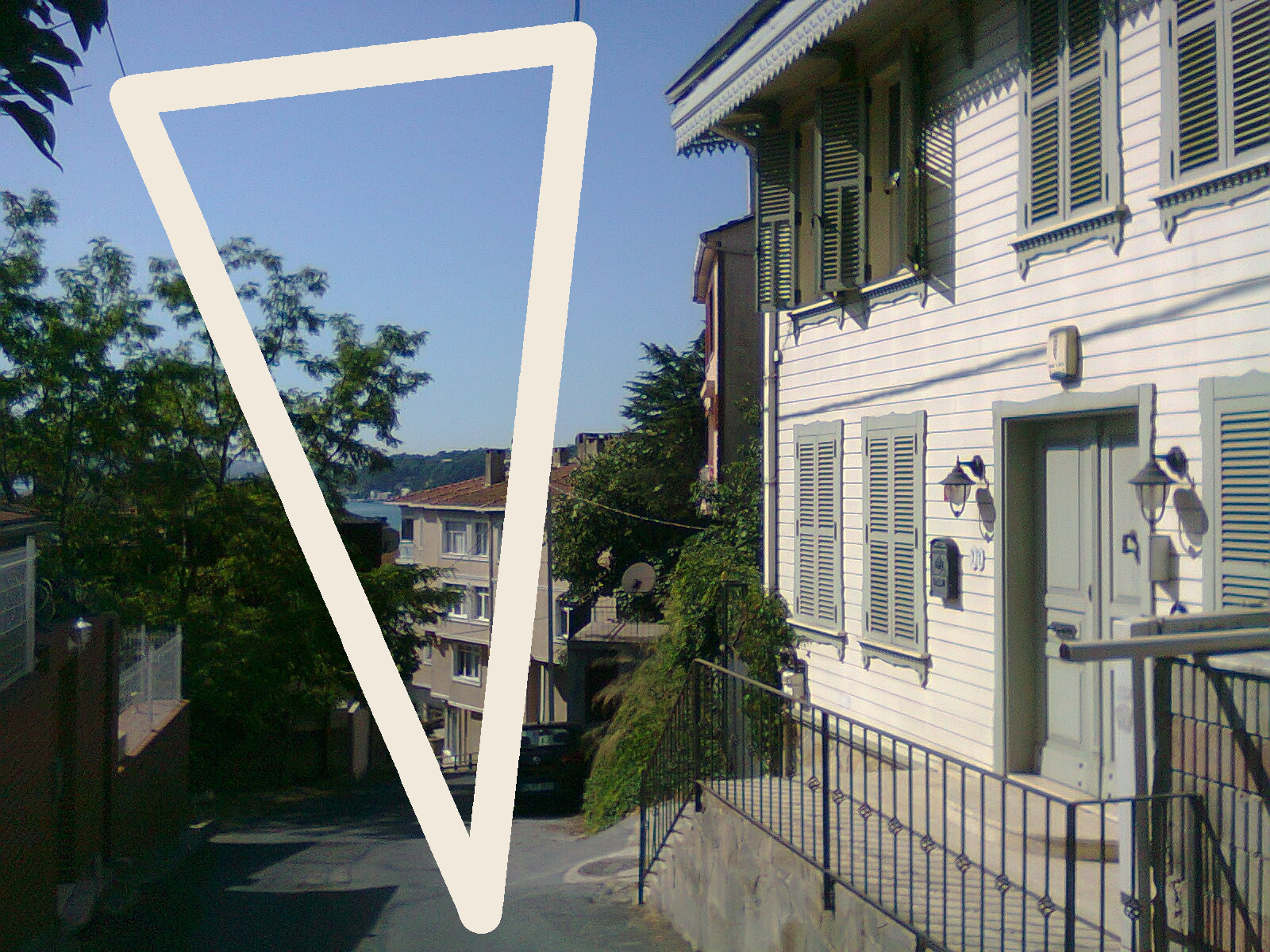
An isosceles triangle covers up the power lines above
Büyüktepe Sokağı, Büyükdere, Tuesday, July 2, 2024
One of Collingwood’s examples of doing history is understanding a proposition in Euclid’s Elements. The one that Collingwood chooses is that the base angles of an isosceles triangle are equal. In his commentary on Book I of the Elements, Proclus (who seems to have been from here in Constantinople) attributes the proposition to Thales of Miletus. As it appears in Euclid, the proposition is remarkable, perhaps less for the conclusion than for its detailed demonstration. Is not the conclusion just obvious? If a triangle has two equal sides, then we can interchange these by flipping the triangle over, and in this case, each base angle will coincide with the other one; thus those angles are equal to one another. Piece o’ cake, easy peasy. Euclid’s demonstration is not like that.

Another demonstration that Euclid could logically have made, but apparently did not make, is of the construction of a regular heptakaidecagon. I talked about this in the context of Aristotle in February. I put Gauss’s construction in Euclidean terms, as best I could, to try to figure out whether its discovery could have been made in the ordinary course of Greek mathematics. Did it rather require the “paradigm shift” created by Descartes’s Geometry of 1637?
Thomas Kuhn used the term paradigm, apparently,
to refer to a collection of procedures or ideas that instruct scientists, implicitly, what to believe and how to work. Most scientists never question the paradigm. They solve “puzzles,” problems whose solutions reinforce and extend the scope of the paradigm rather than challenging it. Kuhn called this “mopping up,” or “normal science.”
That account is by John Horgan, in a Scientific American blog post called “What Thomas Kuhn Really Thought about Scientific ‘Truth’” (May 23, 2012); this was shared with me recently by a fellow enthusiast of the work of Robert Pirsig. Meanwhile, Horgan’s interview with Tim Maudlin provoked me to write “On Gödel’s Incompleteness Theorem” in December, 2018.
My question now, in Kuhn’s terms, is whether the construction of a regular seventeen-sided polygon would have been normal science for the Greeks, a puzzle they could have solved if they had kept trying. Euclid knew for example that if a sum
1 + 2 + 4 + … + 2n−1
of consecutive powers of 2 is prime, then its product with the last of those powers is the sum of its own proper factors, and so by definition is perfect. This is the last proposition of the arithmetical books VII–IX of the Elements. The sum of those powers of 2 is
2n − 1,
namely the next power, less one. Might it have occurred to Euclid, or to Archimedes, or to Pappus, that if, instead, one more than the power, namely
2n + 1,
is prime, then the regular polygon with that number of sides is constructible? As a special case,
24 + 1 = 17;
in particular, 24, being 16, is less by 1 than 17. Consequently 28, or 162, is greater by 1 than a multiple of 17, and 212, or 163, is less by 1, and so on. Moreover, 62, namely 36, is greater by 2 than a multiple of 17, namely 34; and therefore 616, like 28, exceeds by 1 a multiple of 17. Not only that is true, but each number less than 17 is the remainder of a power of 6 when measured by 17:
| power of 6 | | | 6 | 62 | 63 | 64 | 65 | 66 | 67 | 68 |
| remainder | | | 6 | 2 | 12 | 4 | 7 | 8 | 14 | 16 |
| power of 6 | | | 69 | 610 | 611 | 612 | 613 | 614 | 615 | 616 |
| remainder | | | 11 | 15 | 5 | 13 | 10 | 9 | 3 | 1 |
Somehow this is why we can construct the regular heptakaidecagon.
Could the Greeks have made this connection between arithmetic and geometry? There is an idea that they could not have. Perhaps their mathematics was too polymorphic, in the sense of Collingwood in “The Existence of God,” which is one of the examples of actual metaphysics in An Essay on Metaphysics. Thales started the Greeks on the way to a monotheistic religion and thus a monomorphic science, but to get there, by Collingwood’s account, they needed a Jewish prophet and the theology developed from his teaching. Meanwhile, as far as I know, the unity that Thales had seen in the physical world could have been sought in mathematics as well.
For the record, the exchange with my student was in Turkish and happened on June 24:
Sayılar Kuramı sınavında ispat sorusu olacak mı?
Bence matematikte her sorunun cevabı bir ispattır çünkü herkes cevabın doğruluğunu kontrol edebilir.
The exam was on June 28. My aim in the course was to do as little as possible, but no less. This assertion might be belied by the list of topics on the course webpage and translated below. The particular list is not so important as
- learning something and
- knowing that one has learned.
The possibility of doing this is how Collingwood explains
- thinking somebody else’s exact thought while
- remaining oneself.
Thinking about something comes with the possibility of thinking that one is thinking, and if one re-enacts this thinking, this includes the thinking that oneself is doing it!
This kind of reasoning may explain a passage from the beginning of David A. Hollinger, “T. S. Kuhn’s Theory of Science and Its Implications for History” (The American Historical Review, April, 1973); I included more of this in my own commentaries on Collingwood:
a citation to Collingwood’s profound but forbidding “Epilegomena” enabled historians to perform an act of calm defiance: “we historians are on to something basic and complicated about human experience, which you can read about in Collingwood, and if you can’t understand what he says, well, that’s your problem.”
I get the idea that the historians did not really understand Collingwood either. Their job was to do history, not think about it.
For better or worse, how I teach mathematics is based on what I think about it (and not just on what is customary in the course in question).
Many students want just to learn algorithms. Number theory gives them an important one, the Euclidean Algorithm, and students learn this pretty well. Given counting numbers a and b, students can find the greatest common measure (or “divisor”), say m. I try to induce them to understand that they can check their work. First, they can check that m is one of the common measures of a and b. To check that it is greatest, they can use the computations of the Algorithm, in reverse, to solve one of the equations
ax − by = ±m.
If this all checks out, then the students have really done something, and they can know it. At least, this is my dream.
We can still use the Euclidean Algorithm, even if a and b are incommensurable. This means at least one of them is no longer a counting number. If d is a nonsquare counting number, and we let
(a, b) = (√d, 1),
then the Algorithm leads us to the discovery of infinitely many solutions to the Pell Equation,
x2 − dy2 = 1.
We get all solutions that way, and I proved this in Number Theory II in Ankara in the spring of 2008. Because I kept notes, I had an easier time doing a lot of the work again in the summer of 2018 in Şirince, in a course called “Continued Fractions.” Some of the work may be too much for Number Theory I; at least, I didn’t try do it this year. However, without knowing that the algorithm is generally effective, one can use it to solve the Pell Equation for any particular d, and one can know in this case that the algorithm has been successful, because one can prove one’s results by induction.
To attain such success, one does have to practice, and students tend not to do this. Apparently they did it in Şirince, according to my notes; but they were students who had chosen to do mathematics on their summer holiday. Perhaps it matters that they had suffered no Covid-19 infections, and TikTok was not so big yet.
Today, even students of musical instruments do not practice playing them, according to Rick Beato, who is three years older than I. He says in his recent video, “I Know You’re Angry, So Am I …,” at 4:35,
I called one of my friends who’s a music teacher to ask him, how many of your students only play during their lessons, meaning they never practice during the week, just play in their lesson, and he’s like, oh, that’s easy, 100%. And that pretty much goes for any of my kids’ friends’ parents. When I ask them that question, they tell me their kids don’t practice, they go to their lessons every week without ever having touched their instrument, and I know right now there are thousands of music teachers out there watching this that are going, Yeah, that’s pretty much all my students too.
The inevitable explanation is mobiles.
Why are they not learning instruments, and why is video game playing going down? Because it takes work, and they don’t want to put in the work, because it’s way easier just to open up their phone and put TikTok on or YouTube shorts or Instagram and swipe up …
Again, I might also ask about the direct and indirect effects of Covid-19, and of the state of the world in general.
When I was my students’ age, the world was under threat of nuclear war. It still is, perhaps even worse, but people may not think about it so much. Back then, I was annoyed to learn that Allan Bloom didn’t think we young people could really be worried about it.
This was in The Closing of the American Mind: How Higher Education Has Failed Democracy and Impoverished the Souls of Today’s Students, published in the year I graduated from college – and Bloom had been the commencement speaker. In the book (page 83), Bloom reported a conversation with a woman whose son
had a law degree, but, she said, he and his friends had little ambition and had moved from one thing to another. She did not seem to be very distressed by his behavior … So I asked her why she thought they behaved this way. She responded firmly, quietly and without hesitation, “Fear of nuclear war.”
This was at a faculty dinner at “an Ivy League college where I was a visiting professor,” and,
This prompted me to ask my group of students whether they were frightened of nuclear war. The response was a universal, somewhat embarrassed giggle. They knew what their daily thoughts were about, and those thoughts had hardly anything to do with public questions.
In a 2021 seminar on the Republic, I read mainly Bloom’s translation. According to Bloom’s teacher Leo Strauss, in his lectures delivered in 1959 On Plato’s Symposium (2001, page 1),
When we look at the present situation in the world, this side of the Iron Curtain, we see that there are two powers determining present-day thought. I call them positivism and historicism. The defect of these powers today compels us to look out for an alternative. This alternative seems to be supplied by Plato rather than anyone else.
I have the idea that Collingwood pointed out the complementary defects of positivism and historicism in ¶¶41–3 (distinguished by me as § IX) of “History as Re-enactment of Past Experience,” although Strauss himself thought Collingwood was too historicist. In any case, my question now for Strauss and Bloom is whether they believe the account of John Tzetzes of Constantinople, that Plato wrote over his doors,
Μηδεὶς ἀγεωμέτρητος εἰσίτω μου τὴν στέγην,
Let no one unversed in geometry come under my roof.
According to my source here, Ivor Thomas quâ editor of the Loeb volumes Selections Illustrating the History of Greek Mathematics,
Tzetzes … is not the best of authorities, so this charming story must be accepted with caution. The doors are presumably those of the Academy.
Should one pontificate on Plato without having undergone the years of mathematical training prescribed in the Republic?
Anyway, here is a translation of the list of topics of my recent number-theory course.
- Euclidean Algorithm
- in the counting numbers
- in the real numbers
- Lamé’s Teorem
- Foundations of number theory
- Congruence
- Primeness
- Arithmetic functions
- Quadratic residues
- Primitive roots
- Quadratic reciprocity
Quadratic reciprocity is important theoretically, and it supplies us with an algorithm for computing Legendre symbols (n/p), but unfortunately I do not know a good way to have students confirm that their computations have been successful. As for the foundations, they may not strictly be part of number theory itself. Most mathematicians may not understand them very well, and textbooks can get them wrong, as I discussed in “Induction and Recursion” (originally in the De Morgan Journal, 2012). To me, this is all the more reason to get the foundations right. I have decided that the counting numbers are best defined logically, not with the so-called Peano Axioms, but as constituting a well-ordered set that has
- at least one element, and therefore a least element, namely 1;
- no greatest element, so that for every element n, there is a least greater element or successor, n + 1;
- no element that is neither the least, nor a successor of some other element, so that proof by induction is possible.
It is still somewhat tedious to prove that definition by recursion of functions on the set is possible. Once one has this and has defined addition, multiplication, and exponentiation, there is a sort of algorithm for proving most of their basic properties by induction. The proofs are “real,” if only in the sense that they can go astray. If for example you are going to prove distributivity of multiplication over addition, do you prove
x ⋅ (y + z) = x ⋅ y + x ⋅ z
or
(x + y) ⋅ z = x ⋅ z + y ⋅ z,
and which variable do you use for the induction? Taking up such questions, one may understand that one is indeed dealing with the third of the four parts of the Divided Line.
Edited and augmented, July 5, 2024.
Edited again, slightly, July 9.
 Polytropy
7 Trackbacks
[…] « Rethinking […]
[…] wrote about my number-theory class of last spring in “Rethinking.” One student earned no credit from an exam problem, although he thought he knew how to do it. […]
[…] for Thomas Kuhn (1922–96), he has come up in other posts, such as “Rethinking” (July, 2024), but again only in quotations about him, since I have not spent much time with his […]
[…] Heptakaidecagon construction (mentioned in “Rethinking” […]
[…] wherever it comes from. We have to be able to know that we have learned: that’s what I said in “Rethinking,” having been studying Collingwood’s “History as Re-enactment of Past Experience” (1936; […]
[…] same string with Google gave me what I wanted (and nothing else): “Rethinking,” which I wrote only last summer […]
[…] Line, although there is a fourth part, addressed by dialectic. That’s fine, but as I asked in “Rethinking,” Does Strauss think he can get to dialectic without actually doing […]