The son of the king of Persia wants to press the advantage, after the combined forces of Media, Persia, Armenia, and Chaldaea have
- killed the Assyrian king, along with most of his best men, and
- driven the rest of the Assyrian army from their fortifications.
The king of Media is of another mind: he would rather quit while he is ahead. He has an argument for standing pat, by the account of Xenophon in the Cyropaedia (IV.i.11–18).
One may consider the argument of Cyaxares as an example of “motivated reasoning.” I think it is a specious argument: attractive, but ultimately unsound. Perhaps I say that, only because the king’s nephew Cyrus rejects the argument, but is nonetheless successful in what he goes on to do. With his Persian troops and as many Medians as wish to join them, along with the Hyrcanians, who have defected from Assyria, Cyrus pursues and defeats again the Assyrian army. He kills the kings of Cappadocia and Arabia, and he puts to flight both the king of Phrygia and Croesus, king of Lydia (IV.ii.28–31). Of course, this is not the end of the story; history never ends.
I have been reading and discussing the eight books of the Cyropaedia with a Catherine Project group, at the rate of half a book a week, since July 8 of this year (2024). Thus we shall have completed the sixth book (called “On the Eve of the Great Battle” in the Loeb edition) on September 23. It has astonished me that some of my fellow readers think well of the argument for taking it easy, even as they acknowledge that the man who makes it may be a fool. The argument does not seem to me like one that a king such as Cyaxares can afford to make.
Possibly Xenophon has an esoteric message, as Plato is thought to have. However, although these two writers had a common teacher in Socrates, he never went far from Athens. Xenophon helped lead a stranded army of ten thousand Greek mercenaries, from Babylon north to the Black Sea, after the failure of the coup for which they had been hired by Cyrus the Younger. Xenophon admires a practical man who can actually get things done. This being what Cyrus the Elder is, he is the hero of the Cyropaedia. I shall review my textual reasons for saying this. First I shall look at “motivated reasoning” today, along with the idea that we could have “evolved” to use it. (In short, the rest of this post has the three parts just linked to.)

Photo taken September 17, 2024, of Lesbos over the sea, from a beach in Lydia. Of this country, Chrysantas says to Cyrus, after the latter has pursued the Assyrians over the objections of his uncle Cyaxares (Cyropaedia VI.ii.21),
since it now appears that Syria is not to be the only prize – though there is much to be got in Syria, flocks and herds and corn and palm-trees yielding fruit – but Lydia as well, Lydia the land of wine and oil and fig-trees, Lydia, to whose shores the sea brings more good things than eyes can feast on, I say that once we realise this we can mope no longer, our spirits will rise apace, and we shall hasten to lay our hands on the Lydian wealth without delay.
This is in response to the suggestion of Cyrus that his army are intimidated by the alliance that Assyria has formed with Lydia.
Reason
All reasoning is motivated reasoning. I wrote that here, in the last year of the infamous administration of an American President who now wants another chance. I was making an addition to my 2017 post on the “Reason” chapter of Collingwood’s New Leviathan. I said it again in “Mathematics and Logic,” October, 2020: all reasoning is motivated reasoning, because we engage in it for a reason.
I was responding each time to a different essay in the Guardian Weekly. According to one of them, by Tim Harford,
Motivated reasoning is thinking through a topic with the aim, conscious or unconscious, of reaching a particular kind of conclusion.
Why else would you think through a topic? Contemplating the rotting wood in the roof over the porch where I am writing now, my wife and I aimed to reach a conclusion about whether and how to have the wood replaced. Is that an example of “motivated reasoning”? If not, or not necessarily, would it be, if we
- wanted to conclude that no action was needed?
- did conclude that no action was needed?
In fact we did not so conclude, but we have a contractor on the job.

September 19, 2024
Oliver Burkeman begins his own Guardian essay with the following list of beliefs (bulleted by me) that the reader is expected to count as errors; but then Burkeman mentions a single mistake:
One of the most obvious truths about the modern world is that a whole lot of people believe a whole lot of nonsense – about
- climate change not being real,
- Brexit being a sensible idea,
- gun ownership helping reduce crime,
and so on. By contrast, one of the hardest truths to accept is that you – you, of all people! – are just as susceptible, in principle, to the very same mistake.
What is the “mistake,” in the singular? I am not sure that the sequel explains (again, the bullets are mine):
That’s the gist of years of research into “motivated reasoning”: across the political spectrum, we use reason not simply to get at the facts, but for all sorts of ulterior motives, such as
- persuading others of our opinions,
- feeling a sense of belonging to our tribe, or
- reducing the sense of mismatch between our beliefs and reality.
What’s the problem? Using reason for an ulterior purpose is not a mistake, but an inevitability. There is always an infinity of facts to work on. To work on some particular facts, at the expense of others, we need an ulterior or further reason, beyond the facts themselves. Thinking otherwise: that would be a mistake. This could be Burkeman’s point, except he says,
people judge the seriousness of a social problem, it’s been found, partly based on how appetising or displeasing they find the proposed solution. Obviously, that’s illogical: the fact that you might hate paying more tax to keep the NHS afloat has no bearing on whether or not the NHS is in crisis.
It depends on what is meant by “crisis.” If you are British, then how you feel about paying taxes does bear on what should be done about the NHS. Nobody’s judgment is illogical, unless they agree that it is. In that case, they will show their agreement by changing their judgment.
This is what I say, as a professional mathematician whose specialty is logic. At the same time, I may mark down students for failures in logic, as in the example in the preamble of my last post, “On The Human Condition of Hannah Arendt.” The logic of mathematics is universal, and learning mathematics means coming to understand this, at least implicitly.
Not all of life is like mathematics though. The wood that holds up the tiles of the roof above me is rotting, only on the side where fallen pine needles build up. However, the whole roof lacks a waterproof membrane between the wood and the tiles. I couldn’t believe this, but that’s the way the roof was made, about twenty years ago.
If the roof had been kept clear of pine needles and other debris, then water from winter rains might not have sat on the tiles long enough to soak through, and the wood supporting the tiles might have remained sound. Indeed, the part of the roof that is sound now has no pine needles on it. I pointed this out to the contractor, when we were looking down on the roof from the terrace above.
The usta was not interested. He did not question what he must have learned from his father, that a roof always needs an underlayment. That’s fine, and the part of the roof that the usta will be working on certainly does need it.
The man did also suggest trimming the branches that hung low over the roof, and we have now had this done.
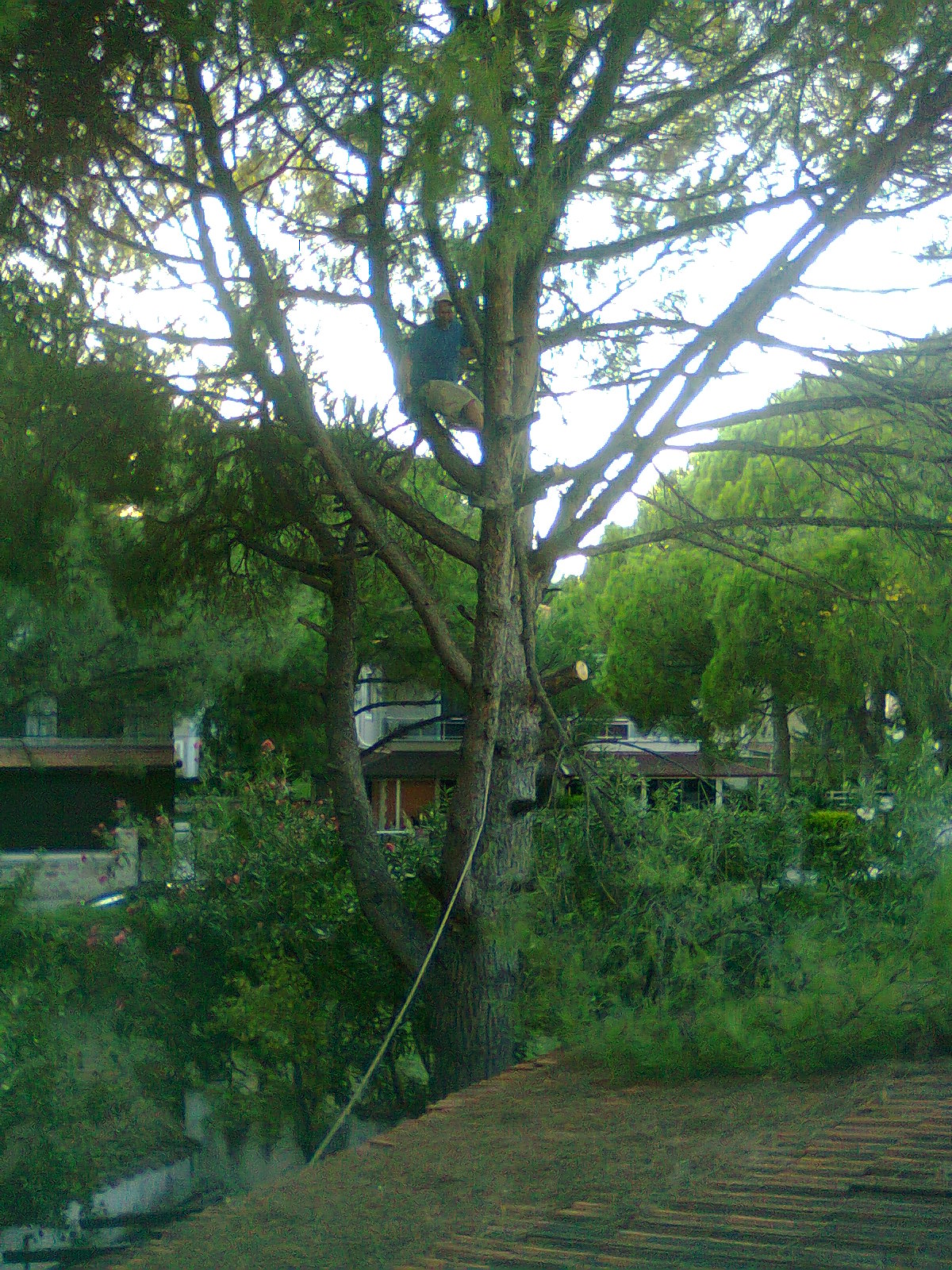
Tree trimming, September 17, 2024. The man way up in the tree with a chainsaw wore no safety harness. I was always disappointed that the trimmed branches of the umbrella pines of our cité had not been cut off at the trunk. If they had been, then bark might have grown over the cuts. Now I see that the stumps of the branches serve as steps for reaching the next branches.
I was looking at Oliver Burkeman’s article, “What problem?’ When tricky solutions prompt an easy answer.” After mentioning putatively “illogical” reasoning about the NHS, the author continues:
But that’s how people reason: show Americans who support gun control an article suggesting that looser gun laws would help deter violent burglaries, and they’ll judge violent burglary less of a problem than if they’re told tighter laws are the answer.
That is all perfectly natural, and indeed, this seems to be Burkeman’s ultimate point. However, he has backed up his argument by referring to an essay in The Washington Post, according to which, when people in a study were asked to analyze data about gun control,
the participants’ political views significantly affected how they interpreted the results. Democratic participants were more likely to correctly interpret the results when the data showed the gun ban decreased crime, and Republican participants were more likely to correctly interpret the results when the data showed the gun ban increased crime. People’s political preferences biased their view of the evidence.
So writes Jen Zamzow in “Why we can’t agree on gun control.” Myself, I don’t think Zamzow should be presuming to know the “correct” interpretation of the data. The question is not why other people are wrong, but why we don’t agree with them now.
I got hold of the study in question (it was behind a paywall, so I used the doi with sci-hub):
KAHAN DM, PETERS E, DAWSON EC, SLOVIC P. Motivated numeracy and enlightened self-government. Behavioural Public Policy. 2017; 1(1):54–86.
doi:10.1017/bpp.2016.2
As far as I can tell, the researchers paid YouGov to administer a study of “a nationally diverse sample of 1111 US adults.” Each subject was given four numbers, which I would tabulate as follows:
| positive | negative | |
|---|---|---|
| X is done: | 223 | 75 |
| X is not done: | 107 | 21 |
For the “correct” interpretation of the numbers, one is supposed to compare the ratios of positive to negative results. These ratios are about three-to-one and five-to-one respectively. Thus not doing X is supposed to be better than doing it, if you want a positive result.
You might want a negative result, as in a test for disease. You might want something more complicated, not reflected in the numbers (it is not clear to me whether neutral results were possible). In the study itself, each subject was given just one of four scenarios for the matrix of numbers:
| X | positive result | |
|---|---|---|
| A. | applying a cream; | a rash got worse. |
| B. | applying a cream; | a rash got better. |
| C. | banning concealed handguns in a city; | crime went up. |
| D. | banning concealed handguns in a city; | crime went down. |
Subjects tended to give the “correct” interpretation with the skin cream. With gun control, the interpretation varied, in a way that corroborated the “identity-protective cognition thesis (ICT),” which
sees a particular recurring form of group conflict as disabling the capacities that individuals have to make sense of decision-relevant science.
There are times when I would seem to have a “disabled capacity,” as when I cannot think of somebody’s name; or perhaps I am sitting outside before dawn, and the temperature is closer to 15 Celsius than 20, and I want to wear the cotton scarf that I brought here to the cottage, but I cannot find it, even though I look in one of the places where it will turn out to have been.
On the other hand, if I have agreed online to answer some questions from people whom I have not met, and whom I am not going to meet, then I may not give my highest priority to figuring out answers that they think are correct. I don’t think this would mean I was “disabled” by my prejudices.
There may be a good account of the situation in the article by Tim Harford already mentioned (it is from his book, How to Make the World Add Up, published in North America as The Data Detective):
In the case of climate change, there is an objective truth, even if we are unable to discern it with perfect certainty. But as you are one individual among nearly 8 billion on the planet, the environmental consequences of what you happen to think are irrelevant. With a handful of exceptions – say, if you’re the president of China – climate change is going to take its course regardless of what you say or do. From a self-centred point of view, the practical cost of being wrong is close to zero. The social consequences of your beliefs, however, are real and immediate.
I would still observe that “social consequences” are not the same kind of thing as the physical consequences of climate change or anything else. The latter are studied by empirical science; the former, criteriological. Collingwood made the distinction, and I took it up in “A New Kind of Science.” Unfortunately Collingwood’s work does not seem to be well understood, if it is known at all; one relevant post where I looked at this is “On Causation.”
Evolution
As for the question of whether to affirm or reject a scientific finding, why do “social consequences” matter? Harford says,
So perhaps it is not so surprising after all to find educated Americans poles apart on the topic of climate change. Hundreds of thousands of years of human evolution have wired us to care deeply about fitting in with those around us.
This makes as much sense as saying God made us that way. Either account makes perfect sense, if you are predisposed to accept it.
Our species Homo sapiens seems to have existed for hundreds of thousands of years, so I am not sure what Harford means by its evolution. As far as I understand Darwin’s theory of evolution, it has three requirements:
- Random variation in the features of an organism.
- Selection of some of these features, either
- naturally, by the environment, or
- sexually, by the organism itself in choosing a mate.
(I have taken up selection in “Words,” “More on Dialectic,” and “Eudemony.”)
- Reproduction of the selected features in one’s offspring.
The third requirement is in tension or conflict with the first. Parents must usually pass on their traits to their children, but the children must sometimes exhibit new traits, never found before.
It is fundamental to the theory that these new traits have no explanation. Their initial coming into existence is not to be explained by their usefulness, if they even are useful; for the most part, they are not.
Sometimes indeed we must accept that there is no explanation for something. An example may be the first assassination attempt on the American Presidential candidate mentioned earlier. (The reason for the second attempt may become clearer, with the help of such reports as by Malcolm Nance.)
Each step on the way to opposable thumbs was based on a random, inexplicable event; but the continuation along those steps is somehow explained by the usefulness of the result.
The way our five fingers come together at a point: an intelligent designer could have ensured this. I suppose this is why we may be interested in how we “really” got the ability to pick raspberries in the first place.
Our liability to backache is of interest because it could be due to a malicious designer.
In short, the theory of evolution makes sense, in the light of our independent notion of the good. The heights of the stacks of beads in the bins of a Galton board make sense mathematically, and one can predict what they are going to be, even though they are due to random variation. However, I don’t suppose extraterrestrials could have visited earth a billion years ago and figured out what it was going to look like today.
If they did figure it out, how could they prove that they had done so, without actually waiting a billion years? In this regard, I note an interesting passage in yet another Guardian Weekly article, “He knew this would happen,” by Stuart Jeffries (GW Vol. 207, No. 16, 14 October 2022, page 55):
Perhaps Nostradamus didn’t predict the king’s death so much as make it look to future readers as if he had. That is not to suggest that Nostradamus was a charlatan, but something more interesting. “The point of prophecy is not to give you tipoffs about share-price fluctuations but to be able after the event to affirm that they were foreseen,” argues Steven Connor, professor of English at Cambridge University, “Prophecy is only ever retroactively potent, or by the kind of anticipated retrospection that we could call ‘posticipation’, which always means knowing too late what you might have known in advance.”
Even if he didn’t know Darwin (1809–82), I agree with Kant (1724–1804), who wrote in the Critique of Judgement (in the translation of Meredith, revised by Walker),
It is, I mean, quite certain that we can never get a sufficient knowledge of organized beings and their inner possibility, much less get an explanation of them, by looking merely to mechanical principles of nature. Indeed, so certain is it, that we may confidently assert that it is absurd for human beings even to entertain any thought of so doing or to hope that maybe another Newton may some day arise, to make intelligible to us even the genesis of but a blade of grass from natural laws that no design has ordered. Such insight we must absolutely deny to mankind.
A zoologist friend once alluded to this passage as if it were obviously wrong. Maybe he thought Darwin was the other Newton. The zoologist’s standards for the intelligibility of the genesis of something, be it a blade of grass or ourselves: they might be as mine were, when Jehovah’s Witnesses came to my door, asking about how I thought we had got here, and I said we had evolved. Today I would ask them whether they had ever created anything.
Cyrus
The parentage of Cyrus is told by Xenophon as hearsay:
The father of Cyrus, so runs the story, was Cambyses, a king of the Persians, and one of the Perseidae, who look to Perseus as the founder of their race. His mother, it is agreed, was Mandane, the daughter of Astyages, king of the Medes.
This is at the head of chapter ii of Book I of the Cyropaedia. This title is a Latin transliteration of ΚΥΡΟΥ ΠΑΙΔΕΙΑ, which is also translated as The Education of Cyrus. The title could also be referring to an education by Cyrus. Does the work tell us about how Cyrus is educated, or how he educates others, and ultimately us?
The Cyropaedia consists of eight books, and in the first we see Cyrus grow up in both Media and Persia. Before that, in chapter i, Xenophon gives us a preview. Herds of animals never conspire against their keeper, but humans do, against their ruler – unless that ruler is somebody like Cyrus (I.i.3):
here is a man, we said, who won for himself obedience from thousands of his fellows, from cities and tribes innumerable: we must ask ourselves whether the government of men is after all an impossible or even a difficult task, provided one set about it in the right way.
Apparently dating to the 1890s, the translation that I am cutting and pasting from is by Henry Graham Dakyns, revised By F. M. Stawell, “Produced by John Bickers, Dagny, and David Widger” for Project Gutenberg.
I have been reading the 1914 translation by Walter Miller in the Loeb Classical Library. I first read it after a tour of Iran in 2012 that included a visit to the (supposed) tomb of Cyrus.
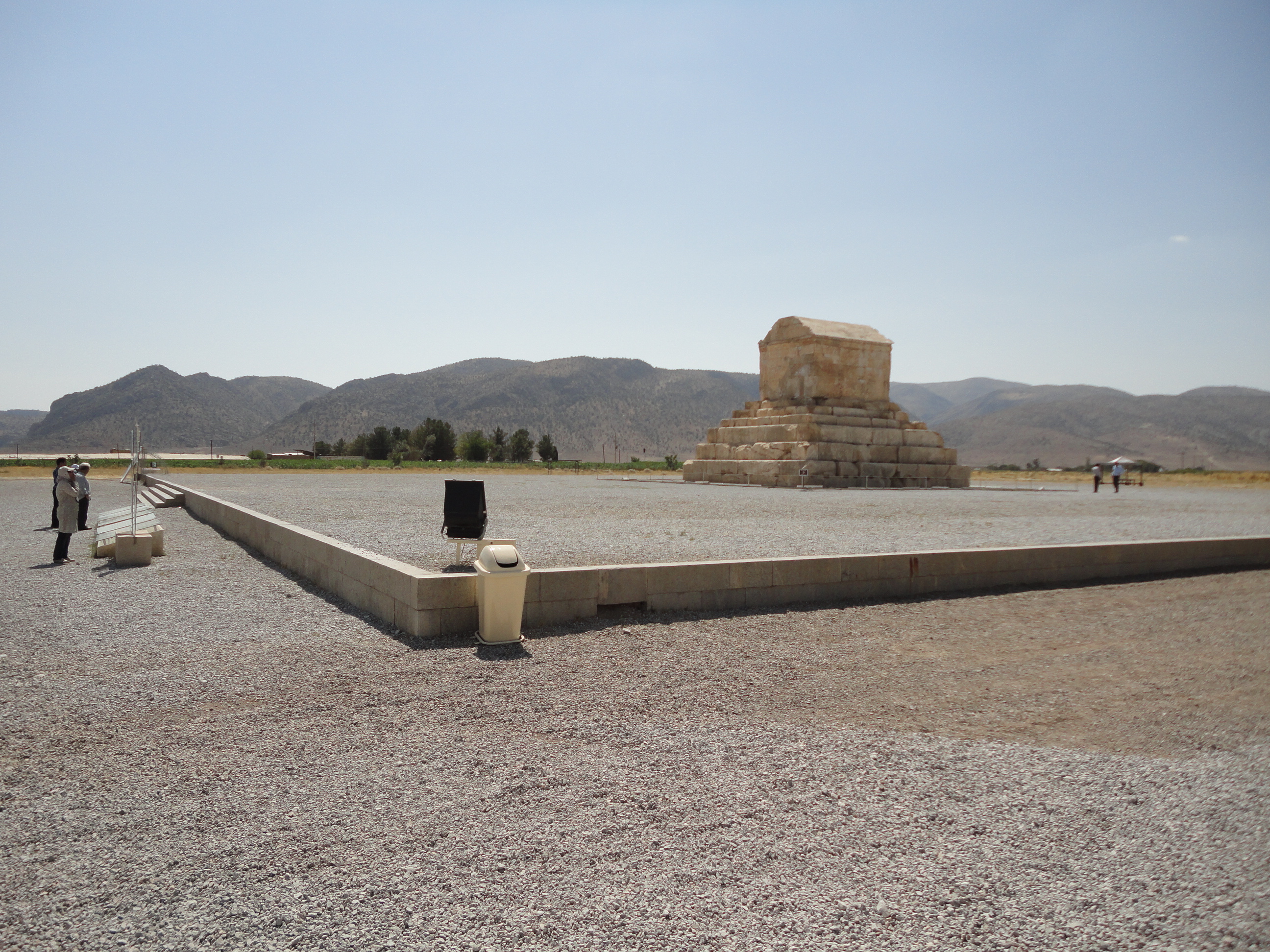
Tomb of Cyrus, September 4, 2012
I have written about the Iran tour elsewhere. The simple tomb was at a place called Pasargad, which was a long drive from Persepolis. This palace complex of Darius the Great was in turn some ways from Shiraz, where we were staying, but I thought it worth the price of admission to see the pride of Iranians in the splendor of their forefather Darius. He had taken over the Persian Empire from Cyrus’s successor (either a son or an imposter).

Tomb of Cyrus, September 4, 2012
At Pasargad, our tour guide praised the temperance of Cyrus. Back home in Istanbul, when I read the Cyropaedia, I noted Cyrus’s own account of this temperance – it may be a virtue, but it is not its own reward (I.v.8–9):
I have long felt sure that our forefathers were in their time as good men as we. For their lives were one long effort towards the self-same deeds of valour as are held in honour now; and still, for all their worth, I fail to see what good they gained either for the state or for themselves. Yet I cannot bring myself to believe that there is a single virtue practised among mankind merely in order that the brave and good should fare no better than the base ones of the earth. Men do not forego the pleasures of the moment to say good-bye to all joy for evermore – no, this self-control is a training, so that we may reap the fruits of a larger joy in the time to come.
This account would seem to be inadequate. There are things we do for their own sakes, and they still may turn out to be virtues. One may also learn to practice virtue for its own sake.
In chapter v of Book I, having succeeded Astyages as king of Media, Cyaxares asks Cyrus to come from Persia to help him, because an attack on Media is being planned by the king of Assyria.
This king is unnamed, but we have already seen his son invade Media to hunt game for his wedding feast. The groom was going to stay on his side of the border, until he realized that
- his own men;
- the border garrison;
- their replacements, just arrived;
– all were at his disposal. Thus he could attempt an incursion into Media.
When Astyages and his son go to investigate the incursion, Cyrus dons his armor for the first time. He is fifteen or 16, but he suggests an attack on the hunting party, and his grandfather agrees.
Astyages sends Cyaxares out into the field, but Cyrus rides out after him and soon takes the lead; his uncle can only follow (I.iv.21–2).
But when the Assyrian army saw their friends in trouble they pushed forward, rank on rank, saying to themselves the pursuit would stop when their own movement was seen. But Cyrus never slackened his pace a whit: in a transport of joy he called on his uncle by name as he pressed forward, hanging hot-foot on the fugitives, while Cyaxares still clung to his heels, thinking maybe what his father Astyages would say if he hung back.
I imitate Cyrus, it would seem, when street dogs in Istanbul block my way. I run at them, and they scatter. (I learned to do this from another American in Ankara.)
Cambyses summons Cyrus back to Persia to complete his education there (I.iv.25–28). Meanwhile, in Media, Astyages dies and is succeeded by Cyaxares (I.v.2).
The king of Assyria has been subjugating Syria, Hyrcania, and Bactria. Setting his sights now on Media, he has invited others to join him, including King Croesus of Lydia, where I am on holiday now. Somehow Cyaxares learns of the Assyrian plans and asks
- Cambyses to send troops,
- Cyrus to lead them.
The Persian ruler and his son agree. Cyrus speaks to his men as above about how virtue must be practical. Cambyses has advice for his son, including that the gods help those who help themselves (I.vi.5–6, list formatting mine):
- Cambyses
And do you remember certain other conclusions on which we were agreed? How we felt there were certain things that the gods had permitted us to attain through learning and study and training? The accomplishment of these is the reward
- of effort,
- not of idleness;
in these it is only when we have done all that it is our duty to do that we are justified in asking for blessings from the gods.
- Cyrus
I remember very well that you used to talk to me in that way: and indeed I could not but agree with the arguments you gave. You used to say that a man had no right to
- pray he might win a cavalry charge if he had never learnt how to ride, or
- triumph over master-bowmen if he could not draw a bow, or
- bring a ship safe home to harbour if he did not know how to steer, or
- be rewarded with a plenteous harvest if he had not so much as sown grain into the ground, or
- come home safe from battle if he took no precautions whatsoever …
Such thinking may explain the specificity of people’s prayers, as in the Iliad. In Book VI for example, Theano prays Athena, not that the whole Greek effort collapse, but only that the spear of Diomedes break; and even this will turn out to have been too much to ask.
Perhaps the greatest lesson of Cambyses is to find one’s own way (I.vi.38):
you must not confine yourself to the lessons you have learnt; you must show yourself a creator and discoverer, you must invent stratagems against the foe; just as a real musician is not content with the mere elements of his art, but sets himself to compose new themes. And if in music it is the novel melody, the flower-like freshness, that wins popularity, still more in military matters it is the newest contrivance that stands the highest, for the simple reason that such will give you the best chance of outwitting your opponent.
For the passage that has been bolded (by me, as elsewhere), Miller has,
yourself also be an inventor of stratagems against the enemy,
which follows the Greek more literally:
αὐτὸν ποιητὴν εἶναι τῶν πρὸς τοὺς πολεμίους μηχανημάτων.
Etymologically speaking, Cambyses is telling Cyrus to be a poet (ποιητής).
Cyrus tries to pass on this teaching to his own men. I see a corollary in what Collingwood observes in An Autobiography (chapter IX, “The Foundations of the Future,” pages 102–3):
there are situations which, for one reason or another, can be handled without appeal to any ready-made rules at all, so long as you have insight into them. All you need in such cases is to see what the situation is, and you can then extemporize a way of dealing with it which will prove satisfactory.
I review now passages of the Cyropaedia that suggest things like this to me, up to the part where Cyaxares does not want to pursue the fleeing Assyrians. First of all, we have the plans of Cyrus for a new model army.
Cambyses sends his son off to Media. By numbers, the combined forces of Media and Persia are no match for the Assyrians. Bringing even more troops from Persia would not change this. In fighting at long range, with missiles, numbers alone determine the outcome (II.i.8); therefore, concludes Cyrus, the Persians should plan on fighting hand to hand.
He asks Cyaxares to arm the common Persian soldiers to the level of the peers. Raising the level of courage of the commoners will the job of the peers themselves, to whom Cyrus says (II.i.11),
to-day you are here, and your men behind you, stalwart and stout of limb, and to-morrow they shall have armour like our own. None could find fault with their thews and sinews, and as for their spirit, it is for us to see it does not fail. A leader must not only have a stout heart himself; he must see to it that his followers are as valiant as he.
Cyrus talks to the commoners about the arbitrariness of the former class distinction (II.i.15):
Men of Persia, born and bred in the same land as ourselves, whose limbs are as stout and as strong as our own, your hearts should be as brave. I know they are; and yet at home in the land of our fathers you did not share our rights; not that we drove you out ourselves, but you were banished by the compulsion that lay upon you to find your livelihood for yourselves. Now from this day forward, with heaven’s help, it shall be my care to provide it for you; and now, if so you will, you have it in your power to take the armour that we wear ourselves, face the same perils and win the same honours, if so be you make any glorious deed your own.
Later he warns the peers about men who are not only lazy, but acquisitive (II.ii.25):
It is true there are degrees, and where the evil springs only from sloth and lethargy, I look on the creatures as mere drones, only injuring the hive by what they cost: but there are others, backward in toil and forward in greed, and these are the captains in villainy: for not seldom can they show that rascality has its advantages. Such as they must be removed, cut out from among us, root and branch.
Again, Miller seems more literal with the emphasized passage:
But those who are poor companions in toil,
and also extravagant and shameless in their desire for any advantage,
these are likely also to lead others to what is vicious.οἳ δ᾽ ἂν τῶν μὲν πόνων κακοὶ ὦσι κοινωνοί,
πρὸς δὲ τὸ πλεονεκτεῖν σφοδροὶ καὶ ἀναίσχυντοι,
οὗτοι καὶ ἡγεμονικοί εἰσι πρὸς τὰ πονηρά.
When such men are weeded out, their replacements must be chosen for the right reasons (II.ii.26):
And I would not have you fill their places from our fellow-citizens alone, but, just as you choose your horses from the best stocks, wherever you find them, not limiting yourselves to the national breed, so you have all mankind before you, and you should choose those, and those only, who will increase your power and add to your honour.
What Xenophon has Cyrus say reflects teachings of Socrates that Plato puts in the Republic. I hear also in Xenophon’s Cyrus an echo of a story in Taoist Teachings, “translated from the Book of Lieh-Tzü, with Introduction and Notes by Lionel Giles,” 1912. J. D. Salinger has Seymour Glass read this story to his ten-month-old sister Franny, near the beginning of “Raise High the Roof Beam, Carpenters.” The person who can recognize the really good cannot even tell whether it satisfies a checklist of conditions, such as class and nationality:
Duke Mu of Ch’in said to Po Lo: “You are now advanced in years. Is there any member of your family whom I could employ to look for horses in your stead?”
Po Lo replied: “A good horse can be picked out by its general build and appearance. But the superlative horse – one that raises no dust and leaves no tracks – is something evanescent and fleeting, elusive as thin air. The talent of my sons lies on a lower plane altogether: they can tell a good horse when they see one, but they cannot tell a superlative horse. I have a friend, however, one Chiu-fang Kao, a hawker of fuel and vegetables, who in things appertaining to horses is nowise my inferior. Pray see him.”
Duke Mu did so, and subsequently despatched him on the quest for a steed. Three months later, he returned with the news that he had found one.
“It is now in Sha-ch’iu,” he added.
“What kind of a horse is it?” asked the Duke.
“Oh, it is a dun-coloured mare,” was the reply.
However, on some one being sent to fetch it, the animal turned out to be a coal-black stallion! Much displeased, the Duke sent for Po Lo.
“That friend of yours,” he said, “whom I commissioned to look for a horse, has made a nice mess of it. Why, he cannot even distinguish a beast’s colour or sex! What on earth can he know about horses?”
Po Lo heaved a sigh of satisfaction.
“Has he really got as far as that?” he cried. “Ah, then he is worth a thousand of me put together. There is no comparison between us. What Kao keeps in view is the spiritual mechanism. In making sure of the essential, he forgets the homely details; intent on the inward qualities, he loses sight of the external. He sees what he wants to see, and not what he does not want to see. He looks at the things he ought to look at, and neglects those that need not be looked at. So clever a judge of horses is Kao, that he has it in him to judge something better than horses.”
When the horse arrived, it turned out indeed to be a superlative horse.
That story is typeset as a quotation in Salinger’s own story. My post “Romance” concerns, among other things, a story of that name by Maugham, who turns out to have copied his opening from the article on Chang Ch’ien in A Chinese Biographical Dictionary, by Herbert Giles, who is the father of Lionel.
Let us return to Cyrus, who tells his soldiers to take individual responsibility for their fate (II.iii.3):
wherever those who have joined together for war remember that unless each and every one of them play his part with zeal nothing good can follow; there we may look for glorious success. For there nothing that ought to be done will be left undone. But if each man thinks ‘My neighbour will toil and fight, even though my own heart should fail and my own arm fall slack,’ then, believe me, disaster is at the door for each and all alike, and no man shall escape.
Seeking funds to prepare for a fight against Assyria, Cyrus returns Armenia to vassalage under Media. He also makes peace between Armenia and the neighboring country called Chaldaea. The result could go into a basic textbook of economics, to explain the benefits of free trade: the Chaldaeans will be able to plant crops in Armenia; the Armenians, to graze their herds in Chaldaea.
The Armenians, at least, are so grateful, the queen offers special gifts. In seeming anticipation of the Parable of the Talents, Cyrus refuses (III.iii.3):
Nay, you must not make me a mercenary and a benefactor for pay; take this treasure back and hie you home, but do not give it to your lord that he may bury it again; spend it on your son, and send him forth gloriously equipped for war, and with the residue buy yourself and for your husband and your children such precious things as shall endure, and bring joy and beauty into all your days. As for burying, let us only bury our bodies on the day when each must die.
As I recall being told by a friend who earned an MBA, it is probably a good thing, economically speaking, that most of the gold that was ever buried in tombs got looted, well before today’s archaeologists could find it.
Augmented with Armenian and Chaldaean troops, the Median and Persian forces approach the Assyrians to within a parasang. Cyrus reminds the Persian peers of their duty (III.iii):
- Our new comrades, the men we desire to make our peers – it may be well to remind them of the terms on which Cyaxares has kept us and of our daily discipline, the goal for which we asked their help, and the race in which they promised to be our friendly rivals.
- Remind them also that this day will test the worth of every man. With learners late in life, we cannot wonder if now and then a prompter should be needed: it is much to be thankful for if they show themselves good men and true with the help of a reminder.
- Moreover, while you help them you will be putting your own powers to the test. He who can give another strength at such a crisis may well have confidence in his own, whereas one who keeps his ideal to himself and is content with that, ought to remember that he is only half a man.
- There is another reason, why I do not speak to them myself, but ask you to do so. I want them to try to please you: you are nearer to them than I, each of you to the men of his own division: and be well assured that if you show yourselves stout-hearted you will be teaching them courage, and others too, by deeds as well as words.
When our reading group had reached the middle of Book VI, one person suggested something like this, that Cyrus sought a direct connection with the troops, disregarding the intermediate officers. Perhaps I did not understand the interlocutor, but § 39 in the quotation above would seem to contradict the point that I have tried to describe.
Cyaxares has agreed with Cyrus’s proposal to approach the Assyrians. He even wants to go right up to their camp, until Cyrus explains why it would be a bad idea. The main reason, as I understand it, is that the enemy should be allowed to stew in the fear that comes from uncertainty.
When some of the Assyrians are outside their fortifications, Cyaxares wants to attack them – bad idea, says Cyrus, since the rest of the Assyrians would have to be dealt with later.
Eventually, but still reluctantly, Cyrus agrees to attack. When his men are about to enter the Assyrian encampment, he orders a retreat, lest they get trapped – like Asius, I would say, who will not leave his horses behind when he enters the Achaean fortifications in Book XII of the Iliad; as a result, he pays with his death in Book XIII. I cannot say that Homer’s epic is on the mind of Cyrus or Xenophon now, but the latter will tell us later (VI.i.27), of the former,
The old Trojan type of charioteering, still in use to this day among the Cyrenaeans, he abolished; before his time the Medes, the Syrians, the Arabians, and all Asiatics generally, used their chariots in the same way as the Cyrenaeans do now.
Meanwhile, Cyrus still keeps his troops just outside the enemy camp, in case the Assyrians will come out to fight. When they don’t, he goes back to camp, where he tells his men (IV.i.5),
Never let slip the lesson of this day’s encounter, and judge for yourselves whether it is cowardice or courage that saves a man in war, whether the fighters or the shirkers have the better chance, and what the joy is that victory can yield. To-day of all days you can decide, for you have made the trial and the result is fresh.
The Assyrians flee in the night from their fortified position. In that case, asks Cyrus, how much more timidly would they fight in the open? Somebody suggests pursuing them, but that would require horses, which are what Cyaxares has.
Now Cyaxares felt, no doubt, a certain jealousy that the Persians should be the first to broach the matter, but he may also have felt that it was really wiser to run no further risks for the present; he had, moreover, abandoned himself to feasting and merrymaking, and he saw that most of his Medes were in like case.
So Xenophon tells us (IV.i.13). In like manner, C. S. Lewis tells us about an act that may or may not be cowardly, performed by the first title character of The Horse and His Boy.
Perhaps Xenophon does leave it to us to decide whether Cyaxares is using “motivated reasoning” to argue (IV.i.14),
My good nephew, I have always heard and always seen that you Persians of all men think it your duty never to be insatiate in the pursuit of any pleasure; and I myself believe that the greater the joy the more important is self-restraint. Now what greater joy could there be than the good fortune which waits on us to-day?
If I understand some of my fellow readers, Cyaxares is indeed reasonable. He has some attendant arguments:
- As with seafaring, so with land battles, intemperate pursuit of victory ends in loss.
- If the Assyrians are made to fight, then, with their superior numbers, they may win.
- They are as keen to save their women and children as we are to take them.
- In the open plain, they can surround us.
- Owing to yesterday’s victory, the Medes are already “making merry” (εὐθυμέω, IV.i.18).
The best response to such arguments may be like that of a British Imperial governor in a story by Somerset Maugham. The title is “The Door of Opportunity,” possibly in allusion to such Bible passages as in 1 Corinthians 16:
5 Now I will come unto you, when I shall pass through Macedonia: for I do pass through Macedonia.
6 And it may be that I will abide, yea, and winter with you, that ye may bring me on my journey whithersoever I go.
7 For I will not see you now by the way; but I trust to tarry a while with you, if the Lord permit.
8 But I will tarry at Ephesus until Pentecost.
9 For a great door and effectual is opened unto me, and there are many adversaries.
Verse 9 comes up when I search DuckDuckGo on “door of opportunity”; presumably this is because some Bible translations actually use the word “opportunity.”
“Door of Opportunity” is also an alternative expansion of the letters that abbreviate the title of Alban Torel. He is District Officer. On a rubber estate in the district, a hundred fifty Chinese workers with communist ideas seize control of the means of production. To take back control, the D.O. declines to use the “eight policemen and a sergeant” at his disposal; instead, he awaits the arrival of twenty Sikhs from the constabulary down river. Meanwhile, with only two companions, the Dutch manager of a timber camp ends the rebellion. The governor calls in the D.O. and tells him,
If the officers of this Government had hesitated to take unjustifiable risks it would never have become a province of the British Empire … Do you realise that by leaving a Dutch planter to do what you should have done yourself, you have covered the Government with ridicule? … The utility of a government official depends very largely on his prestige, and I’m afraid his prestige is likely to be inconsiderable when he lies under the stigma of cowardice.
This may suggest why the writer of another blog post on the story would say,
Maugham takes up the format of the adventure story and inverts it to underline the reality of colonial practices and present a critique on colonialism.
My own interest now is in the theme of cowardice, shared with the Cyropaedia. The other blogger observes of the D.O.,
Already mocked at for his sense of superiority and cultivated tastes, now he is ridiculed for being a coward and a fake.
I would say that he is a coward. He is a fake too, like men in two other Maugham stories, “The Lion’s Skin” and “The Alien Corn,” which I looked at in “Biological History.” The men misunderstand what they are trying to be.
The wife of Alban Torel thought he would one day be governor, and then:
When the best way to the Governor’s favour was to be intelligent, intelligence would become the fashion. She and Alban would cherish the native arts and collect carefully the memorials of a vanished past. The country would make an advance it had never dreamed of. They would develop it, but along lines of order and beauty. They would instil into their subordinates a passion for that beautiful land and a loving interest in these romantic races. They would make them realise what music meant. They would cultivate literature. They would create beauty. It would be the golden age.
Unfortunately intelligence, scholarship, and even empathy are no substitute for other virtues, such as courage. See for example Boyd Tonkin, “The empathy of Joseph Stalin: Nothing is more dangerous than a well-read dictator.”
Her husband does not understand, but Anne Torel learns something like what Cyrus told his men. There is no point to virtue if it doesn’t actually make you better.
Edited September 25 and November 20 and 21, 2024
 Polytropy
9 Trackbacks
[…] « Tests Motivated Reasoning in the Cyropaedia of Xenophon » […]
[…] « Motivated Reasoning in the Cyropaedia of Xenophon […]
[…] article traces the teaching to the Greeks. I see it in a passage I looked at in “Motivated Reasoning in the Cyropaedia of Xenophon.” This is from […]
[…] Xenophon, because I was also reading the Cyropaedia. This work was the main topic of one post, “Motivated Reasoning in the Cyropaedia of Xenophon.” None of this seems to have any bearing on Babylonian mythology or on the liberation of the Jews […]
[…] summer (2024), in “Motivated Reasoning in the Cyropaedia of Xenophon,” I argued that the theory of evolution explains less than people seem to think it does. In […]
[…] happen to be on holiday in the usual place, described last September (2024) in “Tests” and “Motivated Reasoning in the Cyropaedia of Xenophon.” My wife and I have been reading and discussing, at her suggestion, chapter by chapter, one of […]
[…] Heath makes sense here, although I have a couple of issues, such as I took up last year in “Motivated Reasoning in the Cyropaedia of Xenophon”: […]
[…] Cyropaedia (I’m counting this as a […]
[…] that’s not illogical. [I would be making this point in “Motivated Reasoning in the Cyropaedia of Xenophon,” September 20, 2024.] We cannot be illogical in our moral reasoning, any more than we can be […]