The essay below was originally a post on Medium, August 7, 2017. I wrote from the Nesin Mathematics Village. The crowds there, described here, are a great way to spread infections, as I used to find out. For this reason, I have not gone back to the Village since the winter of 2020, when Covid-19 became pandemic.
The Village is in the hills above Ephesus, site of the temple of Artemis, where there were golden oxen, donated by King Croesus, according to Herodotus (I.92).
When I first came to Turkey in 1998, Herodotus was my tour guide. Because of my interest, from our base in Atarneus, my father-in-law-to-be took seven of us (including himself and a dog) to see Sardis: this was the seat from which Croesus had ruled Lydia, until Cyrus the Great of Persia defeated him.

Cats facing off in the Atatürk City Forest
Tarabya, Sarıyer, Istanbul, October 16, 2024
There is a different account of the whole matter by Xenophon, whose Cyropaedia I have been reading with the Catherine Project. Here, Croesus learns that he didn’t really like being a king in the first place. I may have learned something likewise: the privations of a pandemic need not be onerous and can even be a blessing, at least for me. Of course, people differ, which is something else brought out in the Cyropaedia, and not only in the comparison of Cyrus and Croesus.
When one speaks of such a figures as those, one ought to be clear about which source one is using. Thus I am disappointed by such books as A Handbook of Classical Mythology (New York, 1929), used by my mother at Beloit College (class of 1954). King Croesus of Lydia is not in the book, presumably because he is considered historical, rather than mythological; but there is an entry on King Eurystheus of Mycenae. According to George Howe and G. A. Harrer of the University of North Carolina,
Through the wiles of jealous Hera the kingdom intended for Heracles fell to Eurystheus, while Heracles was compelled to be his servant for a long time.
As far as I know, this story originates in the speech, in Book XIX of the Iliad, where Agamemnon blames the gods for human faults, such as the disrespect that he has shown to Achilles. It would be good for a guide to mythology to point this out. Possibly the authors figured anybody looking up Eurystheus had already been reading about him in Homer.
As for Croesus, by the account of Herodotus, Cyrus chained him up, to burn him on a pyre, just to see whether a god would save him (I.86). Apollo did save him. For, Croesus wailed about not having heeded Solon. Aristotle would recall Solon’s teaching in Nicomachean Ethics I.x.1: none can be counted happy till death. Cyrus then ordered Cyrus to be spared, but the flames could not be quenched, until Croesus prayed Apollo, who sent a cloudburst.
Made to sit with Cyrus, Croesus asked whether he was at liberty to speak. Given the affirmative, he asked what Cyrus’s men were doing.
– They are plundering your city, Cyrus told him.
– It’s not my city now, but yours.
Thus did Croesus become an advisor of Cyrus, by the account of Herodotus. He did the same, according to Xenophon, but in a different way.
As Herodotus tells it, Croesus made three appeals to the oracle at Delphi (I.47–55).
- The first was made to many oracles, to test them: what was Cyrus doing at the moment, back in Sardis? The Pythian got it right: Cyrus was boiling the meat of a tortoise and a lamb in a brazen cauldron with brazen lid.
- The second question was whether Croesus should attack the Persians, allied with whom. The answer was that he would thus destroy a great empire, and he should ally with the mightiest Greeks.
- How long would he reign? Till a mule was lord of the Medians.
Attacking Persia, Croesus destroyed his own great empire. Having Persian father and Median mother, Cyrus was the mule. Croesus was taken alive, because his mute son spoke for the first time, telling a Persian soldier to spare the king. This fulfilled another saying of the oracle, that Croesus would regret the day the voice of his son was heard in the palace.
According to Xenophon (VII.ii.15–end), Croesus had asked the oracle how to have sons in the first place. He had two, but one, again, was dumb, and the other killed in youth.
Croesus figured Apollo was taking revenge for having been tested. Xenophon gives no details here. Perhaps he expects readers to know the story from Herodotus. However, Herodotus does not give us the same sequel. Asking the Pythian how to spend the rest of his life most happily, Croesus was told,
Σαυτὸν γιγνώσκων εὐδαίμων, Κροῖσε, περάσεις.
Knowing thyself, O Croesus – thus shalt thou live and be happy.
That sounded easy, but it wasn’t. Croesus allowed himself to be persuaded by the Assyrian king to fight against Cyrus. This was a mistake. What he really wanted was to live at peace, the way his wife did. Without having to take the trouble of securing them, she had enjoyed the luxuries that Croesus provided.
Was that really self-knowledge on the part of Croesus, or only a way to win the sympathy of Cyrus? Whichever it was, I think it didn’t show great knowledge of the woman in question. In any case, the Persian let Croesus live as before, with his wife and daughters, without having (or being allowed) to go to war.
Explaining why he should not have gone to war against Cyrus, Croesus pointed out a difference in genealogy:
- Cyrus descended from the gods in a line of kings.
- Croesus descended from a freedman.
Not noticing these things was a failure of self-knowledge, according to Croesus.
A further bit of self-knowledge would have been the recognition that Croesus believed in the value of genealogy, it seems to me.
At the Nesin Mathematics Village, I was glad to be able to get away from the crowds, into the surrounding wooded hills and valleys. It seemed odd to me that students did not take advantage of the opportunity to do this, unless invited by me.
As I said, people differ. In the Cyropaedia, after Cyrus has taken Babylon and is establishing the manner of his rule, Xenophon gives us a vignette (VIII.iii.25–end) in which an unnamed Sacian befriends an agent of Cyrus called Pheraulas. The Sacian admires the wealth of Pheraulas, but for the latter, the wealth is more trouble than it is worth. Getting wealth may be nice, but keeping it is neutral at best, and losing it would be worse. Τhe Sacian does not agree:
ἀλλὰ καὶ εὐδαιμονίαν τοῦτο νομίζω τὸ πολλὰ ἔχοντα πολλὰ καὶ δαπανᾶν.
my idea of happiness is both to have much and also to spend much.
Pheraulas offers a deal, which the Sacian accepts: that the latter take all of the wealth and keep the former as a guest. Others in my seminar thought this could not work out, but all Xenophon tells us is, “Thus these two continued to live,” and I am content to accept this.
In my own life, when the pandemic kept me from walking to my department, I learned instead to walk to Yıldız Parkı.
As for the essay below, I have put it here, because Medium has turned out not to be a place where I want to write. One reason is that, when I go there, I am given a warning: “Your account was found in violation of the Medium Rules.” I have never found out why.
Also, Holly Lawford-Smith was banned from Medium, as I mentioned in “Words.”
This essay began as a response to the 218th chapter of War and Peace, as discussed by Brian E. Denton; but mostly I am meditating on my present situation.
Away from the city, in the hills of old Ionia above Ephesus, I am in my favorite place, devoted to the life of the mind and to the sharing of understanding. Nominally the Nesin Mathematics Village, this place hosts also workshops in such disciplines as philosophy, archeology, and philology, with some international participation. While I am preparing and giving lectures to interested students (undergraduates mostly) in mathematical topics that interest me, I may learn from professors in other areas. Thus I know now that there was once a Roman village nearby, as can be understood by the pieces of fired red clay that lie along the tracks through the olive trees; and I understand that biologists publish articles that misclassify Indo-European languages, because the scientists think their ability to classify organisms is sufficient for languages, but then they look only at the lexica of languages, not their morphology and phonology.

The Nesin Mathematics Village makes the closest approach that I know to the ideal community. The reality of the Village then becomes a challenge, when for practical, financial reasons, the Village must take so many visitors, especially students, that nowhere is free of the sounds of chatting and giggling, unless one goes off among the olive trees that I mentioned. I do this regularly, but I cannot do it when I want to prepare a lecture or, for that matter, read War and Peace and write this little essay.
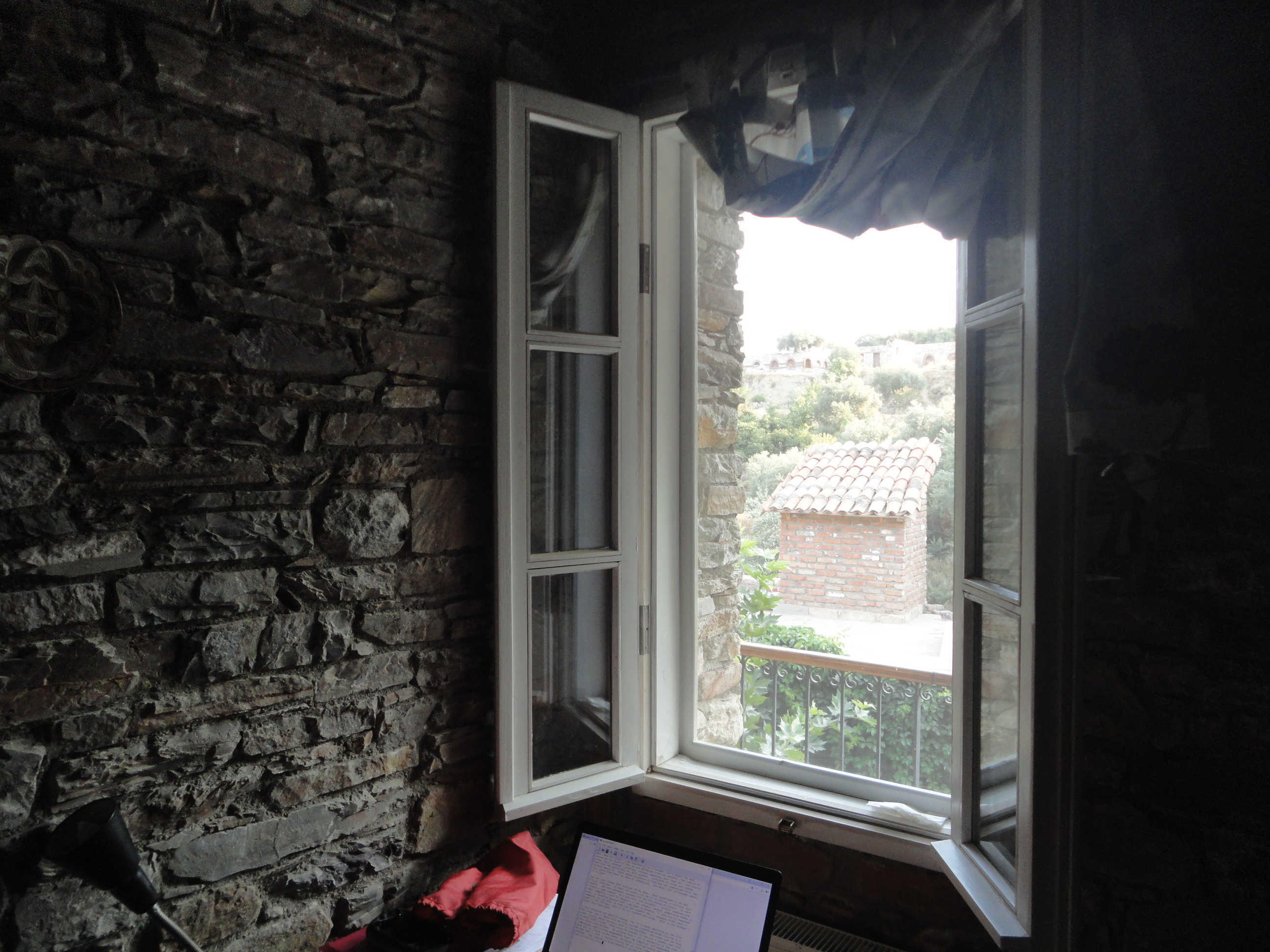
As Mr Denton asks, while reading Tolstoy: how indeed can one live in a world with so much humanity – when people set out to harass and kill, or even when young people who are only enjoying the cool of the evening, and one another, away from their parents, seek this enjoyment within earshot of the window of the room where one is trying to sleep? The window is open because, by this point in the summer, the stone walls of the room have been warmed by daily temperatures that approach those that are counted as feverish in humans. Any breeze that might come through is needed.
If I can decide that the noise and the heat are really beyond my control, then there is no problem. This is something I contemplated the other day, as I was returning to the Village after two hours of hiking – sometimes running – among the olive trees on the slopes, and I was coming up the last stretch from the valley bottom to the hilltop, under the noontime sun. If I truly lived in the moment, I would just accept my fatigue as a part of life. I would not even notice the fatigue. As it is, I do notice it, and I can wonder at the point of inducing it in myself.
We give lectures to our students, and we may try to do the best job we can; but ultimately the students must decide whether they are going to learn or not. They must then have the freedom to decide. I sometimes shudder to think of what my elders must have put up with from me when I was young. Should I now give young people the opportunity to have a similar realization, when they are older? I am supposed to be a teacher, and one of the best lessons we can learn is that we are different from one another. The habits of sleep, diet, reading, listening, talking, exercise, what have you – the habits that suit one person may not suit another. Tolerance of noise and crowds differs among us. Those whose tolerance is high may not understand this; but then again they may be able to understand. How might this be brought about, if it can?
One can just assume that nothing can be done. That would seem to be the Stoical response. It might be useful, if one is an island. One then abandons concerns for the well-being of others. Is such concern a sham anyway? In a big city like Istanbul, I readily suppress any human sympathy I have for beggars in the streets: peasant women with babes in arms, or disabled persons with club feet on display. I tend not to suppress sympathy for my wife, or even for the student who, I imagine, might want to come to the Village, only it is too crowded and noisy. This is the student I might once have been.
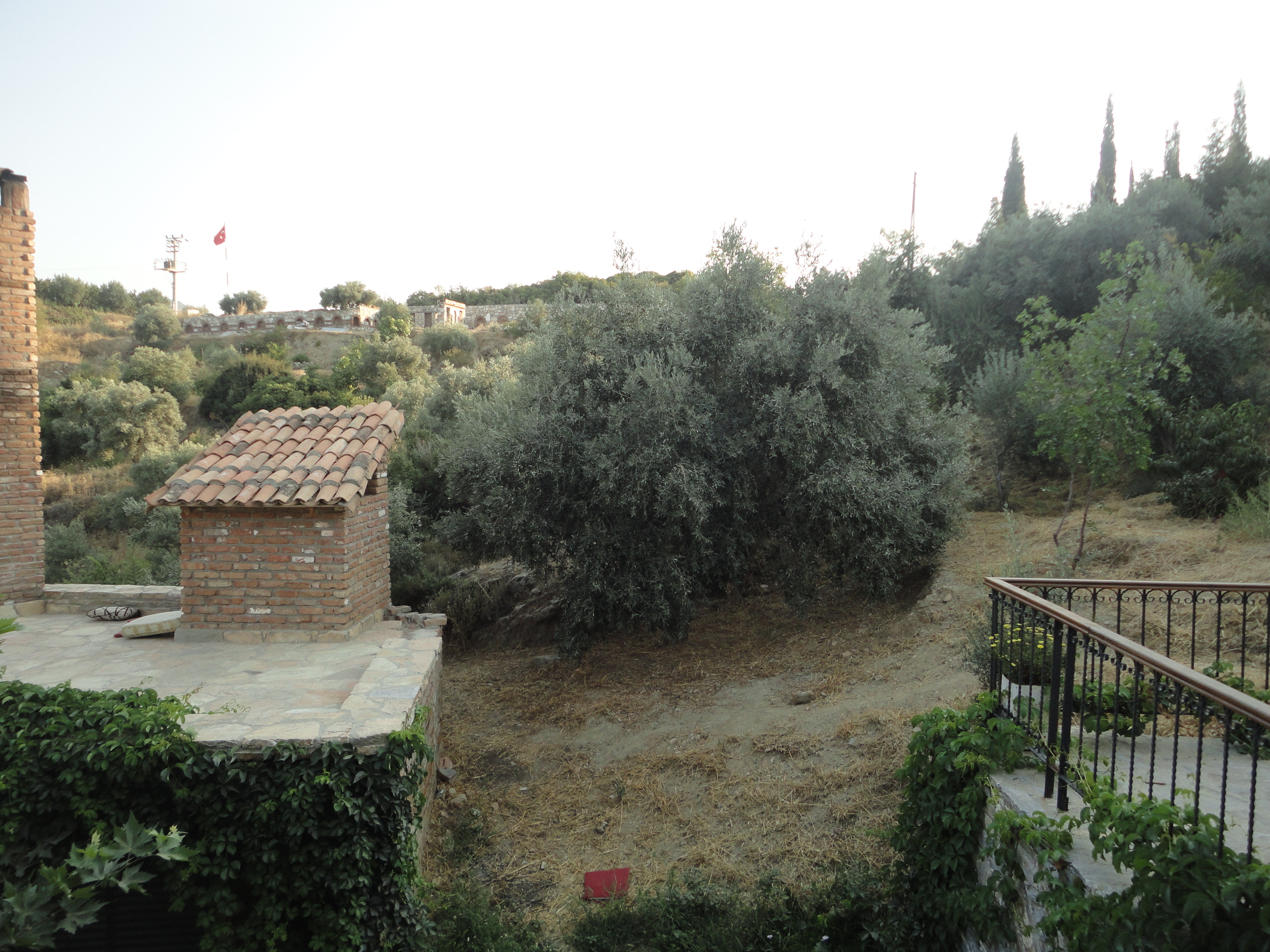
I have effected one material change that is already improving my own life. The rooms that I share with my wife include a bathroom whose ceiling is a tower, rising above the main roof of the building. The room is elegant, and the architect must have had fun, and it is good that he was able to do this work. The tower has two high windows, but both were closed. They could be opened, if one had a ladder or the nerve to climb the walls; but then the open windows would need screens. We already have a lot of mosquitoes in the room. I became a squeaky wheel. I complained, and Village management heard my complaint and responded. Warm air is rising in the tower, bringing a cooling breeze through the window that I face, looking out on olive trees that are buzzing with the one sound that I have no complaint about: the voice of the cicada. The lecture being given to high-schoolers, in the theater out of sight to the left, is not too loud.
 Polytropy