This is adapted from emails I wrote in 2022 (on February 10 and July 16 and 17). I post them now, because I have been updating the “Directory” of documents that I have saved on this blog, other than as posts. I could not remember why I had saved an “Annotation” from Harper’s, until I found the reason below. I take up poetry by T. S. Eliot, E. McKim, and Robinson Jeffers, in addition to the one I first quote.
An email friend shared a poem called “Merrymakers” (from “Four Poems,” London Review of Books, 9 May 2013), by Charles Simic:
A troop of late night revellers,
most likely shown the door
at some after-hours club
or a party in the neighbourhood,
still whooping it up
as they stagger down the street
with a girl in a wedding dress
walking pigeon-toed far behind them,
and calling out in distress:
‘Hey, you! Where the fuck
do you think you’re going?’
The poets sets us up, sort of the way young Eliot does in “Prufrock”:
Let us go then, you and I,
When the evening is spread out against the sky
Like a patient etherised upon a table …
The shock from Simic is not in image, but in meter, which one might have expected to continue iambically:
A troop of late night revellers,
most likely shown the door
at some old after-hours club,
continued with their roar,
forgetting sensibilities …
As it is, the poem gets prosy. The lines are pretty much just units of speech, “end-stopped,” never “emjambed,” at least until the end.
Just printing the vignette as poetry makes us pay attention in a certain way. Art is everywhere, if we know how to see it. The other day I was walking by an ugly old electrical box on the street, covered with remains of old posters, and I thought it could be spruced up with a small brass plaque, as if it were a sculpture.
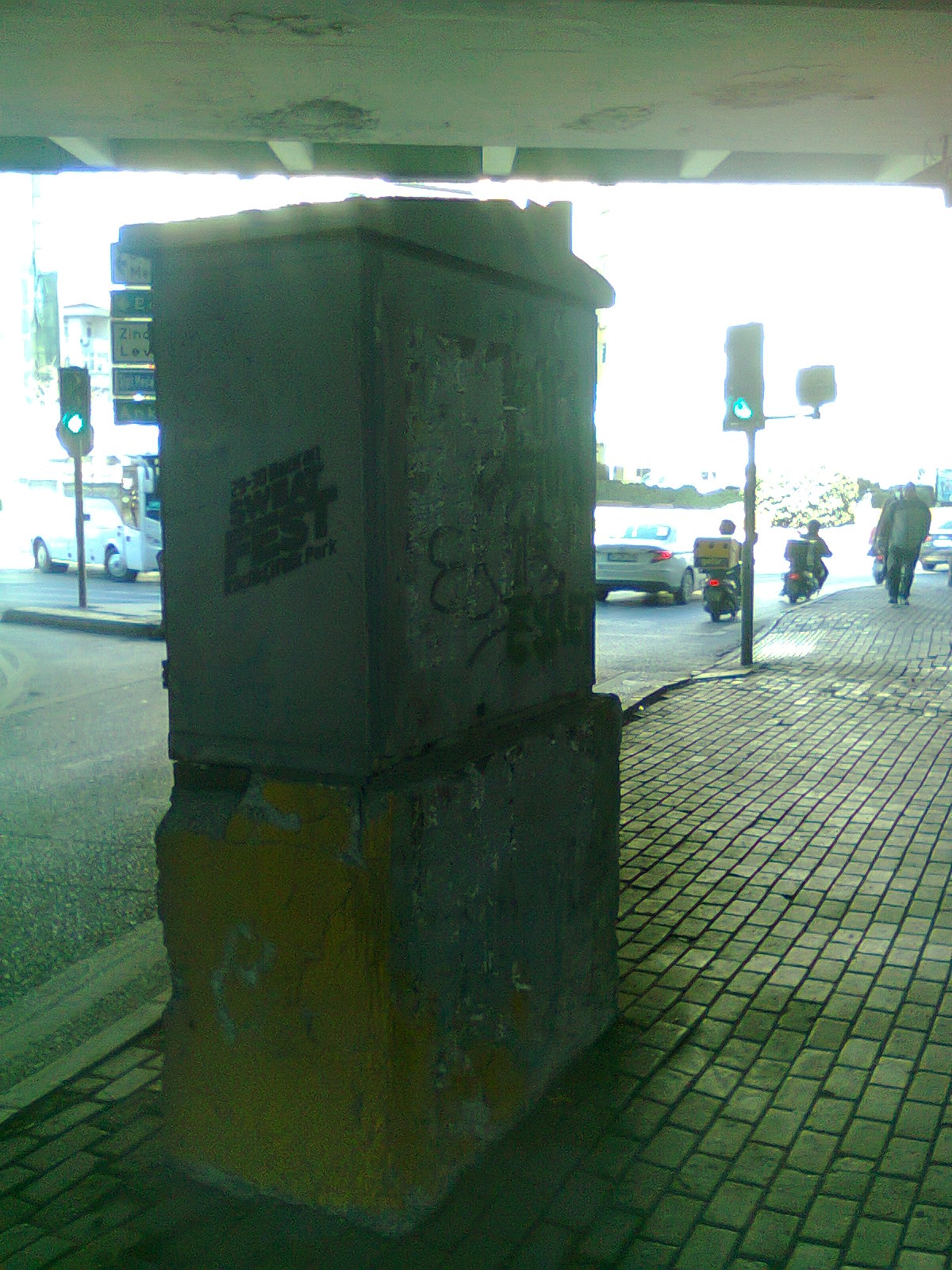
The day after writing the above, I went back to photograph the box (February 11, 2022). This was in Şişli, underneath Büyükdere Caddesi, but we moved at the end of the summer. Now we live in Sarıyer, on the heights above the northern terminus of Büyükdere Caddesi, which is near the stream (dere) and settlement of that name
Announcing the box as art might be in the spirit of the Maintenance Art Manifesto 1969! of Mierle Laderman Ukeles, which I first heard about in a Friday lecture and question period at St John’s College in Santa Fe. Ukeles had invited maintenance workers in New York to think of themselves as making “maintenance art” one hour daily. I rediscovered Ukeles’s work of performance art when she was one of the artists featured in the 13th Istanbul Biennial in 2013.
Maybe my idea for the box on the street owes more to Duchamp’s “Fountain,” the urinal displayed as art.
One of my art friends in high school was fond of the quote, “Art is anything you can get away with.” I think he attributed this to Andy Warhol, though now it seems Marshall McCluhan is the source.
There’s somebody calling herself Razzlekhan who has tried to get away with making rap videos, e.g. “Rap Anthem for Misfits and Weirdos.”
It seems pretty lame to me, but maybe I wouldn’t know, I’m not a rap aficionado. Razzlekhan and her accomplice-husband are also accused of trying to get away with “laundering billions of dollars in stolen cryptocurrency.”
Saying the bitcoins are worth billions is like assigning some astronomical “street value” to an intercepted shipment of heroin. It’s entirely artificial. So is money generally, but it doesn’t have the problem that Nathan Robinson talks about:
A Wall Street Journal analysis in 2018 found that 20 percent of all Bitcoin tokens were lost and probably unrecoverable, because if you lose your PIN for your Bitcoin wallet, you can never access it again …
If you lose access to your Bitcoin, a “crypto hunter” can help you try to track it down, but one of the great things about having a bank is that when I lose my PIN, I just call the bank and they let me into my account. I don’t want this “third party” to disappear, even for an additional kind of privacy that means nothing to me practically speaking.
Perhaps cryptocurrency is more of a fraud than poetry that doesn’t scan or rhyme!
Here is an untitled poem from Poetry that fascinated me in 1979–80:
horses move across unlighted landscapes
of the dream. overhead the golden crows
form galaxies; in the foreground we are
shown a room, a thousand corridors, some
place to move, falter, or become before
the red storms come to scatter precious
emblems: horse crows men rooms all into
a warmer place protected from the winds
and sensed obscurities the mind can seeand sensed obscurities the mind can see
a warmer place protected from the winds
emblems: horse crows men rooms all into
the red storms come to scatter precious
place to move, falter, or become before
shown a room, a thousand corridors, some
form galaxies; in the foreground we are
of the dream. overhead the golden crows
horses move across unlighted landscapes
I wrote about this and about the November 2014 issue of Poetry in a blog post of that December. There are some nice photos of the Bosphorus and the sky above it.
That issue of Poetry was “The Translation Issue,” and it included an essay from which I quoted: “The Medium of the English Language,” by James Longenbach. This seems relevant to questions of subjectivity and objectivity:
A medium … is a little bit of the world outside the self that, unlike the resolutely stubborn world at large, may be malleable, subject to the will while continuing to maintain its own character … Shakespeare was a powerful writer who in his lifetime was poised at exactly the right moment to take advantage of the medium that the English language had only recently become.
I was reading stuff like that, sitting by the Bosphorus, behind me the building of the old Mekteb-i Sanayi-i Nefise-i Şâhâne. Reviewing what I had blogged about this, I remembered having later written more about the Imperial School of Fine Arts. This turned out to be in “Figs,” illustrated mostly with photos of the fig trees that I see when walking around Şişli and Beşiktaş; but there is also another quote about medium, this by Ingo Niermann from the catalogue of the 14th Istanbul Biennial:
One activity that requires a particularly high level of concentration is reading. It involves an enormous narrowing of attention. No other medium conveys less information per unit of time than a text, and no other medium allows for less distraction. Text is the least tolerant medium in competition with other stimuli, and yet it also leaves the most room for your own imagination.
This generally makes sense, though I don’t know how Niermann measures “information.” It is all relevant to my ongoing musings on an essay in The New Atlantis dated June 21, 2022, called “Reading Ourselves to Death.”
If he had to choose, apparently Kit Wilson, “a writer in London,” would receive all of his information visually, rather than textually. I don’t know why a writer would do this.
I have been watching the vlogs of “Nomad’s Trails,” comprising Matilda and Peyman, who bicycled from Helsinki through Europe and across to west Africa, then went back to Finland because of Covid-19 and headed for the Arctic Circle in winter. Matilde had to stop because of an unnamed chronic illness, and now it seems Peyman is by himself in east Africa. The original plan was to pedal around the world in ten years.
Somebody told Peyman he should write a book, and he said he couldn’t write. It’s too bad, maybe, but he is not that kind of person. In the last two days, I watched the videos of him and Matilda as they crossed Western Sahara. I don’t know how well one can understand from video what it would mean to spend all day crossing hot, flat, empty land.
When that land is the American West, perhaps a better picture comes from the words of Barbara Savage in Miles from Nowhere (1983). However, the fact that this book is still in print is a sign that it is uncommonly well written. Here is an excerpt from another environmental extreme: a deluge of rain in Canada.
Who would rather have this in video form?
It was pointed out that galaxies come up both E. McKim’s poem and in recent photos from the James Webb Space Telescope.

Concerning photos from an earlier space telescope, Christopher Hitchens wrote:
Not all can be agreed on matters of aesthetics, but we secular humanists and atheists and agnostics do not wish to deprive humanity of its wonders or consolations. Not in the least. If you will devote a little time to studying the staggering photographs taken by the Hubble telescope, you will be scrutinizing things that are far more awesome and mysterious and beautiful – and more chaotic and overwhelming and forbidding – than any creation or “end of days” story …
In 2018, my response to this was,
Twenty years ago, in 1998, when I was a post-doc in California, a friend sent me prints of a couple of those Hubble photographs. I have them still. They are awesome and mysterious and so on, as Hitchens says; but I leave off the comparative “more.” More awesome to me is the power of the mind, in its ability to create myths; to take and interpret photographs; and especially to discover, prove, and make use of such results as Gödel’s Incompleteness Theorem.
Perhaps I was only echoing a koan, “Not the Wind, Not the Flag”:
Two monks were arguing about a flag. One said: “The flag is moving.”
The other said: “The wind is moving.”
The sixth patriarch happened to be passing by. He told them: “Not the wind, not the flag; mind is moving.”
Above I linked to an account of a bicycle trip that included an encounter with a bear.
I asked whether one would rather have a video. Actually there is an amazing video of an encounter between a bicyclist and a leopard.

As for whether rhyme in a poem such as Simic’s would be “artificial,” it would seem to me that all art is artificial. One may use artifice to create an appearance of its lack, an appearance of simplicity and ease. There was a Harper’s annotation about this by Marshall Blonsky in June, 1992, and I have saved it:
the terribly rich face a dreadful dilemma: How can they flaunt their wealth at a moment when we would seem to be atoning for the riotous excesses of the decade gone by? Is there a tasteful compromise? Yes – advertise one’s money without seeming to do so …
While it was once de rigueur to stuff a room with expensive floral arrangements – profusions of birds-of-paradise, African lilies, and hothouse roses – this room contains modest, just-thrown-in-a-vase arrangements of garden flowers. Like so much else in the room, they send two messages. The untutored might think that these flowers were picked by the owner, an unpretentious soul who keeps a garden and actually gets his hands dirty now and then. But this is Manhattan, and to [House & Garden]’s initiates, the garden flowers more likely say: house in the country and gardener on the payroll.
Blonsky is talking about the apartment featured in “Rooms With a Past: Joe D’Urso gives modernist spaces a sense of history,” by Joan Kron (House and Garden, July 1992, pages 76–83 and 124). I could find the article, because the Internet Archive seems to have all issues of HG from 2007 back to 1901.
Artificial simplicity from earlier in the century is seen in Maugham’s account of an American snob in France in The Razor’s Edge (1944):
He was still unwilling to accept such painters as Picasso and Braque – “horrors, my dear fellow, horrors” – whom certain misguided enthusiasts were making such a fuss about, but felt himself at long last justified in extending his patronage to the Impressionists and so adorned his walls with some very pretty pictures. I remember a Monet of people rowing on a river, a Pissarro of a quay and a bridge on the Seine, a Tahitian landscape by Gauguin and a charming Renoir of a young girl in profile with long yellow hair hanging down her back. His house when finished was fresh and gay, unusual, and simple with that simplicity that you knew could only have been achieved at great expense.
In Republic Book III, 393d–4a, Socrates gives a prose rendition of the opening of the Iliad, though his main point is to turn all of the speech into narration. Tragedy does the reverse: turn all narration into speech. Socrates does the reverse in another sense in the Phaedo; at 61b, he tells of turning the prose of Aesop into verse. I don’t know what to make of this. It’s true that the differentia of verse here is not rhyme, but rhythm, meter.
Evidence that poetic or at least rhythmic speech is natural is given by Julian Jaynes in The Origin of Consciousness in the Breakdown of the Bicameral Mind (1976), page 73:
If we erase all our preconceptions about poetry and act toward the poem [namely the Iliad] as if we had never heard of poetry before, the abnormal quality of the speech would immediately arrest us. We call it meter nowadays. But what a different thing, these steady hexameters of pitch stresses, from the looser jumble of accents in ordinary dialogue! The function of meter in poetry is to drive the electrical activity of the brain, and most certainly to relax the normal emotional inhibitions of both chanter and listener. A similar thing occurs when the voices of schizophrenics speak in scanning rhythms or rhyme. Except for its later accretions, then, the epic itself was neither consciously composed nor consciously remembered, but was successively and creatively changed with no more awareness than a pianist has of his improvisation.
That somewhat echoes Collingwood in Speculum Mentis (1924), page 58:
THAT poetry is in a special sense the spiritual kingdom of the child was first divined by Plato; and when the theory of art was seriously taken up again by philosophers of the eighteenth century, they reasserted the same notion as the very heart and core of their new speculations on the subject. When Hamann wrote that ‘poetry is the mother-tongue of mankind’, and when Vico a generation earlier laid it down that poetry is the natural speech of children and savages, they held in their hands the clue to the solution of all the problems of aesthetic.
Perhaps Robinson Jeffers disagreed. There are some of his verses in the latest weekly digest of The Marginalian:
What is this thing called life? – But I believe
That the earth and stars too, and the whole glittering universe, and rocks on the mountain have life,
Only we do not call it so – I speak of the life
That oxydizes fats and proteins and carbo-
Hydrates to live on, and from that chemical energy
Makes pleasure and pain, wonder, love, adoration, hatred and terror: how do these thing grow
From a chemical reaction?I think they were here already. I think the rocks
And the earth and the other planets, and the stars and galaxies
Have their various consciousness, all things are conscious;
But the nerves of an animal, the nerves and brain
Bring it to focus.
What’s the point of the lines? Let’s set them as prose:
What is this thing called life? – But I believe that the earth and stars too, and the whole glittering universe, and rocks on the mountain have life, only we do not call it so – I speak of the life that oxydizes fats and proteins and carbohydrates to live on, and from that chemical energy makes pleasure and pain, wonder, love, adoration, hatred and terror: how do these thing grow from a chemical reaction?
I think they were here already. I think the rocks and the earth and the other planets, and the stars and galaxies have their various consciousness, all things are conscious; but the nerves of an animal, the nerves and brain bring it to focus.
I appreciate the corroboration of the idea I had in high school and wrote a short story about, that rocks must be conscious. But breaking up Jeffers’s words into verses: that seems like artifice to me.
A friend sent me a Jeffers poem called “The Answer” in April, 2020, while DJT was still in office:
Then what is the answer? – Not to be deluded by dreams.
To know that great civilizations have broken down into violence, and their tyrants come, many times before.
When open violence appears, to avoid it with honor or choose the least ugly faction; these evils are essential.
To keep one’s own integrity, be merciful and uncorrupted and not wish for evil; and not be duped
By dreams of universal justice or happiness. These dreams will not be fulfilled.
To know this, and know that however ugly the parts appear the whole remains beautiful. A severed hand
Is an ugly thing, and man dissevered from the earth and stars and his history … for contemplation or in fact …
Often appears atrociously ugly. Integrity is wholeness, the greatest beauty is
Organic wholeness, the wholeness of life and things, the divine beauty of the universe. Love that, not man
Apart from that, or else you will share man’s pitiful confusions and drown in despair when his days darken.
Apparently at Jeffers’s “Tor House” in California, visitors were shown an edition of Jeffers’s poetry with pages wide enough to accommodate his lines. Paper of the normal if not natural width could not suffice.
According to Wikipedia,
Jeffers did not accept the idea that meter is a fundamental part of poetry, and, like Marianne Moore, claimed his verse was not composed in meter, but “rolling stresses.” He believed meter was imposed on poetry by man and not a fundamental part of its nature.
Again, poetry is made by humans in the first place; the idea is there in ποιέω “make.”
I wasn’t going to write that much, but my mind kept moving.
Edited December 18, 2024. I added some links, the photo from Harper’s, and the reference to the HG article that it is based on.
Edited again, November 24 2025, because the second naming of E. McKim had left out the “Mc.”
 Polytropy
One Trackback
[…] Marshall Blonsky, “Designer Apt W/’90s Pt of Vu,” Annotation, Harper’s, June, 1992. Used now in “Found Poetry” […]