This is mostly about Goethe’s Faust, but it was not going to be. Faust says he never wants to sit still. It doesn’t seem like a great idea.

Athens, Monday, July 10, 2017
If, as Wikipedia now mentions, and John Warner discusses in the fittingly titled “That’s Not What Lolita Is About” (November 16, 2025) – if Elisa New recommended that Jeffrey Epstein read Lolita (which I have read) and My Antonia (which I haven’t), why not Faust?
But if it is possible at any time that there not be motion, this must come to pass in one of two ways, either as Anaxagoras says (for he says that after all things were together and at rest for an infinite time, the intelligence introduced motion and made things separate), or as Empedocles does, that the world is in part moving and at rest in turns (ἐν μέρει κινεῖσθαι καὶ πάλιν ἠρεμεῖν) moving whenever love makes one out of many or strife makes many out of one, but at rest in the meantime, saying,
So in that a one has learned to grow out of many,
And many in turn are achieved when the one grows apart,
In this way things are becoming and have no stable life;
But since they never leave off changing constantly,
In this way they are always motionless in a cycle
(ταύτῃ δ’ αἰὲν ἔασιν ἀκίνητοι κατὰ κύκλον).
– Aristotle, Physics 8.1
translation by Joe Sachs (1998)
Greek text from Laks and Most (edd.)
Early Greek Philosophy V (2016)
In the last post, “Reading and Writing,” we thought about reading Lyrical Ballads (1798). Our interest may be piqued by knowledge of
- the authors, who were Wordsworth and Coleridge;
- their times;
- their effect on their times.
Such knowledge may also be a distraction. To form a bond with the poets, we need know nothing but the words of the poems themselves.

Munich, August 31, 2009
On the way to Washington from Ankara
we had a number of hours between flights
Need we not even know the words of other poems? By the account of Louis Menand, which we looked at last time,
[T. S. Eliot] argued for the principle that the most important thing you need to know in order to read a poem is other poems.
Knowing other poems may be most important, or perhaps least unimportant. If you read a lot, and you think about what you read, then you may end up making a lot of comparisons. Walter Kaufmann does this, in the fifth of the twelve sections of the Introduction to his 1961 translation of Goethe’s Faust; the section is headed “Goethe’s characters and economy”:
Goethe realized the limitations of romanticism and its questionable character even before romanticism had become the style of an age. The very figure of Faust which inspired romantic poets, philosophers, and composers, and was accepted by the German people as their own ideal prototype – this poetic but unscrupulous titan who, for all his noble sentiments, becomes involved in brutal deeds – is the constant butt of Mephisto’s mockery. The function of Mephistopheles resembles that of Heine’s sudden sarcasms …
I skip the ensuing remarks, because I know nothing of Heine. Kaufmann’s paragraph concludes:
Thus Goethe’s Faust is closer to Ulysses than to the Odyssey. It is one of the first and greatest works of modern literature. And Mephistopheles is one of the most inspired characters in the whole of world literature.
In the post before last, “Craft and Craftiness,” I mentioned finding the Philoctetes of Sophocles more comprehensible than Faust. I had an ongoing seminar on the latter (now concluded; we met five Saturdays, October 18 and 25, and November 1, 8, and 15, 2025). The difficulty of Faust is a reason why I turn to Kaufmann’s Introduction. If Goethe does not seem to speak to me, maybe Kaufmann will.
In college, I read Kaufmann’s translations, not only of Faust, but of Nietzsche, in both The Basic Writings of Nietzsche and The Portable Nietzsche. I could not get much out of Nietzsche either. As for Kaufmann himself, he was a German who had left his country when it went fascist; he took up arms against it, when it tried to conquer Europe. Now I have found his essay “The Faith of a Heretic” (Harper’s, February, 1959). I decided it was worth typesetting, as a page of this blog.

Reichstag, Berlin, September 11, 2007
I note Kaufmann’s closing advice about life:
put into it all you have got, and live and, if possible, die with some measure of nobility.
Why? Who is measuring out nobility anyway? Kaufmann has been talking about how
there are about 100 million galaxies within the range of four telescopes. Man seems to play a very insignificant part in the universe …
I would say that humanity plays
- no part in the universe, as it is studied by physics;
- the only part in pursuing that study.
We humans can study both
- the physical universe and
- one another, or ourselves.
I do not know why or even how we can do those two different things. The fact is, we do them, and
If a thing is, it is possible
– this is “the most obvious and neglected rule of Philosophy,” as Charles Bell points out. (He does that in “The Axiomatic Drama of Classical Physics,” one of the first lectures I heard as a student at St John’s College; I posted it with my annotations.)
Kaufmann’s statement about life is echoed by Steven Weinberg’s, looked at by me in “Astronomy Anomaly” and then “Ethics of Mathematics”:
The more the universe seems comprehensible, the more it also seems pointless.
But if there is no solace in the fruits of our research, there is at least some consolation in the research itself … The effort to understand the universe is one of the very few things that lifts [sic] human life a little above the level of farce, and gives [sic] it some of the grace of tragedy.
As far as I understand, physics is designed to find a kind of law that is never broken. Finding purpose or grace requires another kind of study:
We normally know things through our physical senses or through our reasoning powers. Because God is not an item in the world, we need a different kind of access.
Thus Sarah Lancaster, “recently retired theologian,” in “Revelation” (November 14, 2025). Perhaps nobody can argue with her words so far. God is not an item – not an entity to be included in a list of many things. This could be because God is everything, or nothing. Lancaster continues:
God gives us a glimpse so that we can understand.
One important aspect of this giftlike character is that the God who is not an empirical thing uses something in our empirical world to give us an opportunity to understand what is beyond us. The choice of vehicle is up to God. Theologian Karl Barth wrote, “God may speak to us
- through Russian communism,
- through a flute concerto,
- through a blossoming shrub or
- through a dead dog.
We shall do well to listen to him if he really does so” [Church Dogmatics, I.1].
The list formatting is mine. “If he really does so,” says Barth – but how does one know that God really does so?
In Book XXIV of the Iliad, God tells Priam to visit the killer of his son, to beg for the return of the body. Hecuba does not think it is a good idea.
In the Bible and the Quran, God tells Abraham to kill his own son, and Abraham thinks this is a good idea – or at least he thinks obedience is a good idea. How can he know it is a good idea? I took up the question in “How to Learn About People” (in response to the 2016 US presidential election), and again in “Sacrifice and Simulation” (during the interregnum). I should add that obedience may result not from thought, but from subjection to power. Invited by Achilles to have a meal and spend the night, Priam has no choice but to do it.

Munich, August 31, 2009
Surfing was legalized the following year
Perhaps Walter Kaufmann and Steven Weinberg obey nobody but themselves. I don’t know, but they may agree with a certain poet:
He that forbears
To suit and serve his need,
Deserves his load.
Both Kaufmann and Weinberg are also confident that they can assess religious art. Here is Kaufmann:
One need not believe in Pallas Athena, the virgin goddess, to be overwhelmed by the Parthenon. Similarly, a man who rejects all dogmas, all theologies, and all religious formulations of beliefs may still find Genesis the sublime book, par excellence.
Perhaps to be properly overwhelmed is to believe. In “Without God” (NYRB, September 25, 2008), another essay that I have typeset and posted, Steven Weinberg says,
When I was an undergraduate I knew a rabbi, Will Herberg, who … warned me that we must worship God, because otherwise we would start worshiping each other. He was right about the danger, but I would suggest a different cure: we should get out of the habit of worshiping anything.
I’m not going to say that it’s easy to live without God, that science is all you need …
Worse, the worldview of science is rather chilling … At our best we live on a knife-edge, between wishful thinking on one hand and, on the other, despair.
What, then, can we do? One thing that helps is humor … In some of Shakespeare’s greatest tragedies, just when the action is about to reach an unbearable climax, the tragic heroes are confronted with some “rude mechanical” offering comic observations …
Apparently Goethe is like that too. I interject some of Kaufman’s remarks from the first section of his Introduction to Faust:
Perhaps the last quality which most people associate with Faust is its overflowing humor, which runs the whole scale from the benign to the sardonic, including in between the raw, the witty, the subtle, and Olympian malice …

Munich, August 31, 2009
The wave disappeared this fall (2025)
Kaufmann continues:
Why, then, is it a cliché in the English-speaking world that the Germans have no sense of humor and have always been a rather pompous, saturnine, and ponderous people? It is partly because Luther’s often coarse humor has been so religiously ignored, and Goethe’s and Nietzsche’s wit was spirited away by Victorian translators.
Meanwhile, Weinberg continues on what to do without God:
Then there are the ordinary pleasures of life … And let’s not dismiss the pleasures of the flesh …
There are also the pleasures brought to us by the high arts. Here I think we are going to lose something with the decline of religious belief. Much great art has arisen in the past from religious inspiration. For instance, I can’t imagine the poetry of George Herbert or Henry Vaughn or Gerard Manley Hopkins being written without sincere religious belief. But nothing prevents those of us who have no religious belief from enjoying religious poetry, any more than not being English prevents Americans from enjoying the patriotic speeches in Richard II or Henry V.
I looked at Weinberg’s essay also in writing “On Kant’s Groundwork,” where I talked also about the response that Wendell Berry has in “God, Science, and Imagination” (Imagination in Place, 2010; included in Essays 1993–2017, Library of America, pages 532–41). On the last paragraph above, Berry has a comment that boils down to this: How does Weinberg know? Here is the whole thing, and it is all good, though I shall not investigate it further here:
I dislike very much the disciplinary provincialisms of the universities; therefore, as a literary person, I ought to be delighted that Prof. Weinberg finds literature as irresistible as religion. But I am obliged instead to regret that he speaks of it with complacent oversimplification and ineptitude. When he says, for example, that “nothing prevents those of us who have no religious belief from enjoying religious poetry,” does he mean that such enjoyment is the same for believers and unbelievers? If so, how does he know this? Does he have a way of comparing objectively the degrees and kinds of enjoyment? I would gladly agree that enjoyment is a desirable, maybe even a necessary, result of any art; but is enjoyment the only or the highest effect of religious art? What is it about religious art that unbelievers enjoy? The underlying question here, and an important one, is this: How do you authenticate, and make credible to somebody else, your response to a work of art? Prof. Weinberg seems not to have suspected that this question exists, or that it implies a careful, difficult job of work.
The poetic assertion that I quoted earlier, “He that forbears / To suit and serve his need, / Deserves his load” – that was George Herbert, whom Weinberg mentioned. Herbert, at least, goes on to recognize that he cannot maintain the pose of autonomy. This is in “The Collar” – and would that poem be known, if not for English class at school? The “Christian Classics Ethereal Library has taken pains to typeset the poem as in an old printed version. I am supplying the long ess. Here are the key verses – for me, now – from the beginning and end:
I Struck the board, and cry’d, No more.
I will abroad.
What? ſhall I ever ſigh and pine?
My lines and life are free; free as the rode,
Looſe as the winde, as large as ſtore.
He that forbears
To ſuit and ſerve his need,
Deſerves his load.
But as I rav’d and grew more fierce and wilde
At every word,
Me thoughts I heard one calling, Childe:
And I reply’d, My Lord.
For the sake of completeness, here are the remaining verses, from the middle:
Shall I be ſtill in ſuit?
Have I no harveſt but a thorn
To let me bloud, and not reſtore
What I have loſt with cordiall fruit?
Sure there was wine
Before my ſighs did drie it: there was corn
Before my tears did drown it.
Is the yeare onely loſt to me?
Have I no bayes to crown it?
No flowers, no garlands gay? all blaſted?
All waſted?
Not ſo, my heart: but there is fruit,
And thou haſt hands.
Recover all thy ſigh-blown age
On double pleaſures: leave thy cold diſpute
Of what is fit, and not. Forſake thy cage,
Thy rope of ſands,
Which pettie thoughts have made, and made to thee
Good cable, to enforce and draw,
And be thy law,
While thou didſt wink and wouldſt not ſee.
Away; take heed:
I will abroad.
Call in thy deaths head there: tie up thy fears.
Perhaps in fact many of us never hear the call at the end of the whole poem. Shall we always be able to ignore the question, raised by Nina Simone and others:
Oh Sinnerman, where you gonna run to, all on that day?
If we laugh at the question, are we reflecting “Faustian culture,” as Kaufmann describes it, again in § 5 of his Introduction to Goethe’s Faust?
Faust leaps out of the book. He was quickly hailed as the incarnation of the German character and influenced German historiography, philosophy, and self-interpretation. Millions of young men decided they were like Faust, and some found the German destiny in boundless, ruthless, Faustian striving. Schopenhauer, in The World as Will and Representation (1819), considered such striving as the essence not merely of man but of the cosmos. Spengler, precisely a hundred years later, saw Faust as the representative of Western man and called Western civilization “the Faustian culture.”
This “Faustian striving” here: its locus classicus must be these verses of the play, here in Kaufmann’s translation (Kaufmann provides the German original on the facing page, but unfortunately I can make little use of it):
- Faust:
- What would you, wretched Devil, offer?
Was ever a man’s spirit in its noble striving
Grasped by your like, devilish scoffer?
But have you food that is not satisfying,
Red gold that rolls off without rest,
Quicksilver-like, over your skin –
A game in which no man can win –
A girl who, lying at my breast,
Ogles already to entice my neighbor,
And honor – that perhaps seems best –
Though like a comet it will turn to vapor?
Show me fruit that, before we pluck them, rot,
And trees whose foliage every day makes new!- Mephisto:
- Such a commission scares me not,
With such things I can wait on you.
But, worthy friend, the time comes when we would
Recline in peace and feast on something good.- Faust:
- If ever I recline, calmed, on a bed of sloth,
You may destroy me then and there.
If ever flattering you should wile me
That in myself I find delight,
If with enjoyment you beguile me,
Then break on me, eternal night!
This bet I offer.- Mephisto:
- I accept it.
- Faust:
I accept it.Right.
If to the moment I should say:
Abide, you are so fair –
Put me in fetters on that day,
I wish to perish then, I swear.
Then let the death bell ever toll,
Your service done, you shall be free,
The clock may stop, the hand may fall,
As time comes to an end for me.
What I continue not to understand is how Faust can say that, and yet go on to let Mephistopheles play Ghislaine Maxwell to his Jeffrey Epstein. I do not know why Faust’s affair with Margaret should take up such a large part of what Kaufmann calls
one of the relatively few great books that is [sic] not only profound and inexhaustible but also readable, enjoyable, and fun.
I was working at the farm in 1988 when the Washington City Paper ran a certain cartoon by Mark Newgarden. In a bar, one man was vomiting on the floor, while the other said, “Time to go home and molest my eight-year-old.” (I’m not sure the age of the child in question was eight.) The following week, there was a reader’s objection to the making light of what was an ongoing serious problem. I would not have said Newgarden was doing that; but then his cartoon was not funny either.
I return to Kaufmann on Faust. He said the play was closer to Ulysses than to the Odyssey. This is useful to me, because my wife and I read the Joyce together last year, and I remember the experience fondly. In § 3 (headed “Faust”) of his Introduction, Kaufmann says,
In all these respects Faust is distinctly un-Greek, non-Aristotelian, modern. It reminds us of Ibsen’s Peer Gynt, which was modeled on it, of the epic theatre of Bertold Brecht – in the nineteen-fifties Brecht staged Goethe’s Ur-faust in East Berlin – and even of Arthur Miller’s Death of a Salesman.
“It reminds us” – if we know those works. I happen to have read Death of a Salesman and to have watched the 1985 TV version with Dustin Hoffman. I’ve read some Ibsen (A Doll’s House in school, where there was also a stage production, and also in college; Hedda Gabler, because of the song by John Cale; An Enemy of the People, because Ayşe and I were going to see a stage production in Ankara); I have not read Peer Gynt. As for Brecht, I am sorry I did not bother to see a high-school production of Mother Courage. There was a work that somehow involved “Mack the Knife” in the Art Gallery of Ontario in 1996.
Kaufmann says a bit more about the Joyce connection, first in § 5 (my bullets):
It may well be that Mephistopheles is Goethe’s greatest single creation, and that he has come into his own only in the twentieth century, after
- Heine and Kierkegaard,
- Dostoevsky and Nietzsche,
- Freud and Shaw,
- Gide and Joyce,
- Mann and Sartre
– who would hardly be offended at being called Mephisto’s progeny – had changed our sensibilities.
Then in § 6, “The Walpurgis Night and The Walpurgis Night’s Dream”:
Those who know Joyce’s Ulysses will realize how much of an avant-gardist Goethe was when he published the Walpurgis Night in 1808 …
Finally, in § 7, “Part Two”:
The relative unpopularity of Part Two is due to many factors … much of it is also very difficult reading – not for those who feel thoroughly at home in classical antiquity and in Joyce’s Ulysses, and who are able, for the most part, to read it in the original German, but for the vast majority of educated readers. That Goethe was a hundred years ahead of his time, and his Faust, alienated from his own world and from classical antiquity, too, can be understood only in terms of both and is thus related to Joyce’s Stephen – that commends the Second Part to modern readers.
Some of the people with whom I read Part One are going on to read Part Two, but I am not joining them. For one thing, Kaufmann continues from where we left him:
But though it is a work of genius, most of it, except the portions offered here, is inferior to Part One in one respect: Goethe never gave it the ruthless pruning he had given to Part One.
Those who wish to study Part Two but have no German should find the Victorian archaisms of existing English versions one of the lesser obstacles. It is my hope that those who would like to enjoy Goethe’s Faust – as opposed to those who want to be able to say that they have read it, all of it – may find the present version readable from beginning to end, and as faithful as any.
“The present version” consists of the first scene and the fifth and last act. There is a summary of what is left out, in § 8 of the Introduction, but Kaufmann admits:
Obviously, any such synopsis is bound to be almost farcical: let those who doubt that attempt a summary of the last four scenes of Part One – or of King Lear or Hamlet.
Wikipedia lists a number of more recent translations of Part Two, but I did not feel like tracking one down. Perhaps I shall read what Kaufmann did translate. However, I may write here next on Wordsworth and Coleridge.
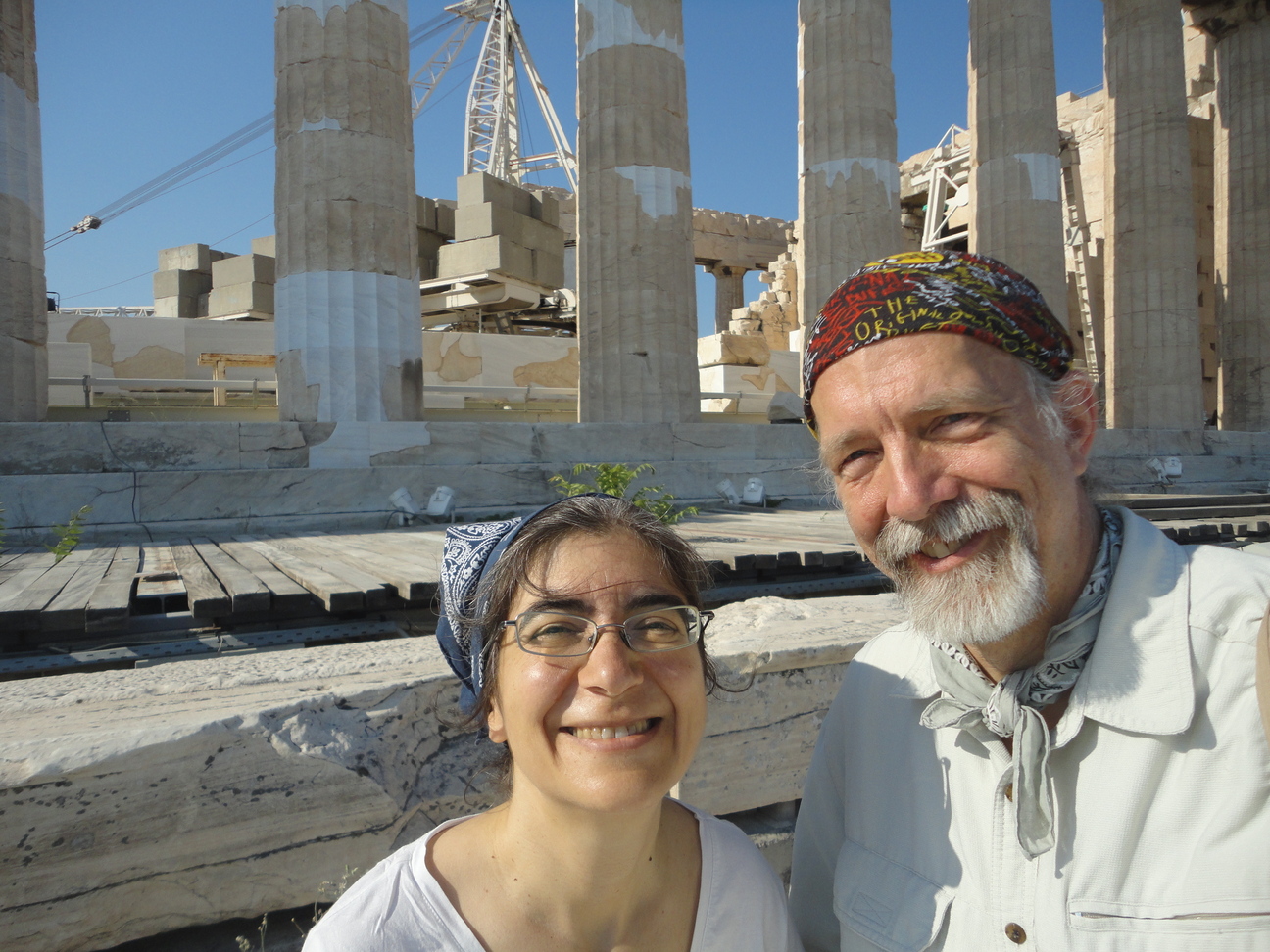
Athens, Monday, July 10, 2017
It may be that, as Kaufmann said,
Goethe realized the limitations of romanticism and its questionable character.
Is this like talking about
- the limitations of Euclidean synthetic geometry, relieved by Cartesian analytic geometry?
- the questionable character of some politicians and business leaders?
Is Kaufmann trying to tell us what art we ought to like?
Edited and augmented November 22, 2025
 Polytropy
2 Trackbacks
[…] « Motion and Rest […]
[…] « Craft and Craftiness Motion and Rest » […]