Here is an image that I made when preparing the article Self-similarity nine months ago. The image appeared as a draft in the list of all of my articles on this blog. Here it is officially:
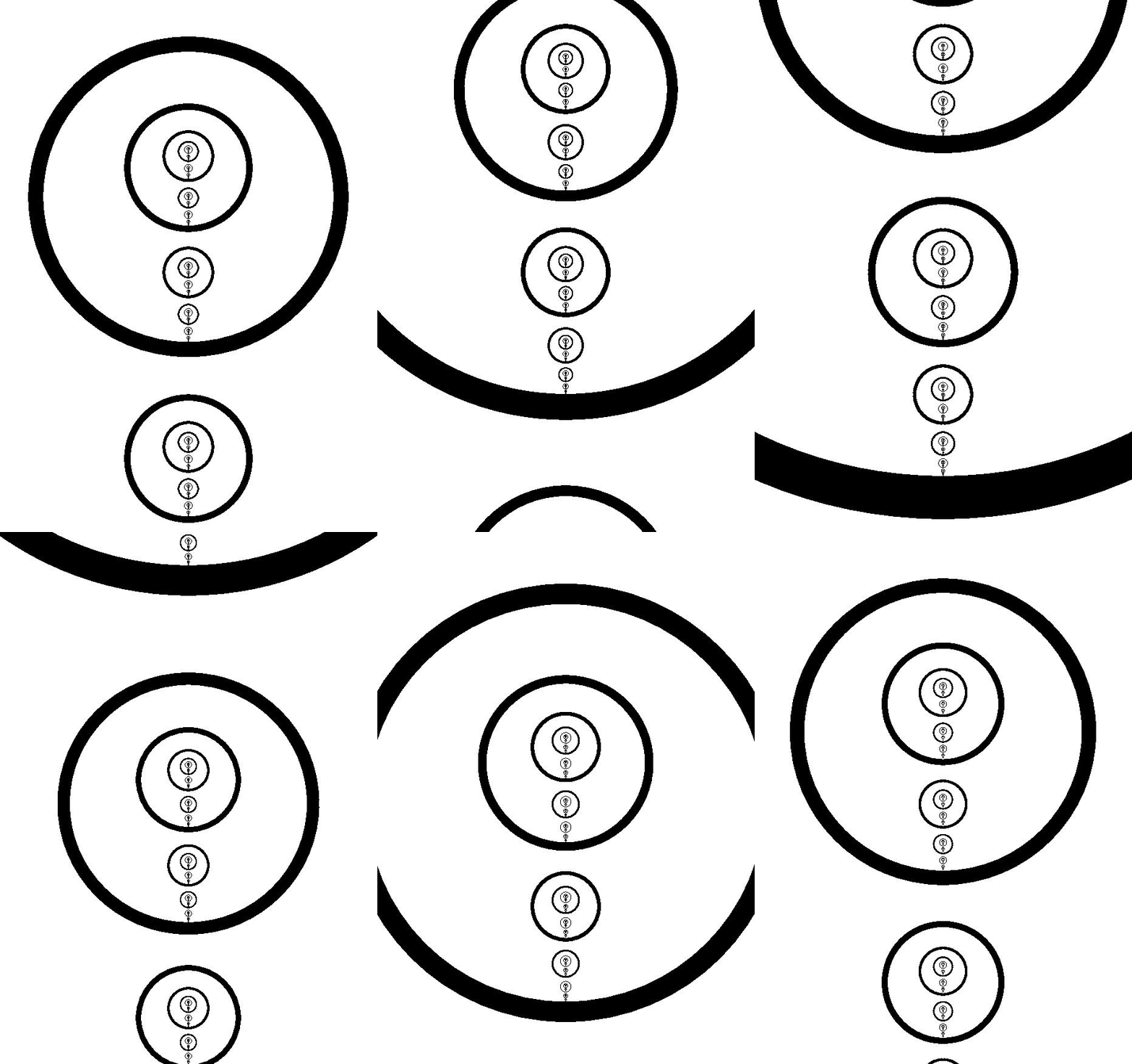
Here is an image that I made when preparing the article Self-similarity nine months ago. The image appeared as a draft in the list of all of my articles on this blog. Here it is officially:
Following up on my last article, here I continue to bring together images from different times and places, albeit with no particular conclusion to draw.
According to the founder of the Freer Gallery of Art in Washington,
For those who have the power to see beauty … all works of art go together, whatever their period.
Here I put together two paintings, one from ancient Pompeii, and the other a nineteenth-century American work from Mr Freer’s collection.
In the archeological museum in Naples a few weeks ago, I was able to see the original sources of a number of famous images. One was this Pompeiian fresco, said to represent Flora:

In fact I did not see the original image in Naples. In its place was a photograph, the original having been sent to London for an exhibit at the British Museum. The photograph above is from somewhere on the web. So is the next photograph below, of “After Sunset” (1892) by Thomas Dewing (Freer Gallery of Art, Washington):

Here is a close-up, taken by me:

Freer collected American works like this, but mostly Asian works of past centuries. Apparently he found some community of spirit among the various elements of his collection. In particular, he compared Dewing’s work with that of Utamaro, as in the following prints, currently displayed at the Freer together with Dewing’s “After Sunset” and the similar “Before Sunrise”:

I have seen no evidence that Dewing knew of the Pompeiian Flora.

From the poster depicting a few von Neumann natural numbers, I created this animation. The moving image no longer depicts natural numbers in the sense of the poster, since there is no infinite descending chain of natural numbers. There is an infinite ascending chain of them; but the poster does not actually depict such a chain as nested circles. So running the animation in reverse would not give a correct suggestion of the original poster, even if it were of infinite size. Continue reading
See the next article, “Self-similarity,” for an animation of the image here.
I have long been fascinated by von Neumann’s definition of the natural numbers (and more generally the ordinals). In developing axioms for set theory, Zermelo used the sets 0, {0}, {{0}}, {{{0}}}, {{{{0}}}}, and so on as the natural numbers. Here 0 is the empty set. Zermelo’s method works, but is not so elegant as von Neumann’s later proposal to consider each natural number as the set of all natural numbers that are less than it is, so that (again) 0 is the empty set, but also n + 1 = {0, 1, …, n}.
I have been impressed by the similar depiction of the two saints here; first, St John Chrysostom, from the Byzantine collection of Dumbarton Oaks:
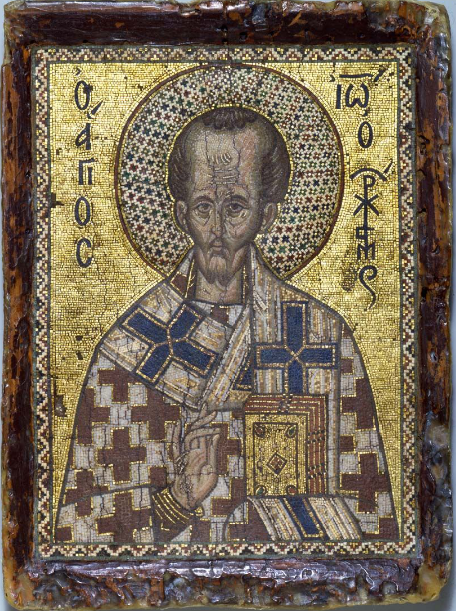
and then St Cyril of Alexandria, in an image taken from Wikipedia, though apparently the original image is in Chora, here in Istanbul. (I visited Chora once, maybe 14 years ago, but hope to visit again soon.)

I was originally impressed by how the blue and red crosses of the vestments of Chrysostom were repeated in his halo; then I happened upon the image of Cyril, with crosses similar in form, though not color, again repeated about the head.
 Polytropy
