Category Archives: Mathematics

The Society of Mathematics 2

This post is a response by Alexandre Borovik to my previous post. The following words then are Sasha’s:

Dear David,

I joined the AMR. In my view, its areas of activities are sufficiently clearly defined [on its homepage]:

The AMR has several initiatives under development. These include:

  • AMR colloquia, lectures and workshops, exploring new ways to present research
  • Updates and reviews of new research
  • Reviews of classic influential papers
  • Discussions of open problems
  • Video expositions of mathematical research
  • AMR journals and publications leveraging new technological opportunities
  • Interviews of mathematicians
  • Developing new ideas for the flourishing of the international mathematical research community

Continue reading

The Society of Mathematics

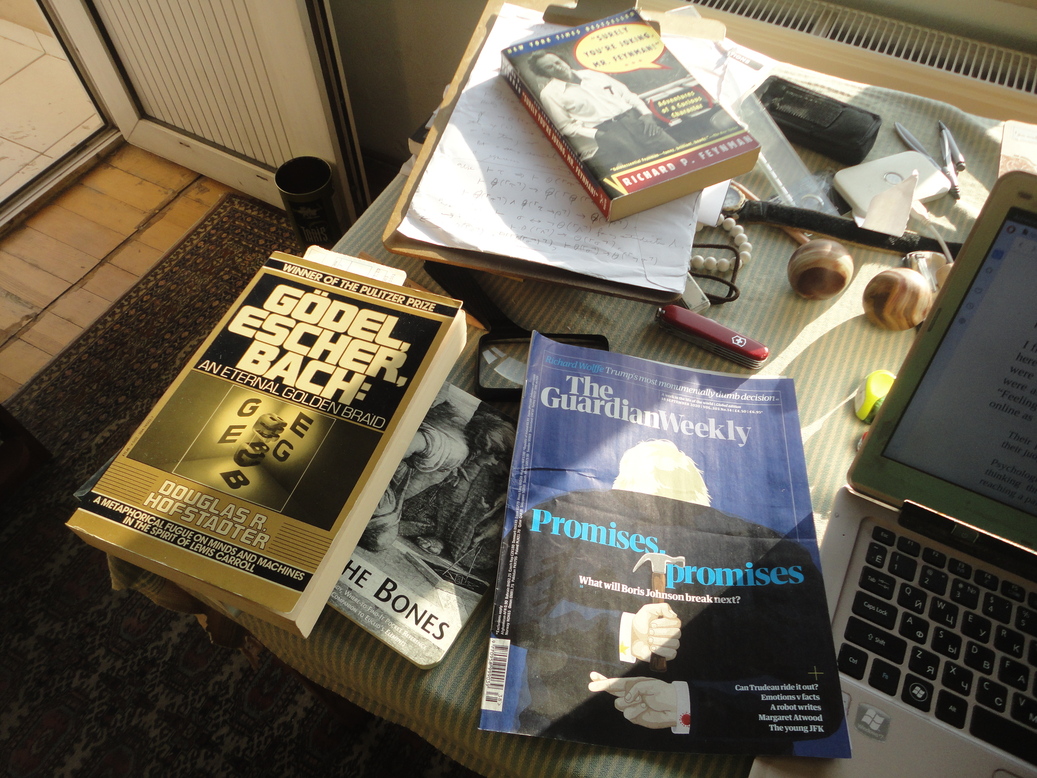
Mannequin in front of summation formula

This post concerns the Association for Mathematical Research, or AMR. A number of people are upset by its existence. I am not exactly one of them, but am suspicious, mainly because I do not know why a new organization would be needed, when we already have

The Twitter account of the AMR is dated to April, 2021. The website of the AMR supplies a list of founding members, but no account of when, how, or why they became founders. The site has a brief mission statement:

THE MISSION of the AMR is to SUPPORT MATHEMATICAL RESEARCH and SCHOLARSHIP

Are those other organizations not doing a good job? Continue reading

Feminist Epistemology

To this post, I am adding this introduction in July 2021. I have returned to some of the ideas of the post, and I see that I left them in a jumble. They may still be that, but I am trying to straighten up a bit.

Beyond this introduction, the post has three parts. Part III takes up more than half of the whole post and consists of my notes on

  1. Elizabeth Anderson, “Feminist Epistemology and Philosophy of Science,” Stanford Encyclopedia of Philosophy, February 13, 2020. 61 pages.

In Anderson’s article I see – as I note below – ideas that are familiar, thanks to my previous reading of philosophers such as Robin George Collingwood, Mary Midgley, and Robert Pirsig. Henry David Thoreau may not exactly be one of those philosophers, but he is somehow why I came to write this post in the first place.

Here is a table of contents for the whole post:

Continue reading

Pacifism

Pacifism is properly pacificism, the making of peace: not a belief or an attitude, but a practice. Mathematics then is pacifist, because learning it means learning that you cannot fight your way to the truth. Might does not make right. If others are going to agree with you, they will have to do it freely. Moreover, you cannot rest until they do agree with you, if you’ve got a piece of mathematics that you think is right; for you could be wrong, if others don’t agree.

The book *Dorothy Healey Remembers,* with photo of subject

Continue reading

Mathematics and Logic

Large parts of this post are taken up with two subjects:

  1. The notion (due to Collingwood) of criteriological sciences, logic being one of them.

  2. Gödel’s theorems of completeness and incompleteness, as examples of results in the science of logic.

Like the most recent in the current spate of mathematics posts, the present one has arisen from material originally drafted for the first post in this series.

In that post, I defined mathematics as the science whose findings are proved by deduction. This definition does not say what mathematics is about. We can say however what logic is about: it is about mathematics quâ deduction, and more generally about reasoning as such. This makes logic a criteriological science, because logic seeks, examines, clarifies and limits the criteria whereby we can make deductions. As examples of this activity, Gödel’s theorems are, in a crude sense to be refined below, that

  • everything true in all possible mathematical worlds can be deduced;

  • some things true in the world of numbers can never be deduced;

  • the latter theorem is one of those things.

Continue reading

Multiplicity of Mathematics

I continue with the recent posts about mathematics, which so far have been as follows.

  1. What Mathematics Is”: As distinct from the natural sciences, mathematics is the science whose findings are proved by deduction. I say this myself, and I find it at least implicit in an address by Euphemia Lofton Haynes.
  2. More of What It Is”: Some mathematicians do not distinguish mathematics from physics.
  3. Knottedness”: Topologically speaking, there is a sphere whose outside is not that of a sphere. The example is Alexander’s Horned Sphere, but it cannot be constructed physically.
  4. Why It Works”: Why there can be such a thing as the horned sphere.

When I first drafted the first post above, I said a lot more than I eventually posted. I saved it for later, and later is starting to come now.

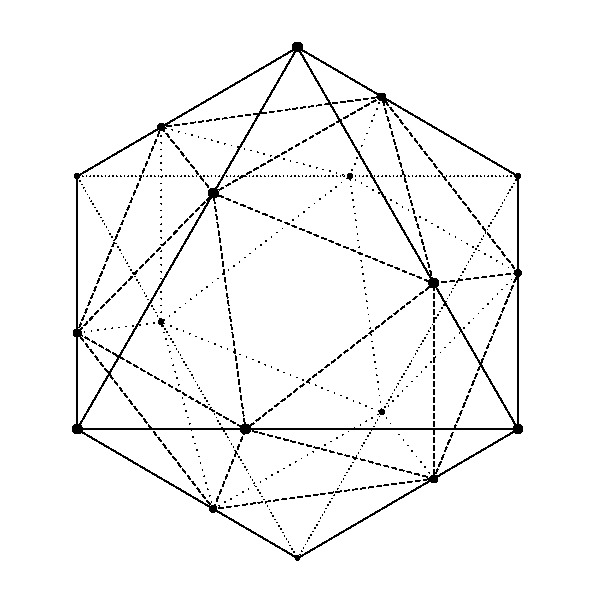
Octahedron with edges divided in the Golden Ratio by the vertices of an icosahedron

Continue reading

Why It Works

The last post, “Knottedness,” constructed Alexander’s Horned Sphere and proved, or sketched the proof, that

  • the horned sphere itself is topologically a sphere, and in particular is simply connected, meaning

    • it’s path-connected: there’s a path from every point to every other point;

    • loops contract to points—are null-homotopic;

  • the space outside of the horned sphere is not simply connected.

This is paradoxical. You would think that if any loop sitting on the horned sphere can be drawn to a point, and any loop outside the horned sphere can be made to sit on the sphere and then drawn to a point, then we ought to be able to get the loop really close to the horned sphere, and let it contract it to a point, just the way it could, if it were actually on the horned sphere.

You would think that, but you would be wrong. Continue reading

Knottedness

If you roll out a lump of clay into a snake, then tie a string loosely around it, can you contort the ends of the snake, without actually pressing them together, so that you cannot get the string off?

You can stretch the clay into a Medusa’s head of snakes, and tangle them as you like, again without letting them touch. If you are allowed to rest the string on the surface of the clay, then you can get it off: you just slide it around and over what was an end of the original snake.

Continue reading

More of What It Is

I say that mathematics is the deductive science; and yet there would seem to be mathematicians who disagree. I take up two cases here.

Page of Greek text with diagram
From Archimedes, De Planorum Aequilibriis,
in Heiberg’s edition (Leipzig: Teubner, 1881)

Continue reading

What Mathematics Is

Mathematics “has no generally accepted definition,” according to Wikipedia on September 15, 2020, with two references. On September 14, 2023, the assertion is, “There is no general consensus among mathematicians about a common definition for their academic discipline”; this time, there are no references.

I suggest that what really has no generally accepted definition is the subject of mathematics: the object of study, what mathematics is about. Mathematics itself can be defined by its method. As Wikipedia says also (as of either date given above),

it has become customary to view mathematical research as establishing truth by rigorous deduction from appropriately chosen axioms and definitions.

I would put it more simply. Mathematics is the science whose findings are proved by deduction.

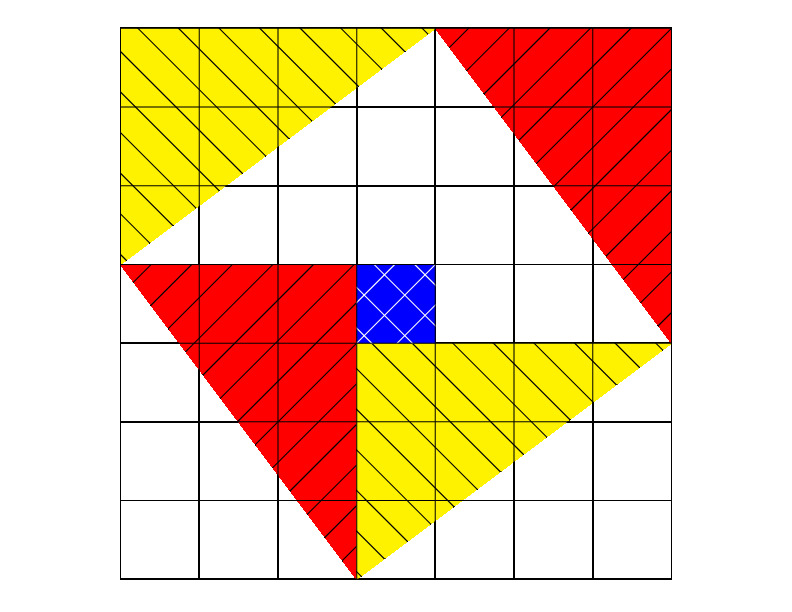
A 7×7 grid of squares, divided into four 3×4 rectangles arranged symmetrically about one square; the rectangles are divided in two by diagonals, which themselves describe a square
The right triangle whose legs are 3 and 4 has hypotenuse 5, because the square on it is
(4 − 3)2 + 2 ⋅ (4 ⋅ 3),
which is indeed 25 or 52. This is also
42 + 32.

Continue reading