Category Archives: Aristotle

Coolness

When I was ten, I learned the adjective “magnanimous” from Star Trek. I learn now from Wikipedia that the episode called “Whom Gods Destroy” was unseen in the UK until 1994, and one reason was the scene that preceded the following dialogue:

Garth of Izar
She’s yours if you wish, Captain.
Kirk
Thank you, that’s – very magnanimous of you.
Garth
You will find that I am magnanimous – to my friends, and merciless to my enemies.

The woman referred to is called Marta. Garth styles himself Lord Garth, Master of the Universe, but he is mad. For Lee Erwin then, the writer of the episode, magnanimity would seem to be generosity exhibited by the powerful, or the deserving of power, at least in their own minds. This understanding is supported by definitions in the Concise Oxford Dictionary (sixth edition, 1976):

magnanimous
Noble, generous, not petty, in feelings or conduct.
generous
Magnanimous, noble-minded; not mean or prejudiced; free in giving, munificent.

Generosity is one word for the main subject of our previous reading. Etymologically, the word refers to birth, so that generosity is literally being of good family.

Nobility, by contrast, is being “in the know”: the letters “no” show the relation, while the K of “know” corresponds to a letter missing in “noble,” but retained in “ignoble.”

In its Latin parts, “magnanimity” is being of “great soul.” The word seems to be a calque of Aristotle’s μεγαλοψυχία, which is our main subject now.
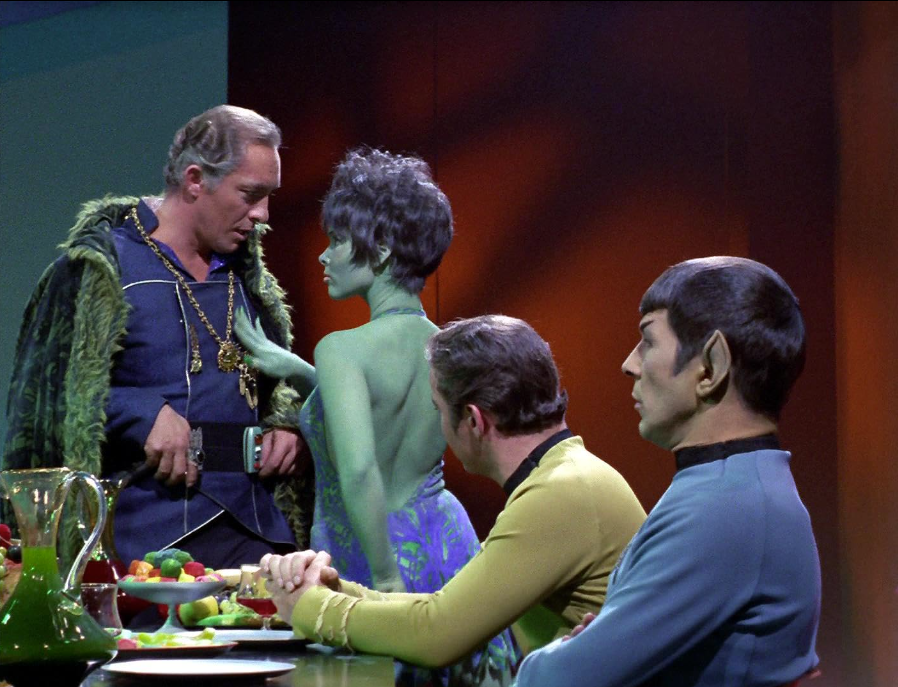
Thumbs in his belt, Garth looks down at Marta, who returns the look, her hand on his chest; seated, forearms on table, Kirk looks on, while Spock, arms crossed, looks into the distance
From “Whom Gods Destroy”
Garth, Marta, Kirk, Spock
Screenshot from IMDb
I learned Star Trek
on a black-and-white TV
The effect
of Marta’s green skin
was lost on me

Continue reading

Freeness

I write this now while many are suffering. Unfortunately that is always true.

What I am supposed to be focused on is virtue in the use of money. I shall get to this.

Toilet facility covered with the image of a forest sits in a real forest

Continue reading

Sanity

We are reading the last part of Book III of the Nicomachean Ethics of Aristotle. The subject is ἡ σωφροσύνη. This might be given various names in English, such as temperance, moderation, modesty, sobriety, sanity, prudence, continence, chastity. Our question is not so much what the best word for sôphrosyne is, but what Aristotle means by it, and how this fits with our own experience.

A grid of floors and columns rises from the ground, dwarfing the trees in front of it
Hacıosman, Sarıyer, İstanbul
September 22, 2023

Work recently began again, now under the name of Hilton, on our neighborhood’s sole skyscraper, which looms over the Hacıosman metro terminal; this is from the residential street on the other side

Like all virtues, σωφροσύνη has two attendant vices:

  • ἡ ἀκολασία, licence, licentiousness, intemperance, profligacy;
  • ἡ ἀναισθησία, “anaesthesia,” insensitivity.

Continue reading

Valor

The virtue of courage is seen most clearly

In saying this, we do not mean

  • we should all engage in such contests, or
  • any of us should, or
  • we cannot be brave without it.

Perhaps we should not be brave at all. Still, it is somehow open to us. It is better than the alternatives, but one has to work that out for oneself.

Fallen warrior on cover of Lattimore’s Iliad, lying on Crisp’s Nicomachean Ethics

Continue reading

Excuses

This post features the first five chapters of Book III of the Nicomachean Ethics of Aristotle. Those chapters take up the following subjects.

  • Chapter I. The voluntary and involuntary (ἑκούσιος and ἀκούσιος).
  • Chapter II. Choice (also called intention, preference, and rational or deliberate choice: προαίρεσις).
  • Chapter III. The deliberated (βουλευτός).
  • Chapter IV. The wished-for (βουλητός).
  • Chapter V. Vice (κακία) as being voluntary.

Mostly bare earth with a few weeds, some trash, a tree with two trunks, and a billboard; cars and low-rise buildings behind, on a sunny day
Public space in Maslak, Sarıyer
“One of the main business districts of Istanbul”
September 19, 2023

Continue reading

Manliness

The scholarship is uncertain, but the Greek word ἀρετή, which we translate as virtue, may not be etymologically related to either of

  • ἀνήρ, ἀνδρός, he-man;
  • Ἄρης, Ἄρεως, the god of war.

However,

  • “virtue” is related to the first part of “werewolf,” were being the old English word for a he-man (as wife was the word for a “she-man,” that is, a she-human, a woman; see “Math, Maugham, and Man”; the Wikipedia article “Indo-European vocabulary” currently gives ἱέραξ “hawk, falcon” as sharing the root of “virtue” and were, but Beekes gives a different root, uncertainly);
  • ἀνήρ yields the adjective ἀνδρεῖος, α, ον and the abstract noun ἀνδρεία (which like many abstract nouns is feminine), denoting respectively the person who has, and that which is, the virtue that in English is called bravery or courage.

This post is the sequel of the previous one, “Eudemony” (now extensively revised), which was on and of the first book of Aristotle’s Nicomachean Ethics. The present post is on and of the second book, whose theme is moral virtue in general.

I do wonder to what extent Aristotle thinks of ἀρετή as manliness. Homer may have done so in the Iliad, as in one of the passages (Book XV, lines 641–3) cited in the lexicon of Liddell, Scott, and Jones. This concerns a man slain by Hector, namely Periphetes, son of Copreus:

τοῦ γένετ᾽ ἐκ πατρὸς πολὺ χείρονος υἱὸς ἀμείνων
παντοίας ἀρετάς, ἠμὲν πόδας ἠδὲ μάχεσθαι,
καὶ νόον ἐν πρώτοισι Μυκηναίων ἐτέτυκτο.

Of him, a father baser by far, was begotten a son goodlier in all manner of excellence, both in fleetness of foot and in fight, and in mind he was among the first of the men of Mycenae.

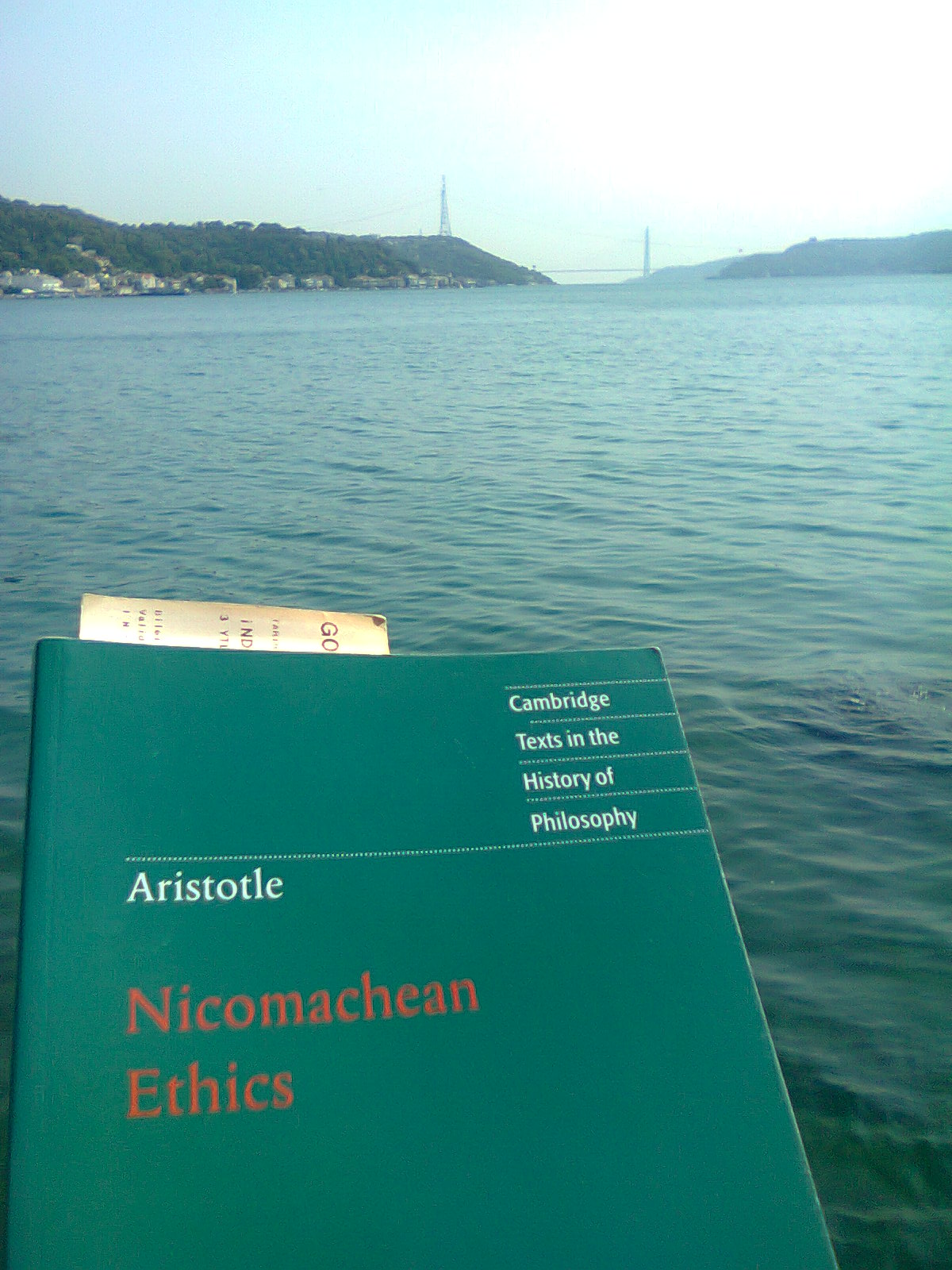
Green cover of Nicomachean Ethics, Crisp translation, against water
Lock and Key of the Bosphorus
opening to the Black Sea
Tuesday, July 11, 2023

Continue reading

Eudemony

When I was an adolescent, I conceived a desire to know “the definition of happiness.” This was all I wanted, when a friend asked what to give me for my birthday. He took me seriously, but unfortunately I could not take his answer seriously, because what he came up with was, “A puppy.” This friend did not understand that

  • an epitome was not a definition;
  • I was a cat person.

Cat roused from nap in grass next to lavender plants
Atatürk Kent Ormanı, Sarıyer, Istanbul
Friday, July 7, 2023

Continue reading

Dawn (Iliad Book XXIV)

The games of Book XXIII of the Iliad have not been enough to let Achilles sleep. He tosses and turns,

yearning for the manhood and valorous might of Patroclus, thinking on all he had wrought with him and all the woes he had borne, passing through wars of men and the grievous waves. (lines 6–9)

It occurs to me to ask: Is that what we call a description? It is a “setting down in words”; however, if it is a “verbal portrait,” this only goes to show what a remarkable power we have, to know what somebody is thinking by how he looks.

Small white flowers among leaves and vines
Atatürk Kent Ormanı
Tarabya, Sarıyer, İstanbul
May 11, 2023

Continue reading

Charles Bell’s Axiomatic Drama

Here is an annotated transcription of a 1981 manuscript by Charles Greenleaf Bell (1916–2010) called “The Axiomatic Drama of Classical Physics.” A theme is what Heraclitus observed, as in fragment B49a of Diels, LXXXI of Bywater, and D65a of Laks and Most:

We step and we do not step into the same rivers,
we are and we are not.

ποταμοῖς τοῖς αὐτοῖς ἐμβαίνομέν τε καὶ οὐκ ἐμβαίνομεν,
εἶμέν τε καὶ οὐκ εἶμεν.

Bell reviews the mathematics, and the thought behind it, of

  1. free fall,
  2. the pendulum,
  3. the Carnot heat engine.

In a postlude called “The Uses of Paradox,” Bell notes:

Forty-five years ago I decided that when reason drives a sheer impasse into an activity which in fact goes on, we have to think of the polar cleavage as both real and unreal.

I like that reference to “an activity which in fact goes on.” In youth it may be hard to recognize that there are activities that go on. We do things then, but that they will get anywhere may be no more than a dream. In any case, Bell himself goes on:

… that is a job as huge and demanding as Aristotle’s, and for me at 70, just begun.

“Look,” my friends say, “Bell’s been doing the same thing since he was 25. About that time he had a vision of Paradox as paradise, and he’s been stuck there ever since.”

Bell’s picture next to Aristotle’s Physics
The back of Bell’s Five Chambered Heart with
the front of the OCT of Aristotle’s Physics

Continue reading

On Plato’s Republic, 14

Index to this series

In the tenth and final book of Plato’s Republic (Stephanus 595–621), with the help of Glaucon, Socrates does three things:

  1. Confirm and strengthen the ban on imitative poetry carried out in Book III.
  2. Prove the immortality of the soul.
  3. Tell the Myth of Er about how best to make use of that immortality.


Bernard Picart
Glaucus Turned into a Sea-God, 1731
“Just as those who catch sight of the sea Glaucus would no longer easily see his original nature because some of the old parts of his body have been broken off and the others have been ground down and thoroughly maimed by the waves at the same time as other things have grown on him – shells, seaweed, and rocks – so that he resembles any beast rather than what he was by nature, so, too, we see the soul in such a condition because of countless evils” – Republic 611d

Here is a finer analysis, as part of a general table of contents for this post.

  • Prologue
    • A Translation Issue. How you translate Book X depends on whether you believe Socrates has a theory that all art is imitation. I have gathered sixteen translations of a diagnostic passage that Collingwood highlights in The Principles of Art (1938).
    • Imitation Elsewhere – that is, in Books II, III, V, and VI, as well as in the Phaedrus.
  • Book X
    • Imitation
      • What It Is. It is at a third remove from reality.
      • Homer and the Tragic Poets – did you ever hear that they had
        • given a city its constitution,
        • led a successsful military campaign,
        • invented something useful,
        • been revered as private teachers, as Pythagoras was and sophists want to be?
      • The Three Arts involving a thing:
        1. Using it.
        2. Making it.
        3. Imitating it.
      • Parts of the Soul – the best part is the calculating part, which can avoid the confusions that imitations subject the worse parts to.
      • Imitation Is of the Worse – our worse aspects, not the good and decent ones.
      • Imitation Makes Us Worse by bringing out shameful feelings for others that we suppress for ourselves.
      • Philosophy and Poetry – they have an old quarrel, but philosophy is willing to listen to an argument on behalf of poetry.
    • Immortality – the soul must have this, because only its specific evils could kill it, and these are the opposites – injustice, license, cowardice, and ignorance – of the virtues identified in Book IV. They do not in fact kill the soul, at least not directly.
    • Myth of Er – a Pamphylian, son of Armenius, he died in battle, but rose again on the twelfth day, having learned that, unless condemned to hell, we are going to choose our next life, after a spell in heaven or purgatory, depending on how we have lived our current life; thus we had better be ready to choose wisely.

Continue reading