Pressure
Istanbul is a crowded, paved city. Consider the graphic below, showing public green space in Istanbul, London, New York, Berlin, Hong Kong, and Paris. The green space of Istanbul is almost invisible.
Istanbul is a crowded, paved city. Consider the graphic below, showing public green space in Istanbul, London, New York, Berlin, Hong Kong, and Paris. The green space of Istanbul is almost invisible.
A march from Taksim Square to the offices of Agos newspaper, where Hrant Dink was assassinated seven years ago today, January 19, 2014.

Seller of water and whistles
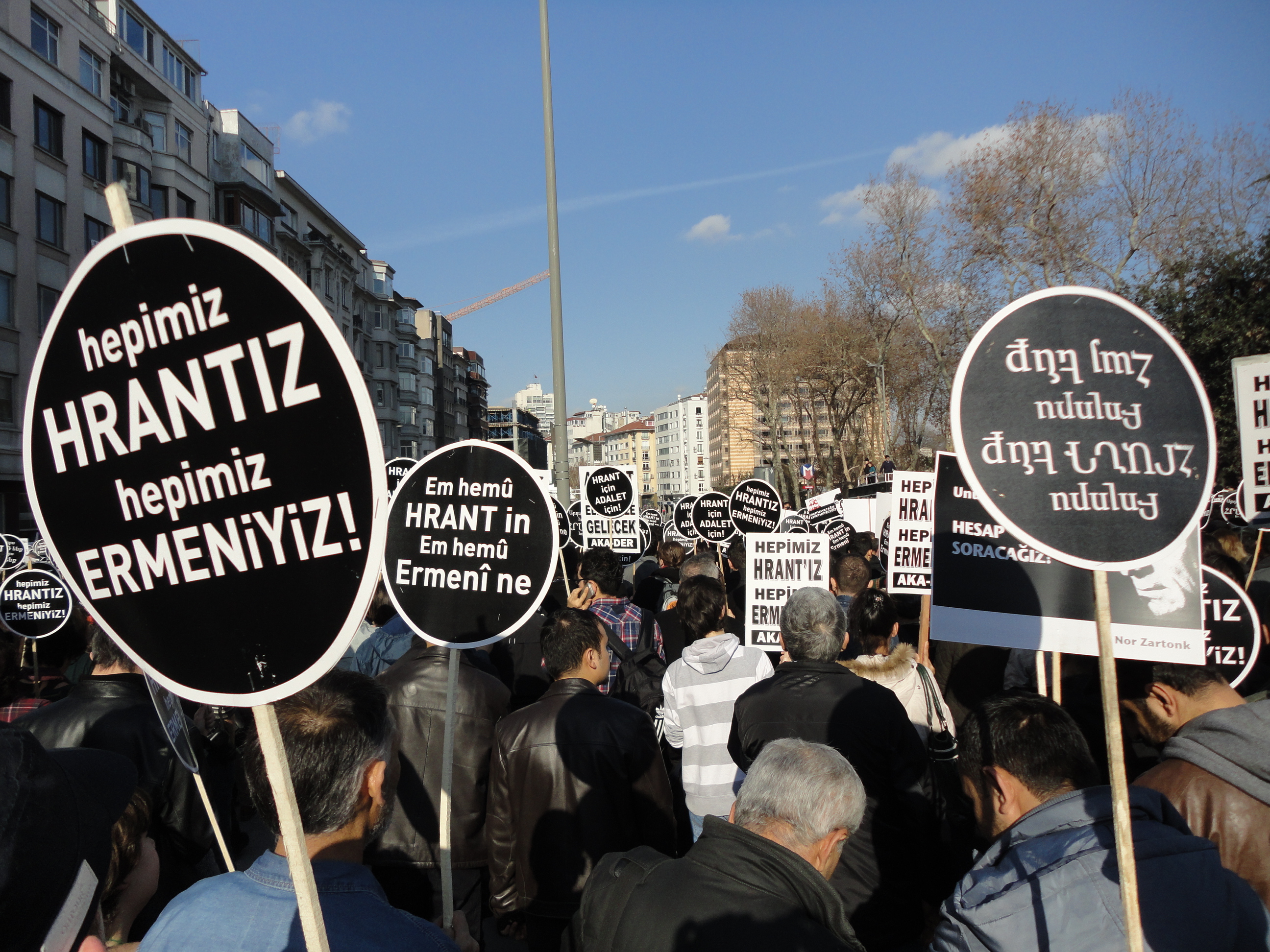
“We are all Hrant, we are all Armenian” (in Armenian, Turkish, and Kurdish)
I am not able, and do not attempt, to tell the full story of recent events in Istanbul. My impression is that mainstream foreign media (in English) do a reasonable job at this. It might be emphasized that the first protesters were yoga practitioners and tree huggers. It was police brutalization of them that drew out more violent protesters—as well as people who had never demonstrated in their lives. If the government had allowed May Day demonstrations this year, as last year, then radicals might have blown off some steam then, and the rest might not have happened. But this is just speculation, not meant to belittle the serious grievances that people have with the government. What follows is just a personal account of a walking tour in the vicinity of Taksim Square, June 1, 2013. I made a Google map of the route. The most interesting experience was seeing plain-clothes police officers retreating from Taksim. The second-most interesting was encountering a wedding of friends of the ruling party, taking place in the gardens of an Ottoman pleasure palace, while police battled protesters about 600 meters away.
We were awakened in the night by a strange persistant sound. Was it the creaking of our building in the Next Big Earthquake? No, it was our neighbors beating on pots and pans.
Continue reading
I returned again this afternoon (Friday, May 31, 2013) to Gezi Park, or rather to its vicinity. Since yesterday the police had fenced it off.
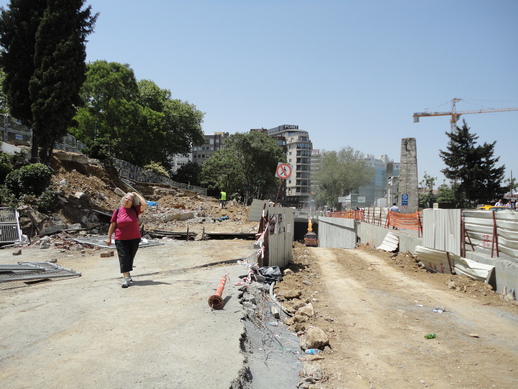
Northern end of Gezi Park
The police fences can be seen on the left above. I think the woman here was just trying to make her way to Taksim. Presently I noticed that my eyes were stinging. It was the same with other people nearby, even in front of the ritzy Hotel Intercontinental adjacent to the park. Some young men I consulted with there confirmed that the police were using tear gas.
Continue reading
They took all the trees and put ’em in a tree museum
And they charged all the people a dollar and a half just to see ’emDon’t it always seem to go
That you don’t know what you’ve got til it’s gone
They paved paradise and put up a parking lot
Taksim Square is the cultural heart of Istanbul. Most of it is paved, but nearby is Gezi Parkı, shaded by many trees. It is somewhat out of the way and hidden from view: from the Taksim side, one must climb steps to reach it, and between it and the main road north, Cumhuriyet Caddesi, there are restaurants and a Turkish Airlines office. As a tourist in Istanbul, I was only vaguely aware of the park. Now, as a resident, whenever I walk from home to Taksim, I pass through the park.
The Turkish Prime Minister Recep Tayyip Erdoğan intends to replace the park with buildings of some kind. His words are translated by Hürriyet Daily News:
If you have respect for history, first you need to learn the history of Gezi Park.
He is supposedly referring to the Topçu Kışlası or Artillery Barracks that used to stand on the land of the park.
It is a bad joke. Continue reading
The value of learning was in question, a thousand years ago, during and after the reign of Emperor Basil II, in what was to become Istanbul. When learning has no purpose, it may flourish; when it has, it may be abandoned when the purpose is not achieved soon enough. Michael Psellus suggests this in Fourteen Byzantine Emperors (London: Penguin, 1966).

Michael Psellos (left) with his student, Byzantine Emperor Michael VII Doukas
This is about the bird and its appearance in the Quran.
We (my wife and I) live at the edge of the upper reaches of a stream valley on the European side of the Bosphorus. The stream drains a plain where Sultan Abdülmecid (1839–61) once invited immigrants to settle. That area is now called Mecidiyeköy (village of Mecid), and until the 1950s, it was mostly open fields. Continue reading
One reason for this blog is to avoid being enclosed by the wall of the garden called Facebook.
Sometimes I enjoy reading the history of where I live, and lately I have been working slowly through Judith Herrin, Byzantium: The Surprising Life of a Medieval Empire. The work is not chronological like that of John Julius Norwich (I have read only his Short History of Byzantium); but it does have a chapter on Emperor Basil II, the so-called Bulgar-Slayer, who apparently led the Byzantine Empire to its apogee. Reading this, I could not remember having read about Basil before, in Michael Psellus; but I had, as I could see when Herrin mentioned the latter.

 Polytropy