Mathematics and Logic

Large parts of this post are taken up with two subjects:

  1. The notion (due to Collingwood) of criteriological sciences, logic being one of them.

  2. Gödel’s theorems of completeness and incompleteness, as examples of results in the science of logic.

Like the most recent in the current spate of mathematics posts, the present one has arisen from material originally drafted for the first post in this series.

In that post, I defined mathematics as the science whose findings are proved by deduction. This definition does not say what mathematics is about. We can say however what logic is about: it is about mathematics quâ deduction, and more generally about reasoning as such. This makes logic a criteriological science, because logic seeks, examines, clarifies and limits the criteria whereby we can make deductions. As examples of this activity, Gödel’s theorems are, in a crude sense to be refined below, that

  • everything true in all possible mathematical worlds can be deduced;

  • some things true in the world of numbers can never be deduced;

  • the latter theorem is one of those things.

Continue reading

Multiplicity of Mathematics

I continue with the recent posts about mathematics, which so far have been as follows.

  1. What Mathematics Is”: As distinct from the natural sciences, mathematics is the science whose findings are proved by deduction. I say this myself, and I find it at least implicit in an address by Euphemia Lofton Haynes.
  2. More of What It Is”: Some mathematicians do not distinguish mathematics from physics.
  3. Knottedness”: Topologically speaking, there is a sphere whose outside is not that of a sphere. The example is Alexander’s Horned Sphere, but it cannot be constructed physically.
  4. Why It Works”: Why there can be such a thing as the horned sphere.

When I first drafted the first post above, I said a lot more than I eventually posted. I saved it for later, and later is starting to come now.

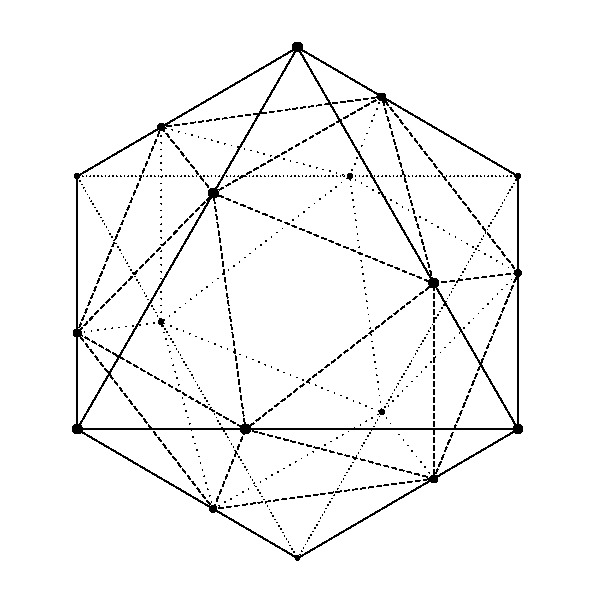
Octahedron with edges divided in the Golden Ratio by the vertices of an icosahedron

Continue reading

Why It Works

The last post, “Knottedness,” constructed Alexander’s Horned Sphere and proved, or sketched the proof, that

  • the horned sphere itself is topologically a sphere, and in particular is simply connected, meaning

    • it’s path-connected: there’s a path from every point to every other point;

    • loops contract to points—are null-homotopic;

  • the space outside of the horned sphere is not simply connected.

This is paradoxical. You would think that if any loop sitting on the horned sphere can be drawn to a point, and any loop outside the horned sphere can be made to sit on the sphere and then drawn to a point, then we ought to be able to get the loop really close to the horned sphere, and let it contract it to a point, just the way it could, if it were actually on the horned sphere.

You would think that, but you would be wrong. Continue reading

Knottedness

If you roll out a lump of clay into a snake, then tie a string loosely around it, can you contort the ends of the snake, without actually pressing them together, so that you cannot get the string off?

You can stretch the clay into a Medusa’s head of snakes, and tangle them as you like, again without letting them touch. If you are allowed to rest the string on the surface of the clay, then you can get it off: you just slide it around and over what was an end of the original snake.

Continue reading

More of What It Is

I say that mathematics is the deductive science; and yet there would seem to be mathematicians who disagree. I take up two cases here.

Page of Greek text with diagram
From Archimedes, De Planorum Aequilibriis,
in Heiberg’s edition (Leipzig: Teubner, 1881)

Continue reading

What Mathematics Is

Mathematics “has no generally accepted definition,” according to Wikipedia on September 15, 2020, with two references. On September 14, 2023, the assertion is, “There is no general consensus among mathematicians about a common definition for their academic discipline”; this time, there are no references.

I suggest that what really has no generally accepted definition is the subject of mathematics: the object of study, what mathematics is about. Mathematics itself can be defined by its method. As Wikipedia says also (as of either date given above),

it has become customary to view mathematical research as establishing truth by rigorous deduction from appropriately chosen axioms and definitions.

I would put it more simply. Mathematics is the science whose findings are proved by deduction.

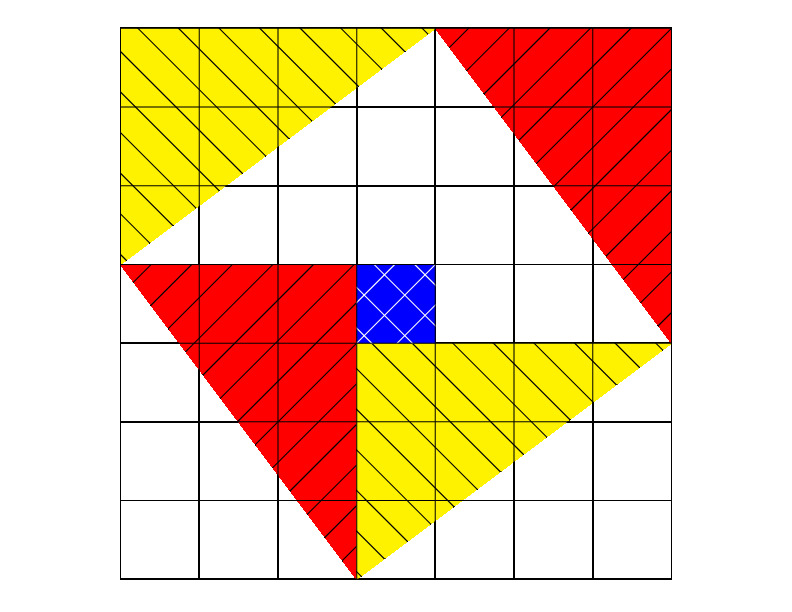
A 7×7 grid of squares, divided into four 3×4 rectangles arranged symmetrically about one square; the rectangles are divided in two by diagonals, which themselves describe a square
The right triangle whose legs are 3 and 4 has hypotenuse 5, because the square on it is
(4 − 3)2 + 2 ⋅ (4 ⋅ 3),
which is indeed 25 or 52. This is also
42 + 32.

Continue reading

LaTeX to HTML

This is a little about mathematics, and a little about writing for the web, but mostly about the nuts and bolts of putting mathematics on the web. I want to record how, mainly with the pandoc program, I have converted some mathematics from a LaTeX file into html. Like “Computer Recovery” then, this post is a laboratory notebook.

A stack of books of and about mathematics: The Princeton Companion to Mathematics at the bottom, volume 2 of Heath’s edition of The Elements of Euclid at the top

Continue reading

Map of Art

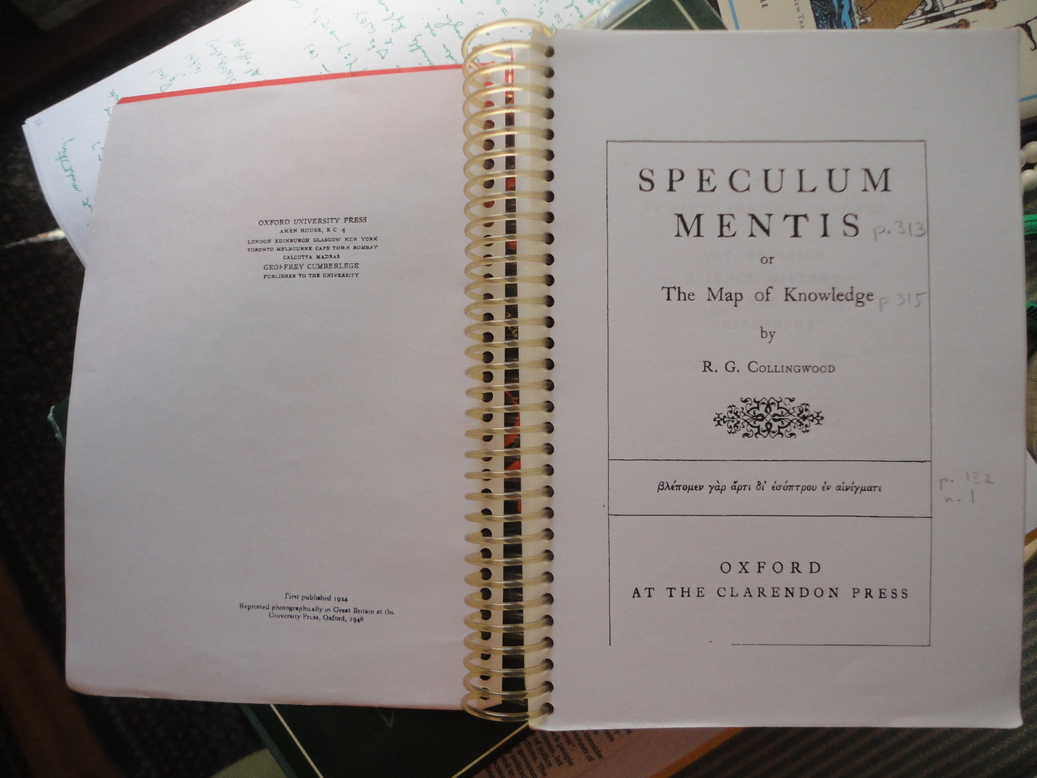
The bulk of this post is a summary of the chapter on art in Collingwood’s Speculum Mentis: or The Map of Knowledge (1924). The motto of the book is the first clause of I Corinthians 13:12:

Βλέπομεν γὰρ ἄρτι δι’ ἐσόπτρου ἐν αἰνίγματι

For now we see through a glass, darkly

The chapter “Art” has eight sections:

Continue reading

Discrete Logarithms

In the fall of 2017, I created what I propose to consider as being both art and mathematics. Call the art conceptual; the mathematics, expository; here it is, as a booklet of 88 pages, size A5, in pdf format.

More precisely, the work to be considered as both art and mathematics is the middle of the three chapters that make up the booklet. The first chapter is an essay on art, ultimately considering some examples that inspire my own. The last chapter establishes the principle whereby the lists of numbers in Chapter 2 are created.

Continue reading

An Exercise in Analytic Geometry

This past spring (of 2020), when my university in Istanbul was closed (like all others in Turkey) against the spread of the novel coronavirus, I created for my students an exercise, to serve at least as a distraction for those who could find distraction in learning.

Diagram from textbook page shows, centered at the origin of coordinates, a circle and an ellipse whose four points of intersection are traversed by two lines in red through the origin
From Weeks & Adkins, Second Course in Algebra, p. 395

Note added, April 17, 2023: An account of the mathematics involved in the exercise would ultimately be published as: Pierce, D. (2021). “Conics in Place.” Annales Universitatis Paedagogicae Cracoviensis | Studia Ad Didacticam Mathematicae Pertinentia, 13, 127–150.

Continue reading