The von Neumann natural numbers: a fractal-like image

See the next article, “Self-similarity,” for an animation of the image here.

I have long been fascinated by von Neumann’s definition of the natural numbers (and more generally the ordinals). In developing axioms for set theory, Zermelo used the sets 0, {0}, {{0}}, {{{0}}}, {{{{0}}}}, and so on as the natural numbers. Here 0 is the empty set. Zermelo’s method works, but is not so elegant as von Neumann’s later proposal to consider each natural number as the set of all natural numbers that are less than it is, so that (again) 0 is the empty set, but also n + 1 = {0, 1, …, n}.
Continue reading

Similar images of different saints

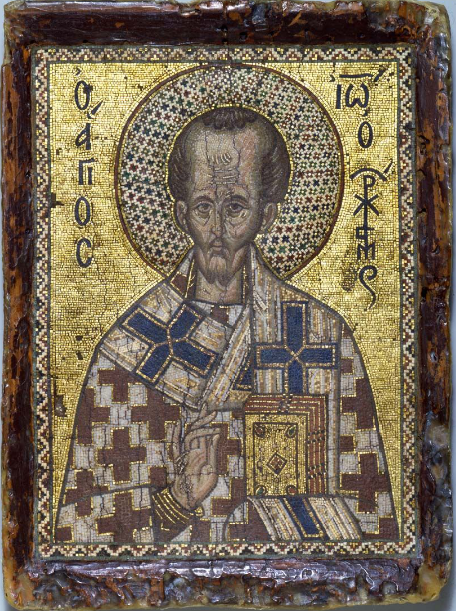
I have been impressed by the similar depiction of the two saints here; first, St John Chrysostom, from the Byzantine collection of Dumbarton Oaks:

Image

and then St Cyril of Alexandria, in an image taken from Wikipedia, though apparently the original image is in Chora, here in Istanbul.  (I visited Chora once, maybe 14 years ago, but hope to visit again soon.)

Image

I was originally impressed by how the blue and red crosses of the vestments of Chrysostom were repeated in his halo; then I happened upon the image of Cyril, with crosses similar in form, though not color, again repeated about the head.

The Point of Teaching Mathematics

This essay was provoked in part by a New York Times opinion piece by Andew Hacker (July 28, 2012) called “Is Algebra Necessary?” (the suggested answer being No):

Continue reading

On reading too much into words

First let it be noted that nothing I say here will have any effect on hostilities in the so-called Holy Land or anywhere else. I have no need here to take any particular line; no reader should assume that I do or do not elsewhere follow any particular line.

I do wish to promote clear thought. I should like to think that my friends and colleagues have a similar wish, especially when they are academics like me.  Of course, what counts as clear thought may vary. I am a mathematician, professionally; I work in the mathematics department of a university. Certain modes of thought are therefore habitual with me; they may not be habitual in other departments, not to mention other walks of life. I may adopt my modes of thought at the expense of others.

I feel compelled to say such things, having been shocked to find that what I say here may be at all controversial. Continue reading

Science and anti-science

I published most of the following as a Note on Facebook, Wednesday, October 3, 2010.

Is there an ongoing or perhaps an increasing antipathy to science, and if so, are scientists to blame? The passage below treats this question, but was written 75 years ago, in December, 1935. The author could remember the war of 1914–1918, a war that he described in his Autobiography as “an unprecedented disgrace to the human intellect”, but “an unprecedented triumph for natural science.” Continue reading

Michael Psellus on learning

The value of learning was in question, a thousand years ago, during and after the reign of Emperor Basil II, in what was to become Istanbul. When learning has no purpose, it may flourish; when it has, it may be abandoned when the purpose is not achieved soon enough. Michael Psellus suggests this in Fourteen Byzantine Emperors (London: Penguin, 1966).

Two standing figures with robes and caps, dark on the left, only outlined on the right, on a gold ground
Michael Psellos (left) with his student, Byzantine Emperor Michael VII Doukas

Continue reading

Strunk and White

The following is a lightly edited concatenation of some emails I wrote several years ago, in response to “50 Years of Stupid Grammar Advice,” Geoffrey K. Pullum’s article in The Chronicle of Higher Education (April 17, 2009). [I returned to Strunk and White in March 2018; I supplemented the present post in July 2018.] Continue reading

Logic (notes on the finger-wagging Cratylus)

The senior essay that I wrote at St John’s College was called something like ‘An account based in Aristotle of the Law of Contradiction’. I do not know now what the point was. I had read the Metaphysics in a preceptorial, so I decided to spend even more time with this book in writing my essay. I remember noting ultimately that humans could indeed be self-contradictory. Hector was an example. To Andromache he described two incompatible expectations: that their son would win renown, and that the boy would die as an infant when the Greeks took Troy. Continue reading

Aristotle on Heraclitus

Along with various fellow alumni of St John’s College (Annapolis and Santa Fe), I am currently reading Eva Brann, The Logos of Heraclitus (Paul Dry Books, 2011). This may inspire some incidental posts, such as the present one, which considers the same sentence about Heraclitus by Aristotle in three languages, mainly because of the oddity of a published Turkish translation. The oddity is in the treatment of opinion and knowledge. The distinction between them is important in, for example, Plato’s Republic; but I shall not really have anything to say here about the distinction as such.

Miss Brann spends III.A (pages 15–19) considering Fragment 50 (by the Diels reckoning):

οὐκ ἐμοῦ, ἀλλὰ τοῦ λόγου ἀκούσαντας ὁμολογεῖν σοφόν ἐστιν ἓν πάντα εἶναι

Continue reading

The swift

This is about the bird and its appearance in the Quran.

We (my wife and I) live at the edge of the upper reaches of a stream valley on the European side of the Bosphorus. The stream drains a plain where Sultan Abdülmecid (1839–61) once invited immigrants to settle. That area is now called Mecidiyeköy (village of Mecid), and until the 1950s, it was mostly open fields. Continue reading