Tag Archives: 2024

Found Poetry

This is adapted from emails I wrote in 2022 (on February 10 and July 16 and 17). I post them now, because I have been updating the “Directory” of documents that I have saved on this blog, other than as posts. I could not remember why I had saved an “Annotation” from Harper’s, until I found the reason below. I take up poetry by T. S. Eliot, E. McKim, and Robinson Jeffers, in addition to the one I first quote.


An email friend shared a poem called “Merrymakers” (from “Four Poems,” London Review of Books, 9 May 2013), by Charles Simic:

A troop of late night revellers,
most likely shown the door
at some after-hours club
or a party in the neighbourhood,
still whooping it up
as they stagger down the street
with a girl in a wedding dress
walking pigeon-toed far behind them,
and calling out in distress:
‘Hey, you! Where the fuck
do you think you’re going?’

The poets sets us up, sort of the way young Eliot does in “Prufrock”:

Let us go then, you and I,
When the evening is spread out against the sky
Like a patient etherised upon a table …

The shock from Simic is not in image, but in meter, which one might have expected to continue iambically:

A troop of late night revellers,
  most likely shown the door
at some old after-hours club,
  continued with their roar,
forgetting sensibilities …

As it is, the poem gets prosy. The lines are pretty much just units of speech, “end-stopped,” never “emjambed,” at least until the end.

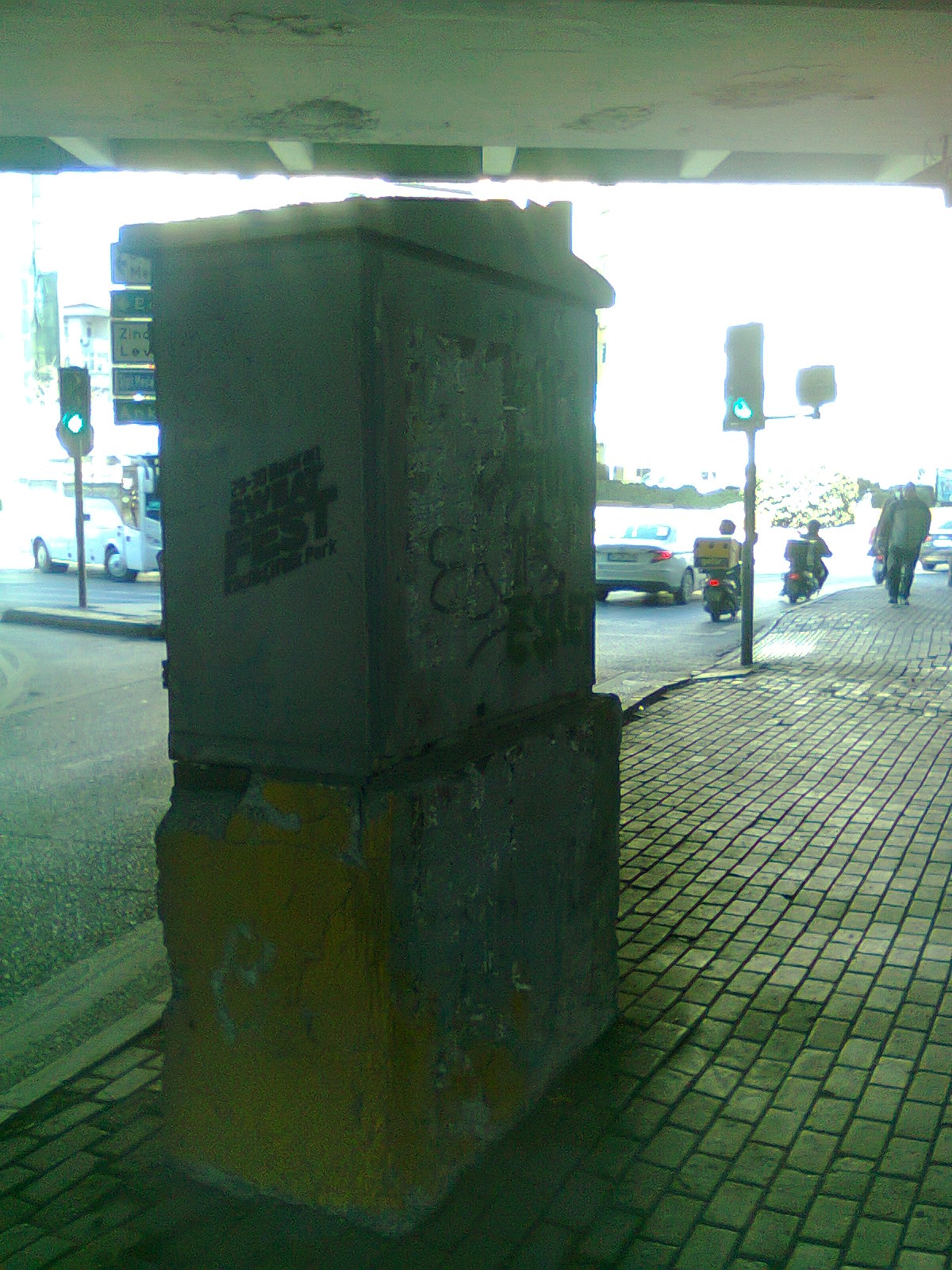
Just printing the vignette as poetry makes us pay attention in a certain way. Art is everywhere, if we know how to see it. The other day I was walking by an ugly old electrical box on the street, covered with remains of old posters, and I thought it could be spruced up with a small brass plaque, as if it were a sculpture.
Religious Science

Below is Chapter 1, “Science and the Modern World,” of The Relevance of Science by C. F. von Weizsäcker.

The last post of this blog was of my annotated version of Chapter 3, “Creation in the Old Testament.”

As the author reports in his Preface, The whole book consists of the first of two series of Gifford Lectures at Glasgow, 1959–61.

Stage seen from audience
I had the opportunity myself to lecture in Tabriz, on August 28, 2012. This was in Iran, so the wall behind me held a portrait of the late Ayatollah Khomeini, along with some kind of icon of science. We were at a national mathematics conference, but I included some of my artwork in the slides of my talk (called “Model-theory of differential fields”)

Continue reading

Biblical Creation

Below is “Creation in the Old Testament,” which is Chapter 3 of The Relevance of Science by C. F. von Weizsäcker. I have highlighted key passages. I have added a note concerning Pascal, because I spent time reading him and blogging about him, and von Weizsäcker mentions him.

I am studying von Weizsäcker’s chapter, to see what the author makes of the Creator’s assessment of His own work. That assessment is the title of another post of this blog: “It Was Good.”

Hundreds of identical unfinished fairy-tale châteaux in a broad valley
Somebody set out to build Burj Al Babas here in Turkey, for buyers in the Persian Gulf, but abandoned the project

Continue reading

Resurrection

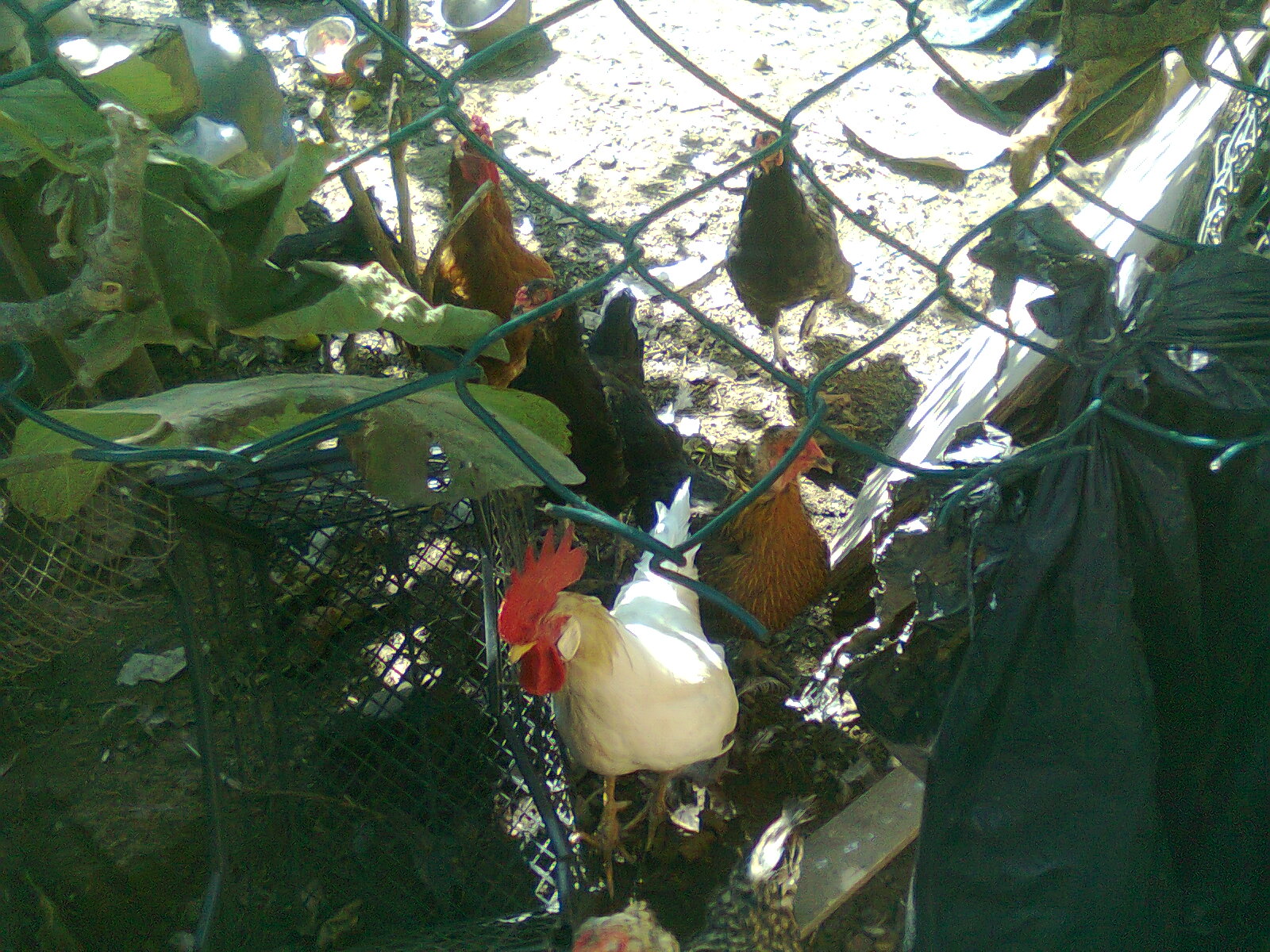
White rooster, brown chickens, behind a chain-link fence
From a walk around the neighborhood
Tarabya, Istanbul, Wednesday, October 9, 2024

There were a couple of tweets on the eve of Easter:

Just a reminder to make sure that you preach a doctrine of the resurrection tomorrow that is not reducible to that of the old IWW song “Joe Hill”


It’s a good song! I find it moving! But if that’s all we have to say about the resurrection (and I have heard many sermons that suggest that it is) – well, we should all be doing something else with our lives.

Fortunately, of course, it’s not all we have to say.

Continue reading

A Five Line Locus

In high school, if not sooner, one learns theorems established more than two millenia ago by Euclid and Archimedes. I am thinking of the theorems expressed today by the equations

𝐶 = 2π𝑟,
𝐴 = π𝑟²

for the circumference and area of a circle whose radius is 𝑟, and

𝐴 = 4π𝑟²,
𝑉 = (4/3)π𝑟³

for the surface area and volume of a sphere whose radius is 𝑟. One may also learn about the curves that Apollonius called parabola, ellipse, and hyperbola and that are given today by instances of the general quadratic equation

𝐴𝑥² + 𝐵𝑥𝑦 + 𝐶𝑦² + 𝐷𝑥 + 𝐸𝑦 + 𝐹 = 0.

Such notation as this was introduced in the seventeenth century by Descartes, who apparently used it also to understand the curve given by the cubic equation

(𝑦² − 𝑎²)(𝑦 − 𝑏) = 𝑎𝑥𝑦.

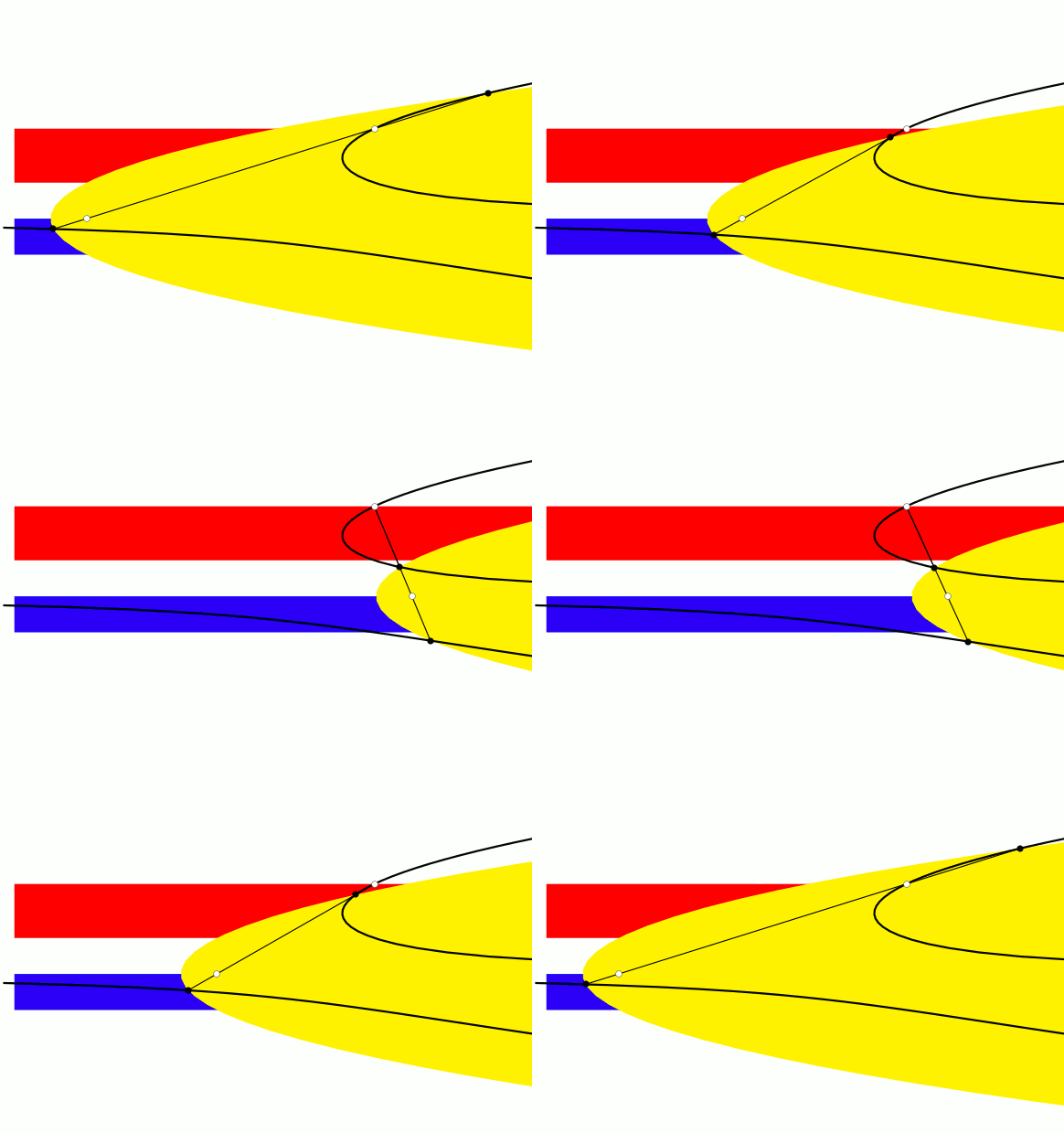
Decartes showed that the curve in question could be generated as in the animation below, where a parabola slides along its axis, and a straight line has one point fixed and one point moving with the parabola, and the points of intersection of this straight line with the parabola give us the desired curve.

Animation described in text

Continue reading

Life in a Crowd

The essay below was originally a post on Medium, August 7, 2017. I wrote from the Nesin Mathematics Village. The crowds there, described here, are a great way to spread infections, as I used to find out. For this reason, I have not gone back to the Village since the winter of 2020, when Covid-19 became pandemic.

The Village is in the hills above Ephesus, site of the temple of Artemis, where there were golden oxen, donated by King Croesus, according to Herodotus (I.92).

When I first came to Turkey in 1998, Herodotus was my tour guide. Because of my interest, from our base in Atarneus, my father-in-law-to-be took seven of us (including himself and a dog) to see Sardis: this was the seat from which Croesus had ruled Lydia, until Cyrus the Great of Persia defeated him.


Cats facing off in the Atatürk City Forest
Tarabya, Sarıyer, Istanbul, October 16, 2024

Continue reading

Free Groups and Topology

My title alludes to some notes for the layperson that I rediscovered recently. I have reviewed and edited them, and they are below, in the following sections (linked to by the titles after the three main bullets; other links are to Wikipedia).

  • Quasicrystals,” based on an email of mine sent to a group of alumni of St John’s College on October 8, 2011. This was my contribution to a thread in which somebody said that
    • Dan Schechtman (whom she called Danny) was a worthy recipient of that year’s Nobel Prize in Chemistry for the discovery of quasicrystals, but
    • John Cahn deserved credit, even the prize itself, as the real discoverer.

    My wife and I had recently moved to Istanbul, and the Istanbul Model Theory Seminar had just got going. The Nobel Prize and quasicrystals had been mentioned there too.

  • Free Groups,” based on an email of October 10, 2011. I tried to describe free groups to somebody who expressed interest, but who also called himself the world’s worst mathematician.
  • Topology” – a draft of an attempt to describe that subject. In graduate school, I got excited about the definition of a topological space when I first encountered it. Here I try to motivate the definition by abstracting from the properties of the Cartesian plane as a metric space. I give the example of the Zariski topology on the same plane. I start to talk about the topology derived from the Gromov–Hausdorff metric on the space of groups with n generators, but then I stop.

A green landscape
Vegetable plot in Yeniköy (where Cavafy lived a while), Istanbul, Saturday, September 28, 2024

Continue reading

Motivated Reasoning in the Cyropaedia of Xenophon

The son of the king of Persia wants to press the advantage, after the combined forces of Media, Persia, Armenia, and Chaldaea have

  • killed the Assyrian king, along with most of his best men, and
  • driven the rest of the Assyrian army from their fortifications.

The king of Media is of another mind: he would rather quit while he is ahead. He has an argument for standing pat, by the account of Xenophon in the Cyropaedia (IV.i.11–18).

One may consider the argument of Cyaxares as an example of “motivated reasoning.” I think it is a specious argument: attractive, but ultimately unsound. Perhaps I say that, only because the king’s nephew Cyrus rejects the argument, but is nonetheless successful in what he goes on to do. With his Persian troops and as many Medians as wish to join them, along with the Hyrcanians, who have defected from Assyria, Cyrus pursues and defeats again the Assyrian army. He kills the kings of Cappadocia and Arabia, and he puts to flight both the king of Phrygia and Croesus, king of Lydia (IV.ii.28–31). Of course, this is not the end of the story; history never ends.

I have been reading and discussing the eight books of the Cyropaedia with a Catherine Project group, at the rate of half a book a week, since July 8 of this year (2024). Thus we shall have completed the sixth book (called “On the Eve of the Great Battle” in the Loeb edition) on September 23. It has astonished me that some of my fellow readers think well of the argument for taking it easy, even as they acknowledge that the man who makes it may be a fool. The argument does not seem to me like one that a king such as Cyaxares can afford to make.

Possibly Xenophon has an esoteric message, as Plato is thought to have. However, although these two writers had a common teacher in Socrates, he never went far from Athens. Xenophon helped lead a stranded army of ten thousand Greek mercenaries, from Babylon north to the Black Sea, after the failure of the coup for which they had been hired by Cyrus the Younger. Xenophon admires a practical man who can actually get things done. This being what Cyrus the Elder is, he is the hero of the Cyropaedia. I shall review my textual reasons for saying this. First I shall look at “motivated reasoning” today, along with the idea that we could have “evolved” to use it. (In short, the rest of this post has the three parts just linked to.)

Pine bough above; bushes below; blue sky, sparkling water, and sand in between

Photo taken September 17, 2024, of Lesbos over the sea, from a beach in Lydia. Of this country, Chrysantas says to Cyrus, after the latter has pursued the Assyrians over the objections of his uncle Cyaxares (Cyropaedia VI.ii.21),

since it now appears that Syria is not to be the only prize – though there is much to be got in Syria, flocks and herds and corn and palm-trees yielding fruit – but Lydia as well, Lydia the land of wine and oil and fig-trees, Lydia, to whose shores the sea brings more good things than eyes can feast on, I say that once we realise this we can mope no longer, our spirits will rise apace, and we shall hasten to lay our hands on the Lydian wealth without delay.

This is in response to the suggestion of Cyrus that his army are intimidated by the alliance that Assyria has formed with Lydia.

Continue reading

On The Human Condition of Hannah Arendt

It could have been nice to live in a world where spending time and energy on playing chess did not seem like an unconscionable luxury.

Above, a sky partly filled with dark clouds, between which are patches of white and pink from a sun recently set behind distant mountains; below, separated by a triangle of sea, is a beach where, sitting on chairs facing west, two figures, male and female, lower their heads to contemplate glowing screens
Is it a luxury to be able to ignore the setting sun over Lesbos
in order to look at your mobile?
Photo taken September 1, 2024
on the coast of what used to be part of Lydia

I used to play chess, until I figured that when I wanted to think mathematically, there were better ways to do it.

Continue reading

Tests

This post concerns different kinds of knowledge, as for example of Achilles, or Cyrus the Great, or even oneself.

According to the last sentence of the “Findings” column in Harper’s for June, 2023,

Researchers developed a blood test for anxiety, which was found to underlie the joy of missing out.

Those researchers need a weatherman to tell which way the wind blows.

Similar research is reported in the Guardian Weekly for 9 September, 2022. The article is called “‘I’m glowing’: How an app is helping us measure the joy of trees.” The app in question does not detect your joy in the woods; it gives you a way to record your own self-assessment for later study. However, writes Patrick Barkham,

several studies suggest that more biodiversity has a bigger boost on people’s mental health, while the recording of brain activity in response to forest density found a more relaxed state and reduced tension and fatigue in forests with a lower density of trees.

Are you going to need a brain scan to tell if you are chilling out? Other people may relax among a few trees; does that mean you will?

My grandfather Kenneth Crawford described his own grandparents’ house in Wisconsin as being

innocent of plumbing, central heat or telephone. But the proportions were good and it was set in a grove of assorted trees.

I wish he had named some of the trees in the assortment. Right now I’ve got doves cooing in the umbrella pines overhead. Beneath these are oleanders and laurels and pomegranate trees.

Pine trunk next to leaves and needles of other trees; white wall below

Continue reading