Tag Archives: “Abscissas and Ordinates”

Astronomy Anomaly

Aristotle was the subject of the last three posts on this blog:

Perception Deception
The Philosopher asserts in De Anima that the eyes cannot be in error about color; Josef Albers contradicts this.
Imitation Limitation
In the Poetics, Aristotle seems to use mimêsis as a differentia of poiêsis among the technai. Arts not poetry are nonetheless imitative, but perhaps artists are to be distinguished for imitating themselves.
Purity Obscurity
Does catharsis clean the emotions, or wash them away?

Two more posts might have taken up the latter half of the Poetics, but they never materialized.

I turn now to the work held under the arm of Aristotle’s teacher, at the center of Raphael’s School of Athens.


Small book atop a pile of rubble on a beach, sea beyond

Altınova, Balıkesir, Monday, June 16, 2025

Continue reading

Foresight

Stairway of solid blocks, lined with ivy and shrubs
Stairway up from Dereiçi Sokağı
(“Inside the Stream Street,” the old road down to the bay)
to Tarabya Bayırı Caddesi (“Therapy Slope Avenue”)
Tarabya, Sarıyer, Istanbul
Monday, January 15, 2024

Continue reading

On Dialectic

This is about dialectic in Plato’s Republic and today. There’s a lot here, and in another post I may investigate why that is; meanwhile, I note words of Serge Lang (1927–2005) in the Foreward of Algebra (third edition, 1993):

Unfortunately, a book must be projected in a totally ordered way on the page axis, but that’s not the way mathematics “is”, so readers have to make choices how to reset certain topics in parallel for themselves, rather than in succession.

From socialism to liberalism and perhaps back

The word “dialectic” has the air of a technical term. It intimidated me in the eighth grade, when I chose communism as my topic for a paper in political geography, and I found myself consulting a big book on dialectical materialism. My main source ended up being the Communist Manifesto, which says nothing of dialectic as such.

The Manifesto may take up dialectic implicitly, as by saying in the beginning (with my bullets),

  • Freeman and slave,
  • patrician and plebeian,
  • lord and serf,
  • guild-master and journeyman, in a word,
  • oppressor and oppressed,

stood in constant opposition to one another, carried on an uninterrupted, now hidden, now open fight, a fight that each time ended, either in a revolutionary reconstitution of society at large, or in the common ruin of the contending classes.

Perhaps one would refer to the ongoing fight between oppressor and oppressed as dialectical. However, dialogue being conversation, I take dialectic to be the art of conversing; fighting is something else.

Two curled-up cats, one on the seat of a motorcycle parked on the sidewalk in front of two joined houses, the other on top of the low wall between the fronts of the houses
Saturday, April 16, 2022
Muvezzi Caddesi, Serencebey, Beşiktaş, İstanbul

Continue reading

Potential (Iliad Book XIII)

Let us first look at the calendar. We see the dawn of a new day in the Iliad in Book I, line 477, when the mission led by Odysseus to give Chryseis back to her father Chryses sails back to the Achaean camp at Troy.

The day before, when the mission arrived in Chryse, Thetis told Achilles that, the day before that, Zeus and the other gods had gone to visit the Ethiopians in Oceanus, but would return on the twelfth day (lines 423–5).

It is not clear to me just how the counting is done, but a twelfth dawn comes on line 493, when the gods return to Olympus, and Thetis gets the nod from Zeus that he will honor Achilles, who meanwhile has been going neither to the “place of gathering” (ἀγορή, line 490) nor to war. We are given no details, such as we now see in Book XIII, of how the war has been going.

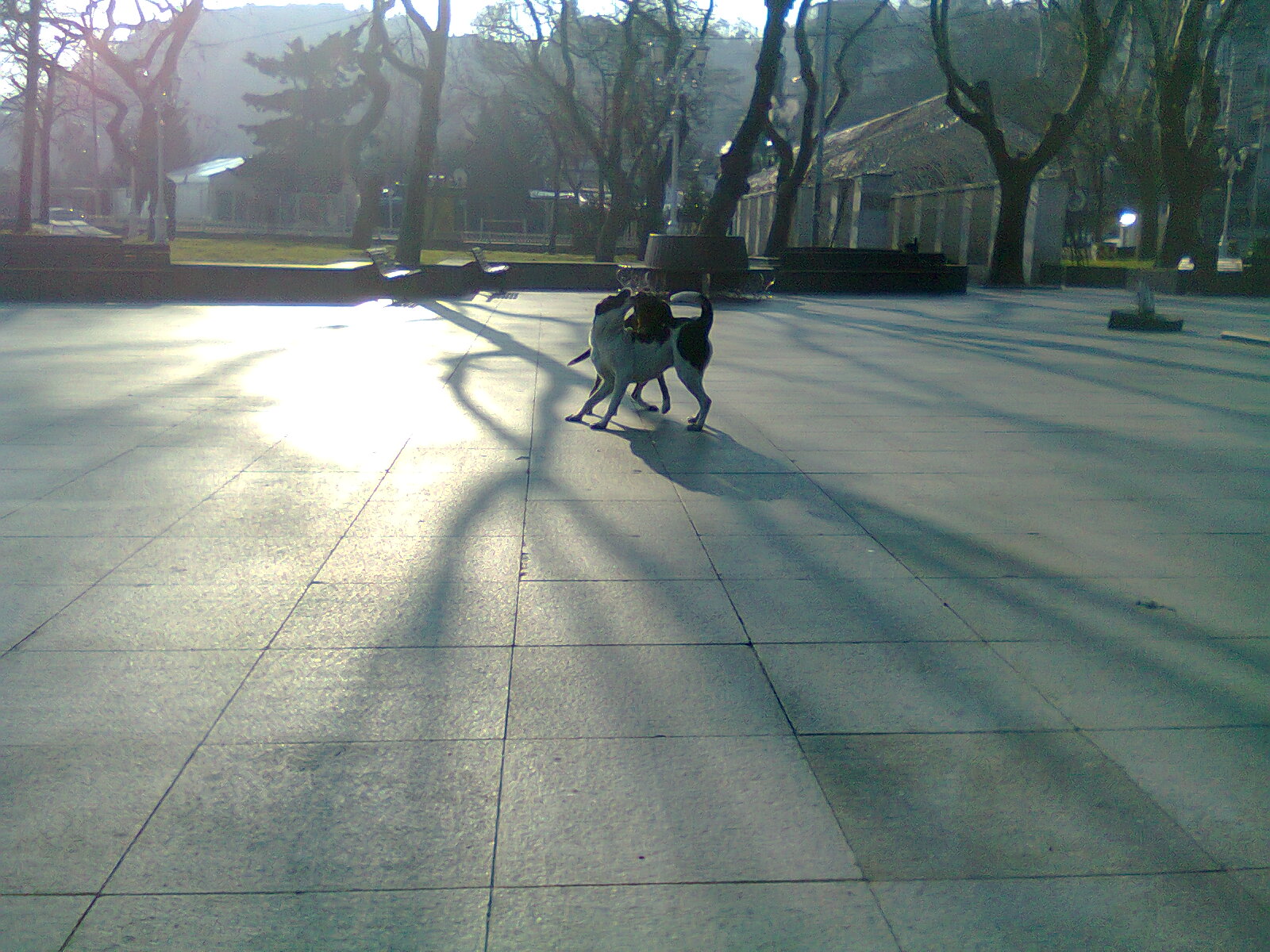
Two dogs on a stone plaza among the shadows of the bare trees that are behind them
Two dogs play-fighting
Haydar Aliyev Parkı
Kireçburnu, Sarıyer, Istanbul
Saturday morning, February 18, 2023

Continue reading

On Plato’s Republic, 14

Index to this series

In the tenth and final book of Plato’s Republic (Stephanus 595–621), with the help of Glaucon, Socrates does three things:

  1. Confirm and strengthen the ban on imitative poetry carried out in Book III.
  2. Prove the immortality of the soul.
  3. Tell the Myth of Er about how best to make use of that immortality.


Bernard Picart
Glaucus Turned into a Sea-God, 1731
“Just as those who catch sight of the sea Glaucus would no longer easily see his original nature because some of the old parts of his body have been broken off and the others have been ground down and thoroughly maimed by the waves at the same time as other things have grown on him – shells, seaweed, and rocks – so that he resembles any beast rather than what he was by nature, so, too, we see the soul in such a condition because of countless evils” – Republic 611d

Here is a finer analysis, as part of a general table of contents for this post.

  • Prologue
    • A Translation Issue. How you translate Book X depends on whether you believe Socrates has a theory that all art is imitation. I have gathered sixteen translations of a diagnostic passage that Collingwood highlights in The Principles of Art (1938).
    • Imitation Elsewhere – that is, in Books II, III, V, and VI, as well as in the Phaedrus.
  • Book X
    • Imitation
      • What It Is. It is at a third remove from reality.
      • Homer and the Tragic Poets – did you ever hear that they had
        • given a city its constitution,
        • led a successsful military campaign,
        • invented something useful,
        • been revered as private teachers, as Pythagoras was and sophists want to be?
      • The Three Arts involving a thing:
        1. Using it.
        2. Making it.
        3. Imitating it.
      • Parts of the Soul – the best part is the calculating part, which can avoid the confusions that imitations subject the worse parts to.
      • Imitation Is of the Worse – our worse aspects, not the good and decent ones.
      • Imitation Makes Us Worse by bringing out shameful feelings for others that we suppress for ourselves.
      • Philosophy and Poetry – they have an old quarrel, but philosophy is willing to listen to an argument on behalf of poetry.
    • Immortality – the soul must have this, because only its specific evils could kill it, and these are the opposites – injustice, license, cowardice, and ignorance – of the virtues identified in Book IV. They do not in fact kill the soul, at least not directly.
    • Myth of Er – a Pamphylian, son of Armenius, he died in battle, but rose again on the twelfth day, having learned that, unless condemned to hell, we are going to choose our next life, after a spell in heaven or purgatory, depending on how we have lived our current life; thus we had better be ready to choose wisely.

Continue reading

More of What It Is

I say that mathematics is the deductive science; and yet there would seem to be mathematicians who disagree. I take up two cases here.

Page of Greek text with diagram
From Archimedes, De Planorum Aequilibriis,
in Heiberg’s edition (Leipzig: Teubner, 1881)

Continue reading

An Exercise in Analytic Geometry

This past spring (of 2020), when my university in Istanbul was closed (like all others in Turkey) against the spread of the novel coronavirus, I created for my students an exercise, to serve at least as a distraction for those who could find distraction in learning.

Diagram from textbook page shows, centered at the origin of coordinates, a circle and an ellipse whose four points of intersection are traversed by two lines in red through the origin
From Weeks & Adkins, Second Course in Algebra, p. 395

Note added, April 17, 2023: An account of the mathematics involved in the exercise would ultimately be published as: Pierce, D. (2021). “Conics in Place.” Annales Universitatis Paedagogicae Cracoviensis | Studia Ad Didacticam Mathematicae Pertinentia, 13, 127–150.

Continue reading

On the Idea of History

Note added, March 10–11, 2021. The bulk of this post concerns race in the theory of history, particularly the theory attributed to Johann Gottfried Herder (1744–1803). Not having read Herder for myself, I rely on the accounts of

  • R. G. Collingwood in § 2, “Herder,” of Part III of The Idea of History (1946),
  • Michael Forster in “Johann Gottfried von Herder,” Stanford Encyclopedia of Philosophy (summer 2019).

Somebody like Herder may introduce race as an hypothesis to explain history, but ultimately the hypothesis fails, by denying us the freedom that is essential to history as such. Nonetheless, Forster defends Herder as having

an impartial concern for all human beings … Herder does also insist on respecting, preserving, and advancing national groupings. However, this is entirely unalarming,

because, for one thing, “The ‘nation’ in question is not racial but linguistic and cultural.”

Change Collingwood’s word “race” to “linguistic and cultural grouping” then. I think his conclusion remains sound: “Once Herder’s theory of race is accepted, there is no escaping the Nazi marriage laws.”

More detail is in the post below. I go on to review the philosophy of history that Collingwood presents in the Introduction of The Idea of History. This book provided me with a title for the post.

I wrote a lot in this post, as I often do. Growing self-conscious for being opinionated about the theory of history, I listed the published evidence of my actually being an historian (an historian of ancient Greek mathematics in particular).

I originally wrote that my research had been inspired by a tweet. The author of that tweet also wrote the nice long comment on this post. However, although the tweet can be found on the Internet Archive, the author later deleted his Twitter account, and so the tweet appears on Twitter today as a gap in the thread above my own tweet in response to the other tweet.

That missing tweet referred to another tweet of the author, but the Internet Archive seems not to have saved it. It did save the present post; so if one were curious, one could see the changes that I have made since initial publication, or rather since September 29, 2020, when the Archive took the first snapshot.

The changes are for style and local clarity. Any large-scale changes would need me to recover the spirit that possessed me when I originally wrote.

I return to this post now, simply because a friend mentioned reading Middlemarch, and I remembered quoting George Eliot’s novel in a blog post, and that post turned out to be this one.

Had somebody mentioned reading Herder, I might have recalled writing about him in a blog post; that would be this post too.


Our environment may influence our feelings, but what we make of those feelings is up to us. Thus we are free; we are not constrained by some fixed “human nature”—or if we are, who is to say what its limits are?


Rembrandt van Rijn (and Workshop?), Dutch, 1606–1669,
The Apostle Paul, c. 1657, oil on canvas,
Widener Collection, National Gallery of Art

Continue reading

Piety

The post below is a way to record a passage in the Euthyphro where Socrates says something true and important about mathematics.

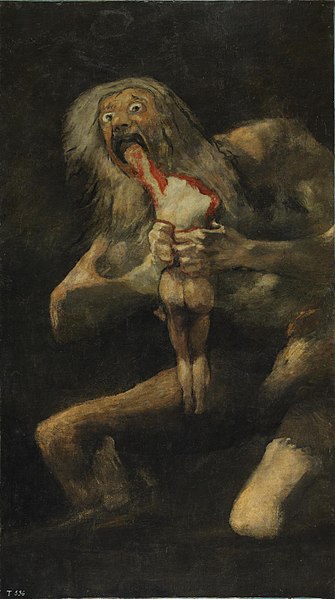
Crude depiction of bug-eyed figure grasping the torso of, and putting into his mouth the arm of, a smaller figure
Goya, [Cronus] Devouring His Son
(see below)

The passage is on a list of Platonic passages that I recently found, having written it in a notebook on May 23, 2018. The other passages are in the Republic; here they are, for the record, with some indication of why they are worth noting (translations are Shorey’s, originally from 1930 and 1935 in the old Loeb edition):

Continue reading

Hypomnesis

When is a help a hindrance? The Muses have provoked this question. They did this through their agents, the cicadas, who sang around the European Cultural Center of Delphi, during the 11th Panhellenic Logic Symposium, July 12–5, 2017.

     Cicada, European Cultural Center of Delphi, 2017.07.15     

Cicada, European Cultural Center of Delphi, 2017.07.15

My question has two particular instances.

  1. At a mathematical conference, can theorems “speak for themselves,” or should their presenters be at pains to help the listener appreciate the results?

  2. When the conference is in Greece, even at one of the country’s greatest archeological sites, does this enhance the reading of ancient Greek texts, or is it only a distraction?

Continue reading