Tag Archives: Claire Berlinski

Machinations

Sources for this post include the following.

  • On recent events in the US:

    1. Seth Masket, “Friday Night Musk-acre” (February 1, 2025).
    2. Olga Lautman: “Why has Musk gained access to our data?” (February 2, 2025).
    3. Timothy Snyder, “The Logic of Destruction: And how to resist it” (February 2, 2025).
    4. Heather Cox Richardson, “February 2, 2025.”
    5. Malcolm Nance, “In The Trump ‘White’ House: No Spies Matter” (February 7, 2025).
    6. “An Uproar as Trump and Musk Wreak Havoc” (New York Times, letters, February 7, 2025).
    7. Elad Nehorai, “Elon Musk Isn’t a White Nationalist. He’s a White Globalist” (February 7, 2025).
  • On technological fantasies and what they may do to students:

    1. Michael Townsen Hicks, James Humphries, and Joe Slater, “ChatGPT is bullshit” (2024).
    2. John Warner, “AI Boosters Think You’re Dumb” (February 2, 2025).
    3. Seth Bruggeman, “A Crisis of Trust in the Classroom” (January 14, 2025) – students either cheat with technology, or do little of anything.
    4. Robert Pirsig, Zen and the Art of Motorcycle Maintenance (1974) – perhaps students motivated only by grades should drop out.
    5. Steve Rose (interviewer), “Five ways AI could improve the world: ‘We can cure all diseases, stabilise our climate, halt poverty’” (Thu 6 Jul 2023) – Ray Kurzweil thinks “Our mobile phone … makes us more intelligent,” and since we already have nukes, AI is “not really making life more dangerous”; anyway, “More intelligence will lead to better everything.”
    6. Rachel Uda, “In Such a Connected World, Why Are We Lonelier Than Ever?” (February 6, 2023).
    7. Hanna Rosin interviewing Jonathan Haidt, “The Smartphone Kids Are Not All Right” (March 21, 2024).
  • On a particular fantasy of effortless learning:

    1. Wikipedia, “Decoded neurofeedback.”
    2. Adam Hadhazy, “Science Fiction or Fact: Instant, ‘Matrix’-like Learning” (June 21, 2012).
    3. Takeo Watanabe and others, “Perceptual Learning Incepted by Decoded fMRI Neurofeedback Without Stimulus Presentation” (9 December 2011).
    4. Kevin Le Gendre, “Steel pan virtuoso Leon Foster Thomas: ‘Some people don’t think it’s a serious instrument’ ” (February 24, 2023).
  • Works leading me, somehow, to all of that:

    1. Northrop Frye, The Double Vision (1991).
    2. Peter Jukes, “In a rare interview, Philip Pullman tells us his own origin story, and why the great questions are still religious ones” (13 January 2014).

Towering over tourists are stone figures that have “the body of a bull, wings of an eagle, and the crowned head of a bearded men”
At Persepolis, outside Shiraz, Iran, Tuesday, September 4, 2012, this is the Gate of Xerxes – the Xerxes whose failed invasion of Greece is recounted by Herodotus


Continue reading

Religious Science

Below is Chapter 1, “Science and the Modern World,” of The Relevance of Science by C. F. von Weizsäcker.

The last post of this blog was of my annotated version of Chapter 3, “Creation in the Old Testament.”

As the author reports in his Preface, The whole book consists of the first of two series of Gifford Lectures at Glasgow, 1959–61.

Stage seen from audience
I had the opportunity myself to lecture in Tabriz, on August 28, 2012. This was in Iran, so the wall behind me held a portrait of the late Ayatollah Khomeini, along with some kind of icon of science. We were at a national mathematics conference, but I included some of my artwork in the slides of my talk (called “Model-theory of differential fields”)

Continue reading

Words (Iliad Book XX)

“The feeling of helplessness and humiliation in the face of an abuse of power is an awful one.” That’s what Achilles found out, back in Book I of the Iliad; however, the words themselves, dated April 11, 2023, are by Claire Berlinski. Her Agamemnon is Elon Musk.

Two cats sit facing one another on a narrow ledge below one window and above another
“And when they were come near, as they advanced one against the other, then first unto Aeneas spake swift-footed goodly Achilles: ‘Aeneas, wherefore hast thou sallied thus far forth from the throng to stand and face me?’ ” (Iliad 20.176–9)
Kireçburnu (“Lime Point”)
Κλειδὴς καὶ κλεῖθρα τοὺ Πόντου (“Lock and Key of the Pontus”)
Sarıyer, Istanbul
Sunday morning, March 26, 2023

Continue reading

Focus (Iliad Book XVI)

Book XVI of the Iliad is where Patroclus

  • comes out to fight in Achilles’s armor,
  • kills Zeus’s son Sarpedon,
  • pushes on to the walls of Troy,
  • is killed by Hector.

In 2019, I gave a fair summary of the book, saying the story was that of Icarus. This time, I shall look at some other details:

  • Achilles continues his struggle for equality.
  • His mother sent him off with a chest of warm clothes.
  • Boys have always taunted wasps.
  • As if he were a boy, Hera tells Zeus, “What if everybody else did the same thing?” when he considers saving his son.
  • Automedon’s response to a problem is not autonomic, but autonomous.
  • Glaucus has a personal relationship with God.
  • It is Zeus’s mind that takes our own off things we mean to do.

A squatting man aims his mobile at several crows who are confronting a cat on a concrete wharf. Beyond them is the Bosphorus, leading out to the Black Sea beneath a suspension bridge between Europe and Asia
Kireçburnu, Sarıyer, Istanbul, Friday, March 10, 2023
The cat whom the crows were harrassing soon walked off

Continue reading

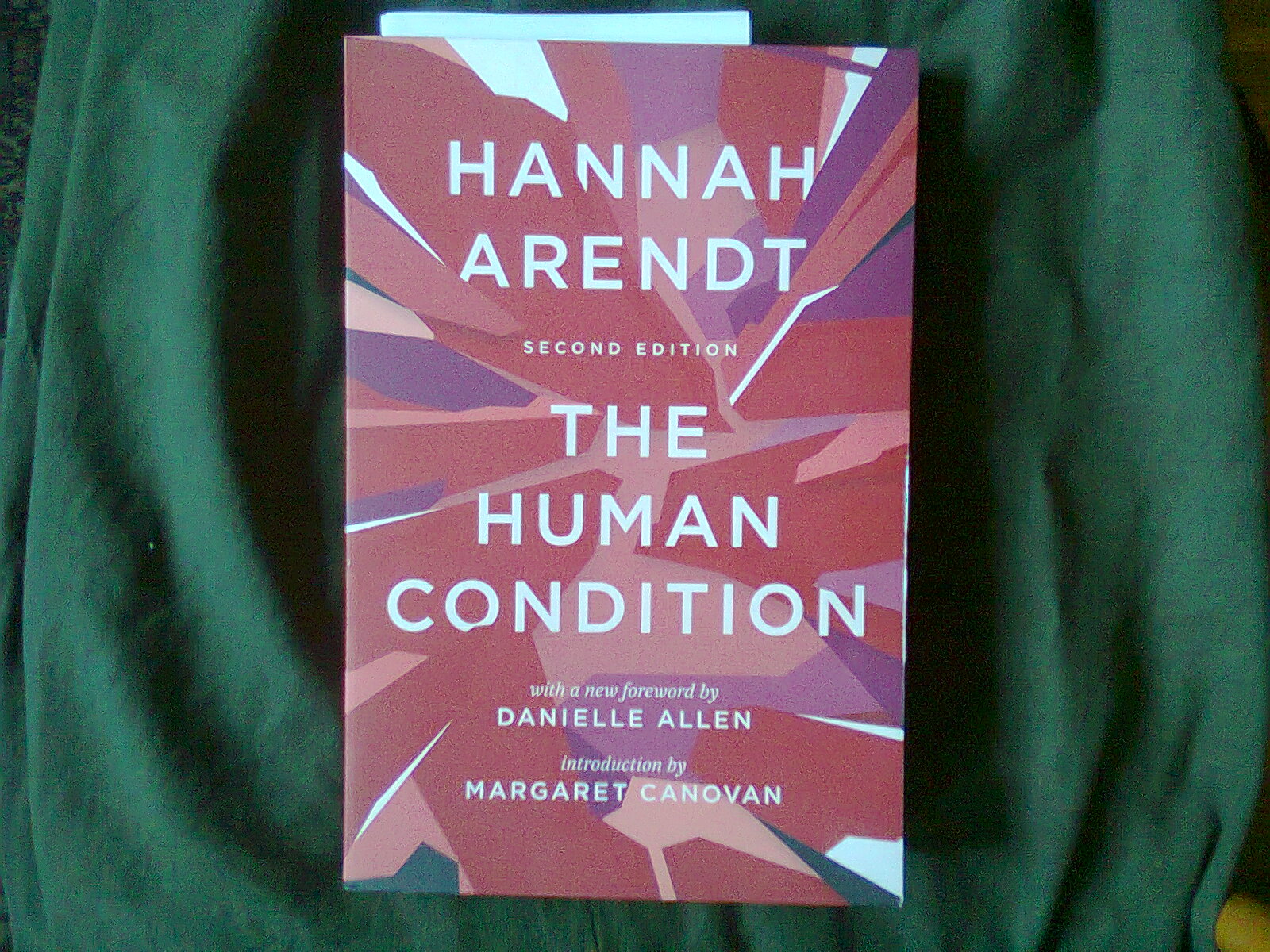
On The Human Condition of Hannah Arendt 1

Here begins a series based on the 1958 book by Hannah Arendt (1906–75) called The Human Condition. The publisher classifies it as philosophy and political science. I sense a kind of similarity with a book that I have devoted many blog posts to: The New Leviathan (1942) of R. G. Collingwood (1889–1943).

Collingwood wrote about European civilization as a war threatened to end it. Arendt managed to escape that war, and she went on to write about civilization in her own way in The Human Condition. Today, February 24, 2022, a new war for territory in Europe begins.

Red-themed cover of The Human Condition against dull green cloth

Continue reading