Tag Archives: Harold North Fowler

We the Pears of the Wild Coyote Tree

This is a preliminary report on two recent films:

  • The Wild Pear Tree, by Nuri Bilge Ceylan;
  • We the Coyotes, by Marco La Via and Hanna Ladoul.

The report is preliminary, not because there is going to be another, but because I have seen each film only once, and I may see one of them again.

I remember that François Truffaut liked to see films at least twice. I believe I read this in The Washington Post, and I might have guessed it was in an appreciation published when Truffaut died; however, he died on October 21, 1984, during the first semester of my sophomore year at St John’s College in Santa Fe, and I would not have been reading the Post then.

While in college, I did enjoy seeing some films twice, or a second time; Truffaut’s own 400 Coups was an example, a French teacher having shown it to us in high school.

The two films that I am reviewing now concern young adults trying to find their own way in the world, in defiance of their elders. We all have to do this. In every generation, some will do it more defiantly than others. Heraclitus can be defiant, he of Ephesus and thus one of the Ionian philosophers, whose spirit I imagine to haunt the Nesin Mathematics Village. A further reason to bring up Heraclitus will be a theme that is explicit in Pear Tree, implicit (or metaphorical) in Coyotes: gold.

A book, whose cover shows a bonfire, sits on a rock dampened by waves of the sea, which laps on the sand beyond
A copy of The Logos of Heraclitus,
by Eva Brann,
on Marmara Island, July, 2012
Continue reading

Piety

The post below is a way to record a passage in the Euthyphro where Socrates says something true and important about mathematics.

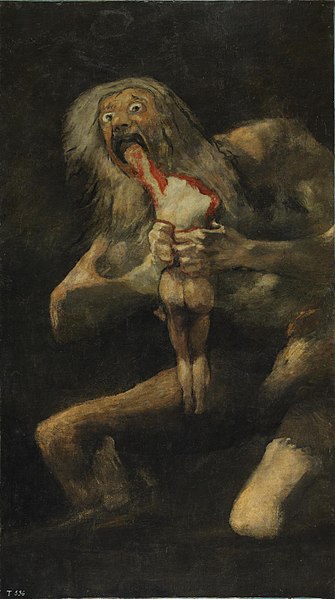
Crude depiction of bug-eyed figure grasping the torso of, and putting into his mouth the arm of, a smaller figure
Goya, [Cronus] Devouring His Son
(see below)

The passage is on a list of Platonic passages that I recently found, having written it in a notebook on May 23, 2018. The other passages are in the Republic; here they are, for the record, with some indication of why they are worth noting (translations are Shorey’s, originally from 1930 and 1935 in the old Loeb edition):

Continue reading

NL XIV: “Reason”

Index to this series

Summary added January 29, 2019, revised May 8, 2019. Practical reason is the support of one intention by another; theoretical, one proposition by another. Reasoning is thus always “motivated reasoning”: we engage in it to relieve the distress of uncertainty. Reason is primarily practical, only secondarily theoretical; and the reason for saying this is the persistence of anthropomorphism in theoretical reasoning: by the Law of Primitive Survivals in Chapter IX, we tend to think even of inanimate objects as forming intentions the way we do.

Reasons for adding this summary of Chapter XIV of Collingwood’s New Leviathan include

  • the tortuousness of the following post on the chapter,
  • the provocation of a Guardian column by Oliver Burkeman on motivated reasoning.

Says Burkeman, whose “problem” is apparently motivated reasoning itself,

One of the sneakier forms of the problem, highlighted in a recent essay by the American ethicist Jennifer Zamzow, is “solution aversion”: people judge the seriousness of a social problem, it’s been found, partly based on how appetising or displeasing they find the proposed solution. Obviously, that’s illogical …

On the contrary, how we reason cannot be “illogical,” any more than how we speak can be “ungrammatical.” Logic is an account, or an analysis, of how we do actually reason; grammar, of how we speak. Of course we may make errors, by our own standards.

Rogier van der Weyden (Netherlandish, 1399/1400-1464), Portrait of a Lady, c. 1460, oil on panel, Andrew W. Mellon Collection
Rogier van der Weyden (Netherlandish, 1399/1400–1464),
Portrait of a Lady, c. 1460, oil on panel
National Gallery of Art, Washington; Andrew W. Mellon Collection

Context

There was a rumor that Collingwood had become a communist. According to David Boucher, editor of the revised (1992) edition of The New Leviathan, the rumor was one of the “many reasons why [that book] failed to attract the acclaim which had been afforded Collingwood’s other major works.” Continue reading