Tag Archives: John Baldwin

Free Groups and Topology

My title alludes to some notes for the layperson that I rediscovered recently. I have reviewed and edited them, and they are below, in the following sections (linked to by the titles after the three main bullets; other links are to Wikipedia).

  • Quasicrystals,” based on an email of mine sent to a group of alumni of St John’s College on October 8, 2011. This was my contribution to a thread in which somebody said that
    • Dan Schechtman (whom she called Danny) was a worthy recipient of that year’s Nobel Prize in Chemistry for the discovery of quasicrystals, but
    • John Cahn deserved credit, even the prize itself, as the real discoverer.

    My wife and I had recently moved to Istanbul, and the Istanbul Model Theory Seminar had just got going. The Nobel Prize and quasicrystals had been mentioned there too.

  • Free Groups,” based on an email of October 10, 2011. I tried to describe free groups to somebody who expressed interest, but who also called himself the world’s worst mathematician.
  • Topology” – a draft of an attempt to describe that subject. In graduate school, I got excited about the definition of a topological space when I first encountered it. Here I try to motivate the definition by abstracting from the properties of the Cartesian plane as a metric space. I give the example of the Zariski topology on the same plane. I start to talk about the topology derived from the Gromov–Hausdorff metric on the space of groups with n generators, but then I stop.

A green landscape
Vegetable plot in Yeniköy (where Cavafy lived a while), Istanbul, Saturday, September 28, 2024
Continue reading

What Mathematics Is

Mathematics “has no generally accepted definition,” according to Wikipedia on September 15, 2020, with two references. On September 14, 2023, the assertion is, “There is no general consensus among mathematicians about a common definition for their academic discipline”; this time, there are no references.

I suggest that what really has no generally accepted definition is the subject of mathematics: the object of study, what mathematics is about. Mathematics itself can be defined by its method. As Wikipedia says also (as of either date given above),

it has become customary to view mathematical research as establishing truth by rigorous deduction from appropriately chosen axioms and definitions.

I would put it more simply. Mathematics is the science whose findings are proved by deduction.

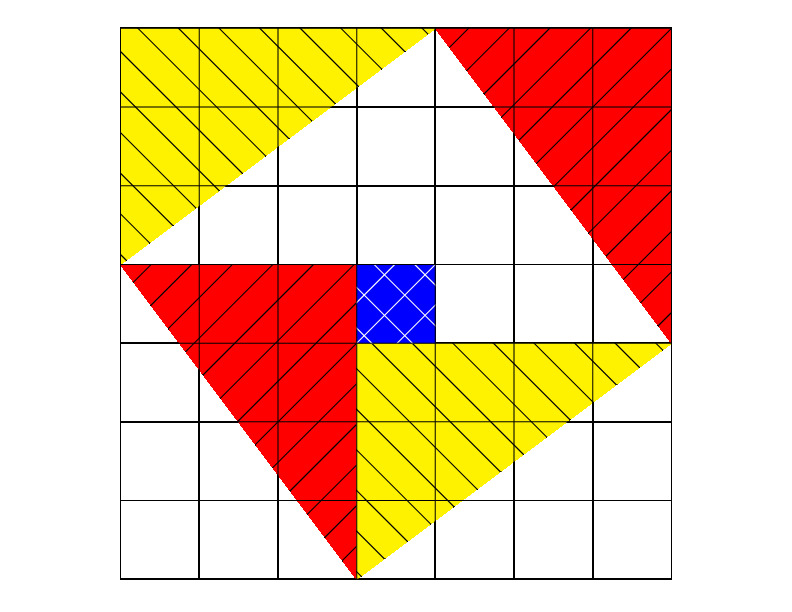
A 7×7 grid of squares, divided into four 3×4 rectangles arranged symmetrically about one square; the rectangles are divided in two by diagonals, which themselves describe a square
The right triangle whose legs are 3 and 4 has hypotenuse 5, because the square on it is
(4 − 3)2 + 2 ⋅ (4 ⋅ 3),
which is indeed 25 or 52. This is also
42 + 32.

Continue reading

Anthropology of Mathematics

This essay was long when originally published; now, on November 30, 2019, I have made it longer, in an attempt to clarify some points.

The essay begins with two brief quotations, from Collingwood and Pirsig respectively, about what it takes to know people.

  • The Pirsig quote is from Lila, which is somewhat interesting as a novel, but naive about metaphysics; it might have benefited from an understanding of Collingwood’s Essay on Metaphysics.

  • A recent article by Ray Monk in Prospect seems to justify my interest in Collingwood; eventually I have a look at the article.

Ideas that come up along the way include the following.

  1. For C. S. Lewis, the reality of moral truth shows there is something beyond the scope of natural science.

  2. I say the same for mathematical truth.

  3. Truths we learn as children are open to question. In their educational childhoods, mathematicians have often learned wrongly the techniques of induction and recursion.

  4. The philosophical thesis of physicalism is of doubtful value.

  5. Mathematicians and philosophers who ape them (as in a particular definition of physicalism) use “iff” needlessly.

  6. A pair of mathematicians who use “iff” needlessly seem also to misunderstand induction and recursion.

  7. Their work is nonetheless admirable, like the famous expression of universal equality by the slave-driving Thomas Jefferson.

  8. Mathematical truth is discovered and confirmed by thought.

  9. Truth is a product of every kind of science; it is not an object of natural science.

  10. The distinction between thinking and feeling is a theme of Collingwood.

  11. In particular, thought is self-critical: it judges whether itself is going well.

  12. Students of mathematics must learn their right to judge what is correct, along with their responsibility to reach agreement with others about what is correct. I say this.

  13. Students of English must learn not only to judge their own work, but even that they can judge it. Pirsig says this.

  14. For Monk, Collingwood’s demise has meant Ryle’s rise: unfortunately so since, for one thing, Ryle has no interest in the past.

  15. In a metaphor developed by Matthew Arnold, Collingwood and Pirsig are two of my touchstones.

  16. Thoreau is another. He affects indifference to the past, but his real views are more subtle.

  17. According to Monk, Collingwood could have been a professional violinist; Ryle had “no ear for tunes.”

  18. For Collingwood, Victoria’s memorial to Albert was hideous; for Pirsig, Victorian America was the same.

  19. Again according to Monk, some persons might mistake Collingwood for Wittgenstein.

  20. My method of gathering together ideas, as outlined above, resembles Pirsig’s method, described in Lila, of collecting ideas on index cards.

  21. Our problems are not vague, but precise.


When Donald Trump won the 2016 U.S. Presidential election, which opinion polls had said he would lose, I wrote a post here called “How To Learn about People.” I thought for example that just calling people up and asking whom they would vote for was not a great way to learn about them, even if all you wanted to know was whom they would vote for. Why should people tell you the truth?

Saturn eclipse mosaic from Cassini

Continue reading