Tag Archives: Michael Psellus

Turks of 1071 and Today

Skip to Michael Attaleiates on Alparslan after the Battle of Manzikert

Published in six volumes between 1776 and 1788, Edward Gibbon’s History of the Decline and Fall of the Roman Empire tells the story of a thousand years and more, from before the founding of Constantinople in 330 till after its loss in 1453. Gibbon can be ridiculed for his title: a millenium is a long time to be in decline. The three thick volumes of the Penguin edition took me a long time to read, if not quite as long as Gibbon took to write. I was living in Ankara at the time, but I enjoyed being able to read Gibbon’s work also while visiting the three old imperial capitals: Istanbul, Rome, and Milan.
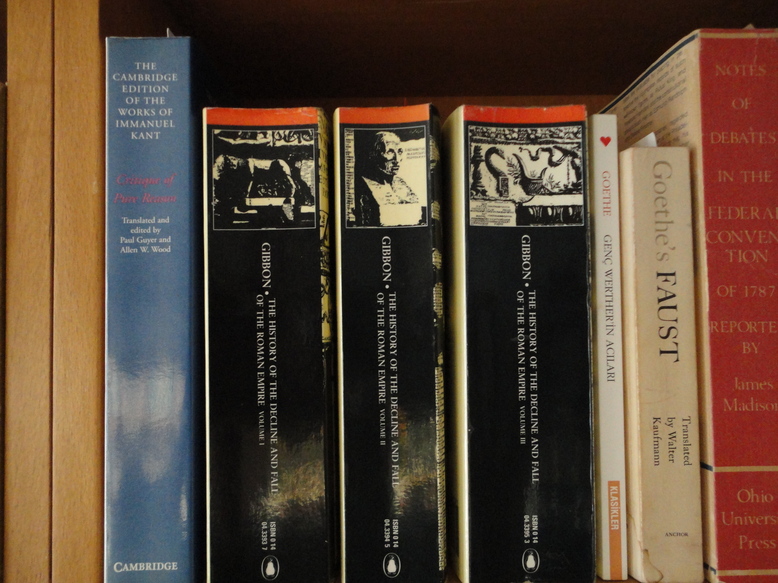
Gibbon’s Decline and Fall on my shelves (which are arranged according to date of birth of author)
Gibbon’s Decline and Fall on my shelves
(which are arranged according to date of birth of author)

Continue reading

Michael Psellus on learning

The value of learning was in question, a thousand years ago, during and after the reign of Emperor Basil II, in what was to become Istanbul. When learning has no purpose, it may flourish; when it has, it may be abandoned when the purpose is not achieved soon enough. Michael Psellus suggests this in Fourteen Byzantine Emperors (London: Penguin, 1966).

Two standing figures with robes and caps, dark on the left, only outlined on the right, on a gold ground
Michael Psellos (left) with his student, Byzantine Emperor Michael VII Doukas

Continue reading

Basil II

One reason for this blog is to avoid being enclosed by the wall of the garden called Facebook.

Sometimes I enjoy reading the history of where I live, and lately I have been working slowly through Judith Herrin, Byzantium: The Surprising Life of a Medieval Empire. The work is not chronological like that of John Julius Norwich (I have read only his Short History of Byzantium); but it does have a chapter on Emperor Basil II, the so-called Bulgar-Slayer, who apparently led the Byzantine Empire to its apogee. Reading this, I could not remember having read about Basil before, in Michael Psellus; but I had, as I could see when Herrin mentioned the latter.

Continue reading