After a year, I return to reading the Iliad on the Asian mainland of Turkey. I am opposite Lesbos, south of Mount Ida, where in the last episode, Juno seduced Jove, so that he would not see Neptune’s interference on behalf of the Greeks, in the war down at Troy.
We were here in Altınova (in the province of Balıkesir) in July, but my mind then was on mathematics, including mathematics coming out of my April post here, “Elliptical Affinity.” I went on to speak of this mathematics in two other countries, one of these the homeland of Medea. In the other country, I was moved to write a post concerning the book I had already blogged a lot about. Now Ayşe and other Peace Academics are being cleared of charges, our fall semester does not begin till October, and we can spend time at the beach.

Twelve Apostles, a former Armenian church, now a mosque, in Kars
In Book XV of the Iliad, Hector is allowed to shine, under the leadership and protection of the god of the sun. The god of the whole heaven will later have Hector killed.
The book has two striking features.
-
From the mouth of Jove comes the plan of the rest of the epic (in Chapman’s lines 53–77):
- Hector will lead the Trojans to the Greek ships;
- Achilles will allow Patroclus to fight;
- Patroclus will kill Jove’s son Sarpedon;
- Hector will kill Patroclus;
- Achilles will kill Hector, fulfilling Jove’s vow to Thetis.
Is this a spoiler? Most of Homer’s audience will already know the story.
The plan is reprised later, after the encouragement
- by Hector of Melanippus,
- by Ajax of the Greeks,
- by Menelaus of Antilochus, who kills Melanippus, provoking Hector.
Now Homer tells of Jove (lines 544–51):
For Hectors glorie still he stood; and euer went about,
To make him cast the fleet such fire, as neuer should go out;
Heard Thetis foule petition; and wisht, in any wise,
The splendor of the burning ships, might satiate his eyes.
From him yet, the repulse was then, to be on Troy conferd,
The honor of it giuen the Greeks; which (thinking on) he stird
(With such addition of his spirit) the spirit Hector bore,
To burne the fleet; that of it selfe, was hote enough before.Note added September 2, 2024.
-
From the mouth of Neptune comes the plan of the universe (lines 174–80). The heavens, the seas, and the underworld are respectively the provinces of the three sons of Rhea and Saturn. All must share the earth and Olympus.
From these we may draw out two more points:
-
The plan of the universe is shaky. Neptune resents Jove’s presumption to control the earth. Jove may rule his own offspring, but not his brother, who does agree to desist from helping the Greeks, but only while vowing eternal strife if Jove do not raze Troy in the end.
-
Near the end of the book (lines 678–83), as Hector seizes the nearest Greek ship and calls for fire, Ajax observes the utter isolation of himself and his comrades:
That on his souldiers thus he cryed: O friends, fight I alone?
Expect ye more wals at your backes? townes rampir’d, here are none;
No citizens to take ye in; no helpe in any kind;
We are, I tell you, in Troys fields; haue nought but seas behind,
And foes before; farre, farre, from Greece; for shame, obey commands;
There is no mercie in the warres; your healthes lie in your hands.If he were with us today, seeing how our use of fossil fuels is setting our own house on fire, Ajax might point out that there is no Planet B.
Book XV has two parts. Lines 1–247 focus on gods; lines 248–687, on men. The parts are thus, as it were, a theology and an anthropology, respectively. However, though the gods include goddesses, there are no women among the men. Thus the second part is more properly an “andrology.”
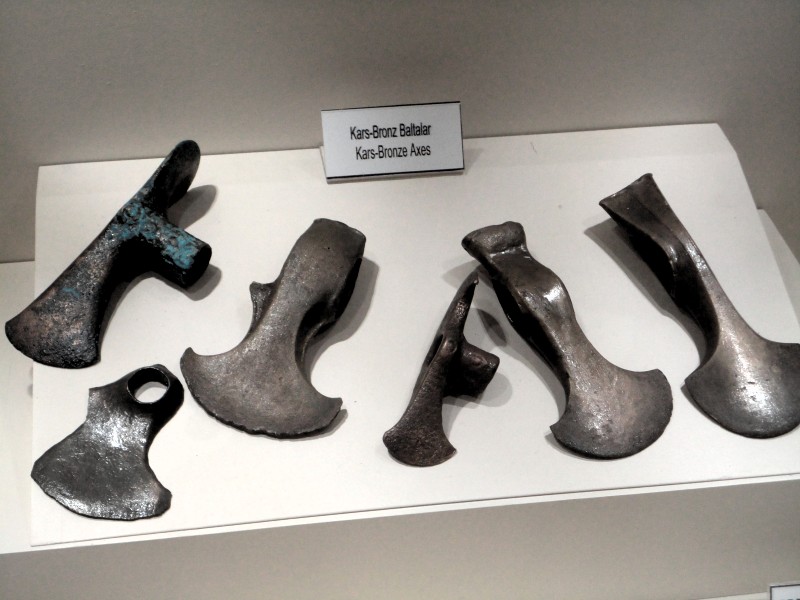
Bronze ax-heads in the Kars museum
Hector joins the parts. Juno having seduced Jove, Neptune having taken the field, Hector was spitting up blood at the end of Book XIV. When Jove recovers his awareness in Book XV, he sends Apollo to cure Hector and lead him to near-victory.
He directs Apollo to wield the aegis, as I discussed in “Masculinity (Iliad Book XV).” Chapman does use the term elsewhere: “I came from Aegis-bearing Ioue,” says Iris to Neptune in an earlier passage, quoted below. Right now though, Chapman has Jove describe the aegis as a shield (211–4):
That had not past vs without sweate. Now then, in thy hands take
My Adder-fring’d affrighting shield, which, with such terror shake,
That Feare may shake the Greekes to flight: besides this, adde thy care
(O Phoebus farre-off-shooting god) that this so sickly fare …
Note added September 2, 2024.
In Homer’s simile (lines 248–54), Hector becomes the lion that saves the Trojan harts or goats from the Greek hunters, who now are themselves put to flight.
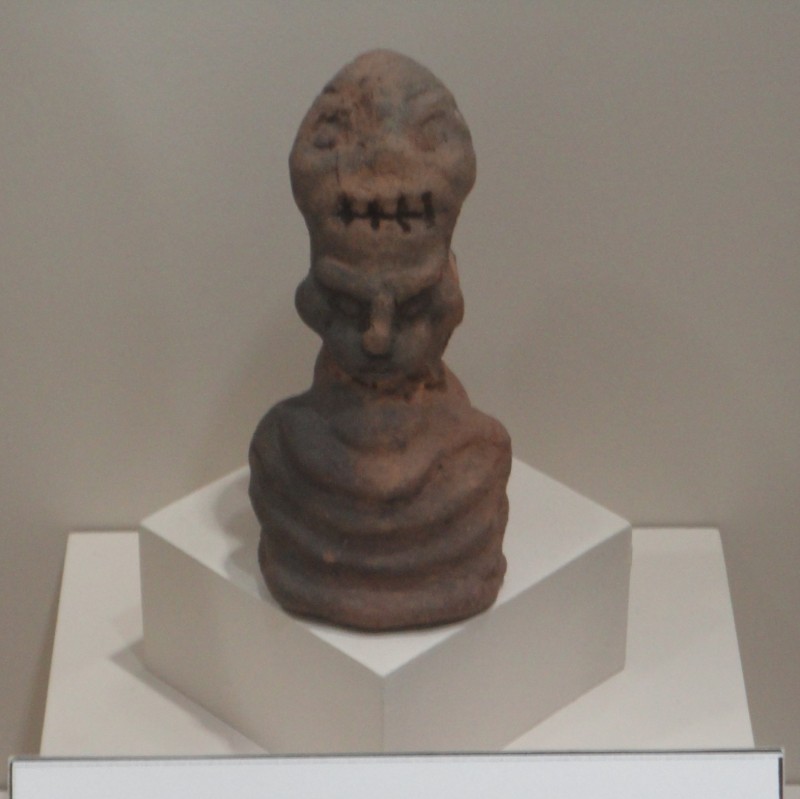
Heracles in a lion skin, from the Kars museum
To reach this turning point, Jove must wake up in the love-nest he has shared with Juno on Mount Ida. Seeing her trick, he reminds her how he tied her up once, after she had troubled his son Hercules at sea. Though other gods might pity her then, none durst help her, lest they be dashed to earth.
Chapman describes what Hera has done with an oxymoron (lines 33 & 4):
This frighted the offending Queene, who, with this state, excusde
Her kind vnkindnesse: Witnesse earth, and heauen, so farre diffusde …
Note added September 2, 2024.
Juno swears not to have caused Neptune to fight. What does a goddess swear on? She calls to witness “earth, and heauen, so farre diffusde” (line 34):
Thou Flood, whose silent-gliding waues, the vnder ground doth beare,
(Which is the great’st, and grauest oath, that any god can sweare)
Thy sacred head; those secret ioyes, that our yong bed gaue forth,
(By which I neuer rashly swore) that he who shakes the earth,
Not by my counsell did this wrong, to Hector and his host.
But (pittying th’oppressed Greekes, their fleete being neerly lost) …
Neptune is aiding the Greeks of his own free will, but she will tell him to stop.
She shall tell Iris to tell Neptune to stop, says Jove, and Phoebus to aid Hector.
Juno goes off like a man who either does not know his way, or is distracted from it. At Olympus she responds only to the greeting of Themis, who perceives her trouble.

Base of the minaret of the Evliya Camii (Mosque of the Saints), Kars, 1579
Neither god nor mortal is pleased with what Jove does, says Juno; but either to envy or to resist him is foolish. Mars is not listening; for Juno makes a fool of him by pointing out that his son Ascalaphus has been killed. He gears up for battle on earth, but Minerva restrains him, lest Jove punish not only him, but all of the Olympians.
What we know about Ascalaphus:
-
In the Catalogue of Ships in Book II (lines 441–6), he is named as a son of Mars:
But those who in Aspledon dwelt, and Mynian Orchomen;
God Mars his sonnes did leade (Ascalaphus, and Ialmen.)
Who in Azidon Astors house, did of Astioche come;
The bashfull Maide, as she went vp, into the higher roome,
The warre-god secretly comprest: in safe conduct of these,
Did thirtie hollow-bottom’d barkes, diuide the wauie seas. -
In Book IX, he is one of the captains of the watch during the meeting that produces the embassy to Achilles.
-
In Book XIII, he is
- one of the friends whom Idomeneus calls on;
- killed, and stripped of his helmet, by Deiphobus, who was aiming for Idomeneus; Mars is unaware.
Note added September 2, 2024.
Hera swore to Somnus in Book XIV. This blog also took up the subject of oaths while covering Collingwood’s treatment of the “Albigensian heresy.” My refusal to swear an oath might be a threat to civilization, if it meant I perceived no obligation to you, beyond what I felt like recognizing at the moment.
What obligation then can a god perceive? Juno understands, sometimes, that Jove is somehow on another level, so that his will must be done, simply because it is his will; and yet even Jove feels himself bound by the oath he has made to Thetis.
With observations like this, though applied to us, C. S. Lewis argues that there is more to that universe than meets the eye of natural science. This is in “Right and Wrong as a Clue to the Meaning of the Universe,” which ultimately formed the first part of Mere Christianity. We quarrel, like the gods, because we are bound by something.
Every one has heard people quarrelling. Sometimes it sounds funny and sometimes it sounds merely unpleasant; but however it sounds, I believe we can learn something very important from listening to the kind of things they say. They say things like this: “How’d you like it if anyone did the same to you?” – “That’s my seat, I was there first” – “Leave him alone, he isn’t doing you any harm” – “Why should you shove in first?” “Give me a bit of your orange, I gave you a bit of mine” – “Come on, you promised.” People say things like that every day, educated people as well as uneducated, and children as well as grown-ups.
Now what interests me about all these remarks is that the man who makes them is not merely saying that the other man’s behaviour does not happen to please him. He is appealing to some kind of standard of behaviour which he expects the other man to know about. And the other man very seldom replies: “To hell with your standard.” Nearly always he tries to make out that what he has been doing does not really go against the standard, or that if it does there is some special excuse …
Jove appeals to the standard of birth-order, as Iris reports to Neptune (lines 165–71):
I came from Aegis-bearing Ioue, to bid thee ceasse from fight,
And visite heauen, or th’ample seas; which, if in his despight,
Or disobedience, thou deniest; he threatens thee to come
(In opposite fight) to field himselfe: and therefore warnes thee home,
His hands eschewing; since his powre, is farre superiour;
His birth before thee; and affirmes, thy lou’d heart should abhorre
To vaunt equalitie with him, whom euery deitie feares.
Neptune’s standard is common parentage (lines 172–86):
He answerd, O vnworthy thing! though he be great, he beares
His tongue too proudly; that our selfe, borne to an equall share
Of state and freedome, he would force. Three brothers borne, we are,
To Saturne; Rhea brought vs forth: this Iupiter, and I,
And Pluto, god of vnder-grounds. The world indifferently
Disposde betwixt vs; euery one his kingdome; I, the seas;
Pluto the blacke lot; Iupiter, the principalities
Of broad heauen; all the skie and clouds, was sorted out: the earth
And high Olympus, common are, and due to eithers birth.
Why then should I be aw’d by him? Content he his great heart,
With his third portion; and not thinke, to amplifie his part
With terrors of his stronger hands, on me, as if I were
The most ignoble of vs all: let him containe in feare,
His daughters and his sonnes, begot, by his owne person: this
Holds more conuenience: they must heare, these violent threats of his.
Thus do the gods themselves recognize justice as a higher power.

A Russian church in Kars, now the Fethiye Camii.
Note how the horizontals were stripped from the cross
Concerning “what this universe really is and how it came to be there,” Lewis distinguishes the “materialist view,” whereby “matter and space just happen to exist, and always have existed, nobody knows why”; and the “religious view,” according to which, “what is behind the universe is more like a mind than it is like anything else we know.”

Fethiye mosque interior
I go along with Lewis so far as to agree that our sense of justice, which is real, is nonetheless not an object of natural science:
Anyone studying Man from the outside as we study electricity or cabbages, not knowing our language and consequently not able to get any inside knowledge from us, but merely observing what we did, would never get the slightest evidence that we had this moral law. How could he? for his observations would only show what we did, and the moral law is about what we ought to do.
Lewis draws theological conclusions. Following Collingwood, I observe only that there are sciences other than the natural or physical sciences, which account for how things are; there are “criteriological sciences,” accounting for how we think things ought to be.
Thus I published a mathematical error in 2003 and a correction in 2014. The error could not have been detected by careful scientific study of my emotional state, using functional magnetic resonance imaging or anything else. I was sure I was right, and others agreed with me. There was nonetheless an error, as I could eventually recognize by careful study of the logic of my proof. Logic is one of Collingwood’s first examples of a criteriological science.
Lewis’s popular arguments may help clarify Collingwood’s; some day I may try to work this out; meanwhile I note how Homer provides an opportunity to think about these things.
Since they usually appear to human beings as other human beings, I have wondered whether Homer’s gods can be left out of the human story.
In Book XV, Apollo comes to the recuperating Hector, “Like a chearfull visitant” (line 227). Hector nonetheless recognizes him as “the best of deities” (line 230).
Homer would seem to use Hector as a way to remind the listeners that the gods know everything (lines 229–38):
Inuade thy fortitude? He spake; but with a feeble voice:
O thou, the best of deities! why (since I thus reioyce
By thy so serious benefite) demandst thou (as in mirth,
And to my face) if I were ill? for (more then what thy worth
Must needs take note of) doth not Fame, from all mouthes fill thine eares;
That (as my hand at th’Achiue fleete, was making massacres
Of men, whom valiant Aiax led) his strength, strooke with a stone,
All powre of more hurt from my brest? my very soule was gone:
And once to day, I thought to see, the house of Dis and Death.
Be strong (said he) for such a spirit, now sends the god of breath …
If the gods do know everything though, or at least everything that is famous, so to speak, then does not Jove in particular how Homer makes him ridiculous in Book XIV for being seduced by Juno? I imagine Socrates tried to get people to think about these things. Note added September 2, 2024.
When Hector comes out like a lion, as in the simile already mentioned, then “one of whom few of the Greekes, could get the better hand, / (For Rhetorique) when they fought with words” (lines 260–1), namely Thoas, whom Chapman calls only Andraemonides: he can see that some god has saved Hector from death.
While Apollo stays behind a cloud, the battle is even (line 289–92):
But when the Greeks had seene his face, and who it was that shooke
The bristled targe, knew by his voice; then all their strengths forsooke
Their nerues and minds; and then looke how, a goodly herd of Neate,
Or wealthy flocke of sheepe, being close, and dreadlesse at their meate …
The Greeks scatter as if they are a herd of neat or sheep, beset by a brace of bears.

From inside Twelve Apostles
Apollo fills the Greek dike and tears down the wall, as if it were a boy’s sand-castle. Nestor gets down on his knees and prays to Father Jove, who hears the prayer and acknowledges it with thunder; however, the Trojans perceive this as a sign for them, and they wash over the Greek wall like a wave. The god helps those that help themselves.
Edited March 2, 2023, and September 2, 2024
 Polytropy
5 Trackbacks
[…] « On Chapman’s Homer’s Iliad, Book XV […]
[…] Book XV gave us Jove’s summary (delivered to Juno) of the rest of the epic, we now get Thetis’s […]
[…] made the point in considering Book XV of the Iliad, where (as elsewhere) the gods are seen to bind themselves by oaths. That humans can […]
[…] has a wife, Hera, to whom he says, in Book XV of the Iliad, in the translation of Caroline Alexander (lines 59–68; bold emphasis […]
[…] There is no Planet B (I said that too in 2019). […]