Note added September 9, 2024: In “Potential (Iliad Book XIII)” and “Femininity (Iliad Book XIV),” I wondered whether an editor would remove Books XII and XIII (or at least the latter) for featuring neither Agamemnon (wounded in Book XI) nor Achilles (still on strike, despite the pleas in Book IX). An editor might remove or trim Books XX and XXI too, for being “only” about a warrior gone berserk. After Achilles has
- recognized his foolishness in Book XVIII,
- patched things up with Agamemnon in Book XIX,
that could be enough, even for an epic. I continue to wonder about the function of the ensuing two books. Do they show how words of contrition may not represent a real change of heart? As well as Aeneas and his genealogy, the books give us Polydorus and Lycaon, sons of Laothoë, daughter of Altes; killed by Achilles, the boys will be missed by their father, Priam, in Book XXII. This book is a relief, not because Achilles gives anybody any relief; that will come in Book XIV.
Andromache draws a hot bath, for Hector to slip into when he comes home from the war. Actually she has her maids heat the water, while she herself weaves flowers into a tapestry.

Mouth of stream forming border between Balıkesir and İzmir
All the Trojans managed to slip into the safety of Troy, while Achilles was distracted in Book XXI of the Iliad. Only Hector and Deiphobus have stayed outside. Hector is really glad to have his brother along to confront Achilles.
Hector thinks he is alone at first. He cannot retreat to Troy, not after chiding Polydamas for recommending it in Book XVIII.
Note added September 9, 2024: I wrote this terse summary in September, 2019, and a longer one as “Grief (Iliad Book XX)” in April, 2023. Now I have some more details to look at, as well as the function of the book.
For Chapman, Hector’s worries include the following (lines 93–100):
Incenst Achilles; I yet staid; though (past all doubt) that course
Had much more profited then mine; which, (being by so much worse,
As comes to all our flight, and death) my folly now I feare,
Hath bred this scandall; all our towne, now burnes my ominous eare
With whispering: Hectors selfe conceit, hath cast away his host.
And (this true) this extremitie, that I relie on most,
Is best for me; stay, and retire, with this mans life; or die
Here for our citie with renowme; since all else fled, but I.
The significance of a burning ear is described by Pliny (Natural History XXVIII.v, 22–4):
Why on the first day of the year do we wish one another cheerfully a happy and prosperous New Year? … Why do we say “Good health” to those who sneeze? … Moreover, according to an accepted belief absent people can divine by the ringing in their ears that they are the object of talk.
However, the superstition is not in Lattimore (lines 104–10):
Now, since by my own recklessness I have ruined my people,
I feel shame before the Trojans and the Trojan women with trailing
robes, that someone who is less of a man than I will say of me:
‘Hektor believed in his own strength and ruined his people.’
Thus they will speak; and as for me, it would be much better
at that time, to go against Achilleus, and slay him, and come back,
or else be killed by him in glory in front of the city.
Hector considers surrendering himself to Achilles, and offering Helen and whatever else Paris stole from the Atrides, along with half the wealth of Troy.
Note added September 9, 2024: I considered the problem of making good on such an offer in 2023.
What’s the use? If Hector disarms, Achilles will only kill him.
Note added September 9, 2024: Moreover, Hector would die emasculated (lines 109–14):
Thy state still in me? Ile not sue; nor would he grant; but I,
(Mine armes cast off) should be assur’d, a womans death to die.
To men of oke and rocke, no words; virgins and youths talke thus;
Virgins and youths, that loue, and wooe; there’s other warre with vs:
What blowes and conflicts vrge, we crie; hates and defiances;
And with the garlands these trees beare, trie which hand Ioue will blesse.
I talked about oak and rock in connection with Book III. The specific conceit of wooing as war would seem to be Chapman’s; Lattimore has (lines 123–30):
I might go up to him, and he take no pity upon me
nor respect my position, but kill me naked so, as if I were
a woman, once I stripped my armor from me. There is no
way anymore from a tree or a rock to talk to him gently
whispering like a young man and a young girl, in the way
a young man and a young maiden whisper together.
Better to bring on the fight with him as soon as it may be.
We shall see to which one the Olympian grants the glory.
When Achilles draws near, Hector’s decisions are made. His knees take flight. Hector runs around Troy, Achilles in hot pursuit. They pass the twin springs of the Scamander, that is, the Xanthus. One spring is fiery hot, the other cold as snow. In times of peace, the Trojan women do the washing there.
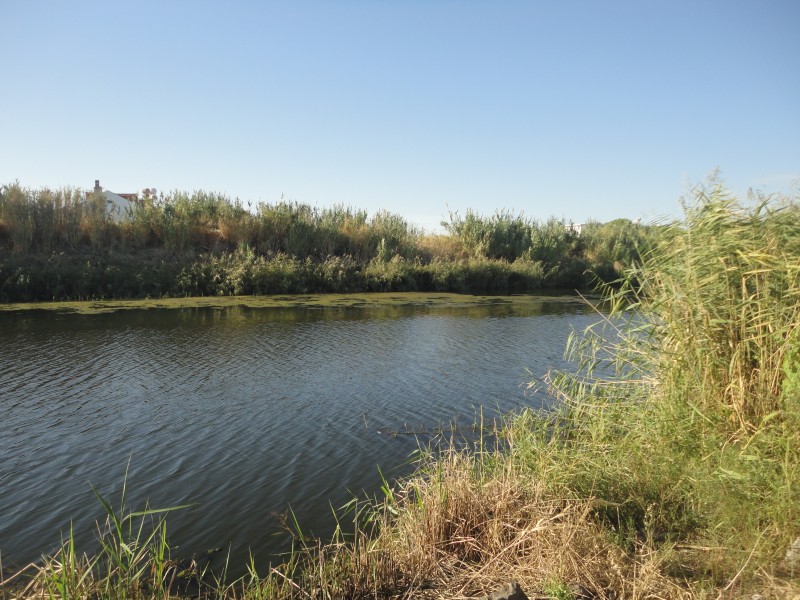
Border stream
I used to run in dreams, but make no progress. I thought later this must have revealed something about me. Homer then reveals the same about himself, by noting that Achilles and Hector run as if in a dream: neither man can achieve what he is trying to do, be it catch up or get some distance.
When the runners reach the springs a fourth time, Deiphobus comes to the aid of Hector, who is now bold to make one last offer of civility: single combat with Achilles, the winner to strip the arms of the loser, but relinquish the body.
No conditions, says Achilles, and throws his spear. Hector ducks.
Now is his chance. He throws at Achilles, but the spear bounces off his shield. Hector calls to Deiphobus for another spear. Deiphobus is not there; he was an illusion.
It is an illusion of Andromache that her husband will come home to enjoy a hot bath. Hector is already dead.
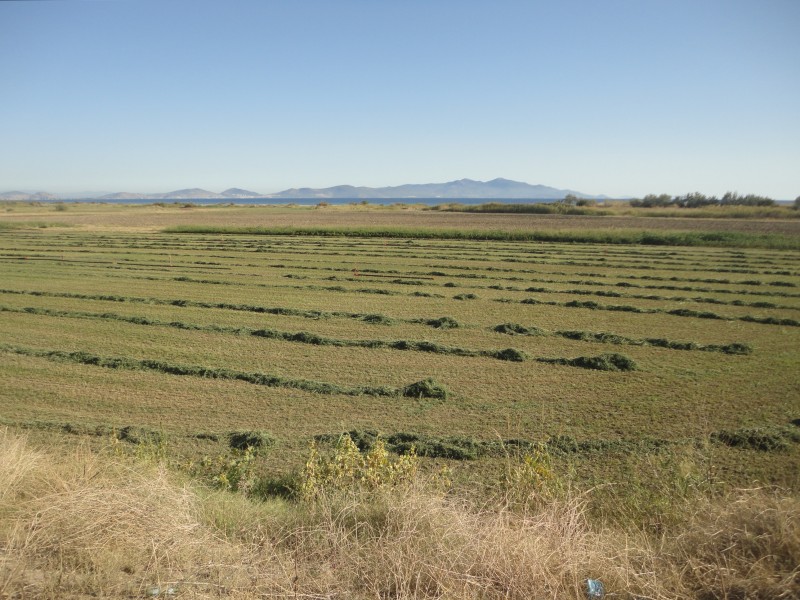
Hayfield in İzmir province
That is the human story of Book XXII. The illusory Deiphobus is really Pallas though, who also returns to Achilles the spear that misses, the spear that Achilles goes on to use to find the chink in his own armor, the armor now worn by Hector, who stripped it from Patroclus.
Jove is a softie: he does not want to see Hector die (lines 146–50):
A man I loue much, I see forc’t, in most vnworthy flight
About great Ilion; my heart grieues; he paid so many vowes,
With thighes of sacrificed beeues; both on the loftie browes
Of Ida, and in Ilions height. Consult we; shall we free
His life from death? or giue it now, t’Achilles victorie?
While Juno recognizes that changing fate is possible in principle, she points out that it would be most unwise.
All right then, says Jove. You see to Hector’s death.
She does.
Though struck through the neck, Hector still has a voice, which begs for his body to be given for ransom.
No way, says Achilles; I want to slice you up and eat you raw.
There is a lot of wailing in the book. Priam shrieks when he sees that his son is outside the walls, where Achilles is. He asks pity for an old man, who would leave an ugly corpse after the Greeks sacked Troy (lines 61–65):
… A faire yong man, at all parts it beseemes,
(Being brauely slaine) to lie all gasht; and weare the worst extremes
Of warres most crueltie; no wound, of whatsoeuer ruth,
But is his ornament: but I, a man so farre from youth;
White head, white bearded, wrinkl’d, pin’d; all shames must shew the eye.
Apparently Chapman’s participle “pin’d” or “pined” means worn out.
Possibly Paris inherited his vanity from his father. I once heard a motto, “Live fast, die young, leave a good-looking corpse”; could this be Priam’s?
If you have body issues, I have read, just go to a Turkish hamam. You could also visit a beach, such as where I first wrote this post and where I am now.
Thoreau writes in Walden of the loads of possessions that people inherit and carry through life. Possibly the metaphorical burden kept people’s real bodies thin, but it no longer does. What people push before them today often includes great bellies. For the pleasure of the words at least, here is Thoreau:
I see young men, my townsmen, whose misfortune it is to have inherited farms, houses, barns, cattle, and farming tools; for these are more easily acquired than got rid of. Better if they had been born in the open pasture and suckled by a wolf, that they might have seen with clearer eyes what field they were called to labor in. Who made them serfs of the soil? Why should they eat their sixty acres, when man is condemned to eat only his peck of dirt? Why should they begin digging their graves as soon as they are born? They have got to live a man’s life, pushing all these things before them, and get on as well as they can. How many a poor immortal soul have I met well nigh crushed and smothered under its load, creeping down the road of life, pushing before it a barn seventy-five feet by forty, its Augean stables never cleansed, and one hundred acres of land, tillage, mowing, pasture, and wood-lot! The portionless, who struggle with no such unnecessary inherited encumbrances, find it labor enough to subdue and cultivate a few cubic feet of flesh.
A human body is a little denser than water, of which a cubic foot weighs about 62 pounds. In Thoreau’s day, perhaps cultivating even three cubic feet of flesh was rare; no longer. Note added September 9, 2024.
Hecuba shows her breasts: if they ever comforted Hector, he should come comfort her.

Stream in Balıkesir province
It’s no use. Hector waits for Achilles as the dragon in her cave waits for the passer-by.
When Hector is dead, the worst thing is to see his body dragged away by the heels. Hecuba covers her head with dust, as Hector’s is covered. Priam wants to throw himself on the mercy of Achilles, just to hold Hector’s body.
When Andromache hears the commotion, and comes out to find what has happened, she faints. From her head falls the veil that Venus gave her to wear on her wedding day.

Carnation Street
Reviewed April 22, 2023
 Polytropy
4 Trackbacks
[…] « On Chapman’s Homer’s Iliad, Book XXII […]
[…] Achilles wished to eat Hector raw in Book XXII, so Hecuba wants to devour Achilles’s liver. It makes no sense to her to visit the Greek […]
[…] will consider requesting the latter of Achilles in Book XXII. However, within the city of the shield, the defenders do not like the idea. The children, women, […]
[…] review the book some more. The review I made in 2019 is […]