The first part of this post concerns a poem by Constantine Cavafy on accepting one’s fate. There are three parts after that:
- Discovery of Cavafy in Istanbul – he lived in my neighborhood
- Dionysius of Byzantium – he wrote of the geography of the neighborhood
- Appendix – a couple of details from Plutarch’s “Life of Theseus” that I didn’t want to forget about
The Cavafy poem, “The God Abandons Antony,” is based on a passage in Plutarch’s life of that person. Susan Cain wrote about the poem in a newsletter. Her book Quiet gave me a new appreciation for my parents. It so happens that my parents had me by adoption. Unfortunately other people are not happy to be in that situation.
Some people are also not happy with their sex. Cavafy’s poem could have given courage to Ms Cain during a painful birth. Courage is literally manliness in Greek. Plutarch writes of a man’s imitation of a woman in labor. Roberto Calasso’s Marriage of Cadmus and Harmony led me to the story. I talk about all of that.
I have since learned of another good essay, “Personal Integrity in the Poetry of C. P. Cavafy,” in Beshara Magazine, by Andrew Watson. A different Andrew Watson played football for Scotland in 1881, and The Guardian has an article, “‘We looked identical’: one man’s discovery of slavery, family and football” (24 December 2020), by Tusdiq Din, about Malik Al-Nasir, formerly Mark Watson, who discovered, through their physical resemblance, a family relation with Andrew.
When Ayşe and I moved from Fulya to Tarabya last October, we were coming nearer where C. P. Cavafy once lived along the Bosphorus.

Last evening in Fulya
Saturday, October 15, 2022
In a recent instalment of The Kindred Letters (received on Thursday, September 7, 2023), Susan Cain quotes “The God Abandons Antony.” She says herself,
I think that next time I’m faced with impending pain or loss I could use, and maybe you could too, the spirit of this marvelous poem by the great Greek poet Constantine Cavafy.
The poem is based on a passage from Plutarch’s “Life of Antony” (chapter 75), here in the translation of Bernadotte Perrin:
- During this night, it is said, about the middle of it, while the city was quiet and depressed through fear and expectation of what was coming, suddenly certain harmonious sounds from all sorts of instruments were heard, and the shouting of a throng, accompanied by cries of Bacchic revelry and satyric leapings, as if a troop of revellers, making a great tumult, were going forth from the city;
- and their course seemed to lie about through the middle of the city toward the outer gate which faced the enemy, at which point the tumult became loudest and then dashed out. Those who sought the meaning of the sign were of the opinion that the god to whom Antony always most likened and attached himself was now deserting him.
The city was Alexandria, and Caesar Augustus was going to take it.

Grand Tarabya Hotel
Sunday, October 30, 2022
Ms Cain’s newsletter issue is called, “How to be courageous, especially in the face of loss or pain.” Courage is a standard example of a virtue, standing as it does as a mean between the vices of cowardice and recklessness. This is explained in a preliminary way
- in Book II of Aristotle’s Nicomachean Ethics, and therefore
- in my last post before this one, “Manliness.”
Manliness is a literal translation of the Greek word for courage, ἀνδρεία (andreia); however, Cain needed this for a difficult labor.
A man would imitate labor during an annual ceremony on Cyprus. This was because, by one version of the story of Theseus, he had abandoned Ariadne there, when she was big with his child:
a very peculiar account of these matters is published by Paeon the Amathusian … The women of the island, accordingly, took Ariadne into their care, and … ministered to her aid during the pangs of travail, and gave her burial when she died before her child was born … He says also that at the sacrifice in her honor on the second day of the month Gorpiaeus, one of their young men lies down and imitates the cries and gestures of women in travail …
So says Plutarch in his “Life of Theseus” (chapter 20, §§ 2–4, also in Bernadotte Perrin’s translation).
I was led to Plutarch by Roberto Calasso’s Marriage of Cadmus and Harmony (London: Vintage, 1994; Italian original, 1988). The book is full of stories, with little hint of where they are going or where they are from. Imagine! The author does not generally name his sources, unless he quotes them directly; and a lot of the time he is only paraphrasing, as from Plutarch’s “Life of Theseus.”
When I first read Calasso’s book, probably in the aughts, I was bothered by its poor scholarly practice. I thought this might have to do with publishers’ ideas about the ownership of words. Now I have seen how another writer interprets what Calasso does.
It turns out Calasso does a lot of surreptitious copying from the Dionysiaca of Nonnus (5th century ce; his epic takes three Loeb volumes). According to Robert Shorrock in “The Artful Mythographer: Roberto Calasso and The Marriage of Cadmus and Harmony” (Arion: A Journal of Humanities and the Classics, Third Series, Vol. 11, No. 2, Fall, 2003, pp. 83–99), if the work under consideration
were a novel that owed a large, and largely unacknowledged, debt to an obscure modern work, then the word “plagiarism” would have now begun to raise its head. We might in that case be witness to serious fraud … As this article is arguing, however, The Marriage of Cadmus and Harmony is best understood not as a novel in conventional terms, but as an active work of mythography.
Calasso opens his book with Zeus’s changing himself into a white bull, in order to make off with Europa. On page 11 he says,
as generation followed generation, metamorphosis became more difficult, and the fatal nature of reality, its irreversibility, all the more evident. Only a generation after Europa, Pasiphaë would have to crouch inside a wooden cow, a big toy on wheels, and have herself pushed as far as the meadows of Gortyn, where the bull she desired was grazing.
This was in Crete. Pasiphaë was Ariadne’s mother. I mentioned the Cypriot ceremony in Ariadne’s memory, where a man pretended to be a woman. Men did that sort of thing for Theseus when he went to Crete in the first place, as part of the third annual tribute from Athens of seven youths and seven maidens. Again according to Plutarch in “The Life of Theseus” (chapter 23),
- … For it is said that he did not take away with him all the maidens on whom the lot fell at that time, but picked out two young men of his acquaintance who had fresh and girlish faces, but eager and manly spirits, and changed their outward appearance almost entirely by giving them warm baths and keeping them out of the sun, by arranging their hair, and by smoothing their skin and beautifying their complexions with unguents; he also taught them to imitate maidens as closely as possible in their speech, their dress, and their gait, and to leave no difference that could be observed, and then enrolled them among the maidens who were going to Crete, and was undiscovered by any.
This is an explanation of how “It was Theseus who instituted also the Athenian festival of the Oschophoria” (these words are in the place of the ellipsis above):
- And when he was come back, he himself and these two young men headed a procession, arrayed as those are now arrayed who carry the vine-branches. They carry these in honour of Dionysus and Ariadne, and because of their part in the story; or rather, because they came back home at the time of the vintage …
Men imitate those two young Athenians today. Some of these men assert that they really are women in all respects. Briefly, I think they are confusing biology and history, in the sense that I tried to work out in January in “Biological History.” From stories of Somerset Maugham, I took examples of people who wanted to be what they logically could not be, but who tried to be anyway, with tragic results.
I mentioned also Lauren Burns, who learned only at age 21 that her father had not been the source of the sperm cell that joined with her mother’s egg to produce the zygote that grew into her, biologically speaking. In Triple Helix (University of Queensland, 2022; chapter 5, page 56), she includes a conversation with another donor-conceived woman, Narelle Grech:
“… I’m not looking for a father figure, or money. I’ve just got all these questions.”
“Me too.” I hesitated. “Sometimes I feel kind of adrift … I wish I could trace my talents and flaws.”
“I get that. It’s called mirroring. I’m loud and colourful and expressive and really into singing and writing. Nobody else in my family shares those interests so it makes it difficult to nurture them. I think the different attributes a donor-conceived person might have inherited from their donor get suppressed if they don’t fit within the family that raises them …”

Narelle Grech with her biological father Ray Tonna
Photograph by Meredith O’Shea, The Age (Melbourne)
My own sister used to wonder why she and I were so different. This was never a puzzle for me, since I thought there was a simple explanation: we were adopted.
Such an explanation is not available to most of the people who feel out of place in their own families. I looked at examples of such people, even Heraclitus, in the 2019 post “We the Pears of the Wild Coyote Tree.” I revisited that post recently, because of what it says about the invention of gold coins in Lydia.
What troubled Narelle Grech is described on Wikipedia, not currently in “Mirroring,” but in “Genealogical bewilderment.” However, number 4 of Tony Corsentino’s “Fourteen Propositions About Adoption” is, “Loss of mirroring is harmful”:
adoptees and the donor-conceived try, perpetually, to explain to the kept why genealogical severance is harmful: a disadvantage, a torment, a trauma, a condition that pervades and shapes one’s life. This is difficult, because living with severance – without “genetic mirroring,” as it is somewhat clinically called – is a distinctive mode of being in the world.
I cannot gainsay Corsentino’s experience. I am sorry if he suffers disadvantage, torment, and trauma. I suggest that the bare fact of being adopted is not to blame; what matters is the meaning that people give to it.
The human species has evolved, only because children are never exactly like either of their biological parents. Neither are they an average of the two. If I understand the biology correctly, your biological parents could be heterozygous in all of their genes, and they might give you only the recessive alleles. Then, biologically speaking, you would be no more like either of your parents than any two people are alike. Such an extreme case may never happen; and yet The Guardian had a piece a dozen years ago: “Different but the same: a story of black and white twins” (24 September 2011).

“James (left) and Daniel Kelly, twin brothers.
Photograph: Martin Godwin for the Guardian”
As Joanna Moorhead writes, one of the twins is “gay … gregarious … academic”; the other is “straight, he’s shy, and he didn’t enjoy school at all.”
Extreme genetic difference between siblings, or between parents and children, may indeed be more likely in cases of adoption. What it matters is not clear to me; neither is it clear how you would tell that genetic differences did matter. We are influenced by one another through our beliefs about one another.
When my sister found her biological mother, she called up our real mother to tell her. I happened to be with her at the time. So was her best friend, who was in awe of how calmly my mother took the news. I didn’t understand. Was she supposed to have a fit of anger or dismay? If many parents would have a fit, this would seem to be an example of what causes a lot of familial strife: parents’ unrealistic expectations from their children.
It doesn’t matter whether the parents are biological or adoptive. In either case, they can think one of two things:
- “This child is a gift, and we must work to deserve it.”
- “This child is going to owe us for raising it.”
Children can have complementary or conflicting thoughts. My own sense of good fortune in having the parents I did was confirmed by Susan Cain’s 2012 book Quiet. I wrote about this in a 2017 post, “Ahtamar Island,” on the occasion of a visit to a church and ruined monastery on an island – just the place for introverts, who were the subject of Cain’s book.
Here is the poem of Cavafy that inspires Ms Cain now. The Greek original and the English translation (by Edmund Keeley and Philip Sherrard in C. P. Cavafy, Collected Poems, Revised Edition, Princeton University, 1992) are at the Cavafy Archive:
| Απολείπειν ο θεός Aντώνιον | The God Abandons Antony |
|---|---|
| Σαν έξαφνα, ώρα μεσάνυχτ’, ακουσθεί | When suddenly, at midnight, you hear |
| αόρατος θίασος να περνά, | an invisible procession going by |
| με μουσικές εξαίσιες, με φωνές – | with exquisite music, voices, |
| την τύχη σου που ενδίδει πια, τα έργα σου | don’t mourn your luck that’s failing now, |
| που απέτυχαν, τα σχέδια της ζωής σου | work gone wrong, your plans |
| που βγήκαν όλα πλάνες, μη ανωφέλετα θρηνήσεις. | all proving deceptive – don’t mourn them uselessly. |
| Σαν έτοιμος από καιρό, σα θαρραλέος, | As one long prepared, and graced with courage, |
| αποχαιρέτα την, την Aλεξάνδρεια που φεύγει. | say goodbye to her, the Alexandria that is leaving. |
| Προ πάντων να μη γελασθείς, μην πεις πως ήταν | Above all, don’t fool yourself, don’t say |
| ένα όνειρο, πως απατήθηκεν η ακοή σου· | it was a dream, your ears deceived you: |
| μάταιες ελπίδες τέτοιες μην καταδεχθείς. | don’t degrade yourself with empty hopes like these. |
| Σαν έτοιμος από καιρό, σα θαρραλέος, | As one long prepared, and graced with courage, |
| σαν που ταιριάζει σε που αξιώθηκες μια τέτοια πόλι, | as is right for you who proved worthy of this kind of city, |
| πλησίασε σταθερά προς το παράθυρο, | go firmly to the window |
| κι άκουσε με συγκίνησιν, αλλ’ όχι | and listen with deep emotion, but not |
| με των δειλών τα παρακάλια και παράπονα, | with the whining, the pleas of a coward; |
| ως τελευταία απόλαυσι τους ήχους, | listen – your final delectation – to the voices, |
| τα εξαίσια όργανα του μυστικού θιάσου, | to the exquisite music of that strange procession, |
| κι αποχαιρέτα την, την Aλεξάνδρεια που χάνεις. | and say goodbye to her, to the Alexandria you are losing. |
Discovery of Cavafy in Istanbul
A couple of weeks ago – I wrote in an email on October 30, 2022 – Ayşe and I moved to the semt of Hacıosman in the mahalle of Tarabya in the ilçe of Sarıyer in the il of İstanbul.

A visit to the flat
that we would ultimately move into
July 24, 2022
Hacıosman gives its name to the terminal station of a subway line, which we now take to the university, instead of walking there. Our time in transit has not changed much, and we now walk between home and subway through a forest.

Atatürk City Forest, September 1, 2023
Tarabya takes its name from a settlement down by the shore, a half-hour away (or less) by foot. There is a bay with a marina. Supposedly the place was first given the name of Pharmakia by Medea of Colchis.
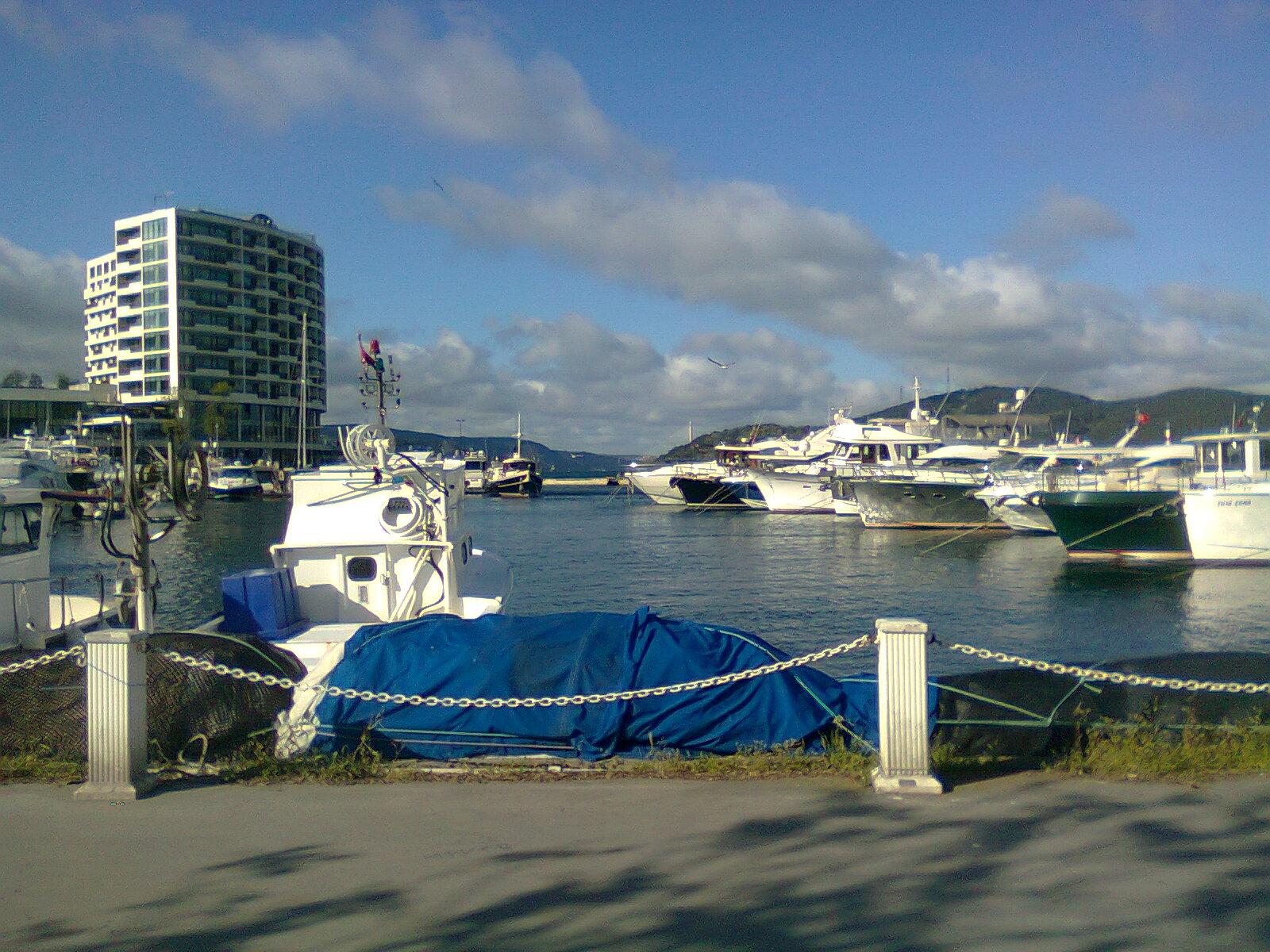
Tarabya Marina, April 23, 2023
Colchis was in what is now Georgia. We saw the statue of Medea in the town square of Batumi, just before the Pandemic, when we attended the Tenth International Conference of the Georgian Mathematical Union.
Apparently I didn’t take photos of the Medea statue in Batumi!
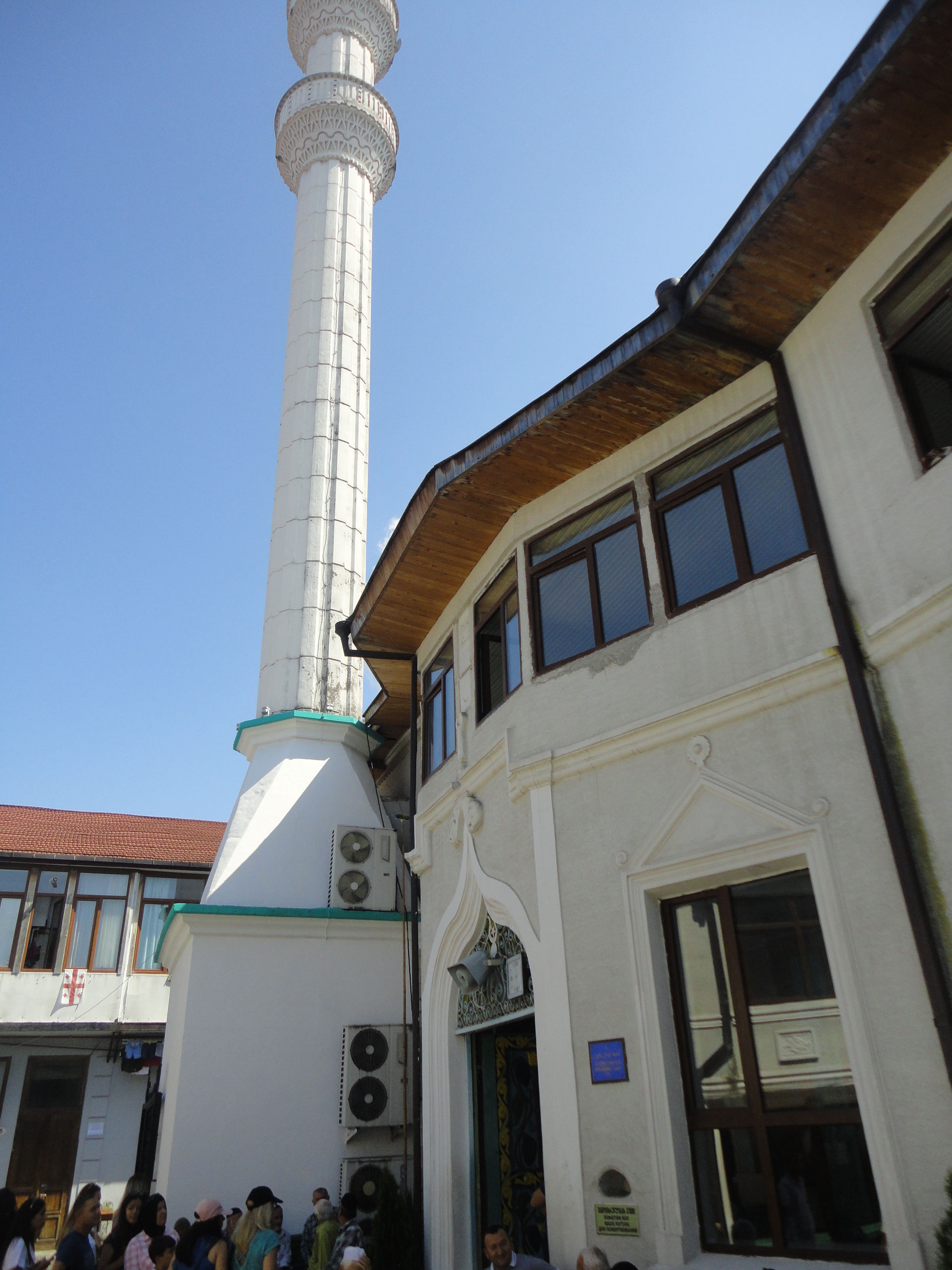
Here is the local mosque, September 4, 2019
Because of the ambiguity of pharmakia – it could be a medicament or poison – they say the name of the settlement on the Bosphorus was changed to Therapeia, which in Turkish became Tarabya. There’s a modernist hotel, just on the water, where Ayşe’s parents had their honeymoon.

Grand Tarabya Hotel
December 30, 2022
The next marina along the Bosphorus towards old Istanbul and the Sea of Marmara is in İstinye, site of the new fortress-like US Consulate, where I once had my passport renewed (ten years later, I could do it all by mail).
Today I headed out from our new home, through the forest and on down to İstinye, then along the Bosphorus to Tarabya and back inland; total time, a little over two hours.

View from the Yeniköy ferry dock, March 16, 2023
Between İstinye and Tarabya, I couldn’t actually be on the Bosphorus the whole time, because mansions are in the way for a stretch. The stretch is in Yeniköy, which has an Aston Martin dealership. The village is also where Constantine Cavafy’s mother was from and where the poet lived as a young man. A sign in Greek, Turkish, and English outside a Greek church told me there was a bust of Cavafy in the garden. This is what was graven on the plinth:
«ΞΕΝΕ
ΣΑΝ ΔΗΣ ΕΝΑ ΧΩΡΙΟ
ΟΠΟΥ ΓΕΛΑΕΙ Η ΦΥΣΙΣ,
[ … ]
ΕΦΘΑΣΕΣ, ΞΕΝΕ,
ΣΤΟ ΝΙΧΩΡΙ»DOĞANIN HEP GÜLÜMSEDİĞİ
BİR KÖY GÖRÜRSEN,
YABANCI,
DUR ORADA YABANCI,
ARTIK YENİKÖY’DESİN

October 30, 2022
Trying to match it to the Greek, I translate the Turkish:
Stranger,
if you see a village
where nature smiles,
stop there stranger,
you are now in Yeniköy.
Yeniköy means New Village, which is the meaning of the Greek name, originally Νεοχώριον, ultimately simplified to Νιχώρι, which is the name of Cavafy’s poem.
The poem is dated 1885 on the manuscript at the Cavafy archive; Cavafy was born in 1863.
Having noted in my email the ambiguity of pharmakia, I was alerted to the existence of two more doubles:
-
the meaning of ΦΑΡΜΑΚΟΣ, and
-
the goats of Leviticus 16:
5 And he shall take of the congregation of the children of Israel two kids of the goats for a sin offering, and one ram for a burnt offering.
6 And Aaron shall offer his bullock of the sin offering, which is for himself, and make an atonement for himself, and for his house.
7 And he shall take the two goats, and present them before the Lord at the door of the tabernacle of the congregation.
8 And Aaron shall cast lots upon the two goats; one lot for the Lord, and the other lot for the scapegoat.
9 And Aaron shall bring the goat upon which the Lord’s lot fell, and offer him for a sin offering.
10 But the goat, on which the lot fell to be the scapegoat, shall be presented alive before the Lord, to make an atonement with him, and to let him go for a scapegoat into the wilderness.
I wrote – initially on November 1, 2022 – about how we have the following cognate words:
- τὸ φάρμακον, drug, in the helpful or harmful sense
- ἡ φαρμακεία, the use of this
- ἡ φαρμάκεια, sorceress or the nymph mentioned in Phaedrus 229c
- ὁ/ἡ φάρμακος, poisoner, sorcerer
- ὁ φαρμακός, scapegoat, lustration
The difference in accent for the last two words was noted or enjoined by the grammarian Aelius Herodianus:
φαρμακός ὁ ἐπὶ καθαρμῷ τῆω πόλεως τελευτῶν, φάρμακος δὲ ὁ γόης.
φαρμακός: one who completes the purification of the city; φάρμακος: enchanter.
Liddell and Scott refer to this passage, or rather its page, as Hdn.Gr.1.150. Unfortunately they use the abbreviation Hdn. to refer also to Herodian the Roman historian. This confused me for a while, since the Wikipedia disambiguation page for Herodian did not list Aelius Herodianus until I added him just now.
I learn from the scholars also that the Septuagint uses φάρμακος in the masculine in Exodus 7:11, the feminine in Malachi 3:5; the King James Version translates it as sorcerer.
Since criminals could be scapegoats, φαρμακός came to be a general term of abuse; Eugene O’Neill translated it as “rogue” at the end of Aristophanes’s Frogs:
Well conceived! he is indeed fit to wrangle with harlots and bathmen; as for you, in return for so many blessings, I invite you to take the place at the Prytaneum which this rogue once occupied. Put on his frog-green mantle and follow me. As for the other, let them take him away; let him go sell his sausages in full view of the foreigners, whom he used formerly to insult so wantonly.
As for Cavafy, when I shared my encounter with his bust and poetry on Twitter, a Cavafy account found my tweet and retweeted it, and then a stranger shared a link to a memoir, “Searching for Cavafy’s House in Istanbul,” by Gregory Jusdanis:
I arrived in Istanbul with the hope of solving a literary mystery. Like many readers before me I wanted to locate the house where the Greek-Egyptian poet, C. P. Cavafy (1863-1933) had lived between 1882 and 1885.
The young Cavafy had landed in Istanbul with his mother and brothers to escape the British bombardment of Alexandria. In order to suppress the nationalist rebellion led by Colonel Ahmed Arabi, the British navy had fired onto the city from the port, destroying a large portion of the famed city center, including the Cavafy ancestral home.
In his account of their stay in Istanbul, Cavafy wrote that the family first spent a few happy days in a hotel in Therapeia (now Tarabya) and then they went to the opposite shore of the Bosporus in Kadiköy because his maternal grandfather (George Photiadis) had rented the family estate in Yeniköy (Neochori in Greek) to the Persian ambassador. When the lease expired, they took up residence in the grandfather’s yali which means waterside home in Turkish. But where was this yali?
So I live around Tarabya and Yeniköy now.
Dionysius of Byzantium
Yesterday – I wrote on June 3, 2023 – at the Lock and Key of the Pontus, a number of boys were bathing, or at least challenging one another to do this. One boy threw another’s shoes out into the Bosphorus, so that the latter boy would have to swim out to get them; and he did.
I have given the location a name translated from the Greek. Kleides kai Kleithra tou Pontou is at a bend of the strait from which there is a view right out to the Pontus Euxinus, the Black Sea. Big tankers go to and fro, some bearing names in Cyrillic letters.

The view out to the Black Sea
April 7, 2023
Today’s name for the place is Kireçburnu or Lime Point. It seems the Ottomans used limekilns here when constructing the Rumeli Hisarı. This is the castle, further down the Bosphorus, that supported the ultimate conquest of Constantinople in 1453.
Thirteen centuries before that, there was no Constantinople yet, but there was Byzantium. A local man wrote a description of the shores of the Bosphorus above his hometown. This is where we learn that Medea left drugs in the bay nearest where Ayşe and I live, so that the place came to be called Pharmakia. The name was later changed to Therapeia, or Tarabya today, as I reported in an email last fall. The hairdresser in the building next to ours is called Salon Therapia.
I have found a rough translation of the Anaplous of the Bosphorus of Dionysius of Byzantium. The translation is by Brady Kiesling, who once worked for the US state department, but resigned in protest of the 2003 invasion of Iraq.
Below then is Kiesling’s rendition of Dionysius’s account, from south to north, of the part of the European shore of the Bosphorus that I walk along regularly.

The places to be described
are on this part of a map in the
Barrington Atlas of the Greek and Roman World
We start in İstinye, location of a ferry dock and the American consulate:
§ 63 After the temple of Hekate follows a bay called Lasthenes from a Megarian man of that name. To the extent it is right to compare small things with great ones, it resembles the bay called Horn, with a swamp at the inmost recess and overhanging promontories and great depth. It is narrow at the entrance, but widens greatly as you go in. It is calm and safe, surrounded by mountains that guard it like a wall against the winds. Into it descends a certain perennial river, not navigable for ships. In this place they honor Amphiaraos, by the precept of an oracle.
Next is Yeniköy, where Cavafy lived a while (and there’s a bust of him in a churchyard, as I wrote in the fall):
§ 64 After Lasthenes stands Komarodes, named for its thicket of arbutus trees, a place beaten by the wavy sea.
§ 65 After Komarodes a high shore follows, rough and with hollow rocks rising from the sea, which the ancients called Bacchias from the fact that the waves seem to rave and dance like Bacchantes around them. Here, when the Byzantines defeated Demetrios, the general of Philip’s army, they named the place Thermemeria (hot day) from what they accomplished. For they fought a naval battle on that day with great skill and zeal.
Inland there are Turkish military facilities. Asteropaeus was an ambidextrous warrior who fought for the Trojans, but was slain by Achilles in Book XXI of the Iliad:
§ 66 Beneath this prominent coast follows a bay in which is Harbor of Pithex, whom [sic] they say was a king of the barbarians who lived here who together with his sons led Asteropaios in the crossing to Asia. From here the shore is broken and steep.
§ 67 Next is a sloping shore down to a bay called Eudion Kalon, which the shore encircles with a small interval of sea, so it is mainland by nature but looks like an island.
Tarabya:
§ 68 Immediately following is the bay call [sic] Pharmakias, from Medeia the Colchian, who deposited coffers of drugs here. It is, however, a very fine and commodious place for fishing and ideal for beaching ships. For right up to the edge of the beach it is deep and very safe from the winds. A multitude of fish are attracted here. The forest, however, is dense, with a deep wood of every species, and meadows, as if the land were competing with the sea. Its circumference is shaded by a forest overhanging the sea, through the middle of which a river descends noiselessly.
Kireçburnu:
§ 69 A steep, rocky shore follows Pharmakias, overhanging the sea […] as of a persuasive vision, from which a variable sight is presented to the eyes. For the Pontos is revealed, which had been covered by lofty promontories, with nothing more impeding the true image. For often what seems to be the end is on the contrary really the beginning. Afterward the vision of the open sea restores faith in a thing that wasn’t believed. Those stones and shore rocks are called Kleides and Kleithra of the Pontos, or the keys and lock of Pontos.
§ 70 Now, once the Kleides are past, the view of Pontos approaches. A rock is sculpted to a sharp point, resembling a pine cone, which is called Dikaia (just), from when two merchants were sailing in Pontos in triremes and deposited some gold at this rock, making a compact that neither would remove the gold until both met together at the rock. When one of them violated the pact, the story goes that the gold hid itself, with the rock recoiling from the bad faith of the treacherous partner.

This rock, just below the surface,
is around where the Dikaia rock was supposed to be
September 12, 2023
It was suggested to me that the walk along the Bosphorus might have passed the cafe that Cavafy wrote about in “A Night Out in Kalinderi” (Cavafy, Selected Prose Works, tr. Jeffreys, University of Michigan Press, 2010; reviewed in The New Republic). The Cavafy Archive has a page with the original Greek manuscript and a letter in abbreviated English about it.
Appendix
There is more gender-bending in Plutarch’s “Life of Theseus,” here in chapter 18:
- And it is reported that the god at Delphi commanded him in an oracle to make Aphrodite his guide, and invite her to attend him on his journey, and that as he sacrificed the usual she-goat to her by the sea-shore, it became a he-goat (“tragos”) all at once, for which reason the goddess has the surname Epitragia.
The “Life” gives us also the ship of Theseus, in chapter 22 (in its entirety):
The ship on which Theseus sailed with the youths and returned in safety, the thirty-oared galley, was preserved by the Athenians down to the time of Demetrius Phalereus. They took away the old timbers from time to time, and put new and sound ones in their places, so that the vessel became a standing illustration for the philosophers in the mooted question of growth, some declaring that it remained the same, others that it was not the same vessel.
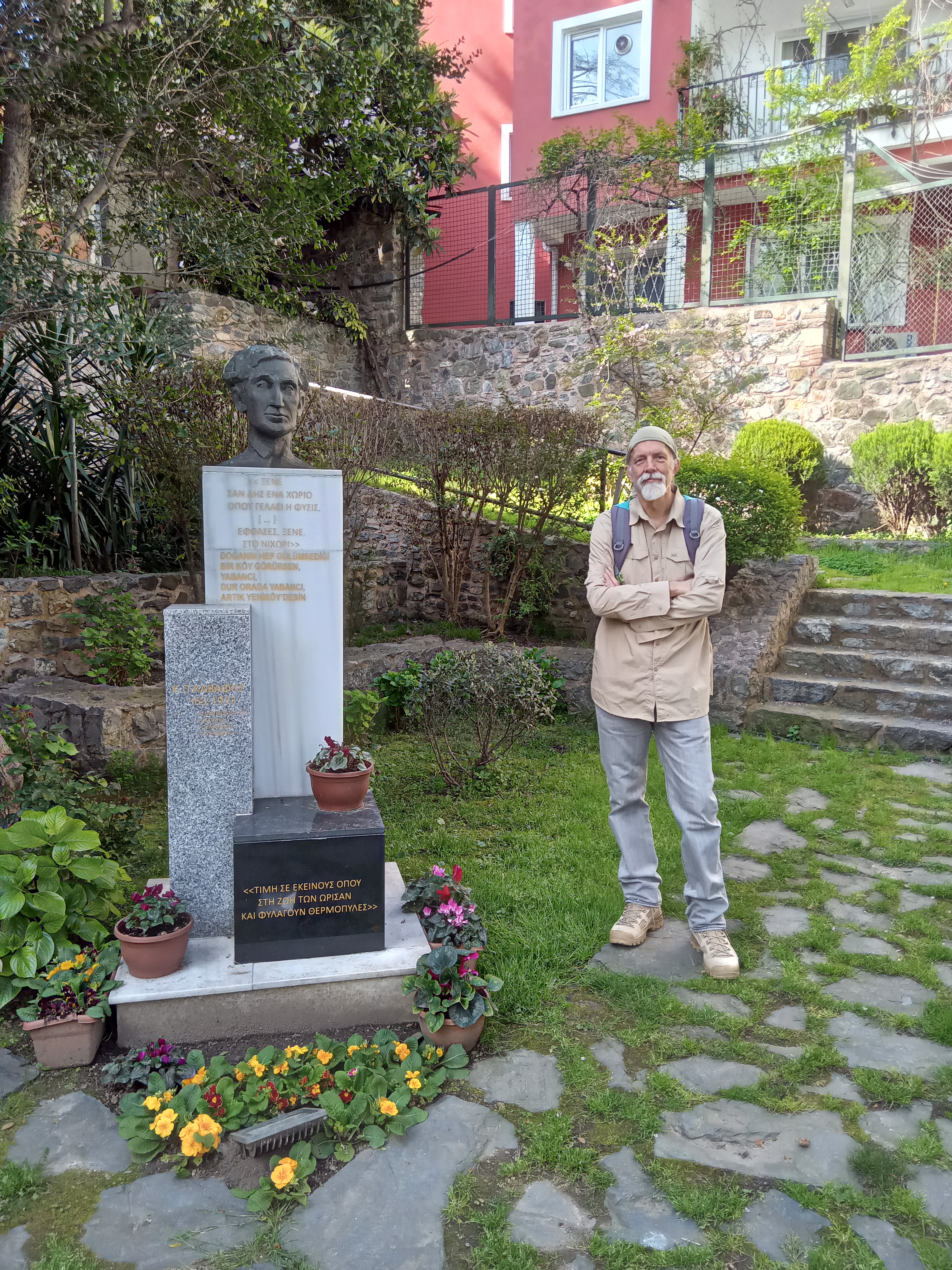
Myself with the Cavafy bust in Yeniköy
April 14, 2023
Photo by Ayşe Berkman
Edited September 13, 2023. Introduction added December 15, 2023. Edited again, March 30, 2024
 Polytropy

5 Trackbacks
[…] “Cavafy in Istanbul” (posted September 10, 2023), I found reason to talk more about Triple Helix and being […]
[…] despite being biologically related (as far as I can tell). This continues a theme I took up in “Cavafy in Istanbul,” that when an adopted person is bothered by differences from his legal and moral relatives, he […]
[…] went into these things more in “Cavafy in Istanbul,” where I observed that, however people become parents, they can believe either that they are in […]
[…] plot in Yeniköy (where Cavafy lived a while), Istanbul, Saturday, September 28, […]
[…] Dionysius of Byzantium had to say about the geography of my region, two thousand years ago. In “Cavafy in Istanbul,” I wrote about this geography. I included § 66 of the Anaplous of Dionysius (and now I correct […]