In “Biological History,” I talk about some stories by Somerset Maugham. The theme is a confusion between biological (or generally physical) facts and historical (or personal) facts.
I originally made the post on January 9, 2023. I have returned to it a few times since. I did this most recently when a friend told me of purchasing, in Toronto, Ontario, a two-volume edition of Maugham’s complete short stories. Probably this was the same edition that I had bought in Hamilton, Ontario, a quarter-century earlier.
Working again through “Biological History,” I wanted to spell out a remark about what is either the just-world hypothesis or the just-world fallacy. I am going to do that here, using verses of Parmenides of Elea. Parmenides will lead me in turn to Dr Seuss and the fallacy of artificial intelligence.
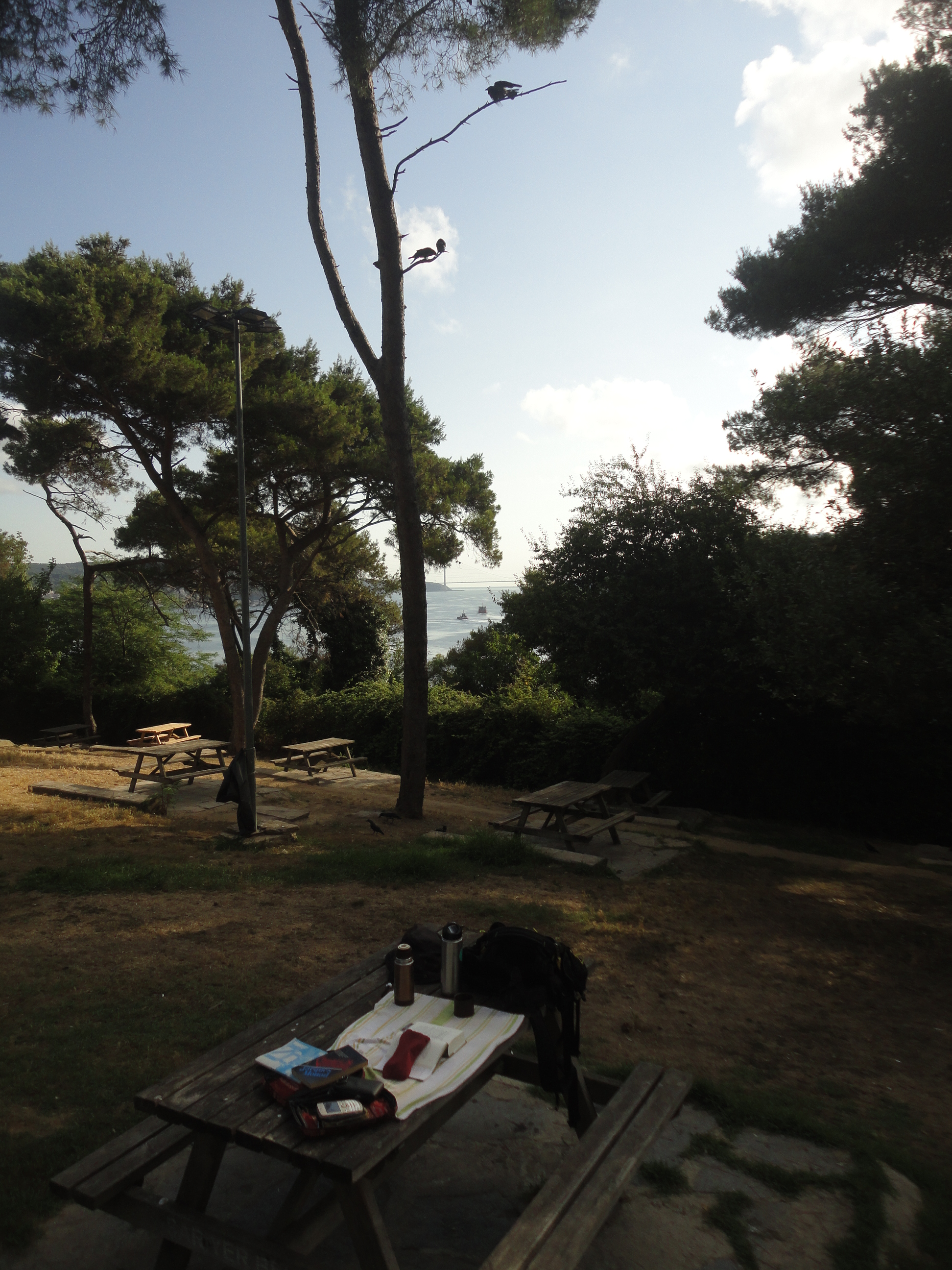
Where I read Parmenides
Erguvantepe, Sarıyer, Istanbul
July 19, 2025
Somebody called Adam Somerset writes of one of Somerset Maugham’s stories,
For a few crucial years, around age fifteen onward, fiction and fables make their deepest mark. Direct experience then takes over. For an inward teenager “The Alien Corn” hit home. It said that wish and will are in themselves insufficient. Life choices as they turn out may be second, third, or even fourth best.
This is in “Favourite Short Stories: Somerset Maugham’s ‘The Alien Corn’,” Wales Arts Review, 3 October 2013. The original link for the article currently directs me to a site apparently in the Thai language. Adam Somerset continues:
Experience reinforced the message of fiction. A couple of years on, while hitch-hiking home from the Gower, I was picked up by a driver who said that he had wished to be an optician. Insufficient family means had instead meant an unglamorous life in vehicle testing. A few months after that and I was on a bus between Der’aa and Damascus. The uniformed conscript in the older Assad’s army standing next to me said his deepest wish was to practice taxidermy. “But there is no work for a taxidermist in my country” he said wistfully.
In “The Alien Corn,” George Bland does not lack the opportunity to be a pianist, or the will; he lacks the ear and the hands. Somerset concludes:
That the world was never designed with our personal convenience in mind is a moral lesson that comes to all. The later it comes, the more shaking is its impact. On re-reading “the Alien Corn” it is rambling and ill-structured, distasteful in its racial stereotyping. But back then, in the hands of a teenager who knew nothing, it was bearer of a message of might and truth; all know disappointment.
As Jagger and Richards explained, “You Can’t Always Get What You Want.” Somerset Maugham says more about this than Adam Somerset cares to get into. Perhaps that is because of what Somerset calls the “distasteful … racial stereotyping.” From what Maugham himself tells us, Somerset reports that George
rejects the family parliamentary seat in favour of ambitions to become a professional pianist.
‘The perfect type of a English gentleman’, observes the narrator, undergoes two years of intense immersion and dedication. His hair grows long, his nails are rimmed with black, and his Oxford Bags become grimy.
Somerset leaves out that those two years are spent in Germany. Since “The Alien Corn” is one of the Six Stories Written in the First Person Singular (1931), Maugham can have his own character visit George in Munich and tell him, “Don’t forget that you’re English yourself.” I quoted that in “Biological History,” along with the first part of George’s reply:
I? I’m not English. I haven’t got a drop of English blood in me. I’m a Jew and you know it, and a German Jew into the bargain. I don’t want to be English. I want to be a Jew. My friends are Jews. You don’t know how much more easy I feel with them. I can be myself. We did everything we could to avoid Jews at home; Mummy, because she was blonde, thought she could get away with it and pretended she was a Gentile. What rot! D’you know, I have a lot of fun wandering about the Jewish parts of Munich and looking at the people. I went to Frankfort once, there are a lot of them there, and I walked about and looked at the frowzy old men with their hooked noses and the fat women with their false hair. I felt such a sympathy for them, I felt I belonged to them, I could have kissed them. When they looked at me I wondered if they knew that I was one of them.
George was not one of them. Biological origins do not determine affinity. Had the Jews of Munich known of George’s origins, they might have been willing to make him one of them. George himself did not try to make this happen.
He did try to be a pianist. He worked at it ten hours a day, by his own report. He said he would work at it for ten years. His ambition drove him so hard, he was able to avoid noticing that his goal was not getting closer.

The proposition that perseverance leads to success: this may be one form of the just-world fallacy. It would also seem to be the inevitable hypothesis of anybody capable of persevering.
If that is obscure, I illustrate it with something even more obscure: some verses of Parmenides.
I happen to have joined a group to read Parmenides in Greek, now in the summer of 2025. Parmenides is doing metaphysics; however, is it the kind of metaphysics that is supposed to apply to what is beyond experience, or is Parmenides only studying what allows us to make sense of experience in the first place?
Here are the Parmenides verses labelled B8.1–10 by Diels and Kranz, and D8.6b–15 by Laks and Most. The translation is by the latter editors:
μόνος δ’ ἔτι μῦθος ὁδοῖο
λείπεται ὡς ἔστιν· ταύτῃ δ’ ἐπὶ σήματ’ ἔασι
πολλὰ μάλ’, ὡς ἀγένητον ἐὸν καὶ ἀνώλεθρόν ἐστιν
οὖλον μουνογενές τε καὶ ἀτρεμὲς ἠδ’ ἀτέλεστον·
οὐδὲ ποτ’ ἦν οὐδ’ ἔσται, ἐπεὶ νῦν ἔστιν ὁμοῦ πᾶν,
ἕν, συνεχές· τίνα γὰρ γένναν διζήσεαι αὐτοῦ;
πῇ πόθεν αὐξηθέν; οὔτ’ ἐκ μὴ ἐόντος ἐάσω
φάσθαι σ’ οὐδὲ νοεῖν· οὐ γὰρ φατὸν οὐδὲ νοητόν
ἔστιν ὅπως οὐκ ἔστι. τί δ’ ἄν μιν καὶ χρέος ὦρσεν
ὕστερον ἢ πρόσθεν, τοῦ μηδενὸς ἀρξάμενον, φῦν;There only remains the word of the path [scil. that says]:
“Is.” On this one there are signs,
Very many of them: that being, it [or: that what is] is ungenerated, indestructible,
Complete, single-born, untrembling and unending [scil. probably: in time].
And was not, nor will it be at some time, since it is now, together, whole,
One, continuous. For what birth could you seek for it?
How, from what could it have grown? Not from what is not – I shall not allow
You to say nor to think this: for it cannot be said nor thought
That “is not”; and what need could have impelled it
To grow later rather than sooner, if it had had nothing for its beginning?
The verses would seem to concern something that verbs with tense do not fit.
Mathematics is such a thing. We state theorems in the present tense: “The base angles of an isosceles triangle are equal to one another.” Normally, the form “are” suggests the possibility of “were not” and “will not be”; however, there is no such possibility in mathematics.
How can anything change from “was not,” to “is,” to “will not be”? Parmenides suggests that there can be no reason for change. However, to conclude, from this absence of reason, the impossibility of change: this would be an instance of the just-world fallacy.
Indeed, what right have we to expect the world to be reasonable? None. And yet we have use of reason. This presumes some such foundation as Parmenides is describing.

I note the suggestion of a belief in such a foundation in Katie Kitamura, “Into the Vortex” (Harper’s, August 2025). The online version of the review omits the explanation at the head of the print version:
Discussed in this essay: Wildcat Dome, by Yuko Tsushima. Translated from the Japanese by Lisa Hofmann-Kuroda. Farrar, Strauss and Giroux. 272 pages. $28.
I am thinking now of the quotation from Tsushima embedded in Kitamura’s review.
In a 2004 conversation with Tsushima, the French writer Annie Ernaux, a longtime admirer, observed, “Your writing is very attentive to the material aspects of everyday life, which are always rendered in precise detail. I might venture to say that, culturally speaking, this is often considered women’s territory” …
In that same conversation with Ernaux, Tsushima told the following anecdote about the vexing relationship between our mundane experience of quotidian life and our apprehension of large-scale historical events:
Recently, a thief broke into my house. Thankfully, the door was the only thing that was damaged. You’d agree that this is a rather trivial, personal event, no? On the same day, I found out that a woman writer in Japan, someone from a younger generation, had taken her own life. … Finally – and this is still on the same day – the Japanese volunteers who had been captured as hostages in Iraq were released. … And then I thought, what does it mean that these three events happened on the same day? … The fact is that these three things really happened simultaneously, and the fact that I can’t help but search for a meaning behind this simultaneity is, I think, profoundly related to the process of literary creation.
The ellipses in the quotation from Tsushima are in the original. The bolding is by me.
The theme of seeking meaning behind simultaneity is found in The Bridge of San Luis Rey (1927). I somehow knew of Thornton Wilder’s novel from school, maybe because at least one classmate wrote a book report on it. I didn’t read the book myself then. A teacher chose Wilder’s play Our Town (1938) for us all to read, and a boy in our car pool played the stage manager in a school production, which my family went to see.
I read The Bridge of San Luis Rey as an adult, in the copy that my mother-in-law had trained herself in English on. I see now her glosses, in Turkish and English, such as “porridge” = yulaf ezmesi and “wicker” = “made of straw,” both on page 40 of her copy, a Penguin Book, printed in 1963, price 2/6.
Reading the novel was unnerving, since I knew there could not be such an explanation as Brother Juniper sought for the deaths of the people whom the novel described. Probably Wilder did not intend for there to be an explanation, and yet inevitably some people will seek one.
Finally, Parmenides reminds me of Happy Birthday to You (1959), quite a few verses of which I can remember from childhood. To confirm and supplement my memory, I tried to borrow a copy of this Dr-Seuss book from the Internet Archive. Alas, the book is one of the many that the Archive can no longer lend out, because of a successful lawsuit, Hachette v. Internet Archive. Apparently it doesn’t matter whether the Archive has legal ownership of physical copies of the books; they cannot be shown, for free, to others such as myself.
A company can use its own copies of books in order to sell a service to others: on this point, in Bartz et al. v. Anthropic, the judge ruled in favor of the defendants. According to the report of Emma Roth in The Verge, June 24, 2025,
“Authors’ complaint is no different than it would be if they complained that training schoolchildren to write well would result in an explosion of competing works,” Judge Alsup writes, adding that the Copyright Act “seeks to advance original works of authorship, not to protect authors against competition.”
The authors’ complaint is different. For one thing, the judge begs the question of whether what AI does is original; but I set that aside.
I should not have thought that the following would need to be pointed out. Traditionally, and presumably in the memory of Judge Alsup (born 1945), each schoolchild was trained on books that were in the possession of him- or herself, the school district, or the school library. The production of many new writers thus required the purchase of many copies of books. Now a single computer program is supposed to be able to supplant all of those writers, by means of single copies of those books, as long as those single copies are first purchased fair and square.
Meanwhile, in “A Government Just Quietly Announced The Collapse of Civilization” (August 12, 2025), Jessica Wildfire passes along news from 404 Media that is summed up in a headline: “UK Asks People to Delete Emails In Order to Save Water During Drought.” This is when, according to Jay Peters in The Verge (“Sam Altman claims [without evidence] an average ChatGPT query uses ‘roughly one fifteenth of a teaspoon’ of water,” June 11, 2025),
AI companies have come under scrutiny for energy costs of their technology. This year, for example, researchers forecast that AI could consume more power than Bitcoin mining by the end of the year. In an article last year, The Washington Post worked with researchers to determine that a 100-word email “generated by an AI chatbot using GPT-4” required “a little more than 1 bottle [of water].”
I located the Dr Seuss text that I wanted, by means of Anna’s Archive:
If we didn’t have birthdays, you wouldn’t be you.
If you’d never been born, well then what would you do?
If you’d never been born, well then what would you be?
You might be a fish! Or a toad in a tree!
You might be a doorknob! Or three baked potatoes!
You might be a bag full of hard green tomatoes.
Or worse than all that … Why, you might be a WASN’T!
A Wasn’t has no fun at all. No, he doesn’t.
A Wasn’t just isn’t. He just isn’t present.
But you … You ARE YOU! And, now isn’t that pleasant!
The logic here is as impeccable as in Parmenides.

View of Tarabya Harbor
from the end of Haziran Sokağı
(the Chinese consulate was apparently behind me
at the end of Çoban Çesme Sokağı)
Edited August 21 and November 3, 2025
 Polytropy
4 Trackbacks
[…] I tried to spell out my meaning here, then decided to make what I had into a new post, “Just World.” […]
[…] last point came up recently on this blog, in “Just World,” where I noted how Parmenides too talked of something timeless. Physics then is about something […]
[…] stories of Somerset Maugham as making the same point. I supplemented that post recently with “Just World,” centered on an argument by […]
[…] Stories (1922) that I have read, having taken them from my mother-in-law’s collection. In “Just World,” I talked about another book from that collection: Thornton Wilder, The Bridge of San Luis Rey. […]