Reading a book as if it had “no introduction, no notes, no aids or guides, no nothing but the naked text” (as William Deresiewicz puts it): such a reading seemed to need a defense. Here is my elaborate one, which seemed in the end to fall into nine sections as summarized below.
Let me note first that searching on “ahistorical reading” led me to a textbook chapter called “What Is Ahistorical Reading?” (in Intro to Poetry, by Alan Lindsay and Candace Bergstrom). The chapter seems to say well what every high-school graduate ought to know, though unfortunately they may not in fact. If you don’t want to slog through what I wrote, read that.
- 1. Some Novels and Novelists.
- These may be read in school or for pleasure – mine, or that of writer and blogger Hai Di Nguyen. There can be epics such as War and Peace, Moby-Dick, and Zen and the Art of Motorcycle Maintenance. George Steiner finds the last two comparable. There can be an unreliable narrator.
- 2. Reading Comprehension.
- This may be challenged by some poetry, such as Wordsworth’s, and annotations may not help.
- 3. Reading Without Preconceptions.
- St John’s College accustomed me to this.
- 4. Reading Groups.
- There are many that (thanks to the Catherine Project) I have been able to join and enjoy, all pursued in the St-John’s way as I understand it.
- 5. Story.
- Mythos or logos. We inevitably tell it in our own words (unless perhaps somebody else has fed us the words).
- 6. Giving What Is Wanted.
- “Ask me no questions, and I’ll tell you no fibs.” (To Goldsmith’s comedy She Stoops to Conquer, the saying is traced by Grammarist, which however has “lies” for “fibs”; Wikipedia currently repeats this apparent misquotation, citing Grammarist.) People are trained now to give most of their attention to their mobiles; in school we may be trained to supply what teachers want to hear.
- 7. Historicism.
- I continue not to understand the objection of Leo Strauss to the “historicism” of R. G. Collingwood, but I agree with such ahistorical reading as is practiced at St John’s and was defended in my day (as I recall) by Strauss’s student and my teacher, David Bolotin.
- 8. The Classics.
- There is something to be said for being assigned to read what one might not otherwise. My example is John Donne.
- 9. Re-Enactment.
- Collingwood came to understand history as the re-enactment of thought, but this can be misunderstood, either when reading a poet such as John Donne, or when thinking of a certain major general who happened to read poetry while getting ready for battle.
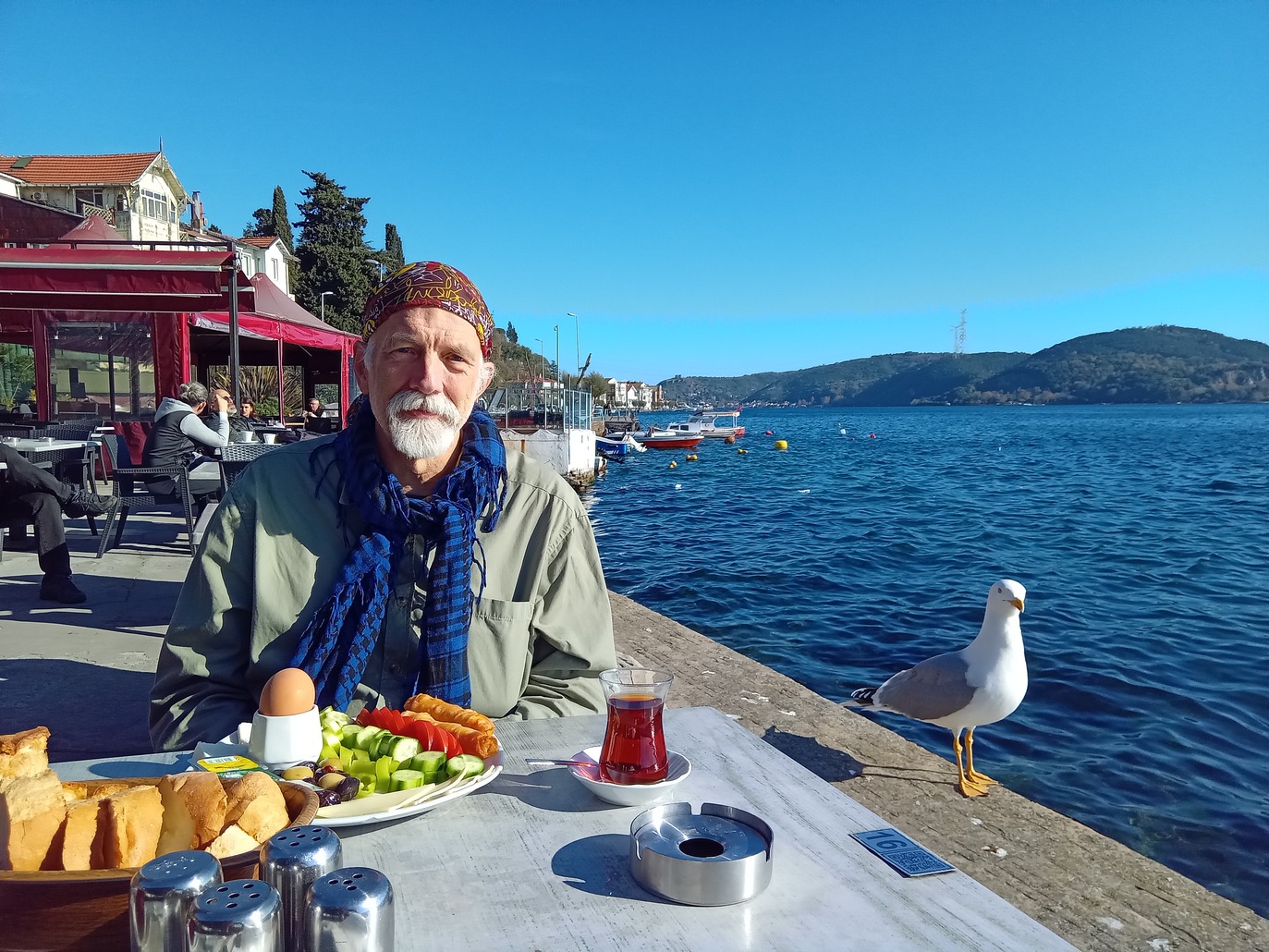
Beyazpark Liseliler Kafe
Sarıyer, Istanbul
November 25, 2025
1 Some Novels and Novelists
“They don’t read very well.” That might be said of a lot of us.
Some of us may still need something.
“They don’t read very well” is the title of an article with the subtitle, “A Study of the Reading Comprehension Skills of English Majors at Two Midwestern Universities.”
What those college students don’t read very well is the opening paragraphs of Bleak House, which is
a standard in college literature classes and, so, is important for English Education students, who often are called on to teach Great Expectations and A Tale of Two Cities in high schools.
Perhaps there ought to be a better reason for reading Dickens than that.
I read Great Expectations and Hard Times in high school, but they did not thrill me. As a teacher told me, when I told him this, “If you don’t like broccoli, you don’t like broccoli.” I must have tried to articulate some reason for my feeling nonetheless, but I don’t specifically remember what it was. Still, when I read A Handful of Dust, some years later (in my father’s copy), I thought Evelyn Waugh had come up with an exquisite punishment for one of the characters: to spend the rest of his life reading Dickens aloud to an illiterate man.
Meanwhile, I had read Hard Times again, when (just after college) I was tutoring a boy who was assigned to read it. I have not read Dickens since then, or Bleak House at all. I am inclined to try that novel now, because of a recent tweet of Hai Di Nguyen:
One thing I’ve learnt over the years is that each great book has a kind of ideal reader.
(I’d like to think) I am for “War & Peace”, “Moby-Dick”, “Don Quixote”, & “Bleak House”, which I love wholeheartedly.
I’m not for the works of George Eliot, Zola, Woolf.
I have enjoyed the first three of those four novels, as well as works by those three novelists. In this blog, see
- “War and Talk” on War and Peace,
- “Purity Obscurity” on Middlemarch,
- “Bohemianism” on Mrs Dalloway (briefly).
I look at Woolf’s essay “On Being Ill” in “Prairie Life.” Don Quixote was the summer reading in college between sophomore and junior year. I read
- Germinal on the recommendation of a Marxist friend;
- Moby-Dick after an email friend said he had finished it and immediately read it again;
- The Mill on the Floss, maybe because Christopher Hitchens had written good words about it;
- To the Lighthouse with my wife, after our reading of Ulysses, which I say more about below.
I would not call myself an ideal reader of any of the novels and novelists here. I continue to list my favorite writers as in my “Victor Vasarely” post, and again on my “About” page: Charlotte Brontë, Henry David Thoreau, Somerset Maugham, Robin George Collingwood, Mary Midgley, and Robert Pirsig.
Three of those writers are novelists. Pirsig is one, after the fashion of Tolstoy and Melville. Nguyen describes this fashion in a blog post, “The whale’s eyes, the structure of Moby Dick, the ‘boring’ chapters” (April 3, 2016):
Before reading Moby Dick, whenever hearing the accusation that it’s not a novel, I thought of War and Peace, which was 3 books put together – a novel, a historical chronicle and a philosophical book about war, history and determinism … for a large part Moby Dick is hardly a novel any more – it’s more like an encyclopedia about whales and whaling, mixed with philosophy.
Before, my interest in whales was zero … What keeps me interested is Melville’s language, and Ishmael’s infectious enthusiasm. It’s easy to understand why many readers think the book boring and give up on it … On my part, I initially was fine with the whale/whaling chapters, thinking they’re necessary. Then I started to enjoy them …
The resemblance of Pirsig to Melville is made explicit by George Steiner, at the end of his review of Zen and the Art of Motorcycle Maintenance (“Uneasy Rider,” The New Yorker, April 8, 1974; reprinted in DiSanto and Steele, Guidebook to Zen and the Art of Motorcycle Maintenance):
A detailed technical treatise on the tools, on the routines, on the metaphysics of a specialized skill; the legend of a great hunt after identity, after the salvation of mind and soul out of obsession, the hunter being hunted; a fiction repeatedly interrupted by, enmeshed with, a lengthy meditation on the ironic and tragic singularities of American man – the analogies with Moby Dick are patent. Robert Pirsig invites the prodigious comparison. It is at many points, including, even, the almost complete absence of women, suitable. What more can one say?
What more can one say? Well, there is more to reading than making comparisons. I was looking at those in the previous post, “Motion and Rest.” I admitted to being helped to read Faust by seeing it likened to Ulysses. However, if you read Goethe, thinking he is like Joyce, then you may miss whatever is special about the former.
That is the kind of point I started working on, in the post before last, “Reading and Writing.” You are allowed to take a writer individually, at face value, and perhaps every writer is owed that courtesy.
In his earlier paragraphs on Pirsig, Steiner has some criticism, first positive:
The two disciplines of apprehension, ideal and instrumental, are bodied forth in what is probably the wittiest, most ramified episode in the tale … Pirsig’s timing and crafting at this juncture are flawless.
I have removed the description of the episode, because
- it would not mean much, if you don’t know the novel;
- if you do know the novel, you can now think about what episodes Steiner might be describing. I might highlight a different episode, such as the one I summarized briefly at the head of “The System.”
In his ensuing paragraph, Steiner has to point out imperfection:
This is not always so. The westward journey is punctuated by lengthy meditations and lay sermons that Pirsig calls “Chautauquas” … Much of this discursive argument, the “inquiry into values,” is finely shaped. But there are pedestrian stretches, potted summaries of Kant which betray the aggressive certitudes of the self-taught man, misattributions (it was not Coleridge but Goethe who divided rational humanity into Platonists and Aristotelians), tatters out of a Great Books seminar to which the narrator once took bitter exception. The cracker-barrel voice grinds on, sententious and flat.
Here I find it useful to recall Pirsig’s own comparison of his novel’s first person with the unreliable narrator of The Turn of the Screw. This is in the Introduction to the Twenty-fifth Anniversary Edition of Zen and the Art of Motorcycle Maintenance. Pirsig recalls “a creative writing seminar held on winter afternoons in the early 1950s at the University of Minnesota.” He learned from Allan Tate, “a distinguished poet and literary critic,” that there was more to Henry James’s short novel than he had realized.
Pirsig does not literally call his narrator “unreliable.” The Wikipedia article “Unreliable narrator” dates the term only to 1961 and notes a new possibility, taken up in
- Murphy, Terence Patrick and Walsh, Kelly S., “Unreliable Third Person Narration? The Case of Katherine Mansfield,” Journal of Literary Semantics, vol. 46, no. 1, 2017, pp. 67–85, DOI 10.1515/jls-2017-0005.
Unfortunately none of the stories considered – “A Cup of Tea” (1922), “Bliss” (1918) and “Revelations” (1920) – is in any of the two Mansfield collections In a German Pension (1911) and The Garden Party and Other Stories (1922) that I have read, having taken them from my mother-in-law’s collection. In “Just World,” I talked about another book from that collection: Thornton Wilder, The Bridge of San Luis Rey. I count the narrator there as unreliable, simply for believing that there might be a moral reason for the particular deaths caused by the failure of the bridge.
If, like George Steiner, you can see that any writer has got something wrong, good for you. Perhaps only the persona of the writer is wrong. (I looked at the personae of Maugham, Collingwood, and Pirsig in “Books Hung Out With” and “The Writer and the Persona.”)
2 Reading Comprehension
Taking a writer at face value does require some ability to read that face, as for example by knowing the language it speaks. A simple example that has stuck in my mind is that the tree blown over by the wind is not therefore like the full-blown rose. There are two English verbs that now have the principle parts “blow, blew, blown.” One of the verbs is rarely used actively today, but Wordsworth uses it at the end of Ode: Intimations of Immortality from Recollections of Early Childhood:
Thanks to the human heart by which we live,
Thanks to its tenderness, its joys, and fears,
To me the meanest flower that blows can give
Thoughts that do often lie too deep for tears.
A college classmate became defensive when told (not by me) that the flower was blooming, not bobbing in the wind as he had imagined.
Perhaps it matters little what Wordsworth’s flower is doing, beyond just being there, giving thoughts to the poet. Greater difficulties were had by the subjects of the study by Susan Carlson, Ananda Jayawardhana, and Diane Miniel that I began this post with.
The subjects frequently looked up a word they did not know, realized that they did not understand the sentence the word had come from, and skipped translating the sentence altogether.
We might consider the possibility that the subjects did not feel the need to put much effort into their reading, since it was not for a course grade.
Looking up words or history is of little help, if we want to understand the following sentence of Wordsworth in “Lines: Left upon a seat in a yew-tree which stands near the Lake of Esthwaite, on a desolate part of the shore, yet commanding a beautiful prospect”:
[The beauty still more beautious.] Nor, that time,
Would he forget those beings, to whose minds,
Warm from the labours of benevolence,
The world, and man himself, appeared a scene
Of kindred loveliness: then he would sigh
With mournful joy, to think that others felt
What he must never feel: and so, lost man!
On visionary views would fancy feed,
Till his eye streamed with tears. [In this deep vale]
We may note that this is unrhymed (“blank”) verse, in iambic pentameter. We may look at which other poems in Lyrical Ballads are like that, and we may ask why. I don’t think this helps with the sentence itself. Of its 61 words, by my count,
- 48 are of one syllable;
- 10, of two;
- 1, of three;
- 2, of four.
Maybe some readers are confused by “benevolence,” but its meaning does not clarify that “fancy feed” is not gourmet cat food. Neither does it help to know that Wordsworth was inspired by a cleric called William Braithwaite. It might help to note that “mournful joy” is an oxymoron, but we need not know the particular technical term. The question remains: Who is the person in the poem?
So it seems to me. However, my point of view is peculiar.
3 Reading Without Preconceptions
I did not take conventional undergraduate classes, in literature or anything else. I must have missed a lot. Since those days, it is true, I have been away from school for only a year, when I was working on an organic farm in West Virginia. However, my academic positions have all been in mathematics.
In “The New Canon Wars” (January 13, 2025), Hollis Robbins writes,
a Great Books program introduces students to the organizing principle of influence over time. Teaching the Odyssey involves understanding who Homer was, when and how the poem circulated and was recorded, which translations have been most influential (and which have faded), why there continue to be new translations, what the differences are, how these arguments have kept translated versions in circulation for millennia, and who are the poem’s intellectual children.
I enjoy reading Robbins’s newsletter, but this passage astonishes me. By the standard it sets out, I was never taught the Odyssey. Nonetheless, I was assigned to read it in both high school and college. Moreover, that college was a Great Books college, even the Great Books college, the one with campuses in Maryland and New Mexico: St John’s College. We read the Odyssey as freshmen, in whatever translations we chose, and we talked about it around a big table. Two tutors were present, apparently because a single tutor might be perceived as, or act as, a sole authority.
I remember a special seminar, in the summer before my senior year in Santa Fe, on the the Joseph Conrad story “The Secret Sharer.” Whoever was on campus was invited to join. There were the standard two leaders at the table, but one of them was the newly appointed president of that campus. As the discussion went on, this man became frustrated, because the rest of us didn’t seem to be getting his point. He even got out of his chair to write it on the blackboard.
His faux pas was ignored like a fart. At the end of the seminar, addressing his co-leader, he said something like, “Well, Mrs A——, I don’t know if they answered all of our questions, but we can certainly recommend more Conrad!” The rest of us had not been there to answer his questions. He himself had a lot to learn, if he was going to stick around; but he was gone from the college in three years.
As I recall from Freud’s General Introduction to Psychoanalysis, which we read as seniors (and which, as it happens, was being read on our Aegean beach last summer by a German man living in Switzerland who spoke French with his Turkish wife): there are things that we cannot be told, even if they are true. We have to discover them for ourselves.
I mentioned Ulysses. Last year I finished reading it with my beloved wife, who had long wanted to read it. We had begun the project two years earlier, reading the Iliad, a book a week; then the Odyssey and the Aeneid, the same way; then Joyce’s Dubliners and Portrait of the Artist As a Young Man. Ayşe had The New Bloomsday Book: A guide through Ulysses (3rd edition, 1996), by Harry Blamires, and this was supposed to help you get from the novel what would normally take several readings. I quickly abandoned the guidebook. If the novel would not be worth reading several times, why bother with it at all?
In the fall of 2024 (I suppose it was), at the Matthew Strother Center for the Examined Life, William Deresiewicz lead discussions of Joyce’s Portrait. By his account, students had come, not knowing what they would be reading,
to prevent them from stuffing their heads in advance with clever things to say that they had read in some professor’s monograph.
They were given an edition of the reading
that included as little ancillary material as possible. I wanted one with no introduction, no notes, no aids or guides, no nothing but the naked text.
That sounds great. However, Deresiewicz himself knew the reading well:
Berta had asked the faculty to select books that had been transformative for us, and I had pretty much become Stephen Dedalus when I was 19.
Does he keep the students hungry, the better to feed them with his own ideas?
The first day’s assignment was nine pages long. This was already a way to signal to the group what we were going to be about. The next morning, we launched right in with no preliminaries, beginning at the beginning, which is not the first line but the title. We ended up spending about an hour on it, turning it this way and that, starting with “Portrait” and discussing every word but “of”. Then it was a good half-hour on the epigraph, a line from Ovid’s Metamorphoses. And so it went; we barely made it past the middle of the second page that day.
If I don’t know Portrait intimately, I don’t think I want to spend an hour talking about its title. That discussion might make more sense after talking about the body of the work.
But then, maybe I’m still bitter about being marked down for an eighth-grade report on Catcher in the Rye, because I hadn’t talked about the title. Another boy was asked to read his report aloud to the class. He had known what the teacher wanted to see. He had probably learned it from his father, who was a psychiatrist.
4 Reading Groups
As my wife recalls, she proposed reading the Iliad together when I didn’t get into some Catherine Project group. Noneless, since 2021, I have enjoyed 23 CP reading groups, seven on works of poetry:
- Chaucer, Canterbury Tales
- Rilke, Duino Elegies
- Ferdowsi, Shahnameh
- T.S. Eliot, Four Quartets
- Beowulf
- Rumi, Love Is a Stranger
- Sophocles, Ajax, Electra, Trachiniae
Each link is to a blog post where I said at least something about the work. I talk below about the Electra. I’m leaving off the group on Lyrical Ballads, which has provoked my writing. I might count a community seminar:
- Sophocles, Philoctetes.
Also, two guerrilla groups:
I have been in official CP groups on other works of fiction, broadly understood. I exclude several dialogues of Plato from the list:
- Njal’s Saga
- Sunjata
- Mwindo
- Xenophon, Cyropaedia (I’m counting this as a novel)
- George Eliot, Middlemarch
In all of the seminars, as I recall, we talked mainly about the stories in the works. This was hard with Rilke, Eliot, or Rumi, and so the question arose, “What is he talking about?”
I suppose the discussions were all in line with one of the Catherine Project “core principles”:
- Freedom – Excepting our subject tutorials, all of our courses are conducted by open-ended conversation. Readers are not directed toward particular conclusions, but are encouraged to bring their own live questions.
Unless we have certain technical knowledge, it seems to me, our questions about a reading are likely to concern its story.
5 Story
What is “story”? Perhaps I mean what
- Aristotle calls mythos or “plot” in Poetics VI (1450a4), and
- Socrates calls logos in Republic III (392c).
Socrates proceeds to talk about lexis, or manner of speech. He “translates,” to indirect speech, the direct speech at the beginning of the Iliad. Chryses says there (in Butler’s prose translation of Homer’s verse),
Sons of Atreus, and all other Achaeans, may the gods who dwell in Olympus grant you to sack the city of Priam, and to reach your homes in safety; but free my daughter, and accept a ransom for her, in reverence to Apollo, son of Jove.
Socrates describes the speech (here in Bloom’s translation of the words that Plato assigns to Socrates):
The priest … prayed the gods on behalf of the Greeks that they might capture Troy and return safely home, but begged that they would give him back his daughter, and take the ransom which he brought, and respect the God.
I am not going to try to talk about what Socrates might mean by his translation exercise. I do suppose we engage in such an exercise, whenever we talk about a work of literature.
A play such as the Electra of Sophocles is entirely direct speech, which we make indirect in our discussions. What is the Electra about? By the current Wikipedia account,
Set in the city of Mycenae a few years after the Trojan War, the play tells of a bitter struggle for justice by Electra and her brother Orestes for the murder of their father Agamemnon by their mother Clytemnestra and their stepfather Aegisthus.
In fact I added the words “their mother” to the article (and I hope every Wikipedia reader feels free to do such things). I am tempted to try a more radical change, to something like,
… the play tells of the bitter struggles between Electra and
- her mother Clytemnestra, who killed Electra’s father Agamemnon;
- her sister Chrysothemis, who thinks Electra should get over it.
As it is now, the Wikipedia article does not mention Chrysothemis (except as being in the cast of characters). The relative significance of her and Orestes would be worth discussing in a CP seminar, it seems to me.
I have thought it would help ensure careful reading, if we brought our own summaries of a reading to the discussion. Then it was pointed out to me, reasonably, that readers might conclude that there was a correct summary.
According to the Advertisement of the Lyrical Ballads,
An accurate taste in poetry, and in all the other arts, Sir Joshua Reynolds has observed, is an acquired talent … if poetry be a subject on which much time has not been bestowed, the judgment may be erroneous …
I would disagree with this, but perhaps the whole Advertisement is irrelevant to the poems themselves. Artists do not necessarily talk well about their own work, otherwise than through the work itself – which therefore we ought to attend to first, it seems to me.
6 Giving What Is Wanted
In the Electra, there is an elaborate account of the death of Orestes in a chariot race at Delphi. The account is fictional, since the man is still alive (in the fictional world of the play).
One may still ask whether the story of the race somehow reflects the story of the play itself, the way the Shield of Achilles reflects the story of the Iliad.
Nonetheless, suppose a teacher asks a class, “How does the chariot race reflect the plot of the Electra?” Students will try to come up with an answer, even when there may be none.
Perhaps indeed Wordsworth himself points out this problem in “Anecdote for fathers shewing how the art of lying may be taught.” Pressed to answer a silly question about his preferences, a boy gives a silly answer. Collingwood takes the problem here quite seriously in the “Desire” chapter of The New Leviathan: Or Man, Society, Civilization and Barbarism (1942):
Trying to force oneself or another to identify the object of an appetite by reflection (‘come, come,’ – one knows the hectoring voice – ‘think; tell me what you want’) can only do untold damage. Already the vulgarized Freud, Jung, and Adler which constitute our popular psychology warns us against the danger of repressing desires; but not against the far worse danger of abating appetites by never letting them grow into desires.
Apparently people do find mates through dating apps. It still seems to me that success here must be accidental, because one does not love a person of a particular kind that one can identify in advance of the person her- or himself.
There will be differing opinions on that point. In “Nature” (October 8, 2021), I looked at the presumption of David Silver that you could identify your life goals in advance, and a computer program could help you achieve them.
People on the street want to be helpful, at least here in Turkey. If you ask them directions, they will try to tell you something, even if they don’t actually know where you want to go.
I face the problem of BS as a teacher of mathematics. On examinations, some students will write down what they think I want to see, even if it does not make any sense to them.
Robert Pirsig had such a problem as a teacher of English composition. He wrote about it in a letter dated April 2, 1961:
Dear Prof. Buchanan:
Professor Grieder has given me a copy of your letter asking for information from persons with good thoughts about teaching or persons who are doing unregimented, unorthodox teaching of English …
… The problem being fought is the old problem that is renewed each time a student brings in a rewritten paper saying, “Is this what you want?” … An instructor often gets the feeling that he could spend the rest of his life telling the student what he wanted and never get anywhere precisely because the student is trying to produce what the instructor wants rather than what is good.
One also notices that on many of these occasions the particular student is as frustrated and angered as the instructor. The student keeps trying to figure out how to please the instructor and to his way of thinking, the instructor doesn’t seem to know himself …
That letter was a source, or a rough draft, for Zen and the Art of Motorcycle Maintenance. I myself used the letter, when I tried to explain the project I had come up with for students of analytic geometry, during the lockdown of the Covid-19 Pandemic. I reviewed the project itself in “An Exercise in Analytic Geometry,” but made the connection with Pirsig only in § 1.3 the ultimately published version (published by a journal, that is: Annales Universitatis Paedagogicae Cracoviensis | Studia ad Didacticam Mathematicae Pertinentia).
7 Historicism
Pirsig’s book helped induce me to attend St John’s College, even though the author has a reading of Plato that now seems foolish to me.
When I visited the Annapolis campus of St John’s College as a prospective student, and I sat in on a seminar on the Gorgias, I was astonished that this dialogue of Plato was treated as a play, rather than as philosophy. By “philosophy,” I must have meant a collection of arguments that needed to be judged, the way a putative proof in mathematics would be.
I’ll just say now that when Socrates makes an argument, it is with a particular character, whose response is just as important (for Plato and us) as the argument itself.
In the Gorgias, where we are likened to storage jars, I think we ought to decide whether we want to be
- sound jars, which hold on to their contents, or
- leaky jars, in constant need of refilling.
Or perhaps it is a stupid question, because we are not like jars at all. Such a response ought to be admissible too.
In a high-school history course, we were given potted accounts of the philosophies of Hobbes and Locke, including an “explanation” of these philosophies as reflecting the respective tenors of their times. If St John’s College ignored history, didn’t that mean students wouldn’t really be able to understand the Leviathan or the Second Treatise of Government?
I say now: No.
Such an answer needs a lot of qualification, which I shall not try to give here. In high school, I decided to attend St John’s anyway, and apparently I ended up drinking the Kool-Aid.
That president of the Santa Fe campus who lasted for three years: his background was in history, and he wanted to incorporate history in the College program. As I understand, the tutors let it be known that they took guidance on such matters from the deans, not the presidents.
The governing board must have backed up the faculty. I just remember an essay in defense of the College program as it was. This was by David Bolotin, who also wrote the chapter on Thucydides in the third (1987) edition of History of Political Philosophy, edited by Strauss and Cropsey.
Bolotin says there,
since political wisdom is primarily good judgment about unprecedented, particular situations, it is not so much a subject matter to be taught as a skill to be developed through practice. Accordingly, instead of telling us whether or not he approves of a given policy, Thucydides asks us to make our own judgments, and then to subject them to the testing that the war provides.
That makes sense. Unfortunately I have not been able to read Thucydides again, except for the Funeral Oration of Pericles, because it is supposed to be the source of our notion of equality before the law.
I brought up that equality in my talk on Thales of Miletus, in Miletus, September 24, 2016. (I was one of six speakers.) I quoted the Universal Declaration of Human Rights:
All are equal before the law and are entitled without any discrimination to equal protection of the law.
Attributed to Thales are several theorems about equality, as that the base angles of an isosceles triangle are equal. Those angles are equal, but not the same. I was taught to see the difference here by my own students, when they became confused by not seeing the difference when they read Euclid.
Equality is not sameness. Though we are all different from one another, it still makes sense to say that we are all created equal, being endowed by our creator with certain unalienable rights.
Bolotin says also of Thucydides,
Not only does he never use the term “political philosophy,” but he doesn’t address, at least not explicitly, its universal questions. Though he tells us what he regarded as the best Athenian regime during his lifetime, he never speaks of the best regime simply; and though he praises several men for their excellence, he never discusses the best or most excellent way of life as such.
Myself, I agree with the argument of Collingwood in An Autobiography (1939) that there are no such “universal questions,” no “best regime simply.” So I disagree with my teacher David Bolotin. If I understand him correctly from some emails of nine years ago, he finds Collingwood to be the best of the historicists, but that still means he is not as good as Leo Strauss – whose own assessment is currently described on Wikipedia as follows (bolding mine):
Leo Strauss used the term historicism and reportedly termed it the single greatest threat to intellectual freedom insofar as it denies any attempt to address injustice-pure-and-simple (such is the significance of historicism’s rejection of “natural right” or “right by nature”). Strauss argued that historicism “rejects political philosophy” (insofar as this stands or falls by questions of permanent, trans-historical significance) and is based on the belief that “all human thought, including scientific thought, rests on premises which cannot be validated by human reason and which came from historical epoch to historical epoch.” Strauss further identified R. G. Collingwood as the most coherent advocate of historicism in the English language. Countering Collingwood’s arguments, Strauss warned against historicist social scientists’ failure to address real-life problems – most notably that of tyranny – to the extent that they relativize (or “subjectivize”) all ethical problems by placing their significance strictly in function of particular or ever-changing socio-material conditions devoid of inherent or “objective” “value”.
This is too vague to be argued about, and here is not the place anyway. I can say that mathematical thought “rests on premises which cannot be validated by human reason,” reason validates only the passage from premises to the conclusion. This may mean that mathematics is stuck on the third part of the Divided Line, although there is a fourth part, addressed by dialectic. That’s fine, but as I asked in “Rethinking,” Does Strauss think he can get to dialectic without actually doing mathematics?
I do not know whether Strauss called Collingwood an “advocate” of historicism, but the word is not apt. In legal deliberations, an advocate tries to make his or her client the winner. The scientist wants only the truth to win. The truth wins only by being found, and it is not found by deliberation. (In “Subjective and Objective,” I trace this idea to the Nicomachean Ethics of Aristotle.)
I do agree with reading Hobbes or Locke or anybody else with as few assumptions as possible. These include assumptions about the time when the author lived. If something in the words doesn’t make sense, then perhaps expanding one’s historical knowledge will help.
As with Thucydides, so with the Leviathan, I have looked at it little since college. However, I have spent a lot of time with The New Leviathan, already mentioned. In this book, though he was dying, Collingwood wanted to do what he could to support civilization against the barbarism that was rampant at the time. However, one should not think that this barbarism would finally be defeated in 1945:
26.9. With too few honourable exceptions the nineteenth-century politicians, dazed by their false view of the French Revolution and the mirage of ‘Revolution’ as such, thought that recent events in France and America had once for all exploded the pretensions of autocracy and had once for all established democracy as the only political system rational in theory and tolerable in practice.
26.94. For that error we are now paying in the feats of a new autocracy, the millennial dreams of its dupes, and the Messianic pretensions of its leaders, the arch-Fascists and arch-Nazis of to-day.
Unfortunately, the Fascists and Nazis are still with us.
8 The Classics
In the 1961 letter already quoted, Pirsig addresses the concern that, if students are left to judge literary work for themselves, they won’t like a certain metaphysical poet:
Any composition student who writes today in the manner of John Donne is writing falsely and should be ranked down for it. I cannot agree that one learns to write effectively by imitating John Donne …
It is generally true that as a person grows older his tastes move from sweet, cloying foods, vibrant colors and sensational reading to sour and bitter foods, subdued colors and deeper and more subtle reading. But it is wrong to force bitter foods, subdued colors and deep reading on children, insisting that if they don’t like it they are not appreciating quality. It only confuses them about the nature of true quality, producing a schizophrenic separation of the things they actually like and the things they feel they are supposed to like.
In fact, Donne became my favorite of the poets I was asked to read in high school. I liked Wordsworth too, or at least what a teacher told us about him, but all I remember reading is what turns out to be the last poem of Lyrical Ballads. As an adolescent, I wished we could take a field trip to Tintern Abbey.
Maybe we read “The World Is Too Much With Us.” Somehow I could recognize the allusion to it, when the Washington Post summarized Donald Trump’s ghost-written book, The Art of the Deal, as concerning “the joys of getting and spending.”
So sure, if Pirsig means young people should never be told what they ought to read, that seems extreme.
9 Re-Enactment
As I said, Collingwood wrote on civilization. Niall Ferguson wrote Civilization: The West and the Rest (2011), while showing no sign of having read The New Leviathan, even as he says he admires Collingwood.
I take some of the following from my post “To Be Civilized” (May 27, 2021). Ferguson makes two quotations from the writer Pirsig mentioned – “my favourite poet, the Jacobean master John Donne”:
-
What Ferguson calls “the greatest of all exhortations to commiserate with the dead,” from Devotions upon Emergent Occasions (more precisely, the “XVII. Meditation” therein):
Any man’s death diminishes me, because I am involved in Mankinde; And therefore never send to know for whom the bell tolls; It tolls for thee.
-
The second of the five stanzas of “A Nocturnal upon St Lucy’s Day, Being the Shortest Day”:
Study me then, you who shall lovers be
At the next world, that is, at the next spring;
For I am every dead thing,
In whom Love wrought new alchemy.
For his art did express
A quintessence even from nothingness,
From dull privations, and lean emptiness;
He ruin’d me, and I am re-begot
Of absence, darkness, death – things which are not.
Ferguson’s comment now is,
Everyone should read these lines who wants to understand better the human condition in the days when life expectancy was less than half what it is today.
I don’t understand the purpose of the qualification after “human condition.” It seems to me we read poetry to understand our own condition, now.
While providing the quotations from Donne, Ferguson gives the reader such details as how, in sixteen years, Donne’s wife bore eleven children, three of whom died before they were ten; and then she herself died after a twelfth child was stillborn.
I don’t think those details matter to me, if I want to read poetry when my friend has just died; the poems themselves matter.
Donne saw many deaths in his family. He also saw many new lives – thus, new mouths to feed. He could have written on any of these themes.
Collingwood makes a related point in his earliest published work, “The Devil” (1916). If somebody has a vision of a saint, who is wearing the same garments as in the stained-glass window of the parish church, this could mean either that
- the vision is a figment of the imagination, or that
- the saint has chosen to be recognizable.
Niall Ferguson has read Collingwood’s autobiography, which includes an account of the author’s discoveries:
- “All history is the history of thought.”
- “Historical knowledge is the re-enactment in the historian’s mind of the thought whose history he is studying.”
It may be difficult to understand what re-enactment means. I have posted, with my own analysis, the part of Collingwood’s Idea of History called “History as Re-Enactment of Past Experience.” Ferguson tells us,
In dutifully reconstructing past thought, I have tried always to remember a simple truth about the past that the historically inexperienced are prone to forget. Most people in the past either died young or expected to die young, and those who did not were repeatedly bereft of those they loved, who did die young.
I’m not sure this “simple truth” has any relevance to the re-enactment of thought.
Here is what I think re-enactment means.
I mentioned a theorem attributed to Thales. Euclid gives its converse as Proposition 6 of Book I of Elements, like this:
Let ABC be a triangle having angle ABC equal to angle ACB.
I say that the side AB is also equal to the side AC …
In my mathematics department in Istanbul, new undergraduates present this and other propositions to one another at the board, as in the freshman mathematics tutorial of St John’s College. Where Euclid says, “I say,” students can
- Report it: “Euclid says …”
- Act it, pretending to be the Euclid of their imagination, while not necessarily understanding what he is saying.
- Say it for themselves, because they have understood Euclid’s proof – Euclid’s thought – and made it their own.
The third option is re-enactment. It requires no knowledge of Euclid’s life (and we have no such knowledge anyway).
How does this relate to poetry? Wikipedia reports on a poem in history:
A cultured man, before the Battle of the Plains of Abraham Wolfe is said by John Robison to have recited Gray’s Elegy Written in a Country Churchyard, containing the line “The paths of glory lead but to the grave” to his officers, adding: “Gentlemen, I would rather have written that poem than take Quebec tomorrow”.
Collingwood talks about this in the posthumous Principles of History: And Other Writings in Philosophy of History (1999). First, he has a general remark:
Biography is not history, because its methods and interests are different. Its methods are scissors-and-paste; its interest is a ‘gossip-interest’, based not on the desire to get at the thought embodied in an action, which is the desire underlying historical work, but on a combination of sympathy and malice which are the emotions aroused in one animal by the spectacle of what another animal does and undergoes.
In short, history is about thought; biography, feeling. Collingwood continues:
It is matter of biography, not of military history, that Wolfe was thinking about Gray’s Elegy during the early stages of his assault on Quebec. It would have been matter of military history if he had allowed Gray’s Elegy to interfere with the assault.
If Wolfe was “thinking” about the poem, as Collingwood allows, does that not matter to history? Well, nothing matters automatically, but anything could matter:
everything in the world is potential evidence for any subject whatever. This will be a distressing idea to anyone whose notions of historical method are fixed in a scissors-and-paste mould; for how, he will ask, are we to discover what facts are actually of service to us, unless we can first of all round up the facts that might be of service to us?
Asked about the title of Joyce’s Portrait …, Deresiewicz’s students dutifully tried to round up everything they could think of – or so I imagine, but maybe I have not been able to understand what really happened.
Robert Pirsig had the problem of too much to work with, when he was a student of chemistry. (He eventually failed out.) Every time a hypothesis was tested, new hypotheses arose like Hydra’s heads. How could you decide what to do next?
He learned later that Henri Poincaré had addressed this problem, particularly in mathematics. Pirsig tried to give some of his own solutions, in Zen and the Art of Motorcycle Maintenance, using precisely the art of the title as an example.
Unfortunately Pirsig does not seem to have read Collingwood’s analysis in The Principles of Art (1938). As I see things, Collingwood addresses
- thought, in The Principles of History (some of which was published as The Idea of History, still posthumously, but in 1946);
- feeling, in The Principles of Art.
Art is the conversion of feeling to thought, though I don’t think Collingwood puts it quite that way. Art is how others, or even we ourselves, can understand how we feel. There is an old-fashioned meaning of art as skill or craft, Greek technê, but that is something else, albeit related.
I’ll just say that The Principles of Art was my introduction to Collingwood, and thus it is one of my favorites. My high-school art teacher made the introduction by lending me his copy, but this happened only when I saw him after I had graduated from college.
 Polytropy
3 Comments
Rat’s wrote quite a long comment … but
(Anonymous there is Ian Glendinning … )
Sorry! I’ve had trouble leaving comments too (even this one!), so I try to compose in my own editor, then cut and paste
One Trackback
[…] at St John’s College. However, most of that defense will come in a later post (namely “Reading and Talking,” preceded by a post on Goethe’s Faust called “Motion and Rest”). I drafted that later post […]