Author Archives: David Pierce

Mathematician & logician; amateur of philosophy; relation of journalists; alumnus of St John’s College (USA)

On Plato’s Republic, 4

Index to this series

Our fourth scheduled reading in the Republic is Book III, Stephanus pages 386–417. Socrates continues to direct the construction of the fantastic city. Plato’s brothers, faithful as dogs, agree to two infamous proposals:

  1. The deportation from the city of any poet “who is able by wisdom to become every sort of thing and to imitate all things” (δυνάμενον ὑπὸ σοφίας παντοδαπὸν γίγνεσθαι καὶ μιμεῖσθαι πάντα χρήματα, 398a).

  2. The teaching of the Noble Lie, that the citizens were formed under ground and distinguished, according to class, with admixture of

    • gold for the rulers,
    • silver for the auxiliaries,
    • iron and bronze for the “farmers and other craftsmen” (414b–5c).

Later in this post, I shall try to analyze the reading into sections; but a serial summary of these seems tedious, and I shall focus on a few remarkable points, such as the ones above.


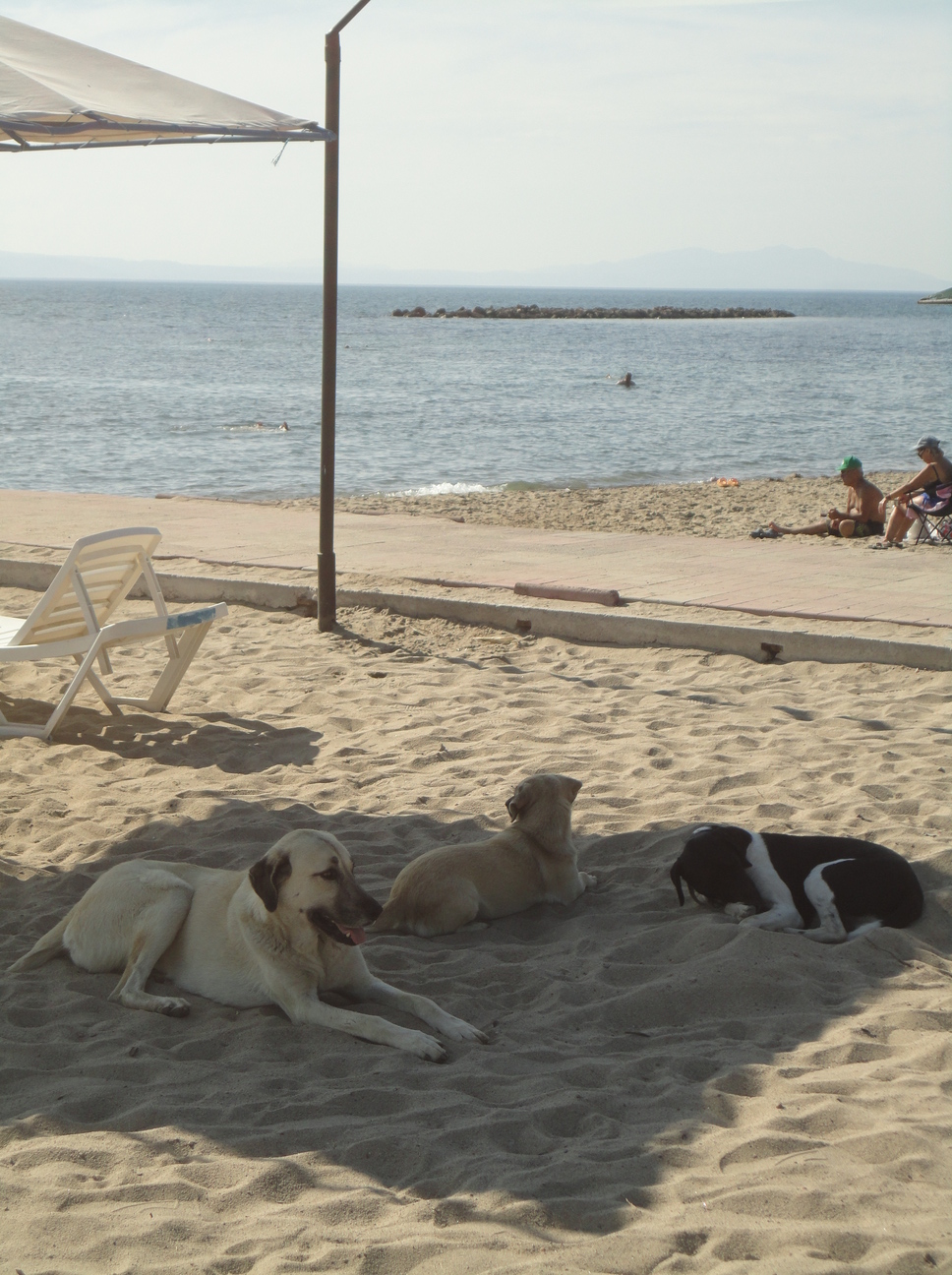
Two dogs with my copy of
Allan Bloom (translator), The Republic of Plato, 2016 edition,
on the beach at
Profesörler Sitesi, Altınova, Balıkesir, Turkey
September 8, 2021

I shall be quoting

  • Homer, whom Socrates loves to hate;
  • Adam Kirsch, from the 2016 introduction to Allan Bloom’s Republic translation, on the danger of summarizing Plato;
  • Pascal on the will of God as the rule for justice;
  • Bruno Bettelheim on fairy tales such as the Three Little Pigs, and perhaps our City in Speech, as opposed to fables;
  • Somerset Maugham on the fable of the Ant and the Grasshopper;
  • Plato, in the Symposium, on the identity of comedy and tragedy, and Socrates as a seductive flute-player;
  • Anne Applebaum on “The New Puritans”: the same as the old ones, called Glaucon, Adeimantus, and Socrates?

Continue reading

On Plato’s Republic, 3

Index to this series

We are reading now Book II of Plato’s Republic, Stephanus pages 357–83, covering:

  1. The conventional arguments in favor of injustice and justice, reviewed by Plato’s brothers Glaucon and Adeimantus respectively.
  2. The beginning of the construction of the city in speech, wherein the advent of justice is to be discerned; the guardians of the city are to be like dogs and to be given a traditional education, although with none of the traditional stories, since they talk about things like parricide and bad luck.

A book next to a dog lying on the beach

Dog with copy of Alain Badiou, Plato’s Republic:
A Dialogue in Sixteen Chapters, with a Prologue and an Epilogue, 2012
Profesörler Sitesi, Altınova, Balıkesir, Turkey, September 2, 2021

Continue reading

Chaucer, CT, Tales of the Prioress and the Monk

Index to this series

In the selection from the Canterbury Tales taken up here,

  • the Prioress tells an unchristian tale of piety;
  • the Host wishes Rome would not put monks under a vow of celibacy;
  • the Monk tells a miniature Canterbury Tales; all of his tales are tragedies, but with various sources, Hebraic, classical, and contemporary.

Andrea Mantegna, Judith with the Head of Holofernes
Andrea Mantegna or Follower (Possibly Giulio Campagnola)
Judith with the Head of Holofernes, c. 1495/1500
Widener Collection
National Gallery of Art, Washington

In some nominal sense at least, the tales of the Prioress and the Monk have a common theme, Judaism; they also have a common character, Satan.

Continue reading

On Plato’s Republic, 2

Constituting the latter part of Book I, the second of the Republic readings features the only sustained contribution of Thrasymachus, who argues that, if it can be pursued perfectly, injustice is superior to justice.

According to my electronic search of Jowett’s translation, confirmed with a search of Bloom’s, Socrates will mention Thrasymachus and his argument in Books II, VI, VIII, and IX, but the man himself will speak again only near the beginning of Book V, to agree with the demand of Polemarchus, Adeimantus, and Glaucon that Socrates explain the community of women and children in the imaginary city that Socrates will have been describing.

Continue reading

Chaucer, CT, Franklin’s Tale

Index to this series

Remarkable teachings from the Franklin, who says he never learned rhetoric, nor read Cicero:

Pacience is an heigh vertu certeyn;
For it venquisseth, as thise clerkes seyn,
Thinges that rigour sholde never atteyne.

Patience is a high virtue certain;
For it vanquisheth, as these clerks say,
Things that rigor should never attain.

There are things that you cannot win by force. Love is one, and that is the Franklin’s theme.

You can’t hurry love
No you just have to wait

Respect is another thing that you cannot win by force. I took up that theme in considering Collingwood on “Civilization as Education” (September, 2018). Confusion here may explain the problem of bad leadership that Socrates takes up in the Republic – which I have now taken up in a new series.


Rembrandt van Rijn
Lucretia, 1664
Andrew W. Mellon Collection
National Gallery of Art, Washington

Continue reading

On Plato’s Republic, 1

After the Pensées of Pascal and the Canterbury Tales of Chaucer, here begins another series on readings of a classic, now the Republic of Plato. The sections (after this one) of the present post are

Continue reading

Chaucer, CT, Tales of the Friar and the Clerk

Index to this series

In this reading:

  • The Friar tells a tale about a summoner, who becomes sworn brother to another man. The man turns out to be a devil, but it hardly matters to the summoner, he being more lawless than the devil, who himself takes only what is rightfully his, including the summoner.

  • We are skipping the Summoner’s own tale.

  • The Clerk tells a tale of a common woman with a preternatural patience for the abuse of her noble husband, who (she thinks) has her children put to death and will take another wife. Chaucer makes disclaimers, both as the Clerk and as himself. The Clerk refers explicitly to the Epistle of James, who writes in Chapter 1,

    2 My brethren, count it all joy when ye fall into divers temptations;
    3 Knowing this, that the trying of your faith worketh patience.
    4 But let patience have her perfect work, that ye may be perfect and entire, wanting nothing.

    Griselda follows, as it were, the teachings of Epictetus, here in Chapter XI of the Encheiridion (translation of George Long):

    Never say about any thing, I have lost it, but say I have restored it. Is your child dead ? It has been restored. Is your wife dead ? She has been restored. Has your estate been taken from you ? Has not then this also been restored? But he who has taken it from me is a bad man. But what is it to you, by whose hands the giver demanded it back ? So long as he may allow you, take care of it as a thing which belongs to another, as travellers do with their inn.

    Continue reading

On Being Human in the Age of Humanity

This is about an essay called “Agency in the Anthropocene: How much choice do you actually have?” (Daily Philosophy, August 4, 2021). I fall in the gap in age between the author and Jeff Bezos, who (the author says) is three years her senior.

Continue reading

Chaucer, CT, Wife of Bath’s Tale

Index to this series

The Wife of Bath: the type of the difficult woman? She is the opposite or complement of Constance in the Man of Law’s Tale. About to be sent to a barbarous country to wed a man she has never met, Constance laments,

Women are born to thraldom and penance,
And to be under man’s governance.

In her Prologue (which is longer than her Tale), the Wife says of her first three husbands, who were “gode, and riche, and olde” (line 197),

I governed hem so wel, after my lawe,
That ech of hem ful blisful was and fawe
To bringe me gaye thinges fro the fayre. (lines 219–21)

After the fight with her fifth husband in which he deafened her ear,

He yaf me al the brydel in myn hond
To han the governance of hous and lond,
And of his tonge and of his hond also,
And made him brenne his book anon right tho. (line 813–6)

The book was all about “wikked wyves.”

Continue reading

Summer YILDIZ Park Tour

This post contains images from one of the walking tours that I have learned to make from our flat on the European side of Istanbul.

When the Covid-19 pandemic got going, and there was nowhere in particular to go, I would wander aimlessly, just for the exercise. Then I figured out that, in about two hours, I could walk down to Ortaköy (“Middle Village,” Μεσαχώριον) by one route, coming back by another. I could also pass through the wall around the garden of one of the Ottoman sultans, then exit by another.

The particular route below takes in as much greenery as possible, including several named parks:

Ihlamur Parkı is different from the nearby Ihlamur Kasırları, “Linden Pavilions.” Though it contains two Ottoman stelae, the park does not seem to have a name posted on the ground; its name on the list above links to the Twitter account of a group formed to resist its being built over.

Ayşe and I walked the route below, Sunday morning, August 2, 2021, during a heat wave.

Down into the valley

Continue reading