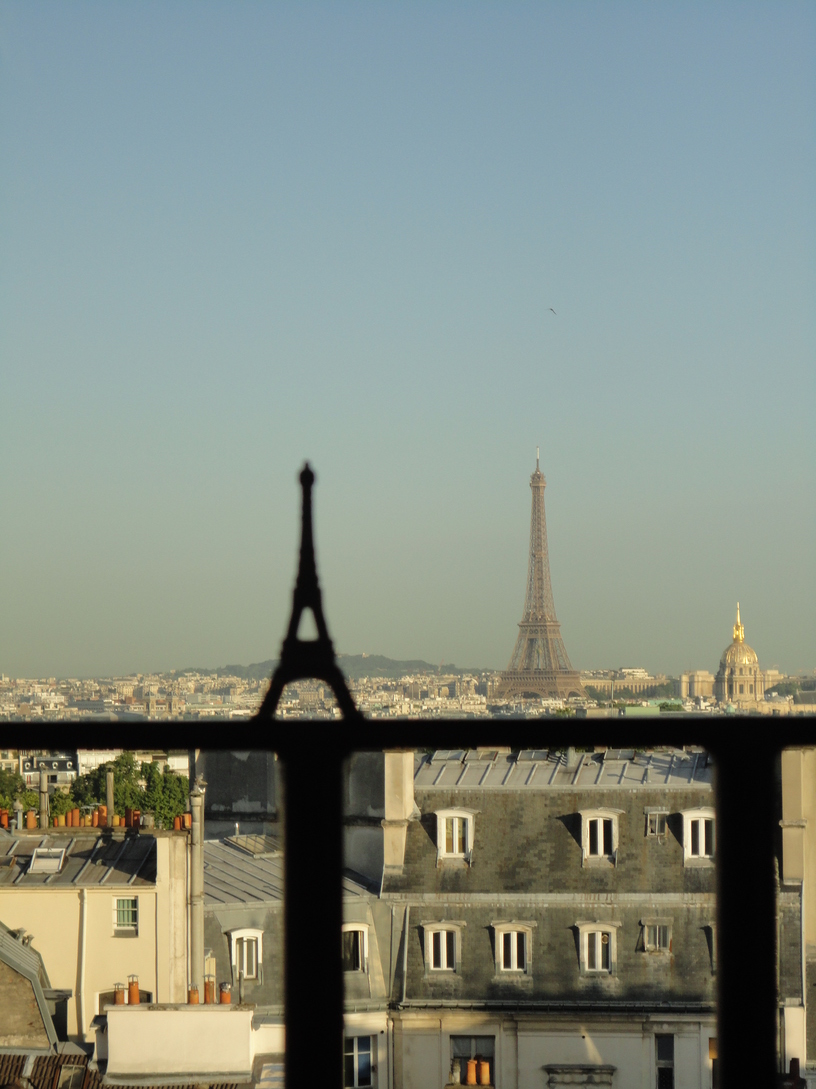
From a flat on the rue Saint-Jacques, Paris
Thursday, June 4, 2015
What René Descartes says here does not make a lot of sense to me:
it is far better never to contemplate investigating the truth about any matter than to do so without a method. For it is quite certain that such haphazard studies and obscure reflections blur the natural light and blind our intelligence.
I am often investigating the truth, as for example in this post, but without a method that I can identify. Maybe this is a problem. However, it sounds as if Descartes is simply approving one great Italian writer over another, at least if they be as described by Jonathan Usher in his Introduction the Decameron of Boccaccio (translation by Guido Waldman, Oxford World’s Classics, 1993):
His extraordinarily indiscriminate reading, and the eclectic way he amassed knowledge, contrast sharply with Petrarch’s more programmatic approach, with its clear idea of what was and wasn’t worth studying. For Boccaccio, everything was worth reading, and he displays none of the cultural snobbery which constipated the early humanists.
Descartes is discussing the proposition, “We need a method if we are to investigate the truth of things.” This is the fourth of his Rules for the Direction of the Mind. He did not actually arrange for these to be published; he died in Stockholm in 1650, and the Rules first appeared thirty-four years later, in Dutch translation from the original Latin. I am using the English translation by Dugald Murdoch in The Philosophical Writings of Descartes, volume I, Cambridge University Press, 1985. The passage above continues:
Those who are accustomed to walking in the dark weaken their eye-sight, the result being that they can no longer bear to be in broad daylight.
One might just as well say that by spending our time in broad daylight, we lose the ability to see obscure things. Nonetheless, according to Descartes,
Experience confirms this, for we very often find that people who have never devoted their time to learned studies make sounder and clearer judgements on matters which arise than those who have spent all of their time in the Schools.
This finally makes some sense, though its accuracy is another question. In his note on the passage in a French edition (Règles pour la direction de l’esprit, Le Livre de Poche, 2002; first published 1963), Jacques Brunschwig writes,
L’on trouvera dans le personnage de Poliandre, l’un des interlocuteurs du dialogue de Descartes intitulé la Recherche de la Vérité par la lumière naturelle, l’illustration la plus vivante de ce personnage de l’honnête homme, chez qui la rectitude du jugement va de pair avec la minceur du bagage scolaire.
The “scholarly baggage” mentioned here might include such “norms” as are urged today as follows:
There is a near constant refrain among the culture war content-generation pundits that academia is being stifled by an orthodoxy that forbids dissent on certain topics. Incidentally, the topics these pundits consider stifled are usually settled matters in the fields that cover them … To insist that the established conclusions be overturned on no evidence, discover that those who specialize in that area do not agree, and suggest that this represents a “taboo” … is arguably dishonest.
Another, more accurate word for how these discussions are managed might be “norm.” Norms in academic disciplines help us socialize one another into the most effective ways of formulating and investigating questions, as developed over time by previous scholars. One such norm is the scientific method …
That is from Caitlin Green, “Academic Freedom in the Media: Who Is Being Silenced?” (Liberal Currents, November 4, 2021). I quoted the article in “Imagination,” named for what J. K. Rowling put into the Harry Potter books, even as she failed to imagine what it could mean to be trans, at least according to one of her former fans.
I brought in Green’s essay also at the end of “Words.” The words in question were such pairs as “male” and “female.” That post is relevant to the foregoing considerations, as well as to the ensuing ones, since it mentions mathematics as giving us a peculiar method for not fooling ourselves.
Zoé and Ayşe around Ravello, Italy
Saturday, July 15, 2013
I investigate here what Descartes has done to geometry. I gave a talk on the subject recently (April 22, 2026). Now I am responding to questions raised by somebody who attended the talk. That person is both a fellow alumnus of St John’s College and a fellow reader of Euclid in an ongoing seminar.
The abstract and slides for the talk are on a page of this blog. The abstract is detailed, and I think I followed it pretty well when I prepared the slides.
The slides show diagrams in successive stages of construction. I tried to minimize text, though I could have gone a lot further that way.
On the first page after the title, there is no text but the page number 2. I originally thought of putting an Agnes Martin painting there. Instead I used pstricks and multido to draw two rectangles divided into equal squares. One rectangle has seven rows and eleven columns; the other, eleven and seven. Thus, the rectangles are equal; alternatively, they have the same area. The talk uses this result implicitly.
Meanwhile, in the middle of each little square is a dot. If we count dots by rows, we reach the same number for either rectangle:
11, 22, 33, …, 77
or
7, 14, 21, …, 77.
This is not an immediate consequence of the equality of the rectangles. To know the sameness of each count, before it is made, one really needs a theorem. Euclid proves it in the sixteenth proposition of Book VII of the Elements. I reviewed Euclid’s proof in “The Geometry of Numbers in Euclid.”
My talk is really concerned with other basic results: Thales’s Theorem and Desargues’s Theorem, shown on page 3 of the slides. Descartes’s algebra is justified by Thales’s Theorem. This theorem can be taken as true by definition, once one has Desargues’s Theorem. This in turn is a consequence of Pappus’s Theorem, shown on page 4, which Pappus proves from Propositions 37 and 39 of Book I of Euclid’s Elements. Those propositions are reviewed on pages 13–19. They are about areas of triangles.
When I received the invitation to give the talk, in September of last year (2025), I chose the title “A Geometry of Points and Polygons.” In place of polygons, the title could have referred to areas, as being distinct from the lengths that Descartes’s geometry is all about. I said this at the beginning of the talk.
Descartes opens La Géométrie of 1637 by as follows (I give the French, as reproduced in the Project Gutenberg edition, and then the English of Smith and Latham in the 1954 Dover edition – unaltered from the 1925 Open Court edition – of The Geometry of René Descartes).
Tous les problèmes de géométrie se peuvent facilement réduire à tels termes, qu’il n’est besoin par après que de connoître la longueur de quelques lignes droites pour les construire.
Any problem in geometry can easily be reduced to such terms that a knowledge of the lengths of certain straight lines is sufficient for its construction.
I bristle now at the universal assertion. As I observe in “Elliptical Affinity,” some important theorems of Apollonius about conic sections are identities of areas.
It may be pointed out that Descartes is talking about problems, not theorems; not things to contemplate, but things to do.
One thing to do is to find the locus of certain points. I alluded to the terminology here when reviewing, for Mathematical Reviews, the paper called “Analytic Nullstellensätze and the model theory of valued fields,” by Matthias Aschenbrenner and Ahmed Srhir (DOI: 10.1002/mana.202200280). I said,
The Satz Beweis style was pioneered by Euclid: statement of theorem, followed by proof. In mathematics also, in lieu of the word “place,” we use locus, topos, and also Stelle, as in Nullstellensatz, the zero locus theorem, established by David Hilbert in 1893.
Hilbert’s theorem concerns polynomials over algebraically closed fields. The paper under review establishes five analogues for power series over p-adic and real-closed fields …
Descartes finds what turns out to be the zero locus of the polynomial
y³ − by² − a²y + a²b − axy.
(I have a note on how the term polynomial seems not to have originated with Descartes.) All of the letters in the polynomial above stand for lengths. I looked at the example in “A Five Line Locus,” as well as in my recent talk (on pages 7–11 of the slides). The problem is not formulated originally in terms of the polynomial; neither is the polynomial of any help in finding the locus.
Pappus knew solutions for three- and four-line locus problems, but not five-line problems. Thus, Descartes’s solution of a five-line locus problem represents something new. I think I said that in my talk; however, the novelty of Descartes’s solution, even in his own mind, turns out not to be so clear.
Pappus makes the following points about locus problems.
- Euclid did what he could with the three- and four-line locus problems, using the work on conics by Aristaeus (now lost).
- Apollonius could not have done any better.
- That is because more work on conics was needed first.
- Apollonius did this work, having studied in Alexandria under students of Euclid.
- The three-line locus problem concerns an equation of rectangle and square, the sides being distances to the lines; the solution is a conic section.
- The four-line problem is likewise given by an equation of two rectangles; the solution is still a conic section.
- Nobody has solved even the easiest case of the five-line problem, not to mention the six-line problem (or maybe somebody has, depending on how one reads the text of Pappus).
- Each of these problems concerns an equation of parallelepipeds.
- We cannot state a problem of more than six lines that way.
- We can however state it in terms of compounded ratios of distances to the lines.
You can check all of that against Pappus’s own words, in sections 32–40 of Book VII of the Collection, reproduced below, in the translation of Alexander Jones. Descartes quotes much of the passage (in Latin; see the note on this).
At least as Pappus puts it, in sections 39 and 40, the last point of my summary is called “rather obscure” by Smith and Latham in their footnote on page 22 of the Dover edition. It seems clear enough to me that Pappus could formulate the locus problem for any number of lines, along the pattern that I used in my talk.
The key passage is in § 37, regarding locus problems of more than four lines, and what people have done with them:
They have given a synthesis of not one, not even the first and seemingly the most obvious of them, or shown it to be useful.
It turns out that this is not what Descartes understood. His account of what Pappus says includes the following (see the note for more on all of this):
Et Pappus dit que lorsqu’il n’y a que trois ou quatre lignes droites données, c’est en une des trois sections coniques; mais il n’entreprend point de la déterminer ni de la décrire, non plus que d’expliquer celles où tous ces points se doivent trouver, lorsque la question est proposée en un plus grand nombre de lignes. Seulement il ajoute que les anciens en avoient imaginé une qu’ils montroient y être utile, mais qui sembloit la plus manifeste, et qui n’étoit pas toutefois la première. Ce qui m’a donné occasion d’essayer si, par la méthode dont je me sers, on peut aller aussi loin qu’ils ont été.
Pappus says that when there are only three or four lines given, this line is one of the three conic sections, but he does not undertake to determine, describe, or explain the nature of the line required when the question involves a greater number of lines. He only adds that the ancients recognized one of them which they had shown to be useful, and which seemed the simplest, and yet was not the most important. This led me to try to find out whether, by my own method, I could not go as far as they had gone.
According to Pappus, at least as Jones and others now interpret him, nobody else could solve even the easiest five-line problem. However, Pappus also praises Euclid for modesty. Did Pappus then leave us to infer that he had solved that problem? In any case, Descartes solves the problem, but I do not think his solution requires any new conception of geometry.
I tried to show that in my talk, by working out such a solution as I think Pappus could have left us. This solution involves manipulations of ratios. Pappus does lots of such manipulations in the nineteen lemmas that I have read several times with students in my geometriler course. The only lemma that does not involve ratios is the one that I am calling Pappus’s Theorem for convenience, although that term may encompass several other lemmas as well.
At the top of this post, I looked a bit at the fourth of Descartes’s Rules for the Direction of the Mind: “We need a method if we are to investigate the truth of things.” Such a rule seems to have the problem of circularity. How are we to know that our method is true?
The method that Descartes has in mind seems to comprise two points:
we should never assume to be true anything which is false; and our goal should be to attain knowledge of all things.
Perhaps we should remember that Descartes never published the Rules, “qu’il abandonne peut-être en 1628” (according to Brunschwig). He began them possibly in 1619, having been born in 1596. He says of the method,
I can readily believe that the great minds of the past were to some extent aware of it, guided to it even by nature alone. For the human mind has within it a sort of spark of the divine … This is our experience in the simplest of sciences, arithmetic and geometry: we are well aware that the geometers of antiquity employed a sort of analysis which they went on to apply to the solution of every problem, though they begrudged revealing it to posterity. At the present time a sort of arithmetic called “algebra” is flourishing, and this is achieving for numbers what the ancients did for figures …
… ordinary mathematics is far from my mind here … it is quite another discipline I am expounding … This discipline should contain the primary rudiments of human reason and extend to the discovery of truths in any field whatever.
David Bessis refers to Descartes’s suspicions in Mathematica: A Secret World of Intuition and Curiosity (2024):
Descartes thought that mathematicians guarded their secrets for fear of losing their prestige. If people knew that there was a method and it was that simple, he reckoned, they would stop looking at mathematicians like they were demigods, and come to the realization that they’re just normal people.
The real explanation is undoubtedly more trivial: mathematicians are simply afraid of being called insane.
Regarding his five-line locus problem, I think Descartes himself has a secret method: to think in terms of ratios, as the Ancients did. He just covers his tracks, as he accuses the Ancients of doing.
If one wants to see for oneself, Descartes’s solution is on pages 82–7 of the Dover edition of the Geometry, pages 21–2 of the Project Gutenberg French edition. That edition looks like a facsimile of the 1886 Hermann edition, but unfortunately it’s not: the pages in that edition are 29–30, as I can see from the facsimile edition that I was pleased to be able to buy in Paris from the publisher, Jacques Gabay, when I chanced upon his shop on the rue Saint-Jacques in June, 2015 (Ayşe and I were attending a conference on geometric group theory; the photo above was taken Thursday, June 4, from the study window of a novelist, Augustin Billetdoux, whose flat we had rented through AirBnB).
In my post and slides, I have made Descartes’s problem slightly more general by replacing his 2a with b; also, in the slides, I let b be less than a. Otherwise I use Descartes’s letters for points and lengths. I have turned his diagram by a right angle, so that x is measured horizontally as today.
As I understand him, Descartes states his five-line problem as an equation of parallelepipeds, just as Pappus does. Then he plugs in his letters for the lengths, and he multiplies out to get a polynomial equation corresponding to (21) on page 11 of my slides.
Next, Descartes computes the equation that will be satisfied by the point labelled (x,y) on my page 10, if this point is to lie both
- on the parabola in the diagram and
- on the line GL (as in the lettering on my page 9).
This new equation is seen to be the same as the earlier one.
How did Descartes know that a parabola was going to be involved in the solution? I think this knowledge arises naturally in the solution that I proposed on my page 9. Archimedes or Pappus could have given such a solution, I think.
I repeated the solution in Cartesian notation on my page 10 by introducing the new variable z. I learned that trick from the Ancients. I was tempted to say as much in another slide or two, but I was also trying to avoid saying too much.
As I understand, Menaechmus is said to have discovered conic sections by introducing a new variable to find what we call a cube root. This information comes from the commentary on Archimedes by Eutocius, who may have been a student of Isidore of Miletus, himself one of the architects of the Hagia Sophia, here in what is now Istanbul (I still get a kick out of being able to say that).
In Cartesian terms, Menaechmus turned the equation
x³ = a²b
into the system of equations
x² = ay & xy = ab,
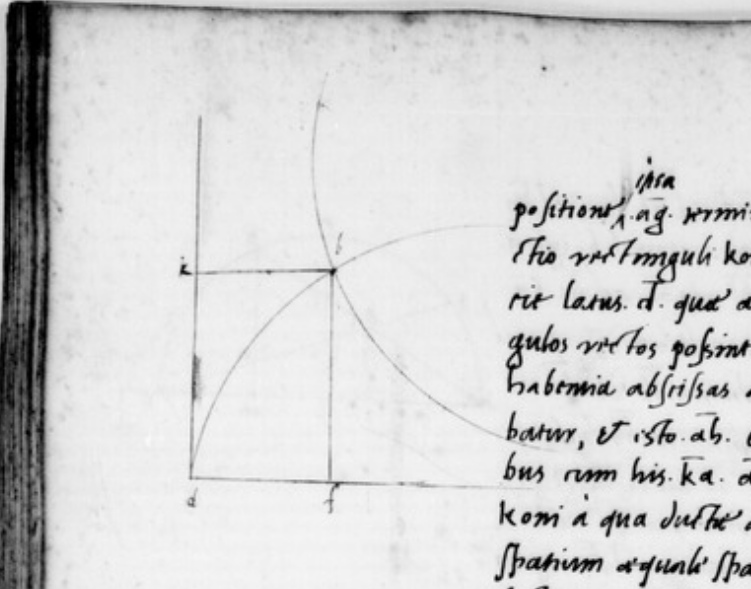
which turn out to define a parabola and hyperbola respectively. It is fascinating to see those conics drawn, as if in a “Cartesian” plane with axes, in an old manuscript. The image I just linked to is in my page on the history of analytic geometry, but I wrote this in Turkish when I was teaching analitik geometri in my department.
Strictly, the variable y was in Menaechmus’s problem all along, as being one (along with x) of the two proportional means of a and b, so that
a/x = x/y = y/b.
On the same page of analytic-geometry history, I give the solution by Omar Khayyám to another cubic equation,
x³ + a²b = a²x.
Rewrite this as
x³ = a²(x − b),
then
x²/a² = (x − b)/x.
Now let y be the mean proportional of x − b and x. Thus
x/a = (x − b)/y = y/x
and then
x² = ay & y² = x(x − b),
defining parabola and hyperbola.
Khayyám was analyzing a one-variable cubic equation. Descartes’s problem was a two-variable cubic, but the same technique applies. I have used Cartesian notation to explicate the technique, but Khayyám did not use it.
Descartes’s Geometry does seem to be the source of the notation that we continue to use in high-school algebra, with minuscule letters from the beginning of the alphabet as constants, and from the end as variables.
From the math book used in the third grade at George Mason Elementary School in Alexandria, Virginia, I recall an exercise where the outline of a VW beetle was drawn over a square grid. We were to estimate the enclosed area by counting up squares. This helped teach the lesson that mathematics was about numbers.
A friend thought the estimation problem could be solved exactly with a slide rule. That was pure fantasy, but still I developed a desire for a slide rule. My desire was satisfied by the gift of the slide rule that my father’s cousin had used at MIT.
I have it today. I have sometimes taken it to class, perhaps even a number-theory class, when I am talking about primitive roots (see “Discrete Logarithms,” where I presume to turn a kind of whole-number slide rule into a work of conceptual art).
As a student in high school, I took my slide rule to a chemistry exam, to use in place of a pocket electronic calculator. I may have been showing off, but I also wanted the challenge.
I did have a calculator too, an HP-21 like the one that my engineer godfather had had. It makes me nostalgic to look at the photo on the Wikipedia page that I have just linked to.
So sure, I like numbers. Where do they come from? I would say that I was trying to answer this question in my presentation, at least if you understand “number” to mean “element of a field.”
When I learned the term “field” as a junior in high school, I understood it to be a place where something “played out,” namely the operations of addition and multiplication. In other languages, it’s a “body”: Körper, as apparently Dedekind called it in German, and then corps in French and cisim in Turkish, where we have the Platonik cisimler of Book XIII of the Elements.
When students present Euclid propositions in our department in Istanbul, some of them are reluctant to write an equation such as
AB = AC;
instead they may write
|AB| = |AC|.
I figure that, for them, equality is sameness, and the line segments AB and AC are not the same. What is the same, they think, is the lengths of the segments, and those lengths are |AB| and |AC|.
That’s fine, except:
- Euclid does not say the lengths of the segments are equal; he says the segments themselves are equal.
- Our students think length is a number.
It took more than two thousand years to justify that last thought.
I believe medical students are told that half of what they learn will be obsolete in ten years (or something like that). In a book review, Julian Baggini writes (as I noted in “A Five Line Locus”):
No one today would dream of practising the physics, medicine or biology of the ancient Greeks. But their thoughts on how to live remain perennially inspiring. Plato, Aristotle and the Stoics have all had their 21st-century evangelists. Now it is Epicurus’s turn, and his advocate is American philosopher Emily A Austin.
I am sorry Baggini did not observe that we still practice the mathematics of the Greeks. We do that, even automatically, because mathematics is one thing, in a way that other sciences are not.
No mathematics is ever obsolete: if it was correct when published, it is still correct. Some parts of it may happen to be more interesting than others.
The same is true for literature, as may be Baggini’s point. Myself, I’m not sure the Iliad isn’t the greatest thing ever written.
Anyway, Dedekind shows how to derive the “real” numbers from the rational numbers, which in turn can be derived from the counting numbers.
Euclid tries to do geometry without numbers. When in Book I he shows (or all but shows) that every plane figure bounded by straight lines is equal to a rectangle on a given base, so that the area of the figure can be compared with others, there is nothing about obtaining a numerical measure of area.
Thus there is nothing “practical” about Euclid’s work, even though geometry is, etymologically speaking, surveying.
I’m afraid there’s nothing practical about my work; it is just for the sake of contemplation.
In Euclid, the ratio of incommensurable magnitudes is determined by the rational numerical approximations to it. These approximations are obtained from comparing (whole-number) multiples of the magnitudes.
I tried to show that we could define ratios without using numbers at all. Actually, Hilbert already did that; still, he was apparently keen to justify Descartes’s manipulation of lengths.
Again, I prefer to let ratios be the fundamental objects that get manipulated (in the sense of being multiplied or added together).
This way, once a unit of any kind is selected, then all other magnitudes of that kind can be treated as numbers.
True, my way of defining ratios started out with ratios of lengths, rather than of arbitrary magnitudes. This seems to be a requirement of giving up the Archimedean postulate. But then, is there a geometry without lengths – I mean, without the notion of two points on a straight line?
My first published mathematical work (in collaboration with a teacher in Toronto) was a third axiomatization of a theory already known. It’s the theory described by Gerald Sacks in Saturated Model Theory (1972; second edition 2010):
It is no accident that the book suffers from a shortage of examples. As a rule examples are presented by authors in the hope of clarifying universal concepts, but all examples of the universal, since they must of necessity be particular and so partake of the individual, are misleading.
The least misleading example of a totally transcendental theory is the theory of differentially closed fields of characteristic 0 (DCF0). Sections 40 and 41 are devoted to L. Blum’s applications of Morley rank to DCF0. There are many notable applications of model theory to algebra, and above all to theories of fields, but Blum was the first to apply something more than the compactness theorem (Corollary 7.2). (One of the most typical and influential uses of compactness in field theory is due to A. Robinson …)
Robinson first established the existence of DCF0 as the “model-completion” of the theory of differential fields of characteristic 0, using algebraic results of Seidenberg (who happened to be the teacher at Berkeley of another friend, a retired programmer, who came to my talk and who lives part of the time in Turkey, though currently he’s in California). Sacks’s student Lenore Blum came up with better (simpler, more understandable) axioms for DCF0. When Anand Pillay lectured on this theory to me, Ayşe, and others at the Fields Institute in Toronto in 1996, we came up with an alternative axiomatization. A similar approach to ours had been, and went on to be, used for other interesting theories – interesting to model theorists at least! One of the theories is ACFA, the theory of algebraic closed fields with generic automorphism. The fixed field of the automorphism is a pseudo-finite field, which (paradoxically, but correctly) is just an infinite model of the theory of finite fields. You can check out these and other theories (strictly, their completions) on the “Map of the Universe” (the universe of complete theories about which interesting things can be said).
Zoé and the author around Ravello, Italy
Saturday, July 15, 2013
I mentioned a review I had written. I’ve been working on another one, of a posthumously published paper on the theory of pseudo-finite fields by Zoé Chatzidakis. I made myself known to Zoé at the Fields Institute when I noticed that she had a copy of The Nation. Ayşe met her since then at various conferences, and we stayed in her flat in Paris both with and without her. Apparently the paper I’m reviewing was recovered from her computer after her death.

Zoé and Ayşe around Ravello, Italy
Saturday, July 15, 2013
Notes
Polynomials
Though he may have invented the concept, or at least given it the notation that we use today, Decartes does not seem to use the term polynôme. The Larousse dictionnaire d’étymologie (2001) traces the term to the 1691 Dictionnaire mathématique of Ozanam. The Oxford English Dictionary traces “polynomial” to the 1696 ΛΟΓΙΣΤΙΚΗΛΟΓΊΑ, or Arithmetick Surveighed and Reviewed of Jeake. It turns out I had already encountered Jeake’s work when trying to determine whether the term “mean proportional” had ever been understood as noun followed by adjective. Jeake did talk about “two proportional Means.” See my draft article “Mean Proportional.” ↩︎
Pappus on locus problems
The following is from Pappus of Alexandria, Book 7 of the Collection, edited with translation and commentary by Alexander Jones (Springer, 1986). I highlight the three parts of passage that Descartes quotes. Because the highlighting may not show up in some browsers (such as lynx or links), I set those parts also between pointing index fingers (☛ and ☚, which have code points U+261B and U+261A in Unicode):
(32) In any event, Apollonius says what the eight books of Conics that he wrote contain, placing a summary prospectus in the preface to the first, as follows:
… The third (has) many and various useful things, which are both for syntheses of solid loci, and for (their) diorisms; and having found most of them both elegant and novel, we found that the synthesis of the locus on three and four lines was not made by Euclid, but (merely) a fragment of it, nor this felicitously. For one cannot complete the synthesis without the things mentioned above …
(33) Thus Apollonius. ☛ The locus on three and four lines that he says, in (his account of) the third (book), was not completed by Euclid, neither he nor anyone else would have been capable of; no, he could not have added the slightest thing to what was written by Euclid, using only the conics that had been proved up to Euclid’s time, ☚ as he himself confesses when he says that it is impossible to complete it without what he was forced to write first.
(34) But either Euclid, out of respect for Aristaeus as meritorious for the conics he had published already, did not anticipate him, or, because he did not desire to commit to writing the same matter as he (Aristaeus), – for he was the fairest of men, and kindly to everyone who was the slightest bit able to augment knowledge, as one should be, and he was not at all belligerent, and though exacting, not boastful, the way this man (Apollonius) was, – he wrote (only) as far as it was possible to demonstrate the locus by means of the other’s Conics, without saying that the demonstration was complete. For had he done so, one would have had to convict him, but as things stand, not at all. And in any case, (Apollonius) himself is not castigated for leaving most things incomplete in his Conics.
(35) He was able to add the missing part to the locus because he had Euclid’s writings on the locus already before him in his mind, and had studied for a long time in Alexandria under the people who had been taught by Euclid, where he also acquired this so great condition (of mind), which was not without defect.
☛ This locus on three and four lines that he boasts of having augmented instead of acknowledging his indebtedness to the first to have written on it, is like this:
(36) If three straight lines are given in position, and from some single point straight lines are drawn onto the three at given angles, and the ratio of the rectangle contained by two of the (lines) drawn onto (them) to the square of the remaining one is given, the point will touch a solid locus given in position, that is, one of the three conic curves. And if (straight lines) are drawn at given angles onto four straight lines given in positions, and the ratio of the (rectangle contained) by two of the (lines) that were drawn to the (rectangle contained) by the other two that were drawn is given, likewise the point will touch a section of a cone given in position.
(37) Now if (they are drawn) onto only two (lines), the locus has been proved to be plane, but if onto more than four, the point will touch loci that are as yet unknown, but just called ‘curves’, and whose origins and properties are not yet (known). They have given a synthesis of not one, not even the first and seemingly the most obvious of them, or shown it to be useful. (38) The propositions of these (loci) are: If straight lines are drawn from some point at given angles onto five straight lines given in position, and the ratio is given of the rectangular parallelepiped solid contained by three of the (lines) that were drawn to the rectangular parallelepiped solid contained by the remaining two (lines) that were drawn and some given, the point will touch a curve given in position. And if onto six, and the ratio of the aforesaid solid contained by the three to that by the remaining three is given, again the point will touch a (curve) given in position. If onto more than six, one can no longer say “the ratio is given of the something contained by four to that by the rest”, since there is nothing contained by more than three dimensions. ☚
(39) ☛ Our immediate predecessors have allowed themselves to admit meaning to such things, though they express nothing at all coherent when they say “the (thing contained) by these”, referring to the square of this (line) or the (rectangle contained) by these. But it was possible to enunciate and generally to prove these things by means of compound ratios [διὰ τῶν συνημμένων λόγων, apparently from συνάπτω], both for the propositions given above, and for the present ones, in this way:
(40) If straight lines are drawn from some point at given angles onto straight lines given in position, and there is given the ratio compounded of that which one drawn line has to one, and another to another, and a different one to a different one, and the remaining one to a given, if there are seven, but if eight, the remaining to the remaining one, the point will touch a curve given in position. And similarly for however many, even or odd in number. As I said, of not one of these that come after the locus on four lines have they made a synthesis so that they know the curve. ☚
Commandino
Descartes’s quotations of Pappus are from the 1588 Latin version by Commandino, but with some imprecision. That is according to Adam and Tannery in their edition of Descartes’s Oeuvres, volume VI, page 377: “Descartes reproduit le texte de la version, parfois inexacte, de Commandin …” They translate Pappus himself, from Hultsch’s edition, starting on page 721.
My links for the Oeuvres are to Wikisource, where pages numbers exceed the printed numbers by 22. This must have to do with what I observe in the pdf version of volume VI that I obtained from the Internet Archive. There is an Avertissement on pages i–xii; then comes a leaf, blank on the verso, showing, apparently, a facsimile of the 1637 title page for Discours de la methode and the attendant essais. Then begins the Discours, and the second page of this is numbered 2. The Avertissement is preceded by two leaves, for half-title and full title pages.↩︎
Scholarship on the five-line locus
The passage from Pappus in question is, again,
They have given a synthesis of not one, not even the first and seemingly the most obvious of them, or shown it to be useful.
The Greek that Jones gives for this is,
ᾡν οὐδεμίαν οὐδὲ τὴν πρώτην καὶ συμφανεστάτην εἶναι δοκοῦσαν συντεθείκασιν ἀναδείξαντες χρησίμην οὖσαν.
Perhaps this is more literally,
Of which not one, not even the first and seeming to be the most obvious, have they given a synthesis of, showing [it] to be useful.
However, Jones has adjusted the Greek of the manuscript to agree with what he thinks the meaning must be. His note explains as follows (that he heads the note with “none,” while the translation has “not one,” is his inconsistency):
– none, not even the first: The manuscript reading “ᾡν μίαν οὐδὲ τὴν πρώτην” means “(they have given a synthesis of) one, nor this the first …”, which clashes with the context, and would amount to saying that a Greek geometer somehow made a synthesis of a cubic curve (which could only mean that they found some way of generating it independently of the locus definition). Descartes (Géométrie p. 307) notoriously interpreted the passage in that way. Later commentators have translated it more or less as I have, but without correcting the text to yield the necessary meaning.
This note is the sole reference under “Descartes” in Jones’s Index.
The Latin version given by Descartes for the passage from Pappus is,
earum unam, neque primam, & quæ manifestissima videtur, composuerunt ostendentes utilem esse.
Smith and Latham translate this as,
One of them, not the first but the most manifest, has been examined, and this has proved to be helpful.
The translators then say,
Paul Tannery, in the Oeuvres de Descartes, differs with Descartes in his translation of Pappus. He translates as follows. Et on n’a fait la synthèse d’ aucune de ces lignes, ni montré qu’elle servit pour ces lieux, pas mème pour celle qui semblerait la première et la plus indiquée.
The French there is on pages 721 and 722 of volume VI of the Oeuvres. After the translation come “Observations,” signed by Tannery at the end on page 725:
Nous avons déjà, dans le tome IV de la Correspondance (éclaircissement, p. 364–366), discuté le passage particulièrement obscur du texte de Pappus (ci-avant, p. 378, 1. 6–10), et nous en avons donné une traduction un peu différente de celle qui précède, pour laquelle nous avons suivi la leçon des manuscrits.
Nous ajouterons ici quelques autres remarques, d’abord sur le passage de Pappus, puis sur la solution de Descartes …
The referent in Volume IV begins:
Page 363, I. 18. — Pour critiquer l’Aristarchus de Roberval (voir ci-après, lettre CDXXX, p. 396), Descartes n’attendit pas que le professeur lui envoyât ses observations sur la Géométrie, ce qu’au reste il ne fit jamais, en sorte que nous ignorons la nature et la portée de celles dont il s’agit ici …
The note continues later:
Nous sommes, de la sorte, renvoyés à l’examen du texte que Descartes donne d’après la version latine de Commandin. Or il n’y a qu’un passage obscur (Géométrie, p. 305, l. 10-14) :
« Quod si ad plures quam quatuor, punctum continget locos non adhuc cognitos, sed lincas tantum dictas ; quales autem sint, vel quam habeant proprietatem, non constat : earum unam, neque primam, et quæ manifestissima videtur, composuerunt ostendentes utilem esse. »
Descartes (p. 307) traduit (assez librement) que les anciens avaient imaginé une ligne qu’ils montraient être utile à la question, mais qui semblait la plus manifeste, et qui toutefois n’était pas la première.
In the sequel, Tannery treats a line as the zero locus of a linear polynomial, so that the value of the polynomial at a point varies as the distance of the point from the line:
Sur quoi il combine une divination qu’on peut représenter comme suit. Soient
X = 0, Y = 0, Z = 0, U = 0, V = 0,
les équations de cinq lignes droites, λ un coefficient constant, et
XYZ + λ UV = 0,
l’équation générale du lieu à cinq lignes, d’après la définition de Pappus ; le cas que celui-ci aurait regardé comme le premier, et le cas traité par les anciens comme le plus manifeste, correspondraient, l’un au parallélisme des droites X, Y, Z, U (V leur étant perpendiculaire), l’autre au parallélisme de X, Y, U, V (Z leur étant perpendiculaire). — Voir Géométrie, p. 335 à 339.
What I work out in the slides is the former case, where U and V are perpendicular. Tannery continues:
Évidemment, cette restitution pouvait être critiquée, au point de vue grammatical, même sans connaître le texte grec, que d’ailleurs Roberval avait pu consulter sur un manuscrit. En fait, ce texte est incertain et obscur ; dans son édition de Pappus (Berlin, Weidmann, 1876, p. 678-679), Fr. Hultsch le donne sous la forme suivante :
ὧν μίαν οὐδέ τινα συμφανεστάτην εἶναι δοκοῦσαν συντεθείκασιν ἀναδείξαντες χρησίμην οὖσαν
Ce que je traduis, dans un sens totalement différent de celui de Descartes :
« Il n’y a pas une de ces lignes, pas même celle qui pourrait sembler la plus simple, pour laquelle on ait fait la synthèse et montré l’intérêt qu’elle peut présenter. »
Mais, selon toute probabilité, Roberval devait plutôt interpréter, d’après la lettre du texte de Commandin et celle des manuscrits grecs, dans le sens que les anciens « avaient imaginé une ligne dont ils montraient l’utilité, mais qui ne semblait ni la première ni la plus simple ». Sa critique n’avait en tout cas d’intérêt que s’il y avait joint, à son tour, une divination particulière sur cette ligne supposée connue des anciens. – (T.)
In the “Observations” in Volume VI, Tannery notes an inconsistency, that the three-line locus problem is given the form that I would write as
a1a2 : b² :: λ
or rather
(a1 : b)(a2 : b) :: λ
while the locus problem of 2n − 1 lines is
(a1 : b1) … (an−1 : bn−1)(an : c) :: λ,
where c is now some given distance, not one of the varying bk. Tannery says,
Il est à remarquer que la définition de Pappus pour le lieu en général, quand le nombre des droites est impair, ne concorde pas avec sa définition particulière pour le lieu à trois droites …
Enfin, c’est par suite d’une heureuse erreur, puisqu’elle lui a fait aborder au moins deux cas simples du lieu à cinq lignes, que Descartes a interprété la traduction de Commandin comme si les anciens avaient traité l’un de ces cas. Quoique le texte de Pappus reste douteux, il a certainement voulu dire tout le contraire.
As I say, I am not so certain as Tannery about what Pappus wanted to say, given his praise of Euclid’s discretion.↩︎
Edited May 3, 2026


2 Trackbacks
[…] “Geometry and Algebra” (April 30, concerning what Descartes has done to geometry). […]
[…] then they are parallel in the remaining case – this is the result called Pappus’s Theorem in “Geometry and Algebra.” In that post, apparently I was trying to spell out the point of my talk, “A Geometry of […]