This essay is written as a distraction from current events, though I make some reference to them. I am prompted by questions of analogy provoked by
- the similes of Homer and
- a recent theater review in Harper’s that mentions the parables of Jesus.

This essay is written as a distraction from current events, though I make some reference to them. I am prompted by questions of analogy provoked by
Earthquakes have aftershocks. In 2011 in Van, after the quake of October 23, a Japanese relief worker called Atsushi Miyazaki was killed when his hotel collapsed under the force of the quake of November 9.
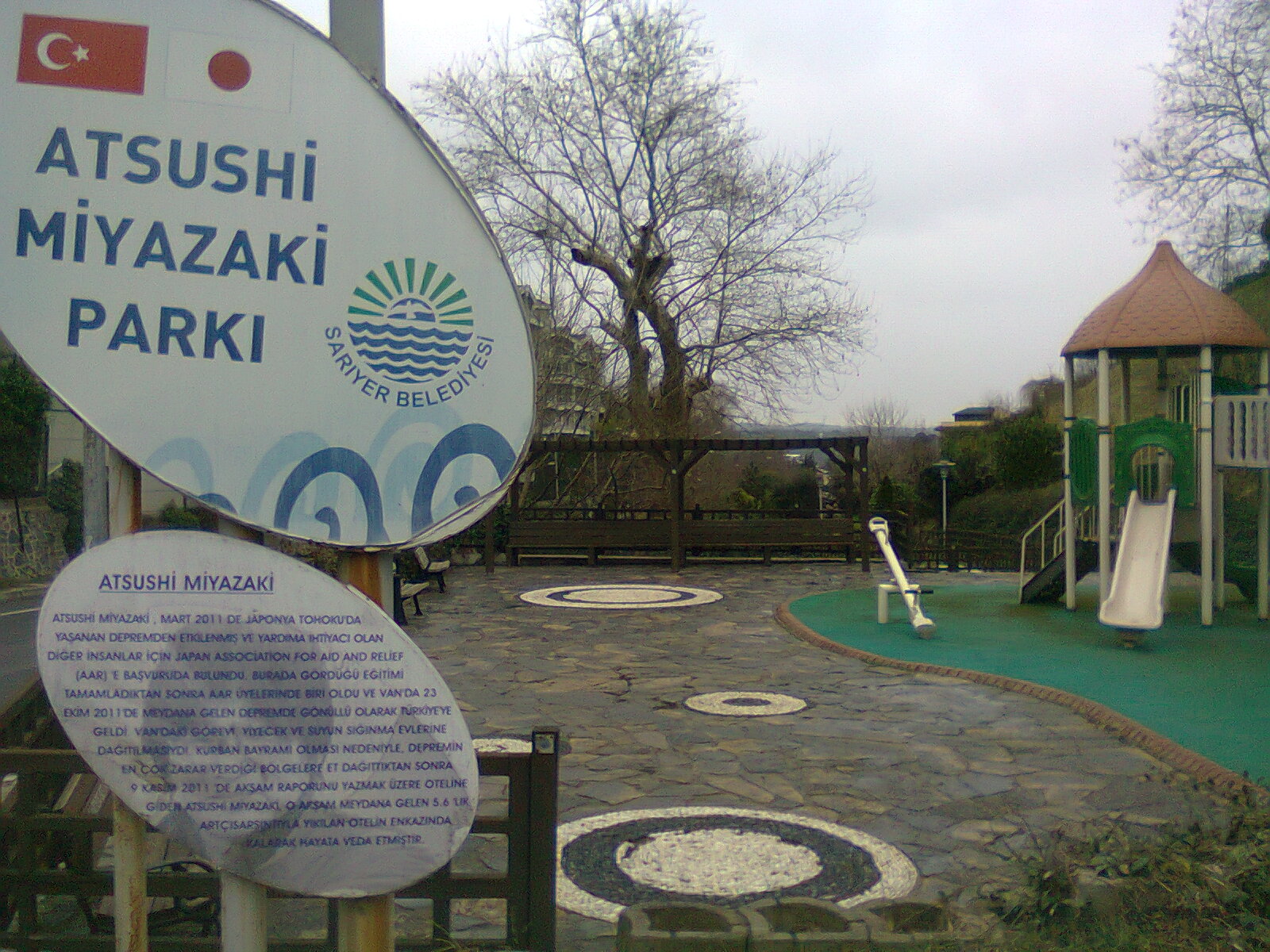

Atsushi Miyazaki Parkı
Sarıyer, Istanbul
Thursday, February 9, 2023
We had moved to the area
the previous fall
Along with everybody we know, my spouse and I survived the coup attempt in Turkey yesterday (July 15, 2016). Continue reading
Turkey has given me a lot. My spouse would be enough; but life in Turkey offers various pleasures, and—for me at least—time to enjoy them. Hard work may be considered a virtue in the United States. Not so in Turkey. I am still driven to do things here, but perhaps only in the way that Thoreau was driven. He was driven to do what he wanted to do. One thing he wanted to do was write as follows.
I sometimes wonder that we can be so frivolous, I may almost say, as to attend to the gross but somewhat foreign form of servitude called Negro Slavery, there are so many keen and subtle masters that enslave both North and South. It is hard to have a Southern overseer; it is worse to have a Northern one; but worst of all when you are the slave-driver of yourself. Talk of a divinity in man! Look at the teamster on the highway, wending to market by day or night; does any divinity stir within him? His highest duty to fodder and water his horses!
For how many Americans is the highest duty to go to work to pay for the car that they drive to work?

Thoreau’s Journal
in the abridgement by Damion Searls
Profesörler Sitesi, Altınova, Balıkesir, Türkiye
Friday, August 28, 2015
See “Thoreau by the Aegean” of the following day
The following notes about the Chronicles of Narnia by C. S. Lewis are from four emails that I wrote in the fall of 2015 (with some noted additions in the spring of 2020 and some additional editing on November 25, 2021). The emails rebut various objections to the Narnia books. I have put my emails here, because I noticed that a friend on Facebook was wondering whether her daughter was ready to read the Chronicles, or perhaps to be read to from them. I do not wish to write much on Facebook, for reasons detailed elsewhere in this blog; so I asked interested persons to read me here.
My explorations continue in “Return to Narnia.”

This essay – these notes for an essay, this draft of an essay – is inspired by Robert Pirsig’s first book. I have made sectional divisions where they seemed to occur naturally.

On June 7, 2016, I underwent surgical repair of an inguinal hernia. I did not know what to expect. I did not know that I did not know: I did not consider that there was anything in particular to be prepared for. But there was.

Clock tower of Şişli Etfal hospital
from the fourth floor
The surgery itself was not such a big deal. It was a fascinating experience, but not one that I found myself wishing I had known more about ahead of time. Recovery has turned out to be something else. If a medical website says of recovery, “You may experience some discomfort,” it is practically lying. Discomfort was what I experienced, waiting in a chair, or on a gurney, for the surgery to take place. What I experienced afterwards was searing pain, at least in getting out of bed, with the rather insistent help of a nurse.
The May 2016 Harper’s features a review of some books about the rock band called Guns N‘ Roses. I find this a bit odd, though perhaps reassuring, since I think I am too old for Guns N’ Roses, and yet Harper’s seems pitched at people who are at least as old as I. During the former editorship of Lewis Lapham, the magazine ran cigarette ads; now it runs ads for retirement communities, hearing aids, and mobile phones with large buttons.

Guns N’ Roses performing at the Los Angeles Street Scene, September 28, 1985 © Marc Canter
Between the composing of parts 1 and 2 of this account came the death of Prince, whose work had inspired Rain the Color of Blue with a Little Red in It. Between the composing of parts 2 and 3 came the release of the four Turkish peace activists, whose imprisonment had given poignancy to The Demons and The Music of Strangers. There is a certain absurdity associated with each event.

Nikkyô Niwano, Shakyamuni Buddha: A Narrative Biography
(Tokyo: Kôsei Publishing Co., 1980; fifth printing, 1989)
On the cover, a modern copy by Ryûsen Miyahara,
owned by Risshô Kôsei-kai, of
“The Nirvana of the Buddha,”
painted in 1086 and owned by temple Kongôbu-ji,
Wakayama Prefecture, Japan

Ayşe was teaching, but I was free to see a movie. The İstiklâl cinemas were twenty minutes by foot from our urban campus, or one subway stop, if you preferred. Our flat was one stop in the other direction. There was a festival cinema in Ortaköy, and another over on the Asian side; but without even considering these (which I have never visited), I had a Canadian, a Mexican, a Polish, and a Turkish film to choose from. I studied them on the festival website, though not too intently. You are not likely to go wrong with any festival film. Moreover, the catalogue synopses do not always provide an accurate sense. I chose the Canadian movie out of interest in this country as being both American and not. It is also where Ayşe and I met. Continue reading
After a preamble on freedom, this is an account of nine movies in three parts.
This part:
Thirst
Rain the Color of Blue With a Little Red in It
Fire at Sea
The Demons
The Music of Strangers: Yo-Yo Ma and the Silk Road Ensemble
Florida
Interruption
Under the Sun
News from Planet Mars

In the summer of 1994, I was a graduate student at the University of Maryland, and I had lived in the state since 1989. My roommate in a suburban apartment complex was finishing her own degree and moving away. I decided to move across the border into the city of Washington, where I had already become involved in some bicycle activism. I found a congenial vegetarian group house. I would bicycle the nine miles to the College Park campus. But moving to the city raised a moral question: should I really give up my political right to a meaningful vote?
 Polytropy