Category Archives: Education

Writing and Inversion

Executive summary: The “voice” of a transitive verb may be active or passive. A piece of writing may be vigorous or torpid. There is not an exact correspondence between passive verbs and torpid writing. However, a passive verb is used to effect inversion of subject and object. One may also invert subject and auxiliary verb, subject and predicate, or two clauses, always adding new words. Each inversion may lead to torpid writing. This is what Strunk warned about in The Elements of Style, by issuing the command, “Use the active voice.” The command must be followed with discretion. Williams makes the same case, more elaborately, in Style: Towards Clarity and Grace. There is no foolproof executive summary of how to write well.


When E. B. White revised William Strunk’s original Elements of Style, he did not retain Strunk’s “Introductory,” whose first paragraph said of the book,

The experience of its writer has been that once past the essentials, students profit most by individual instruction based on the problems of their own work, and that each instructor has his own body of theory, which he may prefer to that offered by any textbook.

Perhaps many students today cannot receive individual instruction. They are just given textbooks that try to spell out everything. Continue reading

A New Kind of Science

Executive summary. Some sciences are called descriptive, empirical, or natural; others, prescriptive or normative. We should recognize a third kind of science, which studies the criteria as such that a thinking being imposes on itself as it tries to achieve success. I propose linguistics as an example. Collingwood introduced the term criteriological for the third kind of science. This was in The Principles of Art (1938), though I find the germ of the concept in earlier work, even in Collingwood’s first book, Religion and Philosophy (1916), in the passage on psychology that the author would recall in An Autobiography (1939).

Collingwood’s examples of criteriological sciences are logic, ethics, aesthetics, and economics. Pirsig effectively (and independently) works out rhetoric as an example in Zen and the Art of Motorcycle Maintenance (1974). We may benefit from clarity here, given how people can have a strong reaction to being lectured by experts. For Collingwood, such a reaction is found in Nazi Germany; see the last chapter of The New Leviathan (1942). Reactions to grammar are the subject of my own two ensuing articles, “Writing and Inversion” and “Writing Rules.”


Some sciences are not recognized for what they are. The sciences themselves are not new, but a proper understanding of them may be new to some of us, including myself.

Continue reading

What Philosophy Is

With my presumptuous title, I imitate Arthur Danto’s What Art Is (2013), mentioned in my last post, “Some Say Poetry.” The book is fine, and I have learned from it; but Danto could have learned from Collingwood’s Principles of Art.

Picasso, The Tragedy (1903), National Gallery of Art, Washington Continue reading

Some Say Poetry

In a poetry review, a remark on being a student has drawn my attention:

In My Poets, a work of autobiographical criticism with occasional ventriloquial interludes, McLane recalls two “early impasses in reading,” freshman-year encounters with Charles Olson and Frank O’Hara. She writes about not “getting it” but wanting to get it, about a desire to get it that was left wanting by code-breaking and analysis and satisfied by hearing and feeling.

This is from the second half of a “New Books” column by Christine Smallwood, in the Reviews section of Harper’s, July 2017. After quoting Smallwood’s review, I want to say something about learning and creating, in poetry and also in mathematics.

Potted palms with plaster farm animals on hillside behind
Kuzguncuk, 2017.11.05

Continue reading

NL XXV: The Three Laws of Politics

Index to this series

Executive summary (added September 11, 2018): The the three laws of politics are that (1) within the body politic, there is a ruling class, which is a society proper; (2) the ruling class can take in members from the ruled class; (3) the ruled and ruling classes will resemble one another, so that e.g. rulers of slaves will become slavish themselves. I compare such laws with physical laws, as discussed by Einstein; but on this subject, a look ahead to Chapter XXXI, “Classical Physics and Classical Politics,” would be in order. Meanwhile, by the Second Law, the body politic, or its ruling class, can be a permanent society; Nazi claims about the youth or senility of different states are bogus. There are further gradations within the ruling and ruled classes, according to strength of will; a weak will can be strengthened by another person’s stronger will through induction.


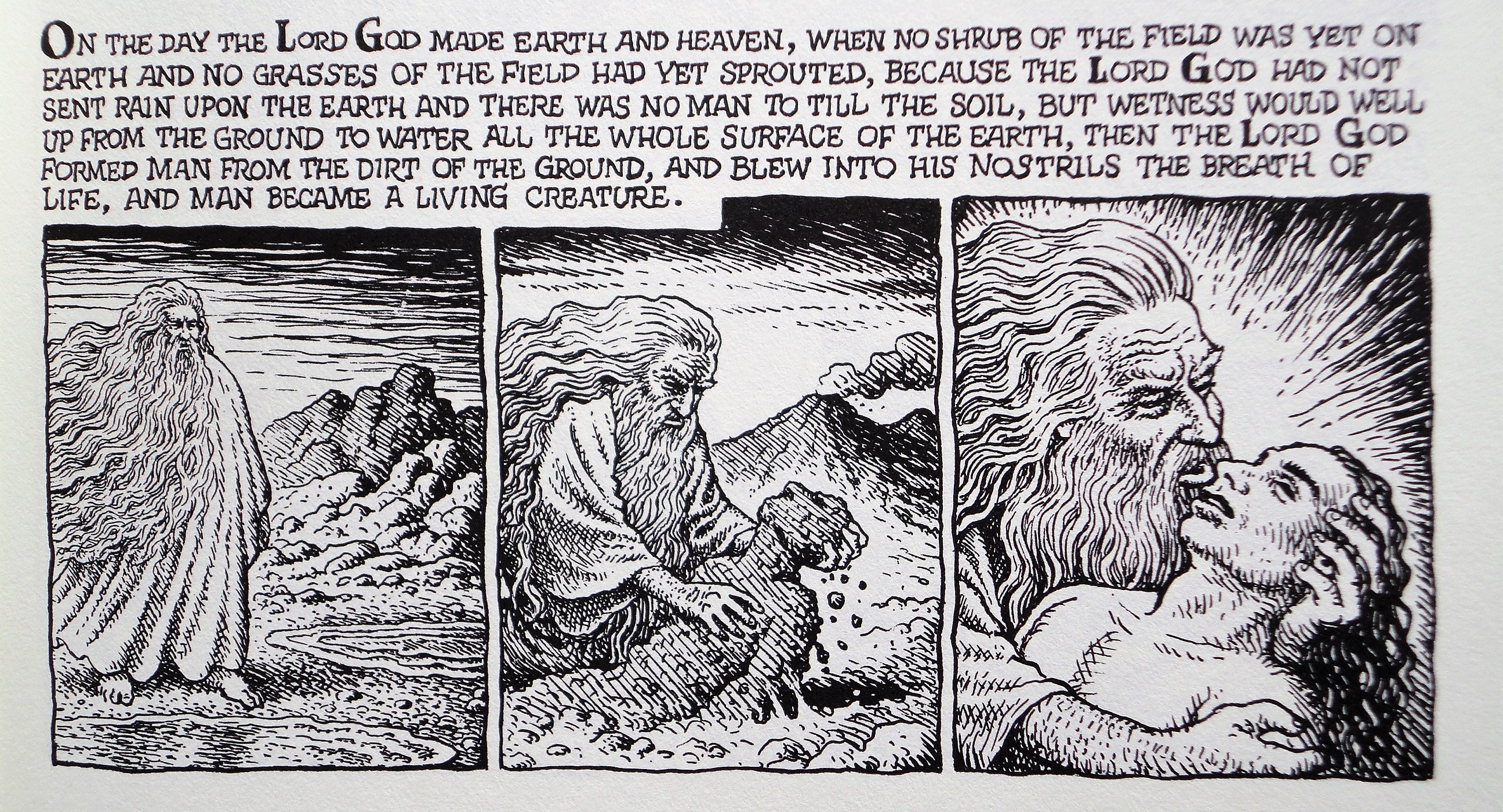
A pervading theme of the New Leviathan is freedom of will. Whether we actually have it is only a pseudo-problem (13. 17). Some persons have been fooled into thinking it a problem, perhaps by the misleading myth that free will is a divine gift, like life itself, breathed into our nostrils when, in Genesis 2:7, God forms us of the dust of the ground. As Collingwood observes at the end of Chapter XXIII, “The Family As a Society,” we are born neither free nor in chains. We have to grow up. Growing up is becoming free.

The Book of Genesis Illustrated by Robert Crumb (New York: Norton, 2009)

Continue reading

Hypomnesis

When is a help a hindrance? The Muses have provoked this question. They did this through their agents, the cicadas, who sang around the European Cultural Center of Delphi, during the 11th Panhellenic Logic Symposium, July 12–5, 2017.

     Cicada, European Cultural Center of Delphi, 2017.07.15     

Cicada, European Cultural Center of Delphi, 2017.07.15

My question has two particular instances.

  1. At a mathematical conference, can theorems “speak for themselves,” or should their presenters be at pains to help the listener appreciate the results?

  2. When the conference is in Greece, even at one of the country’s greatest archeological sites, does this enhance the reading of ancient Greek texts, or is it only a distraction?

Continue reading

The Private, Unskilled One

I went into Istanbul’s Pandora Bookshop a month ago, looking for an English translation of War and Peace, since the Garnett translation I had read at college was falling apart. I was told the Oxford World’s Classics edition (with the Maude translation) was coming the next week, and it did come.

Elif Batuman, The Idiot, in Nesin Matematik Köyü, Kayser Dağı Mevkii, Şirince, Selçuk, İzmir, Turkey, 2017.05.18

Continue reading

Victor Vasarely

Tophane-i Amire
Tophane-i Amire, 2017.03.25

Last week I wrote about the Turkish Impressionist Feyhaman Duran, born in 1886. Now my subject is the Hungarian-French Op Artist born twenty years later as Győző Vásárhelyi. His “Rétrospective en Turquie” is at the Tophane-i Amire Culture and Art Center in an Ottoman cannon foundry.

Vasarely show Continue reading

Freedom to Listen

“It’s a free country, so shut up!”

On Thursday, February 16 of this year (2017), at Bosphorus University, a talk on the subject of freedom of speech was given by a Guardian columnist who was a history professor at Oxford. This was Timothy Garton Ash, who observed that freedom of speech and of the press had been severely curtailed in Turkey. For a defender of the regime, the accusation might be belied by the speaker’s freedom to make it. Academics can still come from abroad and give their critical talks. However, as Professor Garton Ash detailed, many Turkish academics have been fired from their positions; many journalists have been imprisoned; other journalists cannot get their articles published.

Nocturnal scene of city buildings under snow, loomed over by towers displaying the crescent and star of the Turkish flag in colored lights
Fulya, Şişli, Istanbul
Friday evening, January 6, 2017

Continue reading

Confessions

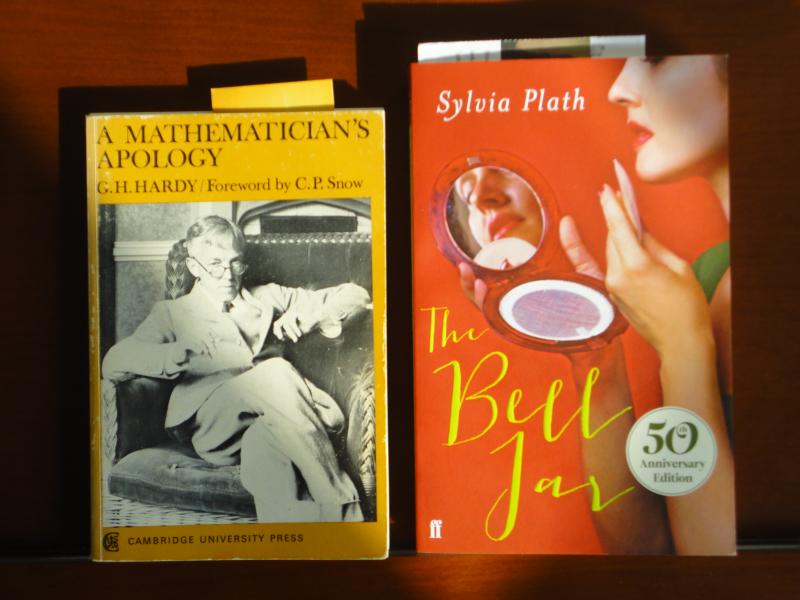
This is about G. H. Hardy and Sylvia Plath: Hardy quâ author of A Mathematician’s Apology (1940); Plath, The Bell Jar (1963).

Photo: the Hardy and Plath books

I first read Plath only recently, after encountering The Bell Jar by chance in the Istanbul bookshop called Pandora. After I finished reading it next day in Espresso Lab on İstiklâl, a woman who had earlier been speaking Turkish asked in English to look at the book. She pondered the front and the back before handing the book back to me. When I asked whether she knew of it, she simply said yes. She may not have understood my meaning; but I did not put her English (or my Turkish) to the test. Had she been made curious by the cover, showing a woman applying powder with the aid of a compact mirror? Did that cover accurately reflect the novel?

On an airplane once I was reading a paperback whose cover displayed a painting of ruins beneath the Acropolis of Athens. “I love historical fiction!” gushed a flight attendant. The term might be stretched to cover what I was reading; but it was the Oxford World’s Classics edition of Plato’s Republic.

Plato’s Republic

I had first read Hardy’s Apology in high school, thanks to the suggested reading at the end of Spivak’s Calculus. A couple of weeks ago, I somehow found a blog that took its title from the end of Hardy’s opening paragraph. That paragraph reads:

It is a melancholy experience for a professional mathematician to find himself writing about mathematics. The function of a mathematician is to do something, to prove new theorems, to add to mathematics, and not to talk about what he or other mathematicians have done. Statesmen despise publicists, painters despise art-critics, and physiologists, physicists, or mathematicians have usually similar feelings: there is no scorn more profound, or on the whole more justifiable, than that of the men who make for the men who explain. Exposition, criticism, appreciation, is work for second-rate minds.

The blog was called just that: Second Rate Minds. “We quote Hardy with irony,” says one of the two creators,

because we do not agree with him.

I believe there is great importance in communicating mathematics as widely as possible. I think it is important that children are encouraged to enjoy mathematics so that they might take further interest in the subject. Equally important is the view of mathematics held by the general public. Despite Hardy’s disdain for applications, mathematics nevertheless pervades the modern world and benefits from society valuing its role.

This is all fine; except I wonder if the writer has been corrupted by the same culture that made Hardy into somebody he found himself in disagreement with. This is the culture of judging people against one another, in order to rank them. Hardy gives a hint of this culture in the closing section of his essay:

I cannot remember ever having wanted to be anything but a mathematician. I suppose that it was always clear that my specific abilities lay that way, and it never occurred to me to question the verdict of my elders. I do not remember having felt, as a boy, any passion for mathematics, and such notions as I may have had of the career of a mathematician were far from noble. I thought of mathematics in terms of examinations and scholarships: I wanted to beat other boys, and this seemed to be the way in which I could do so most decisively.

I do not remember just what I thought of Hardy’s Apology in high school. I was at a school for boys, where I won prizes for mathematics and other subjects. I did not wish to emulate Hardy, either in pursuing just one thing, or in trying to beat others at it. Nonetheless, at the end of my freshman year at St John’s College in Annapolis, I bought my own copy of Hardy’s Apology in the College bookshop. The manager remarked that the book had decided her against pursuing mathematics. She had had dreams of doing good for the world; by Hardy’s account, mathematics was about personal glory.

I did want to do mathematics, as I ultimately understood. But this final understanding came after four more years: three in college, and one at large. I was working at a farm when I understood in a dream that I must learn modern mathematics. I cannot say that Hardy had any role in this, one way or other. Still, I would suggest now that, if Hardy does discourage you from pursuing mathematics, this may be just as well. You will have to focus like a laser if you want to do mathematics; you will be judged mercilessly, as mathematical truth is merciless; and you will suffer self-doubt, when it seems that the hardest you can work is still not good enough.

I am sorry that Hardy continued to be preoccupied with comparing himself to others:

I still say to myself when I am depressed, and find myself forced to listen to pompous and tiresome people, ‘Well, I have done one the thing you could never have done, and that is to have collaborated with both Littlewood and Ramanujan on something like equal terms.’

At least Hardy can accept that he was not quite at the level of his two collaborators. The mathematician must guard against all illusions.

In the end, I say, think what you like about Hardy; but give him credit for giving us a window into his life. Reading his essay yet again, I am impressed by the clarity and rhythm of the language, and by the frankness of the writer.

Sylvia Plath reminds me of Hardy. This is not because she ultimately gives up her virginity to a mathematician, at least in her novel. Like Hardy, she appears early on as an unpleasant person.

Plath’s character Esther proposes to Doreen that they ditch a party and have drinks with a man who wears cowboy boots and a lumber shirt. Doreen agrees to go up to Lenny’s apartment, as long as Esther will go. In the apartment, Doreen asks Esther to stick around. Still, Esther slips out; and back at the hotel, when a drunken Doreen pounds on her door, Esther won’t let her in. She allows Doreen to pass out in the corridor, since she won’t remember the incident anyway.

Maybe this was all part of the Girls’ Code, though it would seem to be a violation. Esther did not seem very nice to me. But then, trying to kill yourself is not very nice either, and Esther will do this repeatedly. There is a lot to investigate and contemplate here, including an academic system that squeezed both Plath and Hardy. It is odd that a bell jar is a place where the pressure is taken off. Now I want just to appreciate both Plath and Hardy, for laying themselves bare.

Written January, 2017. Revisited August 27, 2022. Later in 2017, I wrote more about Plath (and a little more about Hardy) in “Women and Men.”