Category Archives: Education

The geometry of numbers in Euclid

This is about how the Elements of Euclid shed light, even on the most basic mathematical activity, which is counting. I have tried to assume no more in the reader than elementary-school knowledge of how whole numbers are added and multiplied.

How come 7 ⋅ 13 = 13 ⋅ 7? We can understand the product 7 ⋅ 13 as the number of objects that can be arranged into seven rows of thirteen each.
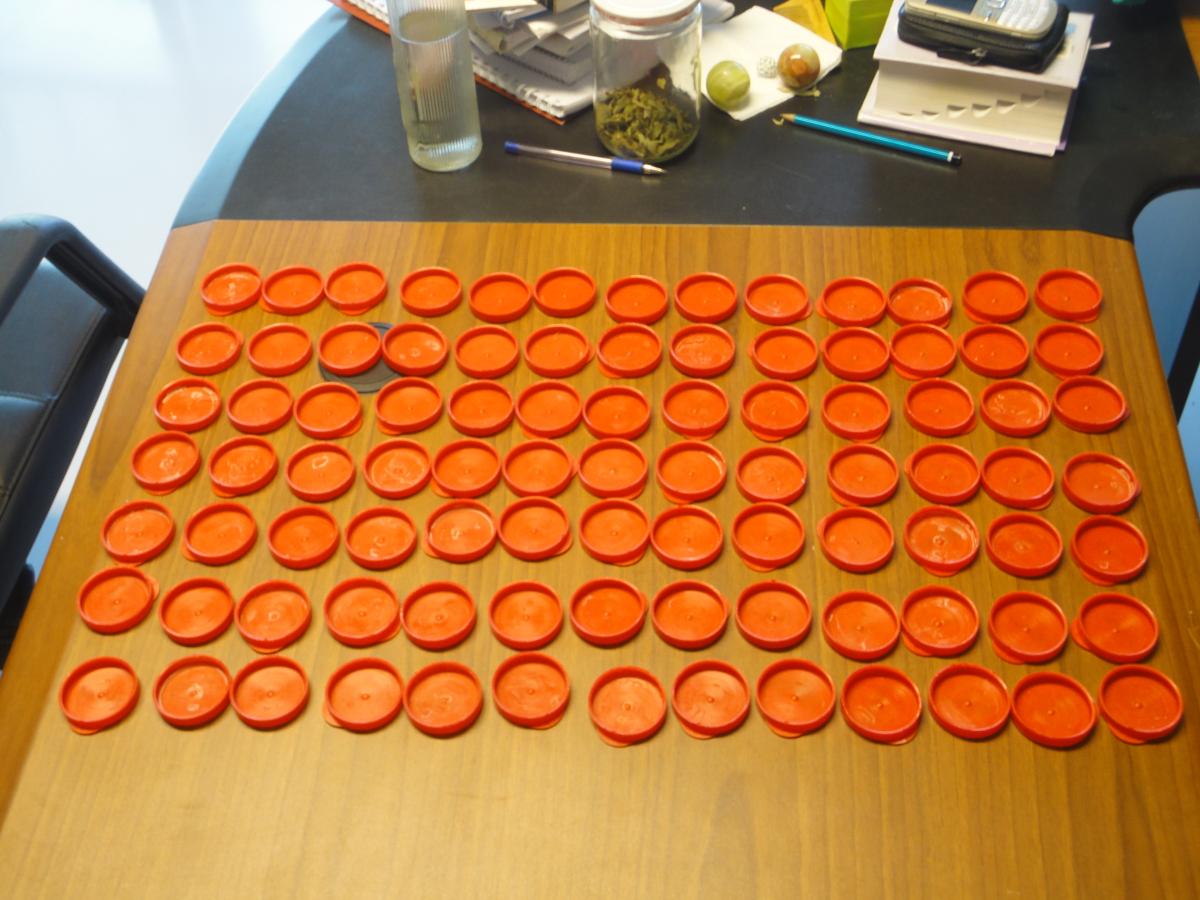
Bottlecaps arranged on a desk in seven rows, thirteen columns
Seven times thirteen

If we turn the rows into columns, then we end up with thirteen rows of seven each; now the number of objects is 13 ⋅ 7.

The same bottlecaps, now seen from another side as thirteen rows, seven columns
Thirteen times seven

Continue reading

Thales of Miletus

This is about Thales of Miletus and what it means to study him. I am moved to ask what history is in the first place. It is a study of the freedom in which we face our conditions. Thales had his way of understanding the world, and we may benefit from trying to learn it.

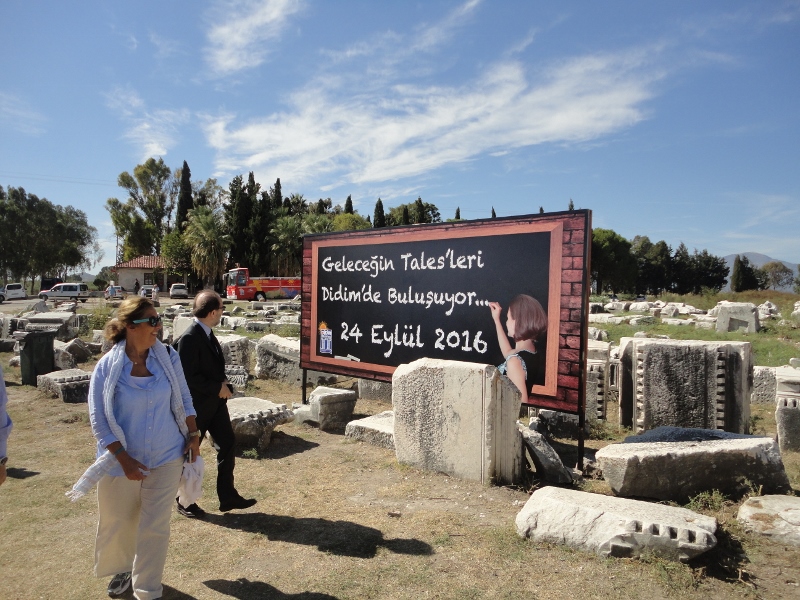
“The Thaleses of the future are meeting in Didim, September 24, 2016”

“The Thaleses of the future are meeting in Didim,
September 24, 2016”

Continue reading

Smarts and Intelligence

I juxtapose interviews with Donald Trump and a schoolchild.

CK boy

Rock star mascarading as Roy Fox

trumpwallace1-960x640

Continue reading

What Now

I composed this post after the US Presidential election of November 8, 2016; I revised it after the election of November 3, 2020. The general question is of responsibility, as for Clinton’s loss in 2016 or the Democrats’ loss of Congressional seats in 2020. More precisely, the question is not whom to blame, but why. The former question depends on the latter. There is a common belief, retained from childhood experience, that somebody, some power, is going to judge our actions. With regard to this belief, many of us continue to behave as if we are still children, be we obedient or not. Asked, for example, to think of the feelings of Trump supporters after their man’s 2020 loss, some of us reply, “Why should we? Did they ever think of our feelings?” You can ask that of a parent whom you expect to impose fairness; do you think there is such a parent of the world? My investigation of the 2016 election continued in “How to Learn About People.”

“Everything will be fine” is usually correct, but not always.

I wrote my last article, “Happiness,” after the arrests of editors and writers at Turkey’s largest independent newspaper, Cumhuriyet (“Republic”).

A philosophical point buried the article was this: there is no one reason, not even a collection of reasons, why things happen.

Continue reading

Happiness

If only tangentially sometimes, this is about living in Turkey, especially under the ongoing official state of emergency.

Aristotle, Marx & Engels, and Collingwood

A blog article on Medium recently struck me for its treatment of science. Dated October 3, the article is called “The Purpose Of Life Is Not Happiness: It’s Usefulness,” and its opening section is as follows.

Continue reading

All You Need Is Love

Note added May 31, 2018: Here are some meditations on education from the summer of 2016, when Donald Trump was threatening to become President of the United States. Education cannot be forced on unwilling students. Neither need students know just what they are accepting; they may be enticed or beguiled into learning. Whether they have learned cannot be directly tested. I include some memories of racism (as an observer, not a victim) and of my own liberal education.

Note added May 22, 2023: I return to this post, precisely because of that assertion that testing does not show directly whether students have learned. As I have learned recently through a friend, Emily Bender said something similar on Medium last year, in response to Steven Johnson in “A.I. Is Mastering Language. Should We Trust What It Says?” (New York Times Magazine, April 15, 2022):

First, large language models have been making steady improvements, year after year, on standardized reading comprehension tests.

Bender’s response is “On NYT Magazine on AI: Resist the Urge to be Impressed” (April 18, 2022):

just because the tests were designed to test for reading comprehension by people, and even if we assume that they do a good job of measuring that, doesn’t mean that comparable scores by machines on the same tests entail that machines are doing something comparable …

Bender goes on to talk about “construct validity.”


Would education solve the world’s problems? A meaningfully positive answer would imply that the appropriate education could actually be supplied to us, or enough of us; and yet education is not a drug that can be administered willy-nilly.

Tables for art entrance exam, MSGSÜ, 2016.08.02

Continue reading

Thinking & Feeling

This essay is written as a distraction from current events, though I make some reference to them. I am prompted by questions of analogy provoked by

  1. the similes of Homer and
  2. a recent theater review in Harper’s that mentions the parables of Jesus.

With sea in the background, on the sand of a beach sits Chapman’s Homer: The Iliad, the cover featuring a 16th-century Flemish tapestry (framed by a circle), Scene from Roman History, showing a number of men, the one in the middle armored; a horse is in the foreground

Continue reading

Narnia

The following notes about the Chronicles of Narnia by C. S. Lewis are from four emails that I wrote in the fall of 2015 (with some noted additions in the spring of 2020 and some additional editing on November 25, 2021). The emails rebut various objections to the Narnia books. I have put my emails here, because I noticed that a friend on Facebook was wondering whether her daughter was ready to read the Chronicles, or perhaps to be read to from them. I do not wish to write much on Facebook, for reasons detailed elsewhere in this blog; so I asked interested persons to read me here.

My explorations continue in “Return to Narnia.”

Side of boxed set of The Chronicles of Narnia from 1970s

Continue reading

One & Many

0

This essay – these notes for an essay, this draft of an essay – is inspired by Robert Pirsig’s first book. I have made sectional divisions where they seemed to occur naturally.

Photo of paperback and hardback editions of Zen and the Art of Motorcycle Maintenance

Continue reading

Academic Freedom

(See also other articles in the Freedom category.)

Yesterday (March 24, 2016) was the first day of the sixth Models and Groups Istanbul meeting. There were participants from the Middle East, Europe, and America. Kıvanç Ersoy was to speak about his own mathematics. He could not speak, because he was in prison. He, Esra Mungan, and Muzaffer Kaya were in prison, because the three of them had publicly insisted that the government of Turkey make peace in the southeast of the country. Absurd, but true. Continue reading