Category Archives: History

Homer for the Civilian

The sources of this essay (originally posted April 8, 2017) are an earlier one, written as an email in 2009, and a conversation that ensued it, on the theme of what Homer may mean in one’s life, and whether an application to one’s life involves an abuse of the original text. I wrote on this blog, in July 2016, on analogies in Homer and elsewhere, in “Thinking & Feeling.” My last post considered an apparent instance of abuse of the Hebrew Bible.

At the end of the Iliad, to retrieve the body of Hector from its killer, King Priam of Troy visits Achilles in his tent in the evening, in the camp of the hostile Greeks. The scene may recall two political enemies from the 1980s, President Ronald Reagan and Congressman Thomas O’Neill, Speaker of the House: these two were able to be on friendly terms “after 6 PM.”

Homer, Iliad, Wordworth edition
Aleksandr Andreevich Ivanov
“King Priam begging Achilles for the Return of Hector’s Body,” 1824
Tretyakov Gallery, Moscow

Continue reading

The Hands of an Angry Deity

I first drafted the following essay in late October, 2011, a few days after the first of the earthquakes in Van, and a few weeks after moving from Ankara to Istanbul. I rediscovered the essay recently by chance. It seems worth revisiting now, in the spring of 2017, given the political upheaval in the United States last fall, and the potential for more around the world.

Body of minivan with missing windows on overgrown grassy slope
Above Mehmetçik Caddesi in Şişli, one of the most densely populated of Istanbul’s 39 boroughs; 2017.04.02

Continue reading

Feyhaman Duran

Born on the Asian side of Istanbul in Kadıköy in 1886, İbrahim Feyhaman was orphaned nine years later. His father had been a poet and calligrapher. His mother’s dying wish was that Feyhaman attend the Lycée Impérial Ottoman de Galata-Sérai; his maternal grandfather, Duran Çavuş, saw that this happened. Some time after graduation, headmaster Tevfik Fikret had Feyhaman come back to Galatasaray to teach calligraphy.


Garden of Aşiyan, September 10, 2015

Continue reading

NL XIII: “Choice”

Index to this series

Adolph Gottlieb, “Centrifugal,” gouache on paperboard, 1961 (National Gallery of Art, Washington; gift of the Woodward Foundation)

Adolph Gottlieb, “Centrifugal,” 1961 (National Gallery of Art, Washington; gift of the Woodward Foundation)

The key idea of Chapter XIII of New Leviathan is the correct statement of the “problem of free will”:

Continue reading

NL X: “Passion”

Index to this series

Passion is literally the correlate of action, as suffering is the correlate of doing. In the ordinary, vulgar sense, passion is our response to what we suffer. This is how we shall understand it.

Above, from a cross made of steel I-beams, a stone figure hangs, while others mourn at his feet; below, more stone figures, one bearing a cross, another, back to us, with robe bearing the image of a face

Sagrada Familia, Passion Façade, November, 2008

Continue reading

NL IX: “Retrospect”

Index to this series

“All I want to know about mind,” says Collingwood,

is what it has done on certain definite occasions; not everything it has done, but enough for my purely practical purpose, deciding how to deal with the present attack on civilization.

This is from ¶9. 2 of New Leviathan. Three years ago, I set out here to read and write about this book, chapter by chapter. Continue reading

Thales of Miletus

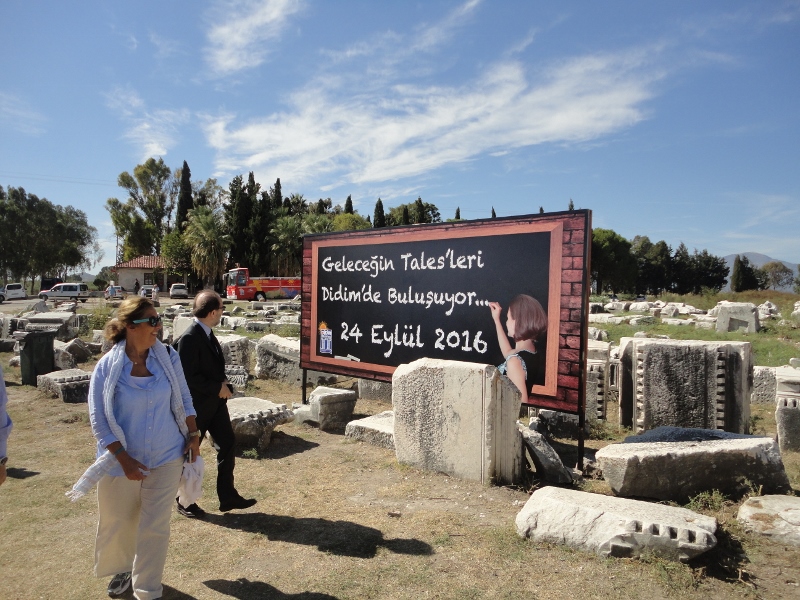
This is about Thales of Miletus and what it means to study him. I am moved to ask what history is in the first place. It is a study of the freedom in which we face our conditions. Thales had his way of understanding the world, and we may benefit from trying to learn it.

“The Thaleses of the future are meeting in Didim, September 24, 2016”

“The Thaleses of the future are meeting in Didim,
September 24, 2016”

Continue reading

Attribution of Fascism

I began writing this article on Saturday, December 10, 2016; I finished the next morning, Istanbul time. I wrote the first three paragraphs last. The planned breakfast did take place, quite pleasantly. The death toll in the bombing rose to 39. No matter how much I read drafts of my articles, I usually want to make changes after they are published. I made one such change visible in the first paragraph. After a friend left some comments, I made some other small changes. Again these are visible. Last I heard, the policy on Diaspora* is that published posts cannot be edited at all, because there should never be any question about which version of a post any resulting comments refer to. WordPress is not so strict, and in future I may just remove all signs of editing. There may not be any point in doing this in an essay that does not say everything that seemed worth saying at the time of writing. Better perhaps to leave the signs of work in progress. In any case, I shall retain access to the older versions.

Everything changes so fast, at least when one has an internet connection and a Twitter feed. As I try to wrap up this essay, I learn of a bombing outside a football stadium not too far from us here in Istanbul. Deaths are said to be in the teens, mostly of police officers. Twenty-nine persons are said to have died, all but two being police officers. Turkey has been in a state of emergency since the summer. Rescue vehicles had trouble getting through the normal traffic. The nearest hospitals are not operational.

Meanwhile, Donald Trump and his would-be appointees are called treasonous; but it is mainly liberals and lefties who are saying this. Russia was the big enemy when it was Communist; now some Republicans do not seem too concerned with its hold over Trump, while Democrats are reinventing the Red Scare.

If I hadn’t hooked up the internet connection, I would just be looking forward to a breakfast with friends later this morning, over on the Asian side of the Bosphorus. I expect this event to happen as planned, despite the bombing.

Now I just want to think a little bit about what fascism means, historically. It does seem to me that if Donald Trump has any ideology at all, it is fascism. Fascism is the doctrine that will guide his Presidency, if he is allowed to assume it. What this means is the main subject of this essay.

Books seen from above on a table: A Collection of Essays by George Orwell, on top of The Rise and Fall of the Third Reich; next to these, The Bones: A Handy, Where-to-Find-It Pocket Reference Companion to Euclid’s Elements

Continue reading

How to Learn about People

A chance encounter with a Medieval definition of God, used as the title of a sculpture, leads to an ancient plane tree and to more consideration of what can go wrong with public opinion polls.

Ancient plane tree of Bayır, Marmaris Peninsula, September 9, 2010

Continue reading

What Now

I composed this post after the US Presidential election of November 8, 2016; I revised it after the election of November 3, 2020. The general question is of responsibility, as for Clinton’s loss in 2016 or the Democrats’ loss of Congressional seats in 2020. More precisely, the question is not whom to blame, but why. The former question depends on the latter. There is a common belief, retained from childhood experience, that somebody, some power, is going to judge our actions. With regard to this belief, many of us continue to behave as if we are still children, be we obedient or not. Asked, for example, to think of the feelings of Trump supporters after their man’s 2020 loss, some of us reply, “Why should we? Did they ever think of our feelings?” You can ask that of a parent whom you expect to impose fairness; do you think there is such a parent of the world? My investigation of the 2016 election continued in “How to Learn About People.”

“Everything will be fine” is usually correct, but not always.

I wrote my last article, “Happiness,” after the arrests of editors and writers at Turkey’s largest independent newspaper, Cumhuriyet (“Republic”).

A philosophical point buried the article was this: there is no one reason, not even a collection of reasons, why things happen.

Continue reading