Category Archives: History

Istanbul in the Sun

The first Saturday in December promised to be cloudy, like every other day in recent weeks; but it would probably be rainless, so I spent it outside. Sunday was supposed to be rainy, so I planned on doing mental work indoors. In fact there were showers at dawn, but there was also orange light in the clouds. The clouds eventually cleared up, and I saw that I had better go out again. I returned to the seaside park where I had been the previous weekend; but this time I brought a proper camera.

I took some photos on the way to the park; these have now been incorporated in another article, ”Taksim in Limbo.” They serve to illustrate the previous article, “The Istanbul Seaside,” on that earlier park visit; so do the photos below.

Continue reading

Taksim in Limbo

This is a personal report on the current condition of Taksim square. I visited Taksim recently (early December, 2014) on a rare sunny day.

Continue reading

Mîna Urgan on alphabets & Atatürk

mina-urgan-paragraf

In the news in Turkey lately (December 2014) is the vow or threat of the President to make lessons in Ottoman Turkish compulsory for Turkish schoolchildren. How realistic the threat is, I do not know. There is the Constitutional question of what the President’s powers actually are. There is also the practical question of whether it is even possible for most Turkish students to learn Ottoman. Foreign language education in Turkey is not generally very good; and as far as I can tell, Ottoman Turkish is practically a foreign language now. Two paragraphs from Geoffrey Lewis’s Turkish Grammar (Oxford, 1967, pages xx–xxi) are very interesting in this regard:

Continue reading

The Istanbul Seaside

The original purpose of this article was to display and explain two photographs by me: one of a seaside park, the other of an abandoned car. I do this, and I talk about the stresses and compensations of the big city. I continue with the theme of Freedom from an earlier article of that name.

It is now early December in Istanbul, 2014. We have hardly seen the sun for weeks. Some rain falls almost every day. One has to learn to go out when one can. Last Saturday was cloudy, but dry, so we walked down to the Tophane-i Amire—the “Cannon Foundry Imperial.” The name is romantic, because it dates from Ottoman times, and because, like Koh-i-Noor, it is in a Persian grammatical form that is obsolete in Turkish. Today’s name of the cannon foundry would be Amire Tophane.
Continue reading

Hands on ≠ Minds on

I “reblog” an article about a history lesson in which students knock down a mock-up of the Berlin Wall. I think this “reenactment” (in the quotation in the re-blogged post) of the demolition of the Berlin Wall is just what Collingwood said (in An Autobiography) was not doing history. Here follows Collingwood:

I expressed this new conception of history in the phrase: ‘all history is the history of thought.’ You are thinking historically, I meant, when you say about anything, ‘I see what the person who made this (wrote this, used this, designed this, &c.) was thinking.’ until you can say that, you may be trying to think historically, but you are not succeeding. And there is nothing except thought that can be the object of historical knowledge. Political history is the history of political thought: not ‘political theory’, but the thought which occupies the mind of a man engaged in political work: the formation of a policy, the planning of means to execute it, the attempt to carry it into effect, the discovery that others are hostile to it, the devising of ways to overcome their hostility, and so forth…Military history, again, is not a description of weary marches in heat or cold, or the thrills and chills of battle or the long agony of wounded men. It is a description of plans and counter-plans: of thinking about strategy and thinking about tactics, and in the last resort of what men in the ranks thought about the battle.

On what conditions was it possible to know the history of a thought? First, the thought must be expressed: either in what we call language, or in one of the many other forms of expressive activity…Secondly, the historian must be able to think over again for himself the thought whose expression he is trying to interpret…If some one, hereinafter called the mathematician, has written that twice two is four, and if some one else, hereinafter called the historian, wants to know what he was thinking when he made those marks on paper, the historian will never be able to answer this question unless he is mathematician enough to think exactly what the mathematician thought, and expressed by writing that twice two are four. When he interprets the marks on paper, and says, ‘by these marks the mathematician meant that twice two are four’, he is thinking simultaneously: (a) that twice two are four, (b) that the mathematician thought this, too; and (c) that he expressed this thought by making these marks on paper…

This gave me a second proposition: ‘historical knowledge is the re-enactment in the historian’s mind of the thought whose history he is studying.’

grantwiggins's avatarGranted, and...

from today’s Smartbrief:

Student members of the Young Americans for Freedom at a school in Rome, Ga., marked the 25th anniversary of the fall of the Berlin Wall and the reunification of Germany with a re-enactment at their school. They knocked down a graffiti-covered, 12-foot-long wall made from wood for the dramatization. “It is great to see them internalizing the lessons of history and exhibiting the power of freedom,” said Brad Poston, history department chair.

By that argument, burning down the school would be a rich learning activity in support of “internalizing the lessons of history” of the urban riots of the 60s.

When, oh when, will teachers truly understand the difference between fun activity and experiential well-designed learning?

View original post

The Hyperbola

Here is the model that I made of the hyperbola, or rather the conjugate hyperbolae, as Apollonius calls them.

Conjugate hyperbolae and their common diameter

Conjugate hyperbolae and their common diameter


Continue reading

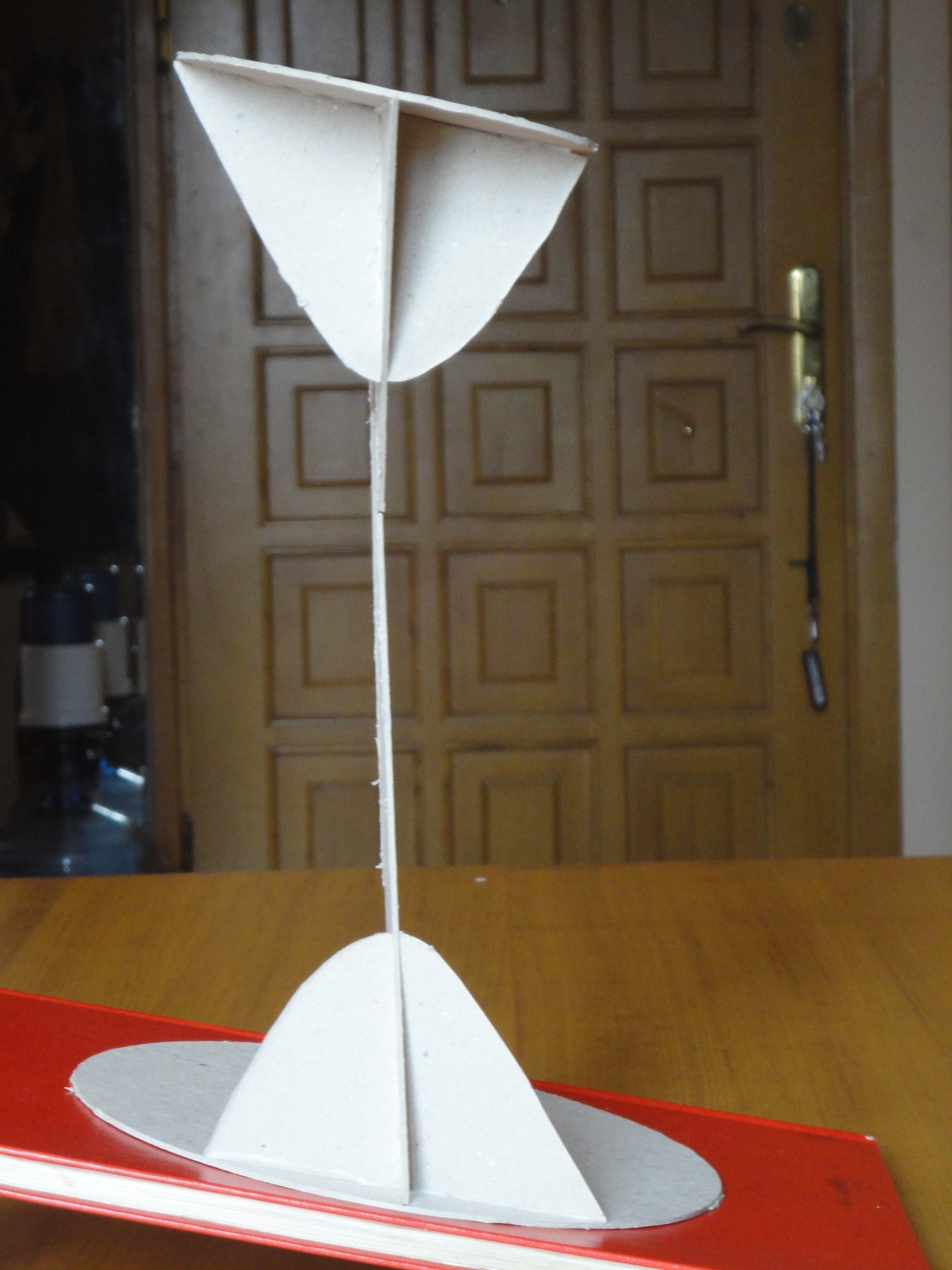
The Parabola

I do not now recall my specific inspiration; but in January of 2012, sitting at home in Istanbul, I cut up a cardboard box in order to make a model of a parabola quâ conic section.

January 14, 2012

January 14, 2012


Continue reading

Graffiti grammar

I happened to notice the words in the photograph below, written on a sidewalk box near the Özel Fransız Lape Hastanesi (the private Hôpital de la Paix), which has apparently been run by the Sisters of St Vincent de Paul since 1858. These must be the Sisters whom I occasionally see on the street.

It seems Gomidas was a patient at the Peace Hospital after his breakdown: a breakdown resulting from his deportation from Istanbul with other Armenian intellectuals in 1915. Gomidas was saved in body, not in spirit. Such is the history of the streets I walk daily.

Are the clouds descending on us?

DSC01607

The words in the photo:

Buraya Gri Boya Gelecek → Geliyor → Gelemedi

To here grey color will come → is coming → could not come

It could only come so far!

Cosmopolitanism

A discussion elsewhere, provoked by the Israel–Gaza conflict, has moved me to recall one and then another article in Katrina vanden Heuvel, ed., The Nation, 1865-1990: Selections from the Independent Magazine of Politics and Culture (New York: Thunder’s Mouth Press, 1990). As I recall, I ordered this anthology, having recently started subscribing to The Nation. I found the best way to read the anthology was backwards, thus starting with what I knew best.

DSC01229

Having now transcribed passages from the anthology, I record them here also.

Continue reading

Freedom

How do our thoughts age?

Having written recently that natural science was not history of nature, I looked back at Collingwood’s posthumous Principles of History for his arguments about this. I read his discussion of freedom as what distinguishes history from natural science. I recalled that his earlier writing was more concerned with removing distinctions than drawing them.

This is something that I investigate here. I occasionally encounter denials that we have “free will.” I find such denials bizarre; but evidently some people believe them, or at least believe they are worthy of consideration. I find Collingwood’s own account of freedom to be worthy of consideration. But then, considering this along with the rest of his œuvre, I have to conclude that everything is free. This conclusion is not really new to me; I drew such a conclusion as an adolescent. It may be a common thought. Wordsworth seems to have had such a thought, according to his Ode:

Continue reading