Category Archives: Philosophy

Free Sevan Nişanyan

Note added July 17, 2018: Sevan Nişanyan is now free, in the sense of having escaped from prison—an open prison—and from Turkey. The story is told well in an article by Lauren Frayer on NPR, September 28, 2017. Alev Scott visited Sevan on the Greek island of Samos and wrote about it in the Times Literary Supplement, July 4, 2018; the article is behind a paywall, but there’s a free version. The friends and colleagues mentioned at the beginning of my own essay are not currently under detention, though trials of them and others continue. My essay remains as an expression of the value of freedom of speech.

We want freedom for our friends and colleagues who are being held in pre-trial detention for their supposed support of terrorism through advocating peace.

İlyastepe, Şirince, May 2013

İlyastepe, Şirince, May 2013

Continue reading

On trial for pacifism

This is about the 1918 trial of American radical political cartoonist Art Young and others for conspiracy and interfering with enlistment. Most of the article is a quotation of Young’s own words. The words provide some perspective on today’s struggle for freedom of speech.

Capitalism, Art Young, private collection (reproduced in Harper's, Jan 2016, p. 64)

Capitalism, Art Young, private collection (reproduced in Harper’s, Jan 2016, p. 64)

Continue reading

Academic Freedom

(See also other articles in the Freedom category.)

Yesterday (March 24, 2016) was the first day of the sixth Models and Groups Istanbul meeting. There were participants from the Middle East, Europe, and America. Kıvanç Ersoy was to speak about his own mathematics. He could not speak, because he was in prison. He, Esra Mungan, and Muzaffer Kaya were in prison, because the three of them had publicly insisted that the government of Turkey make peace in the southeast of the country. Absurd, but true. Continue reading

Kıvanç fêted in absentia

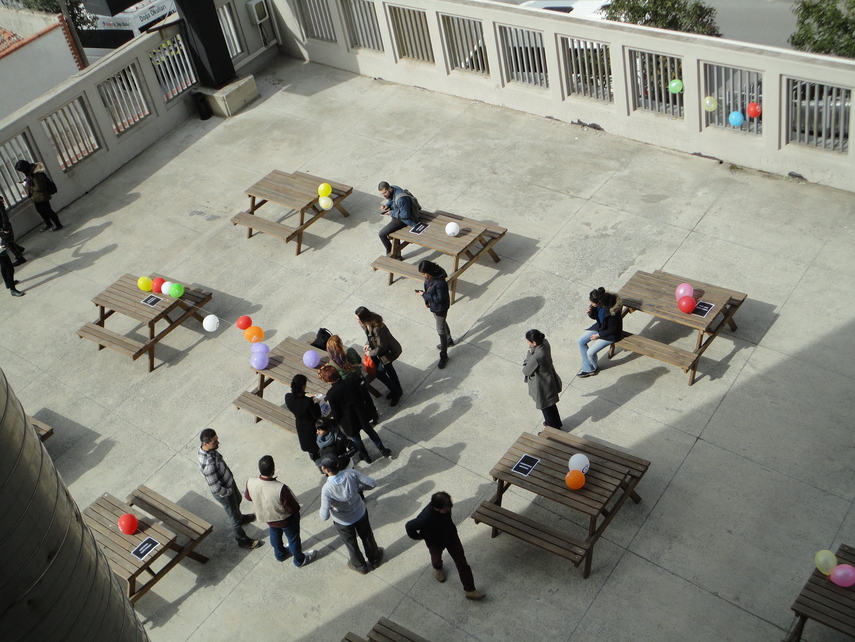
The birthday of one of our departmental colleagues was celebrated today, March 22, 2016. We were a day late, and the principal was away. His parents were present, but he himself had been imprisoned without bail since March 14.

MSGSÜ garden, 2016.03.22

The charge against Kıvanç and two others is spreading terrorist propaganda, as reported by Academic Freedom Monitor, Human Rights Watch and Nature. Continue reading

What I loath about Facebook

I wrote the polemic below as a comment on Facebook, in both senses. I was responding to a Johnnie friend’s comment, “David Pierce loathes fb as a forum for real discussion.” “Johnnies” are alumnae and alumni of St John’s College, the one with campuses in Annapolis and Santa Fe. My own view of our College is expressed in an article called simply St John’s College published in the De Morgan Journal in 2012. Since then, I have written about the College in the present blog, Continue reading

Nicole at the Golden Horn

The setting was gorgeous. We were atop a hotel (and former convent) opposite the compound of the Italian Consulate—the Italian Embassy, in Ottoman times, before Mustafa Kemal founded the Turkish Republic and moved the capital to Ankara. We looked out over old trees. The street just below us was closed to cars; off to the right it became a stairway and a narrow passage up to İstiklâl Caddesi. Beyond the trees of the Consulate were the Golden Horn and Seraglio Point, with the Bosphorus and the Sea of Marmara beyond. As night fell, electric lights illuminated the Seraglio itself—Topkapı Palace—along with the Hagia Sophia.
Continue reading

Thoreau by the Aegean

In a session of the 1986–7 senior laboratory at St John’s College in Santa Fe, for reasons that I do not recall, our tutor asked us students whether we had any heroes: for it was said that young people of the day no longer had heroes. None of the students at the table named a hero. I myself refrained from telling how I had once named a hero, when asked to do so in a high-school French class. This hero was the Buddha.

In recent times, I have listed my favorite writers as Somerset Maugham, Robert Pirsig, and R.G. Collingwood. I might add Charlotte Brontë and Mary Midgley to the list. I cannot add the Buddha, because he is not a writer. If my list were of writers and thinkers, I still could not add the Buddha: I cannot know him or any other thinker well enough, except through his own writing. But now I would add Henry David Thoreau. Continue reading

The Facebook Algorithm

I thank all of the friends who sent me birthday greetings on Facebook this year. [But see note at end.] One friend noted that I was not likely to see his birthday greeting, since I do not pay attention to Facebook these days. I usually do not pay attention; but since so many friends apparently continue to use that medium, I have not closed my account. I recently posted on Facebook a couple of photographs showing a friend from Washington who was visiting Istanbul. These photographs were “liked” by friends of that person or of me. Thus I suppose I used Facebook for its best purpose. Continue reading

Liberation

This article is based on quotations from three writers, of three different nationalities, who share a spirit with which I am in sympathy:

Fukuoka
“The ultimate goal of farming is not the growing of crops, but the cultivation and perfection of human beings.”
Pirsig
“The real cycle you’re working on is the cycle called ‘yourself.’ ”
Collingwood
“I thought that the democratic system was not only a form of government but a school of political experience coextensive with the nation.”

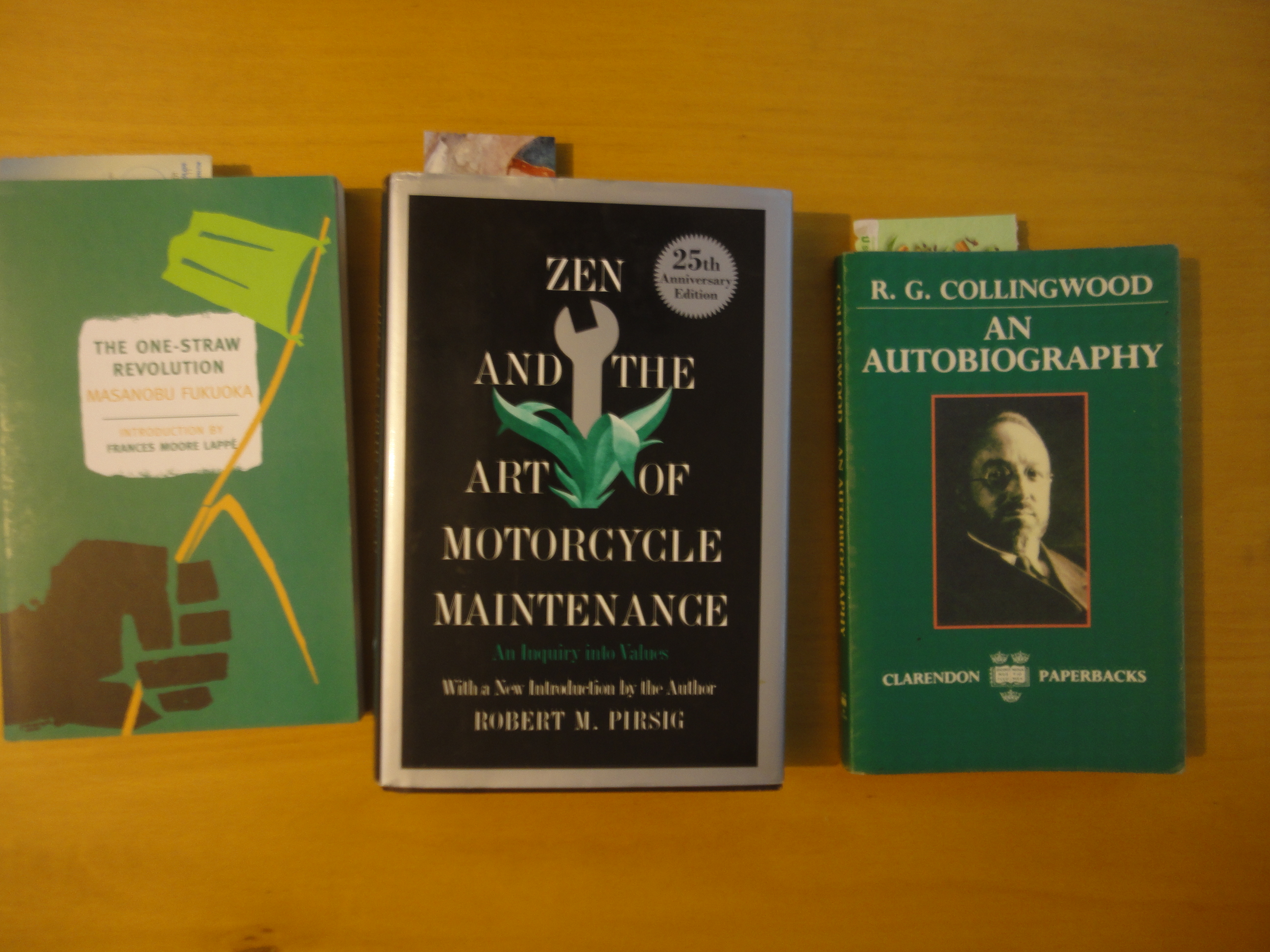
The books quoted here: The One-Straw Revolution, Zen and the Art of Motorcycle Maintenance, and An Autobiography. They all have on their covers a similar forest green, along with black

Continue reading

The Writer and the Persona

One may like a writer’s books without liking the writer. I have not had opportunity to test this maxim directly; but the experience of reading The First Mate’s Log may come close to what is needed. I like the book, as I like all of Collingwood’s books. But the Log is what it says, an account of Mediterranean Sea voyage taken by the author with a bunch of young men (Oxford students) half his age. The Log perhaps reveals more of Collingwood’s personality than his philosophy books do. Or maybe Collingwood just adopts a somewhat different persona for the Log.

Three pages of text, side by side

Continue reading