Category Archives: Philosophy

The Writer and the Persona

One may like a writer’s books without liking the writer. I have not had opportunity to test this maxim directly; but the experience of reading The First Mate’s Log may come close to what is needed. I like the book, as I like all of Collingwood’s books. But the Log is what it says, an account of Mediterranean Sea voyage taken by the author with a bunch of young men (Oxford students) half his age. The Log perhaps reveals more of Collingwood’s personality than his philosophy books do. Or maybe Collingwood just adopts a somewhat different persona for the Log.
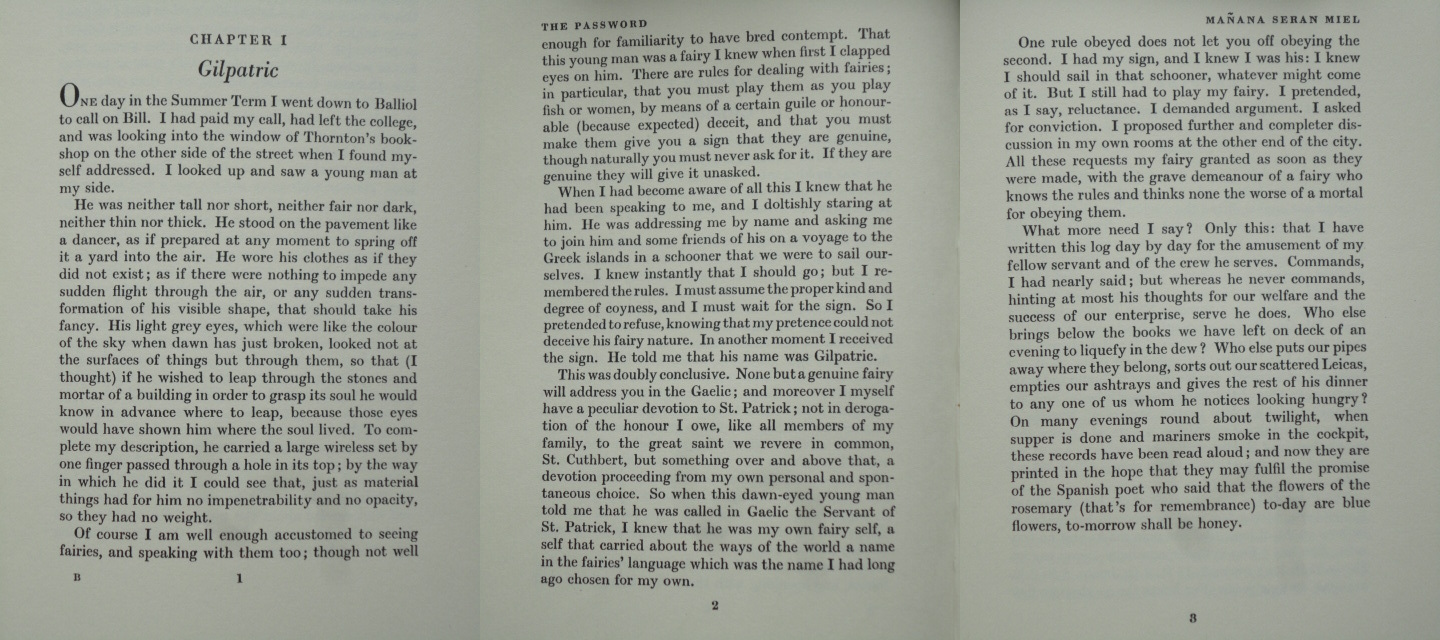
Three pages of text, side by side

Continue reading

Equality Is Not Identity

I want to record here an account by Collingwood of Aristotle’s theory of knowledge. The passages quoted below are relevant, both to something I have learned from reading Euclid with students, and to the considerations of consciousness that led to my recent article “Body and Mind.”

Continue reading

The Academic Battery Cage

The purpose of this article is to record a couple of paragraphs by Mary Midgley about academia today and its judging of people according to numbers of papers published. I have become something of a fan of Midgley. Her field is philosophy, though I think her complaint applies to mathematics or anything else:

Continue reading

Body and Mind

Does consciousness have a “physical basis” or “material basis”? I am provoked by the suggestion that it does; for the question itself is misleading, if not simply meaningless.

In the September, 2014, issue of Harper’s magazine, Edward O. Wilson begins an essay called “On Free Will” with the following paragraph.

Continue reading

Inurement

This is about getting used to things, and things one should not get used to.

There is a free-speech crisis in Turkey now, brought on in part, but not exclusively, by the murders at the Charlie Hebdo offices in Paris. See an editorial of the Platform for Independent Journalism (P24) for a list of issues.

Continue reading

The Peace of Liberal Education

The wall of Dolmabahçe Sarayı, January 11, 2015

The wall of Dolmabahçe Sarayı, January 11, 2015

The occasion of this article is my discovery of a published Turkish translation of Collingwood’s Speculum Mentis or The Map of Knowledge (Oxford, 1924). Published as Speculum Mentis ya da Bilginin Haritası (Ankara: Doğu Batı, 2014), the translation is by Kubilay Aysevenler and Zerrin Eren. Near the end of the book, Collingwood writes the following paragraph about education, or what I would call more precisely liberal education. The main purpose of this article then is to offer the paragraph to any reader who happens to stop by.

Continue reading

Bosphorus Sky

This is about the morning of Thursday, December 18, 2014, a morning I spent by the Bosphorus, thinking mostly about poetry, and photographing the sky.

Seagulls against clouds and a brighter sea

Continue reading

Taksim in Limbo

This is a personal report on the current condition of Taksim square. I visited Taksim recently (early December, 2014) on a rare sunny day.

Continue reading

The Istanbul Seaside

The original purpose of this article was to display and explain two photographs by me: one of a seaside park, the other of an abandoned car. I do this, and I talk about the stresses and compensations of the big city. I continue with the theme of Freedom from an earlier article of that name.

It is now early December in Istanbul, 2014. We have hardly seen the sun for weeks. Some rain falls almost every day. One has to learn to go out when one can. Last Saturday was cloudy, but dry, so we walked down to the Tophane-i Amire—the “Cannon Foundry Imperial.” The name is romantic, because it dates from Ottoman times, and because, like Koh-i-Noor, it is in a Persian grammatical form that is obsolete in Turkish. Today’s name of the cannon foundry would be Amire Tophane.
Continue reading

Uniformity

For certain reasons, this is something of a follow-up to an earlier article, Interconnectness, in which I quoted myself from December of 1987 as saying,

I came to think that if one understood the law of contradiction, there would be nothing left to understand.

I am going to quote now the person I quote the most, Collingwood, from the fourth paragraph from the end of Religion and Philosophy:

Uniformity, in a word, is relative to our needs; and to suggest that a game of cricket, for instance, would be impossible if we supposed that the ball might suddenly decide to fly to the moon, is no less and no more sensible than to suggest that it is impossible because the bowler might put it in his pocket and walk off the field. We know that the friend we trust is abstractly capable, if he wished, of betraying us, but that does not prevent our trusting him. It may be that our faith in the uniformity of matter is less removed from such a trust than we sometimes imagine. Whether we describe it as faith in matter or faith in God makes, after all we have said, little difference.

Continue reading