Category Archives: New Leviathan

NL XII: “Happiness”

Index to this series

Judith Leyster (Dutch, 1609–1660), Self-Portrait, c. 1630, oil on canvas (National Gallery of Art, Washington; gift of Mr. and Mrs. Robert Woods Bliss)
Judith Leyster (Dutch, 1609–1660)
Self-Portrait, c. 1630, oil on canvas
National Gallery of Art, Washington
Gift of Mr. and Mrs. Robert Woods Bliss

I gave ad hoc consideration to Chapter XII of Collingwood’s New Leviathan on November 3 of last year (2016), just before the American Presidential election. This was in an article sharing the title of the chapter: “Happiness.” The idea was that in dreadful times, unhappiness is “parasitic” on happiness.

Allowing himself “a certain freedom of interpretation” (12. 15), Collingwood agrees with Aristotle that “happiness” is the general term for what we desire (12. 11).

Continue reading

NL XI: “Desire”

Index to this series

The four parts of Collingwood’s New Leviathan (1942) are Man, Society, Civilization, and Barbarism. From the first part, we are considering Chapter XI, “Desire.”

Pablo Picasso, The Lovers (1923; National Gallery of Art, Washington)
Pablo Picasso, “The Lovers,” 1923
National Gallery of Art, Washington

Continue reading

NL X: “Passion”

Index to this series

Passion is literally the correlate of action, as suffering is the correlate of doing. In the ordinary, vulgar sense, passion is our response to what we suffer. This is how we shall understand it.

Above, from a cross made of steel I-beams, a stone figure hangs, while others mourn at his feet; below, more stone figures, one bearing a cross, another, back to us, with robe bearing the image of a face

Sagrada Familia, Passion Façade, November, 2008

Continue reading

NL IX: “Retrospect”

Index to this series

“All I want to know about mind,” says Collingwood,

is what it has done on certain definite occasions; not everything it has done, but enough for my purely practical purpose, deciding how to deal with the present attack on civilization.

This is from ¶9. 2 of New Leviathan. Three years ago, I set out here to read and write about this book, chapter by chapter. Continue reading

Thales of Miletus

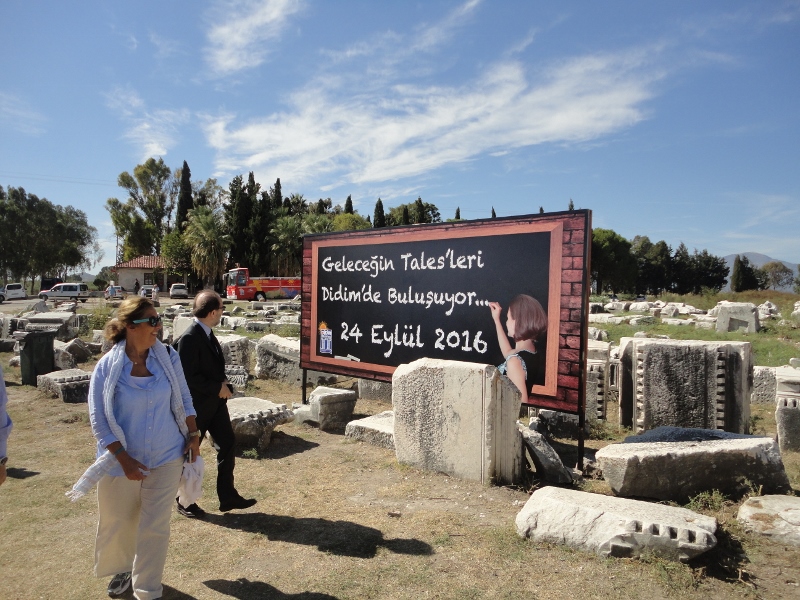
This is about Thales of Miletus and what it means to study him. I am moved to ask what history is in the first place. It is a study of the freedom in which we face our conditions. Thales had his way of understanding the world, and we may benefit from trying to learn it.

“The Thaleses of the future are meeting in Didim, September 24, 2016”

“The Thaleses of the future are meeting in Didim,
September 24, 2016”

Continue reading

Happiness

If only tangentially sometimes, this is about living in Turkey, especially under the ongoing official state of emergency.

Aristotle, Marx & Engels, and Collingwood

A blog article on Medium recently struck me for its treatment of science. Dated October 3, the article is called “The Purpose Of Life Is Not Happiness: It’s Usefulness,” and its opening section is as follows.

Continue reading

Freedom

How do our thoughts age?

Having written recently that natural science was not history of nature, I looked back at Collingwood’s posthumous Principles of History for his arguments about this. I read his discussion of freedom as what distinguishes history from natural science. I recalled that his earlier writing was more concerned with removing distinctions than drawing them.

This is something that I investigate here. I occasionally encounter denials that we have “free will.” I find such denials bizarre; but evidently some people believe them, or at least believe they are worthy of consideration. I find Collingwood’s own account of freedom to be worthy of consideration. But then, considering this along with the rest of his œuvre, I have to conclude that everything is free. This conclusion is not really new to me; I drew such a conclusion as an adolescent. It may be a common thought. Wordsworth seems to have had such a thought, according to his Ode:

Continue reading

Facts (NL IX, ‘Retrospect,’ first 6 paragraphs)

Index to this series

A certain person says,

I am not better than you or more virtuous than you. If you see me on the right path, help me. If you see me on the wrong path, advise me and halt me. And obey me as far as I obey God.

How should one hear these words: as an eminently reasonable expression of benevolent humility such as any of us might honorably make? Well, no matter how qualified, the command obey me might be a warning sign. The words are in fact from a recently published video, as quoted in the Guardian Weekly (Vol 190 No 5, 11–17 July 2014, p. 4). The speaker is the man whose nom de guerre is Abu Bakr al-Baghdadi, on whose head the Department of State of the United States of America placed a ten-million-dollar bounty in 2011. He now styles himself Ibrahim, Caliph of the Islamic State, a new entity that is supposed to restore the lost Muslim glory of past centuries. This restoration is to be achieved through war. War requires military discipline, with punishments meted out for infractions like insubordination, not to mention the slaughter of those perceived as enemies. So al-Baghdadi’s request to be advised and halted if seen to be in the wrong must be interpreted rather carefully.

It is difficult to know how to interpret somebody’s words. With that I pass to the transitional chapter in the first part, “Man,” of Collingwood’s New Leviathan.

Continue reading

NL VIII: “Hunger and Love”

Index to this series

§1

Collingwood recognizes the two kinds of appetites named in the title of the chapter.
Continue reading

NL VII: “Appetite”

Index to this series

How can we compare two states of mind? This is the question of Chapter VII of The New Leviathan. The answer is contained in the chapter’s title. “Appetite” is a name, both for the chapter and for the fundamental instance of comparing a here-and-now feeling with a “there-and-then” feeling. We compare these two feelings because we are unsatisfied with the former, but prefer the latter.

It would seem then that appetite is at the root of memory. Thus we are among the ideas of the opening verses of The Waste Land of T. S. Eliot, who attended Collingwood’s lectures on Aristotle’s De Anima at Oxford (and was just a year older):

Continue reading