Category Archives: Principles of Art

Copyright

Below is a provocative passage from the conclusion of R. G. Collingwood, The Principles of Art (page 325). Oxford first published the book in 1938, and its 1958 paperback edition is still in print. I assume the book continues to be printed without a copyright notice; at any rate, my own paperback copy, from the nineteenth printing, purchased in 1988, has no copyright notice.

I typed up the passage below and put it on my departmental website years ago. I have placed the passage here, because of an article that I chanced upon through the Arts & Letters Daily site. The article itself is on the Poetry Foundation website, is by Ruth Graham, and is called “Word Theft: Why did 2013 become the year of the plagiarists?”

I gather from the article that some contemporary poets have been found to have plagiarized from other contemporary poets; and what is especially annoying about the plagiarism is that the plagiarists are not actually improving what they are appropriating. In this case, they are not following Collingwood’s recommendation, though possibly they are ineptly trying:

To begin by developing a general point already made in the preceding chapter: we must get rid of the conception of artistic ownership. In this sphere, whatever may be true of others, la propriété c’est le vol. We try to secure a livelihood for our artists (and God knows they need it) by copyright laws protecting them against plagiarism; but the reason why our artists are in such a poor way is because of that very individualism which these laws enforce. If an artist may say nothing except what he has invented by his own sole efforts, it stands to reason he will be poor in ideas. If he could take what he wants wherever he could find it, as Euripides and Dante and Michelangelo and Shakespeare and Bach were free, his larder would always be full, and his cookery might be worth tasting.

This is a simple matter, and one in which artists can act for themselves without asking help (which I am afraid they would ask in vain) from lawyers and legislators. Let every artist make a vow, and here among artists I include all such as write or speak on scientific or learned subjects, never to prosecute or lend himself to a prosecution under the law of copyright. Let any artist who appeals to that law be cut by his friends, asked to resign from his clubs, and cold-shouldered by any society in which right-thinking artists have influence. It would not be many years before the law was a dead letter, and the strangle-hold of artistic individualism in this one respect a thing of the past.

This, however, will not be enough unless the freedom so won is used. Let all such artists as understand one another, therefore, plagiarize each other’s work like men. Let each borrow his friends’ best ideas, and try to improve on them. If A thinks himself a better poet than B, let him stop hinting it in the pages of an essay; let him re-write B’s poems and publish his own improved version. If X is dissatisfied with Y’s this-year Academy picture, let him paint one caricaturing it; not a sketch in Punch, but a full-sized picture for next year’s Academy. I will not rely upon the hanging committee’s sense of humour to the extent of guaranteeing that they would exhibit it; but if they did, we should get brighter Academy exhibitions. Or if he cannot improve on his friends’ ideas, at least let him borrow them; it will do him good to try fitting them into works of his own, and it will be an advertisement for the creditor. An absurd suggestion? Well, I am only proposing that modern artists should treat each other as Greek dramatists or Renaissance painters or Elizabethan poets did. If any one thinks that the law of copyright has fostered better art than those barbarous times could produce, I will not try to convert them.

Collingwood’s book suggests the author’s admiration for T. S. Eliot, and the two contemporary thinkers seem to share an opinion about copying. Eliot’s verbalization of the idea is apparently the more memorable one and is quoted by Ms Graham in the article on the Poetry Foundation website:

T. S. Eliot, who relied on other sources for much of “The Waste Land” (plagiarism or allusion?), famously wrote, “Immature poets imitate; mature poets steal.” Less often quoted is the next line, “Bad poets deface what they take.” This is what seems to gall many victims of plagiarists: to see their poems reprinted in weaker versions than the original.

NL I: “Body and Mind”

Index to this series. See also a later, shorter article on this chapter

The Chapter in Isolation

“Body and Mind” is the opening chapter of Collingwood’s New Leviathan. The chapter is a fine work of rhetoric that could stand on its own, though it invites further reading. In these respects it resembles the first of the ten traditional books of Plato’s Republic, or even the first of the thirteen books of Euclid’s Elements. The analogy with Euclid becomes a bit tighter when we consider that each chapter of The New Leviathan is divided into short paragraphs, which are numbered sequentially for ease of reference.

Continue reading

A personal overview of Collingwood’s New Leviathan

These are the notes of an amateur of the work of the philosopher R. G. Collingwood.

Published in 1942, The New Leviathan was the last book that Collingwood wrote. He finished it in some haste, because he knew he was dying—albeit of a condition brought on or at least exacerbated by overwork in the first place. He did die in 1943. Having been born in 1889, he was not so old as Socrates at death; but like Socrates, he had a babe in arms. Continue reading

The Tradition of Western Philosophy

Note added October 16, 2018: Here I compare two projects of re-examining the philosophical tradition named in my title. The projects are those of

  • R. G. Collingwood in An Essay on Philosophical Method (Oxford, 1933);

  • Stringfellow Barr and Scott Buchanan at St John’s College in Annapolis, Maryland, beginning in 1937.

I review

  • how I ended up as a student at St John’s;

  • how Collingwood has been read (or not read) by myself and others, notably Simon Blackburn;

  • how Collingwood’s Essay is based on the hypothesis of the “overlap of classes.”

Continue reading

Psychology

Preface (January 17–18, 2019). This essay is built around two extended quotations from Collingwood:

  1. From the posthumous Idea of History (1946) with the core idea, “people do not know what they are doing until they have done it.”
  2. From An Essay on Philosophical Method (1933), about how logic is neither a purely descriptive nor a purely normative science.

The quotations pertain to the title subject of psychology for the following reasons.

  1. Psychological experiments show that we may not know what we are doing until we have done it.
  2. Psychology is a descriptive science.

Psychological experiments can tell us about what we do, only when we presuppose the general applicability of their findings. This is true for any descriptive science. Philosophy demands more. A philosophical science like logic is categorical, in the sense of the second listed quotation, because it is what Collingwood will later call criteriological. I go on to discuss criteriological sciences as such in “A New Kind of Science,” but not here.

Continue reading

Books hung out with

Here are some books that I have read more times than I can remember.

  1. R. G. Collingwood, The Principles of Art (1938);
  2. Somerset Maugham, The Razor’s Edge (1944);
  3. Robert M. Pirsig, Zen and the Art of Motorcycle Maintenance (1974).

The years of my first readings were 1987, 1984, and 1982, respectively, as best I can remember; in any case, their order is opposite to the order of publication.

I want to say some things about the books and their writers. I intend especially to address the last book, which I shall call ZAMM. From Pirsig’s more recent book, Lila, I mention only the author’s description of keeping notes on slips of paper, then arranging and rearranging them, in hopes that he might finally produce a book out of them. The present article might be considered as a collection of such notes, not necessarily forming a coherent whole. There are more notes that I might add in future.


While I was in high school, I paid the price of three dollars and thirty-three cents (plus tax) for the peculiar purple book in square format called Be Here Now. I suppose the title can be taken as a summation of the spiritual advice contained in the book. This advice is apparently derived mainly from Hinduism, though given to us by an American once called Richard Alpert, who spent a lot of time taking LSD with Timothy Leary. After I had gone off to read Great Books at St John’s College in Annapolis in 1983, and transferred to Santa Fe after a year, I learned that the Director of Laboratories on the occidental campus had lived at a sort of monastery or commune, elsewhere in New Mexico, supported by sales of Be Here Now.

The book ends with lists of recommended reading, headed with the warning, “Painted cakes do not satisfy hunger.” There are three lists:

  1. Books to hang out with.
  2. Books to visit with now and then.
  3. Books it’s useful to have met.

The “books to hang out with” are thirty-five authors and teachers and scriptures. Those that I have on my own shelves are the Bhagavad Gita, the Holy Bible, the Tibetan Book of the Dead, the Tao Te Ching, the I Ching, and the poems of Hafiz. I have not really hung out with any of these, except maybe parts of the Bible and the Tao Te Ching (the latter in the 1972 translation of Gia-Fu Feng and Jane English, illustrated with Chinese calligraphy of the former on lovely spare nature photographs by the latter).

From Be Here Now’s longer list of “books to visit with now and then,” I have read only some of the poetry of Rumi and William Blake, along with Hesse’s Siddhartha, Merton’s Seven Story Mountain, Reps’s Zen Flesh, Zen Bones, Rilke’s Duino Elegies, and Thoreau’s Walden. From the final, longest section, of “books it’s useful to have met,” the works that I have read are a curious mix of mostly science fiction and St John’s College Program books, by Asimov, Bradbury, Castaneda, Dante, Descartes, Heinlein, Milton, Pascal, Plotinus, Plato, Saint-Exupéry, Salinger, and Tolkien.


The three books that I listed at the beginning are among the books that I have hung out with. Let me record here a flaw in my memory concerning one of them. Before checking the lists in Be Here Now, I thought I remembered that The Razor’s Edge was there somewhere, if only among the “books it’s useful to have met”. But it is not there. Since it seems to fit the theme of spiritual journeys, I wonder if its absence is due to ignorance or oversight. Possibly Maugham was judged to be a spiritual lightweight. However, because on a web page I said The Razor’s Edge was one of my favorite books, I received emails from a fellow, calling himself the Wanderling, who said that his mentor, and not a fellow called Guy Hague, was the person who had been the source for Maugham’s character Larry Darrell.


Some people never read a book more than once. Some people cannot even conceive of doing this. Jerry Seinfeld would appear to be one of those people. In an early episode of his television series, Jerry ridicules George for wanting to retrieve some already-read books from the girlfriend with whom he has just broken up.

Presumably Seinfeld could conceive of watching a television show more than once. It is only because I have watched Seinfeld episodes more than once that I am able to recall and mention Jerry’s foolishness about books in the first place.

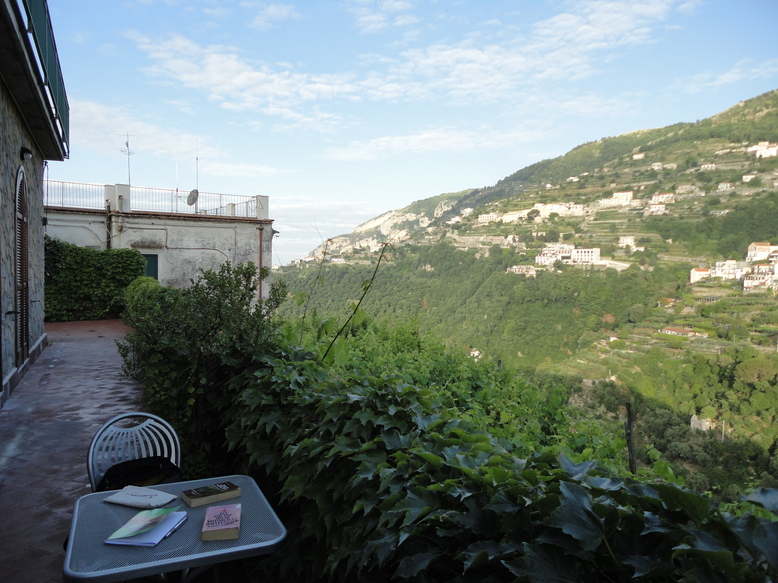
Recently I increased by one the unknown number of my readings of ZAMM. Earlier in this month of June, 2013, above the Tyrrhenian Sea, in the gorgeous hilltop setting of Ravello, where I was attending a mathematics conference, in the early mornings I would rise, sit outside, and either work on mathematics or read ZAMM.

photo of terrace in Ravello
ZAMM in the morning in Ravello

Continue reading