Writing Rules

Executive summary (added July 16, 2018): I have had enough of misrepresentation by experts of what other experts have to say about grammar.


An ongoing concern of this blog is the subject taught in school called grammar. See for example

  • the previous post, “Writing and Inversion,” about how a supposed rule against the passive voice might be better understood as a rule to avoid certain inversions of order (namely those inversions that add words and torpor);
  • the post before that, “A New Kind of Science,” presenting a theory that grammar is properly neither prescriptive nor descriptive, but “criteriological,” because it examines the criteria that we apply to our own speaking and writing;
  • an early expression (from six years ago) of some of those ideas: “Strunk and White.”

Grammar causes anxiety. Every aspect of school would seem to cause anxiety in somebody. Decades after they have left school, how many persons have nightmares of missing an examination? Quite a few, it would seem; see the evidence appended to this post. My mother and her brother were such persons, as I learned when growing up. I seem not to be such a person, though I once dreamt of missing a plane.

How much support of current US President Donald Trump is due to memories of belittlement by teachers at school? Similar questions may be raised about

  • UK government minister Michael Gove’s saying, “people in this country have had enough of experts …”;
  • the rise in Turkey of Recep Tayyip Erdoğan, who has perceived a special threat from the Peace Academics.

On that last matter, see my blog essay of March, 2016, “Academic Freedom.”

In the blog generally, I may criticize some of my fellow academics; but I criticize them for their own criticism of fellow academics and thinkers. Thus in the article “Strunk and White” listed above, I say Geoffrey Pullum was stupid to decry, in 2009, the “50 Years of Stupid Grammar Advice” offered by Strunk and White’s Elements of Style.

Still I have respected Pullum’s recommendation of Style: Toward Clarity and Grace, by Joseph M. Williams. I bought Williams’s book, and in this post I focus on some of his advice.

I thought Williams’s book might be more “democratic” than Strunk and White’s, in the sense of being aimed at a broader audience. That broader audience might include students whose parents didn’t go to college or grow up speaking English.

Now I have doubts that Williams has such an audience in mind. In his final chapter, called “Usage,” Williams writes (on page 176) of

Three Kinds of Rules

1. Some rules characterize the basic structure of English … No native speaker of English has to think about these rules at all.

2. Some rules distinguish standard from nonstandard speech … The only writers and speakers who worry about these rules are those upwardly mobile types who are striving to join the educated class of writers and speakers …

3. Finally, some grammarians try to impose on those who already write educated standard English particular items of usage that they think those educated writers should observe – don’t split infinitives; use that, not which for restrictive clauses …

This may not be much evidence to go on; but judging from the style of #1, I’m not sure Williams has considered the possibility of having readers who are not native speakers of English. In #2, by referring pejoratively to “those upwardly mobile types,” Williams seems to think they are not readers either.

Appearances are corroborated on the next page, after Williams describes again his three kinds of rules:

1. Some rules account for the fundamental structure of English …

2. Some rules distinguish the dialects of the educated and the uneducated …

3. And some rules belong to that category of rules observed by some well-educated people, and ignored by others equally well-educated …

Ordinarily, the first set of rules concerns us not at all. And if you are interested in this book, you probably aren’t much concerned with the second set either. It is the third set of rules that concern – sometimes obsess – already competent but not entirely secure writers. They are the rules of usage out of which the Pop Grammarians have created their cottage industry.

In faithfully transcribing Williams’s words about rules of usage, I have noticed that they violate a certain rule: “Enclose parenthetic expressions between commas.” Indeed, in the first block quotation above, giving the first list of “Three Kinds of Rules,” look again at the last clause (itself a rule):

use that, not which for restrictive clauses.

Here the phrase “not which” is parenthetic, but is not printed that way. Since a comma precedes it, a comma ought also to follow it, at least if one agrees with the rule that I stated, “Enclose parenthetic expressions between commas.”

That rule happens to be Rule 3 of Strunk’s original eight “Elementary Rules of Usage.” It is still Rule 3 in the version of The Elements of Style edited by E. B. White, although some of the other rules have been changed.

I find the same rule also as part of Rule 12d in the Harbrace College Handbook (8th edition, 1977), used in the ninth-grade English class at my private, college-preparatory school for boys in Washington. According to the Handbook:

Commas set off nonrestrictive clauses and phrases and other parenthetical and miscellaneous elements, such as transitional expressions, items in dates, words used in direct address, and so on. Restrictive clauses and phrases are not set off by commas.

Surely I was taught this rule in earlier years too. The rule seems unobjectionable and even natural to me now, and I do not recall any difficulty with it.
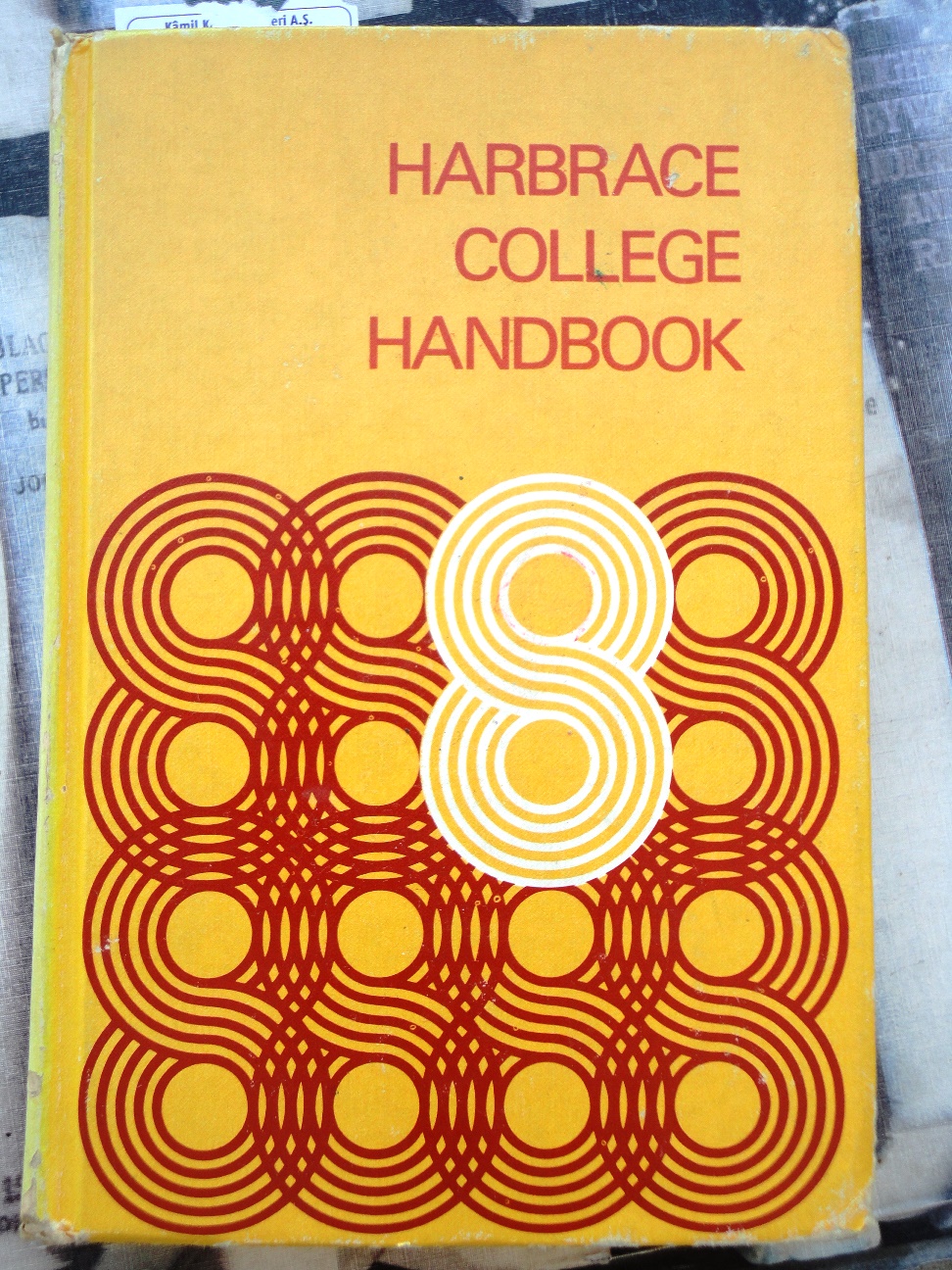
Yellow cover of Harbrace College Handbook 8

Continue reading

Writing and Inversion

Executive summary: The “voice” of a transitive verb may be active or passive. A piece of writing may be vigorous or torpid. There is not an exact correspondence between passive verbs and torpid writing. However, a passive verb is used to effect inversion of subject and object. One may also invert subject and auxiliary verb, subject and predicate, or two clauses, always adding new words. Each inversion may lead to torpid writing. This is what Strunk warned about in The Elements of Style, by issuing the command, “Use the active voice.” The command must be followed with discretion. Williams makes the same case, more elaborately, in Style: Towards Clarity and Grace. There is no foolproof executive summary of how to write well.


When E. B. White revised William Strunk’s original Elements of Style, he did not retain Strunk’s “Introductory,” whose first paragraph said of the book,

The experience of its writer has been that once past the essentials, students profit most by individual instruction based on the problems of their own work, and that each instructor has his own body of theory, which he may prefer to that offered by any textbook.

Perhaps many students today cannot receive individual instruction. They are just given textbooks that try to spell out everything. Continue reading

A New Kind of Science

Executive summary. Some sciences are called descriptive, empirical, or natural; others, prescriptive or normative. We should recognize a third kind of science, which studies the criteria as such that a thinking being imposes on itself as it tries to achieve success. I propose linguistics as an example. Collingwood introduced the term criteriological for the third kind of science. This was in The Principles of Art (1938), though I find the germ of the concept in earlier work, even in Collingwood’s first book, Religion and Philosophy (1916), in the passage on psychology that the author would recall in An Autobiography (1939).

Collingwood’s examples of criteriological sciences are logic, ethics, aesthetics, and economics. Pirsig effectively (and independently) works out rhetoric as an example in Zen and the Art of Motorcycle Maintenance (1974). We may benefit from clarity here, given how people can have a strong reaction to being lectured by experts. For Collingwood, such a reaction is found in Nazi Germany; see the last chapter of The New Leviathan (1942). Reactions to grammar are the subject of my own two ensuing articles, “Writing and Inversion” and “Writing Rules.”


Some sciences are not recognized for what they are. The sciences themselves are not new, but a proper understanding of them may be new to some of us, including myself.

Continue reading

Samatya Tour, July 2018

This is about a solo walking tour on Sunday, July 1, 2018. I was mostly around the Seventh Hill of the old walled city of Constantinople, ultimately in the quarter called Ψαμάθεια in Greek, and in Turkish Samatya.

Continue reading

Çarşamba Tour, April 2018

Ayşe and I toured the northern part of the old walled city of Istanbul – including the religiously conservative district of Çarşamba – with our student Abdullah and his brother Yusuf on Sunday, April 8, 2018. At another site I documented a similar tour in March, 2015. Now I do not try to be so thorough. I did not try to document the whole trip photographically, but here is a selection of pictures that I did take. We saw Byzantine and Ottoman structures. For the former, I have since found a comprehensive reference: The Byzantine Legacy.

Kalendarhane

Continue reading

Re-enactment

Two whiteboards, one above the other, with geometrical diagrams and equations
My whiteboards from Tuesday, November 3, 2015,
concerning Pappus of Alexandria,
in the course “Geometriler


Executive summary (added October 6, 2018). Historian Niall Ferguson praises Collingwood as a philosopher of history, while showing no sign of understanding Collingwood’s actual philosophy. This provokes me. My comments are in the following sections.

Continue reading

What It Takes

This essay ends up considering arguments that natural science – especially mathematical physics – is based on absolute presup­positions whose mythological expression is found in Christianity – especially the doctrine of Incarnation.

I take note along the way of continuing censorship of Wikipedia by the Turkish state.

The post falls into sections as follows.

  • Where to start. To the thesis that everybody can be a philosopher, an antithesis is that persons with the professional title of philosopher ought to know the history of their subject.

  • Ontology. Disdain for this history may lead to misunderstanding of Anselm’s supposed proof of the existence of God.

  • Presupposition. To prove anything, you need a pou sto, or what Collingwood calls an absolute presupposition.

  • Progression. Newton rejected antiquated presuppositions.

  • Reaction. Coal-burners and racists reject new presuppositions.

  • Universality. From the 47th chapter of the Tao Te Ching (in the translation of Gia-fu Feng and Jane English):

    Without going outside, you may know the whole world.
    Without looking through the window, you may see the ways of heaven.
    The farther you go, the less you know.
    Thus the wise know without traveling;
    See without looking;
    Work without doing.

  • Religion. To say that we can know the laws governing the entire universe is like saying a human can be God.

  • Censorship. Thus everybody who believes in mathematical physics is a Christian, if only in the way that, by the Sun Language Theory, everybody in the world already speaks Turkish.

  • Trinity. That the university has several departments, all studying the same world – this is supposed to correspond to the triune conception of divinity.

This post began as a parenthesis in another post, yet to be completed, about passion and reason. To anchor that post in an established text, I thought back to David Hume, according to whom,

Reason is, and ought only to be[,] the slave of the passions, and can never pretend to any other office than to serve and obey them.

David Hume, A Treatise of Human Nature

Continue reading

Effectiveness

Preface

First posted May 17, 2018, this essay concerns Eugene Wigner’s 1960 article “The Unreasonable Effectiveness of Mathematics in the Natural Sciences.” I wrote a lot, which I now propose to summarize by section. (The meditations also continue in the next article.)

  • Some things are miraculous. Among Wigner’s examples are

    • that mathematics is possible at all, and
    • that “regularities” in the physical world can be discovered, as by Galileo and Newton.

    For Wigner, we should be grateful for the undeserved gift of a mathematial formulation of the laws of physics. This makes no sense theologically – and here I agree with the character Larry Darrell in Somerset Maugham’s novel The Razor’s Edge. Wigner’s idea that our mathematical reasoning power has been brought to perfection makes no sense to me either.

  • Everything is miraculous. Here I agree with Collingwood in Religion and Philosophy. A miracle cannot be the breaking of a natural law, since such a thing cannot be broken. A great artist like Beethoven follows no rules in the first place, or makes them up as he goes along; and he is like God in this way.

  • Natural law. That it cannot be broken is part of the very concept of natural law. Quantum phenomena and the theory of relativity have not in fact been brought under a single law; for Wigner, it may not be possible.

  • Mystery. Not only can we not define miracles, but (as we should have observed in the first place) we cannot even say when they happen. If like Wigner we call something miraculous, this means it cleanses our own doors of perception, in the sense of William Blake.

  • Definitions. In his treatment of miracle in Religion and Philosophy, Collingwood shows the futility of trying to define a term when you are not sure how to use it. He makes this futility explicit in The Principles of Art. If we are going to think about the use of mathematics in natural science, this means we ought to be mathematician, natural scientist, and philosopher; and not just “natural scientist,” but physicist and biologist, since if mathematics is effective in physics, it would seem to be ineffective in biology.

  • Being a philosopher. We are all philosophers, in the sense that Maugham describes in the story “Appearance and Reality,” if only we think. All thought is for the sake of action. This does not mean that thought occurs separately from an action and is to be judged by the action. We may value “pure” thought, such as doing mathematics or making music or living the contemplative life of a monk. This however moves me to a give a thought to the disaster of contemporary politics.

  • Philosophizing about science. For present purposes, compart­ment­al­ization of knowledge is a problem. So is the dominance of analytic philosophy, for suggesting (as one cited person seems to think) that big problems can be broken into little ones and solved independently. In mathematics, students should learn their right to question somebody else’s solutions to problems. In philosophy, the problems themselves will be our own. Philosophy as such cannot decide what the problems of physics or biology are, though it may help to understand the “absolute presuppositions” that underlie the problems. Philosophers quâ metaphysicians cannot determine once for all what the general structure of the universe is. This does not mean they should do “experimental philosophy,” taking opinion polls about supposedly philosophical questions. What matters is not what people say, but what they mean and are trying to mean. As Collingwood observes, metaphysics is an historical science.

For more on the last points, see a more recent article, “Re-enactment.” (This Preface added June 3, 2018.)


I am writing from the Math Village, and here I happen to have read that Abraham Lincoln kept no known diary as such, but noted his thoughts on loose slips of paper. Admired because he “could simply sit down and write another of his eloquent public letters,”

Lincoln demurred. “I had it nearly all in there,” he said, pointing to an open desk drawer. “It was in disconnected thoughts, which I had jotted down from time to time on separate scraps of paper.” This was how he worked, the president explained. It was on such scraps of paper, accumulating over the years into a diaristic density, that Lincoln saved and assembled what he described to the visitor as his “best thoughts on the subject.”

Thus Ronald C. White, “Notes to Self,” Harper’s, February 2018. My own notes to self are normally in bound notebooks, and perhaps later in blog articles such as the present one, which is inspired by the 1960 article called “The Unreasonable Effectiveness of Mathematics in the Natural Sciences,” by Eugene Wigner.

Papers on a table with a view of trees and a distant hill between stone columns

Continue reading

Boolean Arithmetic

Mathematics can be highly abstract, even when it remains applicable to daily life. I want to show this with the mathematics behind logic puzzles, such as how to derive a conclusion using all of the following premisses:

  1. Babies are illogical.
  2. Nobody is despised who can manage a crocodile.
  3. Illogical persons are despised.

The example, from Terence Tao’s blog, is attributed to Lewis Carroll. By the first and third premisses, babies are despised; by the second premiss then, babies cannot manage crocodiles.

George Boole, The Laws of Thought (1854), Open Court, 1940

Continue reading

On Knowing Ourselves

In a 2012 post in this blog, I criticized a 2009 essay called “50 Years of Stupid Grammar Advice.” The putative advice was that of Strunk and White. However, what these two had written was not the elements of grammar, but The Elements of Style. They gave style advice by precept and example. The advice is good, if well understood. The critic should recognize that, as I wrote, “Rules of style are supposed to induce thinking, not obedience.”

View between two hotel buildings from one mountainside to another, with a bit of the sea beyond
All photos taken in Delphi, July 12–14, 2017

Continue reading