Tag Archives: C. S. Lewis

A Five Line Locus

In high school, if not sooner, one learns theorems established more than two millenia ago by Euclid and Archimedes. I am thinking of the theorems expressed today by the equations

𝐶 = 2π𝑟,
𝐴 = π𝑟²

for the circumference and area of a circle whose radius is 𝑟, and

𝐴 = 4π𝑟²,
𝑉 = (4/3)π𝑟³

for the surface area and volume of a sphere whose radius is 𝑟. One may also learn about the curves that Apollonius called parabola, ellipse, and hyperbola and that are given today by instances of the general quadratic equation

𝐴𝑥² + 𝐵𝑥𝑦 + 𝐶𝑦² + 𝐷𝑥 + 𝐸𝑦 + 𝐹 = 0.

Such notation as this was introduced in the seventeenth century by Descartes, who apparently used it also to understand the curve given by the cubic equation

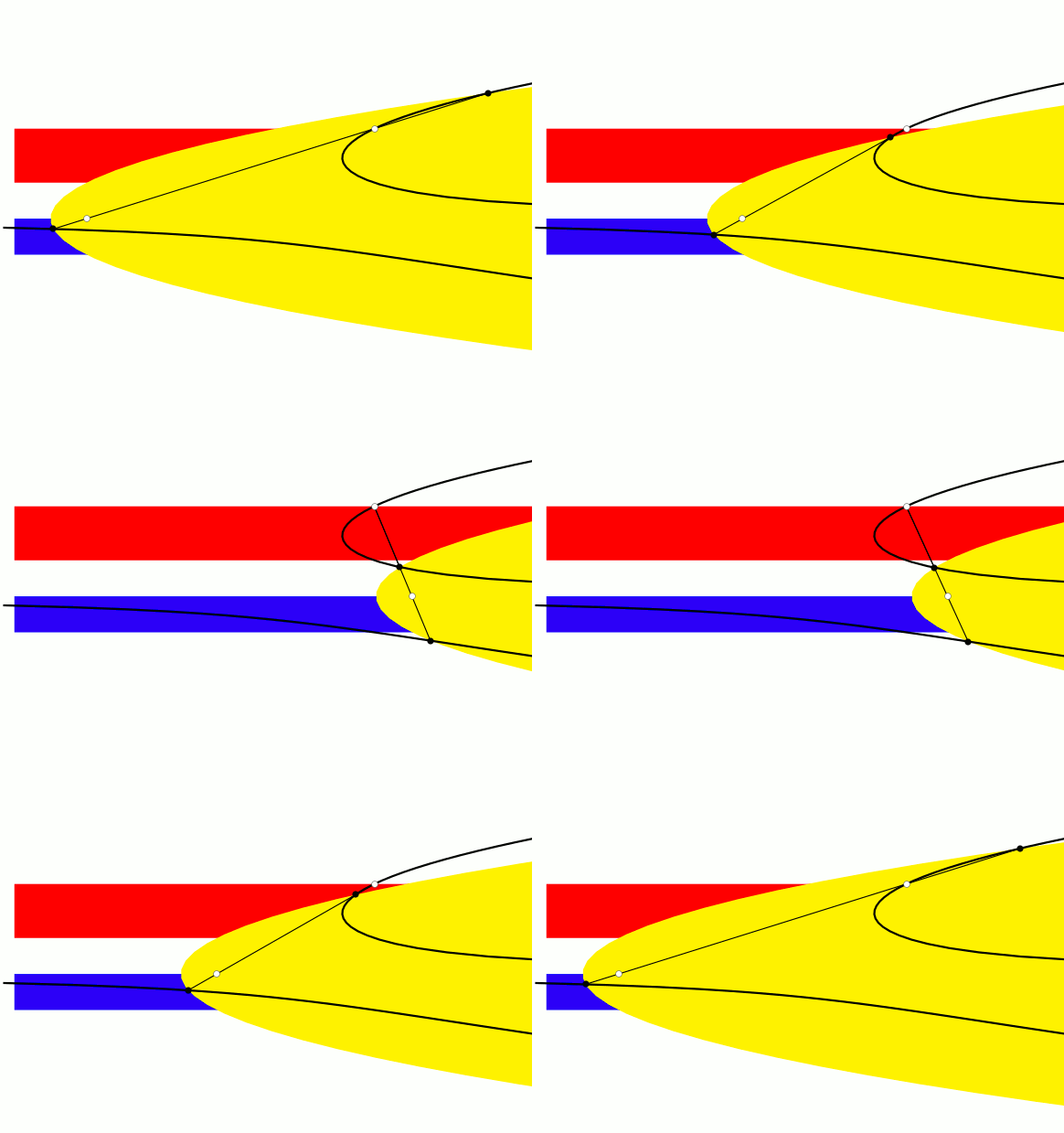
(𝑦² − 𝑎²)(𝑦 − 𝑏) = 𝑎𝑥𝑦.

Decartes showed that the curve in question could be generated as in the animation below, where a parabola slides along its axis, and a straight line has one point fixed and one point moving with the parabola, and the points of intersection of this straight line with the parabola give us the desired curve.

Animation described in text

Continue reading

The Miraculous

The miracles recounted in the Gospels are not violations of the laws of nature, because the Evangelists had no conception of those laws in the first place. So I argued in a post of June, 2022. Having encountered resistance to the argument, I return to it now.

Man wrapped in towel stands under bare trees near a ladder down to the sea; other people walk past in their winter coats
One person did swim in the Bosphorus
here at Kireçburnu on New Year’s Day, 2024

Continue reading

On Religion and Philosophy

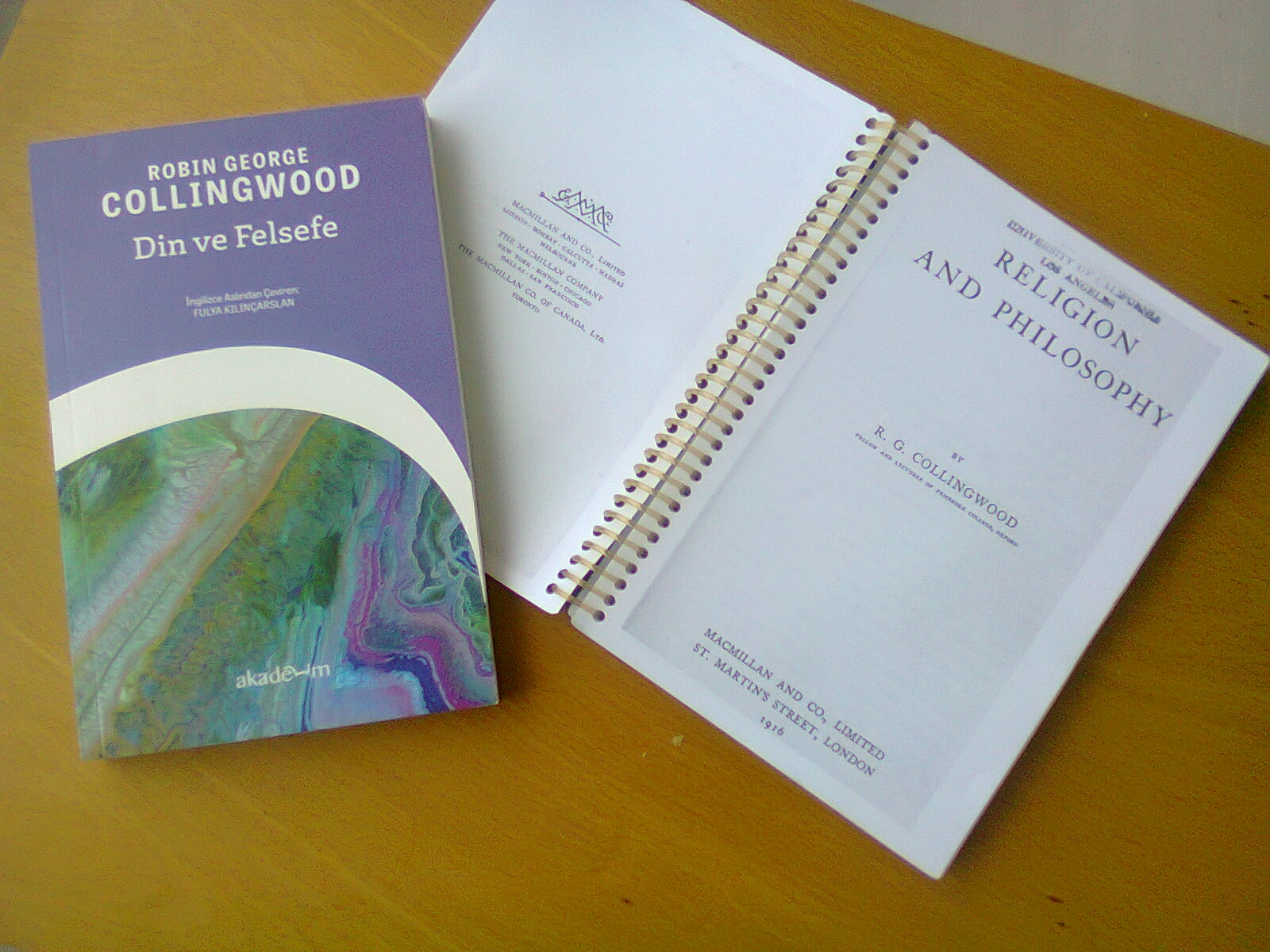
There is a lot about R. G. Collingwood on this blog. Apparently that is why I had the opportunity to write the text below. Something close to it was included in Turkish last year with the Turkish translation of R. G. Collingwood’s Religion and Philosophy.

A paperback copy (bound perfectly) of Din ve Felsefe sitting on a photocopy (bound spirally) of Religion and Philosoph open to the title page

Continue reading

“It Was Good”

In the first creation myth in the first book of the Hebrew Bible, God is always looking back at what he has been doing, to see whether it is any good. It always is, but he cannot have known in advance that it was going to be, and this is why he has to check his work.

So it seems to me. In any case, when we create things, part of the job is checking our work.

Book showing its front cover, reading “Robin George / Collingwood / Din ve Felsefe / İngilizce aslından çeviren: / Fulya Kılınçarslan / akademim,” resting against the spines of other books on a shelf
The new Turkish translation of Collingwood’s Religion and Philosophy
with introduction by yours truly

Continue reading

Sacrifice and Simulation

Executive summary. An experiment has been performed to detect whether we are living in a simulation. The experiment is to tell Abraham to sacrifice his son. Whatever he does, he breaks a law. Thus there is more to the world than can be understood by natural science.

Beach, sparkling sea, mountains, clouds, sky
Altınova, Ayvalık, Balıkesir, Türkiye
Looking towards Lesbos, Greece
September 20, 2022

Continue reading

On Plato’s Republic, 9

Index to this series

We reach now the Analogy of the Sun and the associated Divided Line.

Among pines, a palm tree with highest fronds lit by the setting sun
The highest fronds take the setting sun in Altınova
September 27, 2021

Continue reading

Words

This post is based on recent readings, often on or through Twitter, of the following writers.

  1. Lilith Saintcrow on “Domestic abusers, white supremacists, and religious bigots.”
  2. C. S. Lewis on gulling the educated, and objectivity as a dubious value.
  3. Marilynne Robinson on consensus as concealing the objectively true.
  4. Neil deGrasse Tyson on objectivity as a good value.
  5. Plato on seeming wise, without being so.
  6. Mark Vernon on imagination in William Blake.
  7. whoever wrote an “Open Letter Concerning Transphobia in Philosophy,” signed by many professional philosophers.
  8. Agnes Callard on how philosophers shouldn’t be signing petitions.
  9. Rebecca Reilly-Cooper, on the incoherence of the notion of gender identity.
  10. Christopher Bertram, a signer of the “Open Letter.”
  11. Nathan Oseroff-Spicer, who noticed who had not signed the letter.
  12. Aaden Friday, on what’s wrong with Reilly-Cooper and other such women.
  13. Brian Earp, on why declaring pronouns is not obviously a good thing.
  14. Liam Kofi Bright, another signer of the “Open Letter.”
  15. Masha Gessen, on wishing he could have transitioned as a teen.
  16. John Steinbeck, on being a man.
  17. Christa Peterson, on what gender identity might be.
  18. Holly Lawford-Smith, on third bathrooms and being banned from social media.
  19. Jason Stanley, who signed the “Open Letter,” but also calls for left unity.
  20. Isaac Asimov, on behaviorism.
  21. Dominic Berry, who will block anybody who follows the editor who published Reilly-Cooper’s essay.
  22. Kathleen Stock, the subject of the “Open Letter.”
  23. Caitlin Green, on what people such as Stock should do if they are going to change their research focus.

Having originally posted this essay on January 9, 2021, I edited and augmented it, on January 19 and December 19 of that year. I return to it now, on June 22, 2023, having posted “On Dialectic,” two days ago; this one is another post that quotes lots of people, and I want to check how it reads. It reads fine, to me, although I did have to correct occurrences of “behavior” spelled as “behavor.” Moreover, although I had forgotten what was here, I recognized it instantly as I read; another reader would not experience this recognition.

What stands out most to me now is Christa Peterson’s suggestion,

A representation of our own gender … could … be a means of picking out people as who we are co-gendered with …

As the essay already suggests, if you replaced “gender” with “race,” then the resulting speculation could get you called a racist, and that is supposed to be something bad. However, if we replace “gender” with “sex,” we obtain a proposition that is fundamental to contemporary biology, as I understand it, because evolution is

  • not only by natural selection, or “survival of the fittest” – selection by the rigors of the natural environment,
  • but also by sexual selection, or selection for mating by members of the opposite sex of one’s (sexually reproducing) species.

I think this is why Nina Paley can say, in a blog post called “Why I Don’t Use ‘Preferred Pronouns’,” which I referred to also in “Imagination,”

Like most mammals, I can’t help but identify someone’s sex with +99% accuracy. (… Women, I think, are better at identifying sex than men, either due to instinct or conditioning for survival …)

We know that there are two sexes, and we know who is of which sex, the way we know that some foods are good to eat. However, Peterson seems to think of this knowledge a bit differently:

Trans people’s dignity and legitimacy does not depend on the success of any one attempt to conceptualize their experience. But the most common way, in terms of “gender identity,” is perfectly functional. The commitments of the popular notion are minimal: people have an internal sense of their own gender that can come apart from their knowledge of their assigned sex, and is generally fixed, and certainly not revisable in the way ordinary beliefs are.

What is the word “assigned” doing here? Does whether you are trans depend on whether somebody made a mistake when checking one of the boxes marked “male” and “female” at your birth?

A lot of old PSA’s about drugs are on YouTube and the Web Archive, and sometimes they are linked to by articles that ridicule them. There is one that I have not been able to find, perhaps from around 1970, in which parents confront their teenager with the drug paraphernalia that they have found in his room. The boy storms out of the house, saying, “You don’t understand!”

There’s a lot that I don’t understand. I must not, since it seems childish, but is coming from adults. Some of these adults stormed the US Capitol the other day; others encourage them; still others are professors of philosophy.

Figure in book showing egg and sperm. The circular egg has a fiery corona, and little sperm with wavy flagella come at it from one side. There are also two sperm with parallel straight flagella whose length is the diameter of the egg
“Human egg and sperm cells.”
Asimov’s New Guide to Science (1984), page 600

Continue reading

Return to Narnia

1

My subject is the Chronicles of Narnia of C. S. Lewis (1898–1963). I consider this heptad of books (published 1950–6) as constituting (1) literature (2) for children (3) that I continue to enjoy in my sixth decade, having started in my first.

  1. By literature, I mean a work of art whose medium is prose. Prose may also be a work of craft, intended to fulfil some purpose. This purpose could be to serve a market for fantasy or children’s books. Art as such has no purpose that can be specified in advance.

  2. Writing for children may take certain liberties that annoy adults.

  3. As with any post in this blog, I write out of my own personal interest. As a child, I read other fantasies, such as those of Lloyd Alexander, John Christopher, Ursula LeGuin, and J.R.R. Tolkien. Only the works of C. S. Lewis have stayed with me. This essay may be considered as an exploration of why, or least an example of how.

The seven books of the Chronicles of Narnia, Collier edition

Continue reading

Doing and Suffering

To do injustice is worse than to suffer it. Socrates proves this to Polus and Callicles in the dialogue of Plato called the Gorgias.

I wish to review the proofs, because I think they are correct, and their result is worth knowing.

Loeb Plato III cover

Or is the result already clear to everybody?

Whom would you rather be: a Muslim in India, under attack by a Hindu mob, or a member of that mob?

You would rather not be involved; but if you had to choose, which option would be less bad: to be driven to an insane murderous fury, or to be the object of that fury?

Continue reading

Anthropology of Mathematics

This essay was long when originally published; now, on November 30, 2019, I have made it longer, in an attempt to clarify some points.

The essay begins with two brief quotations, from Collingwood and Pirsig respectively, about what it takes to know people.

  • The Pirsig quote is from Lila, which is somewhat interesting as a novel, but naive about metaphysics; it might have benefited from an understanding of Collingwood’s Essay on Metaphysics.

  • A recent article by Ray Monk in Prospect seems to justify my interest in Collingwood; eventually I have a look at the article.

Ideas that come up along the way include the following.

  1. For C. S. Lewis, the reality of moral truth shows there is something beyond the scope of natural science.

  2. I say the same for mathematical truth.

  3. Truths we learn as children are open to question. In their educational childhoods, mathematicians have often learned wrongly the techniques of induction and recursion.

  4. The philosophical thesis of physicalism is of doubtful value.

  5. Mathematicians and philosophers who ape them (as in a particular definition of physicalism) use “iff” needlessly.

  6. A pair of mathematicians who use “iff” needlessly seem also to misunderstand induction and recursion.

  7. Their work is nonetheless admirable, like the famous expression of universal equality by the slave-driving Thomas Jefferson.

  8. Mathematical truth is discovered and confirmed by thought.

  9. Truth is a product of every kind of science; it is not an object of natural science.

  10. The distinction between thinking and feeling is a theme of Collingwood.

  11. In particular, thought is self-critical: it judges whether itself is going well.

  12. Students of mathematics must learn their right to judge what is correct, along with their responsibility to reach agreement with others about what is correct. I say this.

  13. Students of English must learn not only to judge their own work, but even that they can judge it. Pirsig says this.

  14. For Monk, Collingwood’s demise has meant Ryle’s rise: unfortunately so since, for one thing, Ryle has no interest in the past.

  15. In a metaphor developed by Matthew Arnold, Collingwood and Pirsig are two of my touchstones.

  16. Thoreau is another. He affects indifference to the past, but his real views are more subtle.

  17. According to Monk, Collingwood could have been a professional violinist; Ryle had “no ear for tunes.”

  18. For Collingwood, Victoria’s memorial to Albert was hideous; for Pirsig, Victorian America was the same.

  19. Again according to Monk, some persons might mistake Collingwood for Wittgenstein.

  20. My method of gathering together ideas, as outlined above, resembles Pirsig’s method, described in Lila, of collecting ideas on index cards.

  21. Our problems are not vague, but precise.


When Donald Trump won the 2016 U.S. Presidential election, which opinion polls had said he would lose, I wrote a post here called “How To Learn about People.” I thought for example that just calling people up and asking whom they would vote for was not a great way to learn about them, even if all you wanted to know was whom they would vote for. Why should people tell you the truth?

Saturn eclipse mosaic from Cassini

Continue reading