Tag Archives: fascism

Fascism As Abetted by Realism

Fascism is class warfare waged on behalf of the capitalists. This should be realized by anybody who is attracted to accidental features of Fascism such as nationalism, racism, or militarism. The Fascists are not on your side, even if they share your nationality or “race” or fascination with weaponry and military discipline.

The illustrations are explained near the end of the text. This one, the cover of Cruisin’ 1964, shows a young bearded man, holding Report of the Warren Commission against a law dictionary, saying to another, “Luthor … how come you never make it to the free speech rallies anymore?” Luthor has a cigarette, closed eyes, and a guitar

Continue reading

NL XXIII: The Family As a Society

Index to this series

Executive summary (added September 11, 2018):

1.
The society at the nucleus of the family is temporary, ending with the death of one of the two members.
2.
The family has a life-cycle, with three phases: (1) before children; (2) after children, but before they have free will; (3) after the children have free will.
3.
The community consisting of husband and wife is now a society. It was not a society when a marriage was arranged by the groom or the groom’s father and the father of the bride. The non-social aspect of a marriage survives in the custom of formally “giving away” the bride.
4.
If today a bride and groom do not quite recognize themselves as forming a society, they may come to do so in time.
5.
Contraception helps clarify that a marriage is normally for the sake of having children.
6.
In order to grow up and leave the nursery, the child must be educated. The work of this is both the child’s and its teachers’. Parents must also allow the child to leave the nursery and join their society.
7.
There are three possible needs, and they are distinct: (1) to have a baby, (2) to have a child, (3) to have a grown-up child.
8.
Any of those three needs is fulfilled by an act of will; there is no parental “instinct”—not a scientific term anyway, though it is used popularly for an appetite or desire.
9.
Born without free will, we are not born in chains either, since this would mean suppression of a will that didn’t exist.

The last chapter was called “The Family As a Mixed Community,” because the family consists of both a society and a non-social part, called the nursery. Now we are looking at “The Family As a Society.” We are not in contradiction, but are in the flux that Heraclitus observed in all existence (24. 62). The inmates of the nursery normally grow and join the society of their parents: the family as a whole is a society in this sense.

Altınova bazaar, Wednesday, September 13, 2017

Continue reading

NL XXI: Society as Joint Will

Index to this series

Executive summary (added September 10, 2018):

1.
I cannot say “I will” without recognizing the possibility of joining with others to say “we will.”
2.
A social consciousness consists of (1) a precise idea of one’s place in a society and (2) a vague sense of the society as a whole. The latter sense may be incorrect, having been foolishly accepted on the word of an authority.
3.
Properly understood, ruling, of itself and perhaps of a non-social community, may be all that a society does. It is the responsibility of the members alone.
4.
To form a society means (1) to form social relations and (2) to do this for some purpose. To focus on (1) yields the idea of a universal society—which cannot actually exist, despite foolish hopes for the League of Nations.
5.
The universal society cannot exist, because we produce a society by transforming an earlier community, and some trace of this must remain.
6.
Members of a society are equal, (1) in having the freedom to join and (2) in just being members. A society may create an inequality, as by delegating authority. There may be natural inequalities, not produced by the society itself; society may compensate for them, turn them into assets, or even depend on them, as in the case of initiative.
7.
Rule by force (in a non-social community) may be by rewards and punishments, that is, objects of desire and fear. These may be promised or threatened fraudulently. One who grows too accustomed to exerting force may lose freedom of will.
8.
Societies institute criminal law to mitigate members’ losses of freedom of will.
9.
Societies can be temporary or permanent.

Continue reading

Attribution of Fascism

I began writing this article on Saturday, December 10, 2016; I finished the next morning, Istanbul time. I wrote the first three paragraphs last. The planned breakfast did take place, quite pleasantly. The death toll in the bombing rose to 39. No matter how much I read drafts of my articles, I usually want to make changes after they are published. I made one such change visible in the first paragraph. After a friend left some comments, I made some other small changes. Again these are visible. Last I heard, the policy on Diaspora* is that published posts cannot be edited at all, because there should never be any question about which version of a post any resulting comments refer to. WordPress is not so strict, and in future I may just remove all signs of editing. There may not be any point in doing this in an essay that does not say everything that seemed worth saying at the time of writing. Better perhaps to leave the signs of work in progress. In any case, I shall retain access to the older versions.

Everything changes so fast, at least when one has an internet connection and a Twitter feed. As I try to wrap up this essay, I learn of a bombing outside a football stadium not too far from us here in Istanbul. Deaths are said to be in the teens, mostly of police officers. Twenty-nine persons are said to have died, all but two being police officers. Turkey has been in a state of emergency since the summer. Rescue vehicles had trouble getting through the normal traffic. The nearest hospitals are not operational.

Meanwhile, Donald Trump and his would-be appointees are called treasonous; but it is mainly liberals and lefties who are saying this. Russia was the big enemy when it was Communist; now some Republicans do not seem too concerned with its hold over Trump, while Democrats are reinventing the Red Scare.

If I hadn’t hooked up the internet connection, I would just be looking forward to a breakfast with friends later this morning, over on the Asian side of the Bosphorus. I expect this event to happen as planned, despite the bombing.

Now I just want to think a little bit about what fascism means, historically. It does seem to me that if Donald Trump has any ideology at all, it is fascism. Fascism is the doctrine that will guide his Presidency, if he is allowed to assume it. What this means is the main subject of this essay.

Books seen from above on a table: A Collection of Essays by George Orwell, on top of The Rise and Fall of the Third Reich; next to these, The Bones: A Handy, Where-to-Find-It Pocket Reference Companion to Euclid’s Elements

Continue reading

Liberation

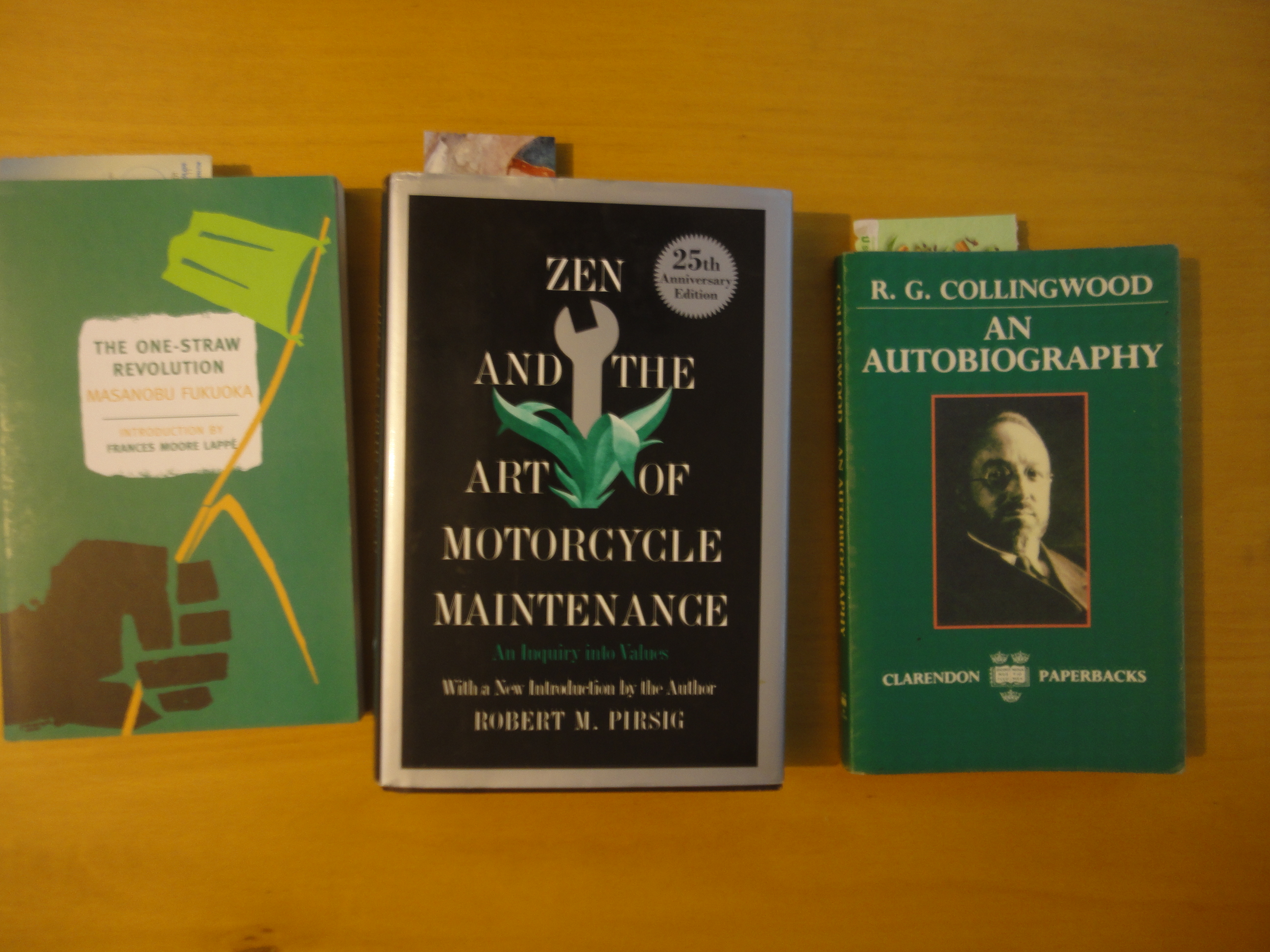
This article is based on quotations from three writers, of three different nationalities, who share a spirit with which I am in sympathy:

Fukuoka
“The ultimate goal of farming is not the growing of crops, but the cultivation and perfection of human beings.”
Pirsig
“The real cycle you’re working on is the cycle called ‘yourself.’ ”
Collingwood
“I thought that the democratic system was not only a form of government but a school of political experience coextensive with the nation.”

The books quoted here: The One-Straw Revolution, Zen and the Art of Motorcycle Maintenance, and An Autobiography. They all have on their covers a similar forest green, along with black

Continue reading