Tag Archives: Hannah Arendt

On The Human Condition of Hannah Arendt 2

Index to this series

CHAPTER II The Public and the Private Realm [1]

Contents

There are four more sections in the chapter, and these constitute the next reading: 7 the public realm: the common; 8 the private realm: property; 9 the social and the private; 10 the location of human activities.

Graffiti: “Now or never” and “Oku” (that is, “Read”) on a wall by a street with a parked car; skyscrapers in the distance

Beşiktaş, February 15, 2022
Oku = “Read” (second-person singular imperative)

History and law

A significant passage in this reading lies on page 42 (¶ 6.9):

… the significance of a historical period shows itself only in the few events that illuminate it. The application of the law of large num­bers and long periods to politics or history signifies nothing less than the wilful obliteration of their very subject matter.

My post “Law and History” took up something like this argument. Continue reading
On The Human Condition of Hannah Arendt 1

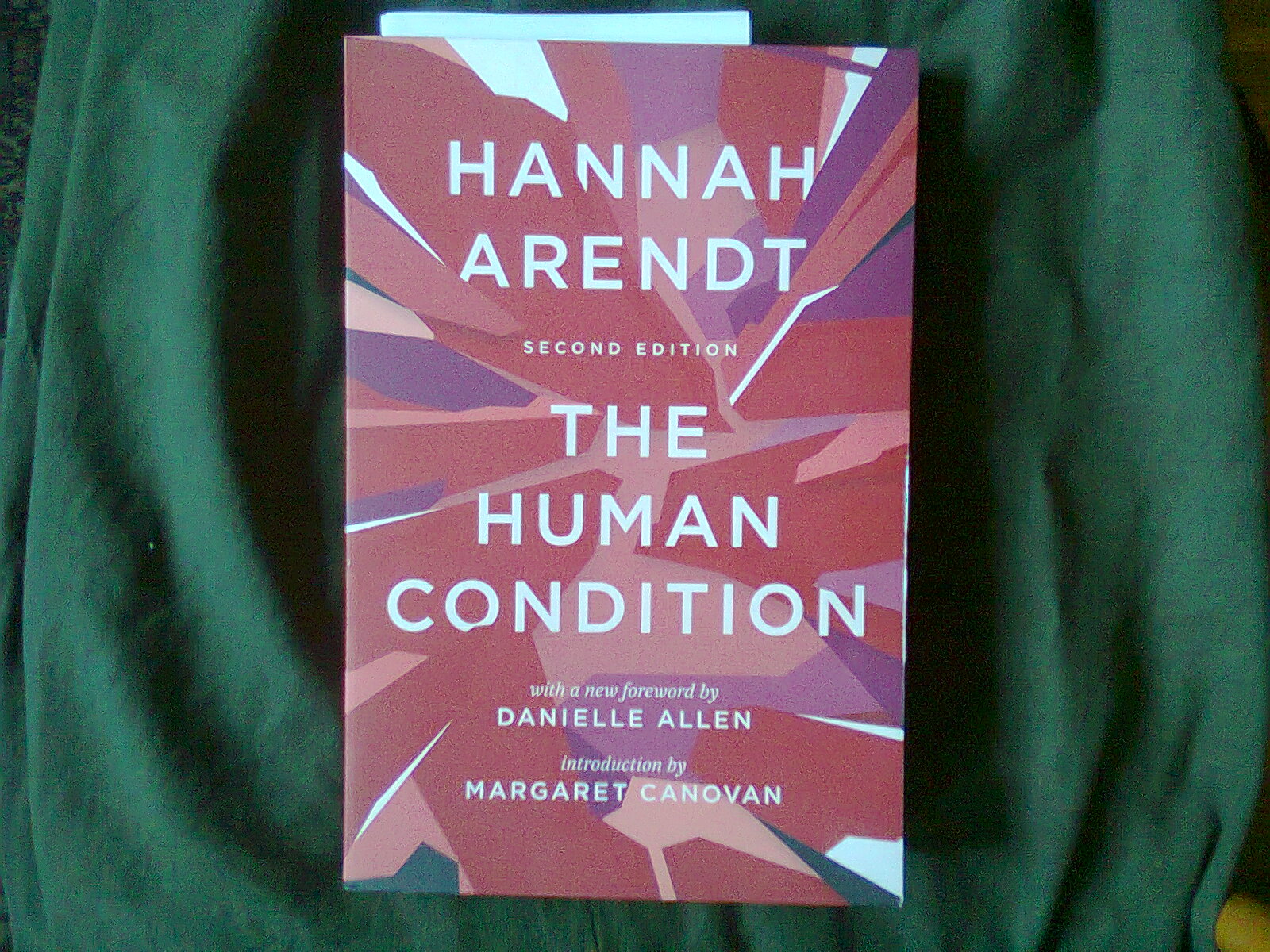
Here begins a series based on the 1958 book by Hannah Arendt (1906–75) called The Human Condition. The publisher classifies it as philosophy and political science. I sense a kind of similarity with a book that I have devoted many blog posts to: The New Leviathan (1942) of R. G. Collingwood (1889–1943).

Collingwood wrote about European civilization as a war threatened to end it. Arendt managed to escape that war, and she went on to write about civilization in her own way in The Human Condition. Today, February 24, 2022, a new war for territory in Europe begins.

Red-themed cover of The Human Condition against dull green cloth

Continue reading

Plato and Christianity

Index to this series

This post uses work of Hannah Arendt, Augustine, R. G. Collingwood, Tom Holland, Somerset Maugham, and Ved Mehta.

Elevated highway, way above city streets

Ortaköy, December 27, 2021

In the first post of this series, I gave some reasons to read the Republic, and one of them was the problem of how our political leaders were not always the best. Plato had not solved that problem, since we still had it; but that meant nobody else had solved it either. Plato had at least taught us that people with great worldly power could nonetheless be more miserable than their subjects. In the Republic, Plato has Socrates teach that lesson

  • to Thrasymachus, in the latter part of Book I;
  • to Glaucon, who concludes at the end of Book IV that if having an unhealthy body is bad, having a vicious soul is worse;
  • in Book IX, with the account of the tyrant;
  • with the Myth of Er in Book X.

Continue reading

On Plato’s Republic, 1

After the Pensées of Pascal and the Canterbury Tales of Chaucer, here begins another series on readings of a classic, now the Republic of Plato. The sections (after this one) of the present post are

Continue reading