Index to this series | Text of Chapman’s Homer’s Iliad
In Book X of the Iliad, Diomedes and Ulysses go to spy on the Trojan camp at night. When they return to the Greek camp (lines 482 & 3),
Then entred they the meere maine sea, to cleanse their honord sweate
From off their feet, their thighes and neckes: and when their vehement heate …
I can enter the same sea now. After more than ten months, I return to my reading of Homer, and Chapman’s Homer, as I have returned to the place where I was doing it last year, on the Aegean coast opposite Lesbos.
Note added August 30, 2024: We were, as we are now, in the vicinity of what was once Atarneus, which (I learn from Wikipedia) was
- given by Cyrus the Great to the Chians, after they surrendered to him Pactyes, the Lydian who rebelled after Cyrus left him in charge of Sardis;
- ruled later by Hermias the Tyrant, a friend of Aristotle;
- thought by Stephanus of Byzantium to be the Tarne mentioned near the beginning of Book V of the Iliad.
If you want to look it up in Herodotus, the story of Pactyes is a good one, particularly as it concerns the temple at Didyma. I enjoyed visiting that sanctuary when my wife and I and a few others spoke on Thales of Miletus in September, 2016, in the old Roman theater of his home town.
There was a hope that such an event might initiate some kind of “intellectual tourism.” In any case, in my own talk, I observed that Thales was credited with theorems about equality:
- A diameter divides a circle into two equal parts;
- the base angles of an isosceles triangle are equal.
I got some applause for mentioning the principle of equality before the law, enunciated
-
in the Funeral Oration of Pericles, as reported by Thucydides, and
-
today in the Universal Declaration of Human Rights:
Kanun önünde herkes eşittir ve farksız olarak kanunun eşit korumasından istifade hakkını haizdir.
All are equal before the law and are entitled without any discrimination to equal protection of the law.
Modern mathematics confuses equality with sameness, but they are different. I think the difference is a part of the Golden Rule, particularly as enunciated by the political campaign of Kamala Harris and Tim Walz. Your neighbor may not believe or do the same things that you do, but is still worthy of respect as an equal.
Chapman’s version of what Homer says about Tarne, which could be Atarneus, is in Book V, lines 48–52:
Idomeneus to the death did noble Phaestus wound,
The sonne of Meon-Borus that from cloddie Tarne came,
Who (taking chariot) tooke his wound and tumbl’d with the same
From his attempted seate. The lance through his right shoulder strooke
And horrid darknesse strooke through him. The spoile his souldiers tooke.
Thus one can
- take a chariot or a wound,
- be struck by a lance and by death.
Chapman enjoys using zeugma like this (there are more examples in Book V).
I am here in Atarneus after the sweat-soaked struggle of – teaching in the Nesin Mathematics Village, south of here, in the hills above Ephesus.
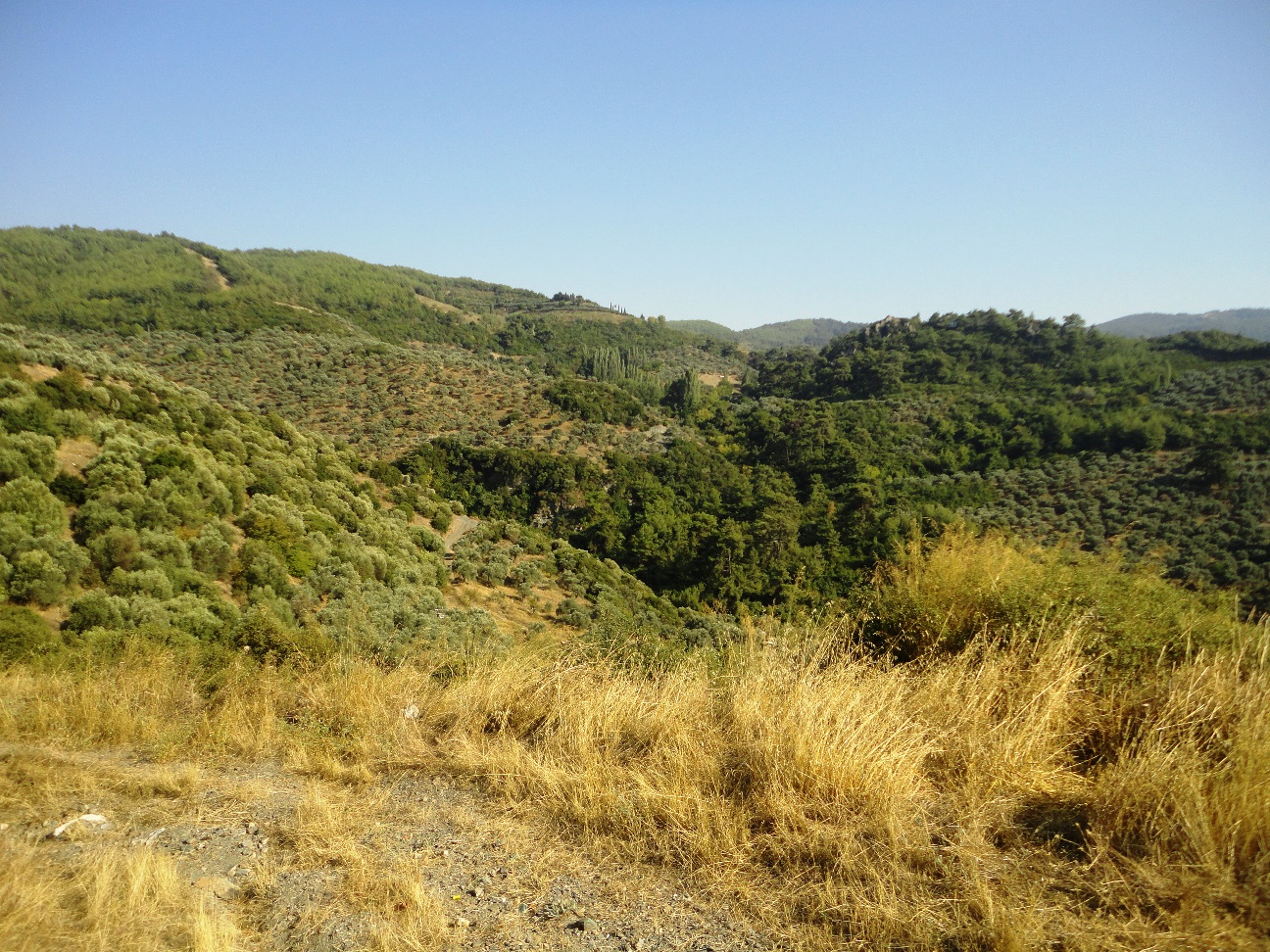
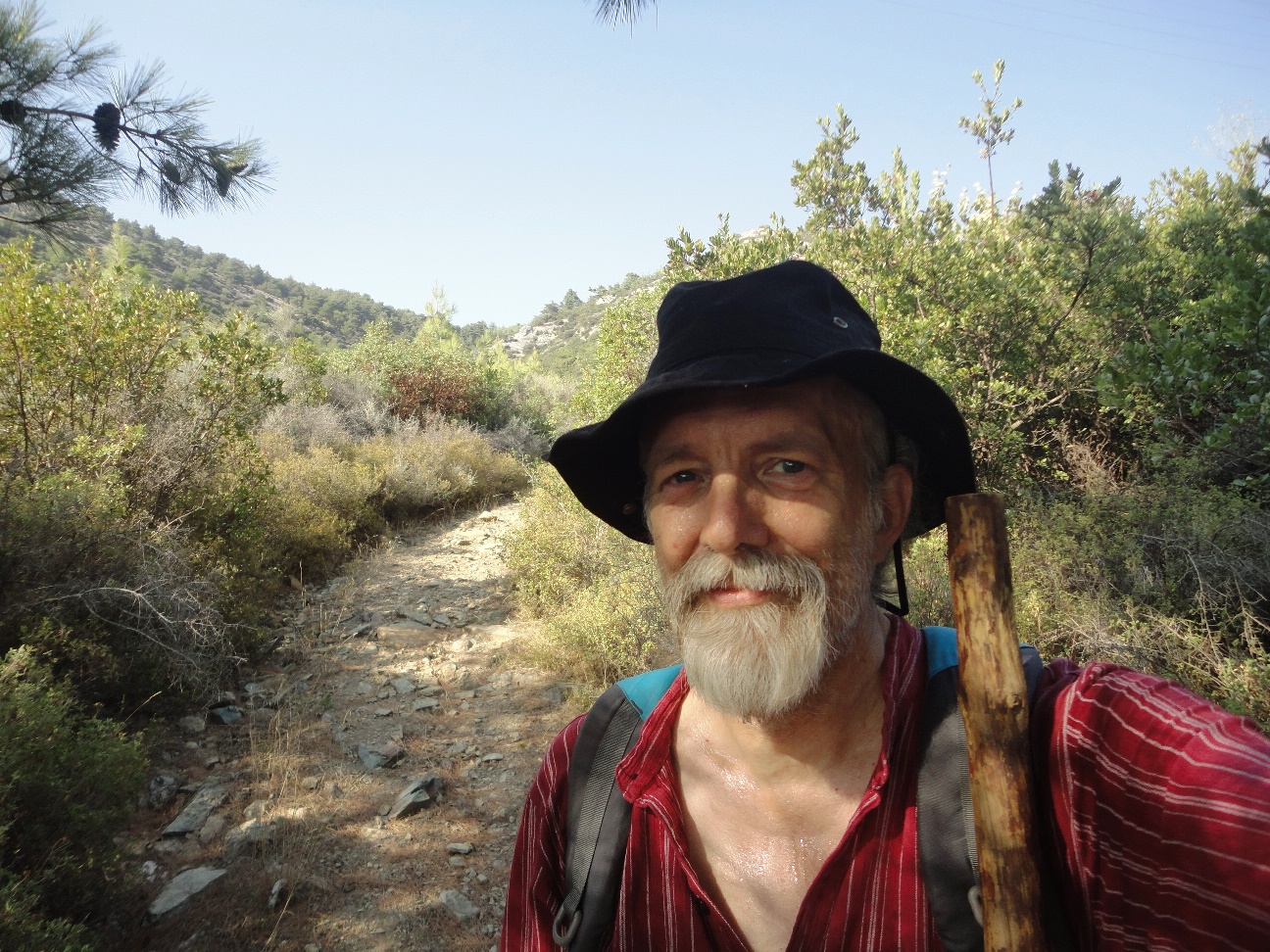
I spent a grueling two weeks outside the village of Şirince, lecturing twice as many hours a week as I do at home, in courses that I was creating as I went along, concerning some matters that I had never taught before. The photos here are from a three-hour solo hike in the first week. I repeated the hike in the second week with Ayşe and the eight students who opted to come; it was more fun, but took an hour longer.
A military man once chastened me for thinking anything in my peaceful life let me understand what had happened on the plain of Troy, as ignorant armies clashed by night. What I claim is not to understand what happened at Troy, but to enjoy reading about it, if only as a child may enjoy a violent fairy tale.

I can also use the retort found in an old Taoist book, which I am also reading on the beach:
Chuang Tzu and Hui Tzu were walking beside the weir on the River Hao, when Chuang Tzu said, ‘Do you see how the fish are coming to the surface and swimming around as they please? That’s what fish really enjoy.’
‘You’re not a fish,’ replied Hui Tzu, ‘so how can you say you know what fish enjoy?’
Chuang Tzu said: ‘You are not me, so how can you know I don’t know what fish enjoy?’
Hui Tzu said: ‘I am not you, so I definitely don’t know what it is that you know. However, you are most definitely not a fish and that proves you don’t know what fish really enjoy.’
Chuang Tzu said: ‘Ah, but let’s return to the original question you raised, if you don’t mind. You asked me how I could know what it is that fish really enjoy. Therefore, you already knew I knew it when you asked the question. And I know it by being here on the edge of the River Hao.’
This is from Chuang Tzu, The Tao of Nature (Penguin, 2010). He hints at an important epistemological point, that our original form of knowledge is knowledge of one another.
Note added August 26, 2024: The point is made by Lorraine Code, as I find out in “Feminist Epistomology,” January 29, 2021. Code makes use of the work of Collingwood.
If our original knowledge includes knowledge of deities, then the idea is suggested by Collingwood, even in his earliest published work, the 1916 essay called “The Devil”:
God, as present to the religious mind, is not a hypothesis at all; He is not a far-fetched explanation of phenomena. He is about our path and about our bed; we do not search the world for traces of His passing by, or render His existence more probable by scientific inductions.
The others whom we know may also be animals. In any case, our knowledge will be imperfect. If today we have evolved a concept of animal rights, does this reflect progress in moral knowledge, or only an attempt to return to the sensitivity that we once possessed, when we lived on more intimate terms with nature?
If I can return to my mission of talking about Book X of the Iliad, I shall talk about what Ulysses and Diomedes do after Agamemnon sends them out for reconnaissance.
Note added August 26, 2024: I talked about what happened before this in the book in “Verity (Iliad Book X),” February 2023. I brought in
- Julian Jaynes on consciousness in the Iliad,
- Jane Austen on tact and wilfulness in Emma and Mansfield Park: Achilles is reflected in – Fanny Price.
I would add that, at the beginning of Book X, when Agamemnon cannot sleep for worry, the same is true for Menelaus, who gets up and comes to his big brother automatically, as he comes to his brother’s meeting in Book II. Homer does not actually have Agamemnon use the word αὐτόματος in Book X, when to Nestor the general explains Menelaus’s already having come.
Before this, the old man tries to reassure Agamemnon (lines 89–94):
Graue Nestor answerd: Worthie king, let good hearts beare our ill:
Ioue is not bound to perfect all, this busie Hectors will;
But I am confidently giuen, his thoughts are much dismaid
With feare, lest our distresse incite, Achilles to our aide:
And therefore will not tempt his fate, nor ours with further pride.
But I will gladly follow thee, and stirre vp more beside.
Cyrus tells his uncle Cyaxares something similar in the Cyropaedia of Xenophon: that the Assyrians, who have supposedly planned an invasion of Media, are anxious about the counter-invasion of Medians (and Persians under Cyrus). This is in Book III, chapter iii, § 32 (in the translation of Henry Graham Dakyns at Project Gutenberg):
At present, they know that we are here, but they have not seen us, and you may be sure they do not despise us; they are asking what all this means, and they never cease discussing the problem; of that I am convinced. They ought not to see us until they sally out, and in that moment we ought to come to grips with them, thankful to have caught them as we have so long desired.

The Trojans have the upper hand. They are camping outside Troy, near the Greeks. Agamemnon cannot sleep for worry. He calls a council where Nestor presides, offering to whoever will go spy on the Trojans (lines 186–9),
In all this host shall honor him, with an enriching meed;
A blacke Ewe and her sucking Lambe, (rewards that now exceed
All other best possessions, in all mens choice requests)
And still be bidden by our kings, to kind and royall feasts.
Diomedes offers to go, and he takes along Ulysses, after Agamemnon warns him (lines 206–13),
Amongst all these, thus spake the king; Tydides, most belou’d▪
Chuse thy associate worthily; a man the most approu’d
For vse and strength in these extremes. Many thou seest stand forth:
But chuse not thou by height of place, but by regard of worth,
Lest with thy nice respect of right, to any mans degree,
Thou wrongst thy venture, chusing one, least fit to ioyne with thee,
Although perhaps a greater king: this spake he with suspect,
That Diomed (for honors sake) his brother would select.
I assume “his brother” is Agamemnon’s brother Menelaus. Ability before family. The invading Greek king differs from the man currently ruling this part of the world.

When he catches Thracian guards sleeping, Diomedes kills them. Ulysses tries to protect the horses of their ruler, by not letting the animals see the dead bodies (lines 414–21):
As when a hungrie Lion flies, with purpose to deuoure
On flocks vnkept, and on their liues, doth freely vse his power:
So Tydeus sonne assaild the foe; twelue soules before him flew;
Vlysses waited on his sword; and euer as he slew,
He drew them by their strengthlesse heeles, out of the horses sight;
That when he was to leade them forth, they should not with affright
Bogle, nor snore, in treading on, the bloudie carkases;
For being new come, they were vnusde, to such sterne sights as these.
Note added August 26, 2024: This passage corroborates the suggestion that our original knowledge includes knowledge of animals. Animals also know Ulysses; at least Argus does, in Book XVII of the Odyssey.
The Thracians and their horses have been betrayed by the man whom Diomedes and Ulysses met when setting forth. With a remarkable precision, or at least a precision to be understood by a peasant who works with animals, Homer describes how the Greeks let the Trojan agent come (lines 303–6),
Suspecting nothing; but once past, as farre as Mules outdraw
Oxen at plough; being both put on, neither admitted law,
To plow a deepe soild furrow forth; so farre was Dolon past;
Then they pursude, which he perceiu’d, and staid his speedlesse hast.
I actually do not understand what “law” is here, or whether some standard furrow length is intended, as I should think it ought to be, if the reference is to be of any use. Diomedes catches the man, Dolon,
Then laid he on his nimble knees; and they pursude like wind.
As when a brace of greyhounds are, laid in, with Hare or Hind.
Ulysses questions him, and Diomedes kills him, as vigilantes do a boy in John Sayles’s movie Matewan, after they catch him stealing coal for striking miners. However, Dolon has been compliant. He has offered truthful information about the Trojan camp. Of the foreign auxiliaries, he has said that the Thracians are camped furthest from the others, and their King Rhesus has excellent horses, “More white than snow.” The boy in Matewan seems compliant too; he gives the names of ten agitators. However, though he has lost sphincter control – his captors say he needs a diaper change – he does not lose his loyalty. The men whom he seems to betray are already in the graveyard, dead from a mining accident.

Dolon has agreed to spy for the Trojans, on condition he be awarded with the divine horses of Achilles. They are what Dolon first pursued when setting out on his mission.
Note added August 30, 2024: Hector has offered a prize to whoever would spy on the Greeks, to see whether they are planning on escaping. This is at a change of scene from the Greek camp, where Diomedes has prayed to Pallas for success (lines 261–70):
The Goddesse heard, and both the kings, their dreadlesse passage bore,
Through slaughter, slaughterd carkasses; armes; and discolord gore.
Nor Hector let his Princes sleepe, but all to counsell cald:
And askt, What one is here will vow, and keepe it vnappald,
To haue a gift fit for his deed; a chariot and two horse,
That passe for speed the rest of Greece? what one dares take take this course,
For his renowne (besides his gifts) to mixe amongst the foe,
And learne if still they hold their guards? or with this ouerthrow
Determine flight, as being too weake, to hold vs longer warre?
All silent stood, at last stood forth, one Dolon, that did dare …
Whether it is precisely the prize offered is not clear, but Dolon volunteers, provided the prize is Achilles’s horse and chariot; and Hector must swear to this. Dolon then lies to Ulysses when caught (lines 333–6):
He trembling answerd: Much reward, did Hectors oth propose,
And vrg’d me much against my will, t’indeuour to disclose,
If you determin’d still to stay, or bent your course for flight,
As all dismaid with your late foile, and wearied with the fight.
It amuses Ulysses to think that such a man could have dreamed of handling Achilles’s horses. Dolon is a real horse-fancier; he praises the horses of Rhesus as above, covetously.
He has also explained that only the Trojans are sleepless, since they have roofs, wives, and children to protect, unlike the foreign auxiliaries, who sleep soundly.
Xenophon has the Assyrian king remind his men that they are in the position of the Trojans (Cyropaedia III.iii.44):
Men of Assyria, to-day you must show your valour. To-day you fight for your lives and your land, the land where you were born and the homes where you were bred, and for your wives and your children, and all the blessings that are yours. If you win, you will possess them all in safety as before, but if you lose, you must surrender them into the hands of your enemies.
Xenophon also tells us that Asians put themselves in the position of the Trojans, even when out campaigning (IV.iii.2):
Indeed, to this day the tribes of Asia never go on a campaign without their most precious property: they say they can fight better in the presence of their beloved, feeling they must defend their treasures, heart and soul. It may be so, but it may also be that the desire for pleasure is the cause.
Perhaps the people described are engaging in “self-love” in the sense considered in “Benefaction (on Aristotle, Nicomachean Ethics IX.iv–vii).
Xenophon has already observed (IV.ii.2):
The Hyrcanians, as they were to be the hindmost, had put their waggons and families in the rear, for, like most of the tribes in Asia, they take their entire households with them on the march.
Diomedes and Ulysses actually return to camp with prize horses, of which Nestor says (lines 467 & 8),
Neuer the like to any sence, that euer I possest;
But some good God, no doubt, hath met, and your high valours blest.
The response is modest and pious, attributing all goods to the gods, or to other humans (lines 470–5):
Vlysses answerd, Honord Sire, the willing Gods can giue
Horse much more worth, then these men yeeld, since in more power they liue:
These horse are of the Thracian breed; their king Tydides slue,
And twelue of his most trusted guard: and of that meaner crew
A skowt for thirteenth man we kild, whom Hector sent to spie
The whole estate of our designes, if bent to fight or flie.
As we have seen, it was Diomedes, son of Tydeus, who killed Rhesus and the twelve guards; and as for the thirteenth man, the first man killed, Ulysses questioned him; but after hearing Dolon’s offer of ransom, and his pleas for mercy, it was Diomedes who said (lines 383–8),
About our ships; or do vs scathe, in plaine opposed armes;
But if I take thy life, no way, can we repent thy harmes.
With this, as Dolon reacht his hand, to vse a suppliants part,
And stroke the beard of Diomed; he strooke his necke athwart,
With his forc’t sword; and both the nerues, he did in sunder wound;
And suddenly his head, deceiu’d, fell speaking on the ground.
I hope never to see any head fall to the ground. Ulysses says to Nestor that “we killed” Dolon. Ulysses may be stealing not credit, but blame.

Edited August 26 and 30, 2024
 Polytropy
5 Trackbacks
[…] « On Chapman’s Homer’s Iliad, Book X […]
[…] all knowledge is acquired by this method. I refer now to the suggestion, in my discussion of Book X of the Iliad, that the original form of knowledge is interpersonal knowledge, and this is not […]
[…] One also needs imagination. Must it be based on battlefield experience, or on having any kind of ability that others take for granted? Perhaps not, by the account of Chuang Tzu; but I have already talked about that in my original post on the next book, Book X. […]
[…] watching, lest the Achaeans sail away in the night. Achilles is staying in his own camp. As we open Book X of the Iliad, Agamemnon cannot sleep. He worries, not just about the Trojans, but about whether his […]
[…] as we may between Zeus and Agamemnon, the former being sleepless now, the latter at the head of Book X. In writing about Book I in November, 2022, I noted how tears were shameful in Njal’s Saga. In […]