Author Archives: David Pierce

Mathematician & logician; amateur of philosophy; relation of journalists; alumnus of St John’s College (USA)

Ethics of Mathematics

The 12 blue edges of a cube and the 12 green edges of an octahedron respectively bisect one another at right angles

Zometool construction, Ankara, November 20, 2010

The main point of this post is to share a passage from an essay by the late William Thurston:

1 What is it that mathematicians accomplish?

… We are not trying to meet some abstract production quota of definitions, theorems and proofs. The measure of our success is whether what we do enables people to understand and think more clearly and effectively about mathematics.

Therefore, we need to ask ourselves:

2 How do people understand mathematics?

This is a very hard question. Understanding is an individual and internal matter that is hard to be fully aware of, hard to understand and often hard to communicate …

Continue reading

Courage

Below is my essay on courage, first drafted in April of last year (2024). A reason to think of it now is a recent pair of essays, coming from the United States:

The latter takes up all of the virtues that Socrates does.

Plato didn’t get everything right, but he remains one of the most widely studied philosophers in western history for a reason. In Book IV of The Republic, he discusses the four cardinal virtues. Hope didn’t make the list.

Here they are:

  • Wisdom (or prudence)
  • Self-control (or temperance)
  • Fairness (or justice)
  • Fortitude (or courage)

These four virtues feed a healthy society. We’re supposed to teach them to our young and practice them every day. Hope stems from an insufficient knowledge about the world, but fortitude grows out of wisdom.

We’re long on hope, but short on fortitude.

It would be good if we had more fortitude. As Wildfire writes more recently, in “Fighting Fascism at The End of The World: What nobody wants to say” (August 20, 2025),

It’s gotten popular to tell people to physically throw themselves in front of ICE agents to stop arrests. Allow me to pose a rude question: If someone won’t even wear a piece of cloth on their face for a few hours a day, are they going to get thrown in jail to protect someone they don’t even know?

For Aristotle at least, there is a distinction between the two qualities that could be meant by fortitude and courage respectively. The distinction is a theme of my own essay below.

Aristotle, Nichomachean Ethics, Crisp translation; behind it calm water, with wooded bluffs dotted with houses beyond

Aristotle, Nicomachean Ethics
Tuesday, July 11, 2023
I usually read Rackham’s translation in the Loeb edition
sometimes along the Bosphorus, as here

Continue reading

Just World

In “Biological History,” I talk about some stories by Somerset Maugham. The theme is a confusion between biological (or generally physical) facts and historical (or personal) facts.

I originally made the post on January 9, 2023. I have returned to it a few times since. I did this most recently when a friend told me of purchasing, in Toronto, Ontario, a two-volume edition of Maugham’s complete short stories. Probably this was the same edition that I had bought in Hamilton, Ontario, a quarter-century earlier.

Working again through “Biological History,” I wanted to spell out a remark about what is either the just-world hypothesis or the just-world fallacy. I am going to do that here, using verses of Parmenides of Elea. Parmenides will lead me in turn to Dr Seuss and the fallacy of artificial intelligence.

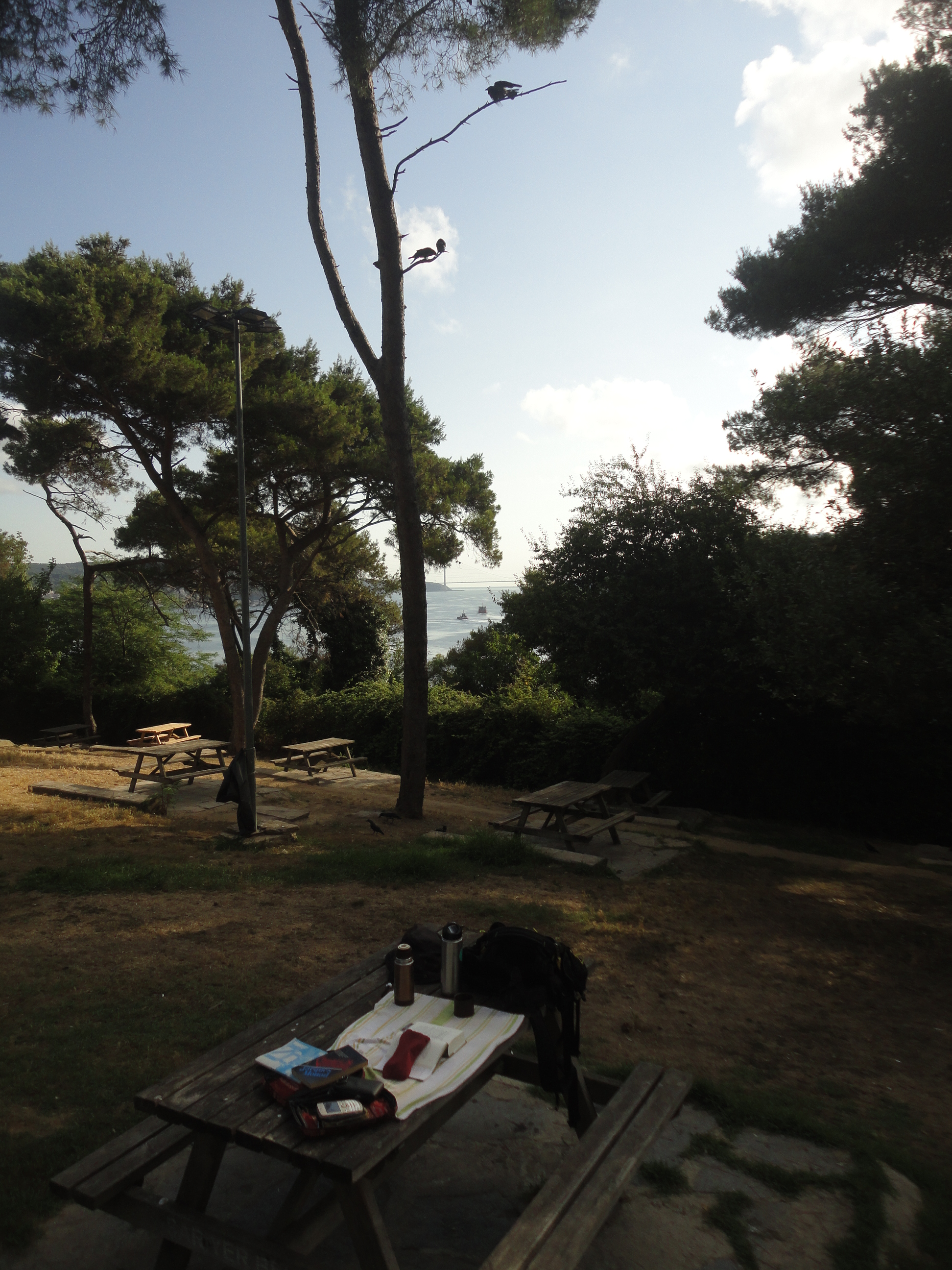
Book and paraphernalia on a picnic table below a pine tree with crows on the bare lower branches

Where I read Parmenides
Erguvantepe, Sarıyer, Istanbul
July 19, 2025

Continue reading

Bohemianism

Summary. Here in Istanbul, the Turkish word kalender appears in the names of both a mosque and an officers’ club: Kalenderhane Camii and Kalender Orduevi. The mosque was earlier a house (hane) for dervishes, apparently of the Kalenderiye order; before that, a church. The officers’ club includes Kalender Kasrı, formerly a summer palace for members of the House of Osman, near where we live on the European side of the Bosphorus, halfway to the Black Sea from Seraglio Point. The palace was erected in its current form during the reign of Abdülaziz, who received there a French prince and was the first sultan to visit western Europe diplomatically. The first Ottoman palace at the site was constructed during the reign of Ahmed I (for whom also the Blue Mosque was built) by an officer called Kalender Çavuş. The location is also called Kalender, and presumably there is a connection, one way or other. Constantine Cavafy described a cafe there in “A Night Out in Kalinderi.” In Roman times, by the account of Dionysius of Byzantium, the adjacent bay was Pitheci Portus, or the Harbor of Pithex. Dionysius reported the story that Pithex had been a Barbarian king who helped a warrior cross over to Asia on his way to the Trojan War. This warrior was the ambidextrous Asteropaeus, who wielded a spear in either hand, but was nonetheless speared by Achilles. However, πίθηξ and πίθηκος can mean ape or monkey (as in Pithecanthropus, “Ape Man,” once the name of the supposed genus of the “missing link,” Java Man). Apparently the name of the bay in question has been interpreted that way.

People can walk around Istanbul without a clue as to what they are passing by. I was like that when walking past the Kalender Kasrı. As for the kalender himself, since he is a dervish, even one devoted to a particularly unconventional life, he may also be any person so devoted: a bohemian.


This blog has been around so long, I can hardly remember writing some of the posts. I look back at them sometimes, to see whether they still make sense, or whether I have been repeating myself. If I make changes to a post, I leave a note at the bottom.

I believe Thoreau kept his journal that way – albeit with a pencil, even one manufactured by the family firm. He wrote,

Contemplation of the unfinished picture may suggest its harmonious completion … Thoughts accidentally thrown together become a frame in which more may be developed and exhibited. Perhaps this is the main value of a habit of writing …

John R. Stilgoe quotes that, in his Preface for the abridgement by Damion Searls of Thoreau’s Journal: 1837–1861. I wrote about the book in “Thoreau by the Aegean,” August, 2015.

Longer than this blog has existed, I have lived in Istanbul. My wife and I came here from Ankara in August, 2011. We lived in the borough of Şişli until October, 2022. Then we moved to Sarıyer. Thus we came in sight of the third bridge over the Bosphorus Strait, where it meets the Black Sea.
On Kant’s Groundwork

Below are some notes (by me) on Immanuel Kant’s 1785 treatise, Grundlegung zur Metaphysik der Sitten. This is the work that introduces the categorical imperative. My notes are in sections corresponding to Kant’s, but with my own titles (after the preface):

  1. That there appears to be a moral law.
  2. What the moral law must be.
  3. Whether there can be a moral law.

The English title of the treatise is Groundwork for the Metaphysics of Morals. Apparently the first word can also be Grounding or Foundation or even Fundamental Principles, and the ensuing preposition can be of. Also, in imitation of the German, Metaphysics can be made singular in form.


Book, bottle, &c. on picnic table; through the trees beyond, water with a passage to open sea

One place I have been reading Kant is Çamlık Parkı, Erguvantepe, Kireçburnu, Sarıyer, İstanbul, here on Wednesday, July 2, 2025. Çamlık = pine grove; erguvan = Judas tree: tepe = peak; kireç burnu = lime point (source for the construction of Rumeli Hisarı, a fortress used in the Ottoman siege of Constantinople, which led to the conquest of the city in 1453); sarı yer = yellow place, perhaps so named for the soil in some part of today’s borough.

The view is of the Bosphorus as it opens to the Black Sea. Jason would have passed through the opening with the Argonauts, and Xenophon with the Ten Thousand. Now the third Bosphorus Bridge crosses it


Continue reading

Astronomy Anomaly

Aristotle was the subject of the last three posts on this blog:

Perception Deception
The Philosopher asserts in De Anima that the eyes cannot be in error about color; Josef Albers contradicts this.
Imitation Limitation
In the Poetics, Aristotle seems to use mimêsis as a differentia of poiêsis among the technai. Arts not poetry are nonetheless imitative, but perhaps artists are to be distinguished for imitating themselves.
Purity Obscurity
Does catharsis clean the emotions, or wash them away?

Two more posts might have taken up the latter half of the Poetics, but they never materialized.

I turn now to the work held under the arm of Aristotle’s teacher, at the center of Raphael’s School of Athens.


Small book atop a pile of rubble on a beach, sea beyond

Altınova, Balıkesir, Monday, June 16, 2025

Continue reading

Purity Obscurity

The covers of the books named just below, showing a stern bearded face (Aristotle), a wrench like a flower on a stem among leaves (Pirsig), a dirt road lined with brick buildings (Eliot)
Books taken up in this post:

Aristotle’s Poetics,
George Eliot’s Middlemarch,
Robert Pirsig’s Zen and the Art of Motorcycle Maintenance

Continue reading

Imitation Limitation

I alluded to this post in my last one, “Perception Deception.” There I questioned the gnomic assertion of its title.

The questioning then consisted of little more than quoting De Anima, where Aristotle points out that a sense cannot be deceived by its proper object. In particular, sight detects color infallibly.


Can of Coca-Cola held in a hand
I do not recall the source of this particular image, which I saved on March 29, 2024. The concept, at least, is apparently due to Akiyoshi Kitaoka.


If you see red in the image above, you are not mistaken, even if none of the pixels is of a kind called red.

Continue reading

Perception Deception


John Donne, Holy Sonnet XIX
(on the last line, “make” should be “ſhake”)

This post involves:

  • “the” philosopher –
    • Aristotle;
  • two mathematicians –
    • Euclid,
    • David Hilbert;
  • three persons associated with Black Mountain College –
    • Josef Albers,
    • Dorothea Rockburne,
    • Max Dehn;
  • one person (in addition to myself and Dehn) associated with St John’s College –
    • David Bolotin.

Continue reading

Visibility

I was nine when I first read the following, and I read it many times after that:

Book opened to the quoted text. In the drawing on the left page, workers are fitting glass between tall mullions. On the right, an octagonal maze in the floor

While the windows were being installed, plasterers covered the underside of the vault and painted red lines on it to give the impression that all the stones of the web were exactly the same size. They were eager for the web to appear perfect even if no one could see the lines from the ground.

Continue reading