Category Archives: Art

Homicide

I understand homicide to be the killing of a human being, be it in murder, warfare, punishment, accident, euthanasia, or suicide.


Sculpture of seated female nude, from the front, head turned left, arms draped over raised left knee, right leg crossing underneath

Sculpture by Iraida Barry (born 1899, Sevastopol; died 1981, Istanbul) at the Istanbul Museum of Painting and Sculpture, connected with Mimar Sinan Fine Arts University (where I have been working); visited December 2, 2025


Continue reading

Reading and Talking

Reading a book as if it had “no introduction, no notes, no aids or guides, no nothing but the naked text” (as William Deresiewicz puts it): such a reading seemed to need a defense. Here is my elaborate one, which seemed in the end to fall into nine sections as summarized below.

Let me note first that searching on “ahistorical reading” led me to a textbook chapter called “What Is Ahistorical Reading?” (in Intro to Poetry, by Alan Lindsay and Candace Bergstrom). The chapter seems to say well what every high-school graduate ought to know, though unfortunately they may not in fact. If you don’t want to slog through what I wrote, read that.

1. Some Novels and Novelists.
These may be read in school or for pleasure – mine, or that of writer and blogger Hai Di Nguyen. There can be epics such as War and Peace, Moby-Dick, and Zen and the Art of Motorcycle Maintenance. George Steiner finds the last two comparable. There can be an unreliable narrator.
2. Reading Comprehension.
This may be challenged by some poetry, such as Wordsworth’s, and annotations may not help.
3. Reading Without Preconceptions.
St John’s College accustomed me to this.
4. Reading Groups.
There are many that (thanks to the Catherine Project) I have been able to join and enjoy, all pursued in the St-John’s way as I understand it.
5. Story.
Mythos or logos. We inevitably tell it in our own words (unless perhaps somebody else has fed us the words).
6. Giving What Is Wanted.
“Ask me no questions, and I’ll tell you no fibs.” (To Goldsmith’s comedy She Stoops to Conquer, the saying is traced by Grammarist, which however has “lies” for “fibs”; Wikipedia currently repeats this apparent misquotation, citing Grammarist.) People are trained now to give most of their attention to their mobiles; in school we may be trained to supply what teachers want to hear.
7. Historicism.
I continue not to understand the objection of Leo Strauss to the “historicism” of R. G. Collingwood, but I agree with such ahistorical reading as is practiced at St John’s and was defended in my day (as I recall) by Strauss’s student and my teacher, David Bolotin.
8. The Classics.
There is something to be said for being assigned to read what one might not otherwise. My example is John Donne.
9. Re-Enactment.
Collingwood came to understand history as the re-enactment of thought, but this can be misunderstood, either when reading a poet such as John Donne, or when thinking of a certain major general who happened to read poetry while getting ready for battle.

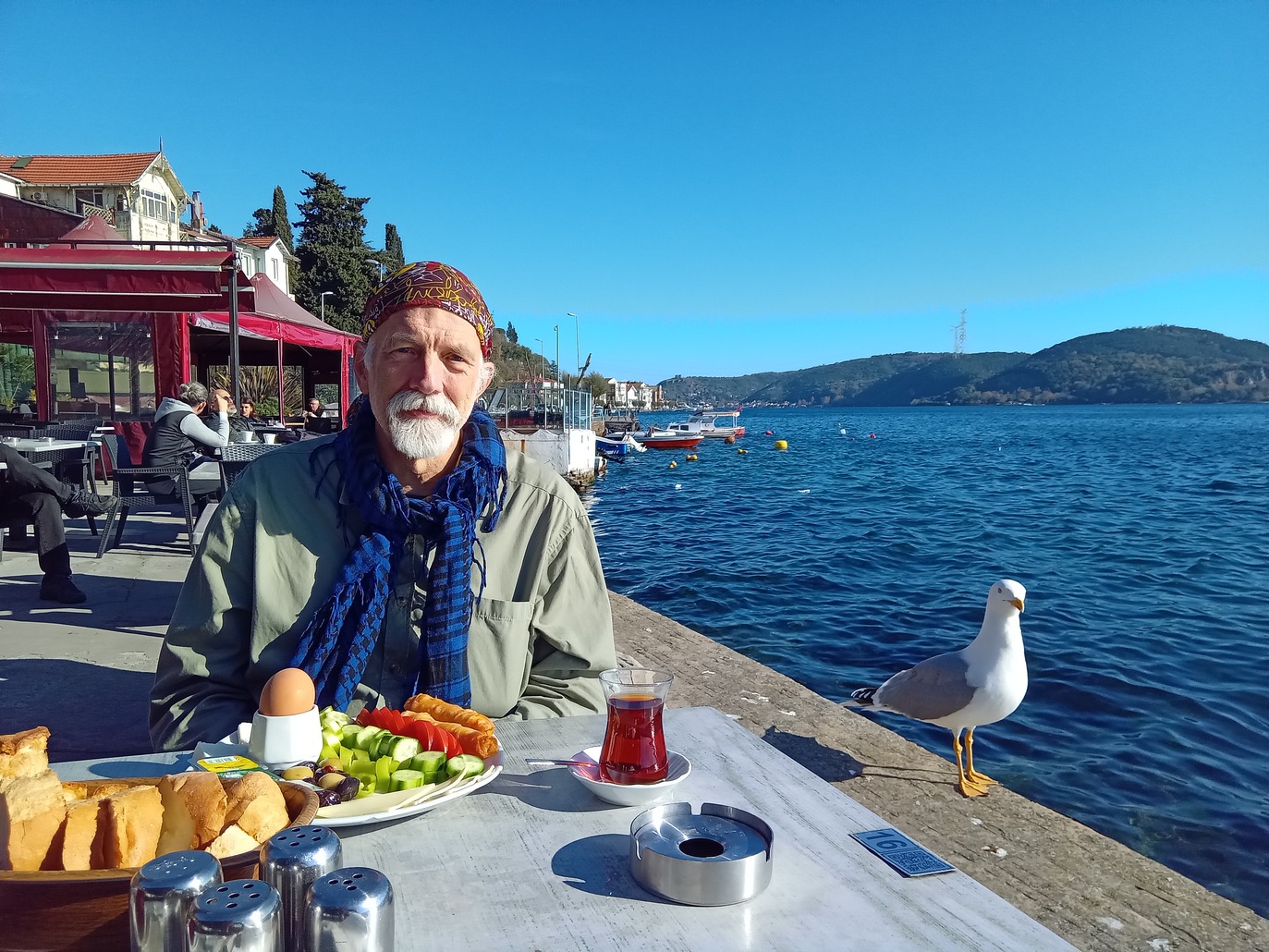
Seaside on a sunny day. Seagull, and human with tea and breakfast plate in front of him

Beyazpark Liseliler Kafe
Sarıyer, Istanbul
November 25, 2025

Continue reading

Motion and Rest

This is mostly about Goethe’s Faust, but it was not going to be. Faust says he never wants to sit still. It doesn’t seem like a great idea.

Parthenon

Athens, Monday, July 10, 2017

If, as Wikipedia now mentions, and John Warner discusses in the fittingly titled “That’s Not What Lolita Is About” (November 16, 2025) – if Elisa New recommended that Jeffrey Epstein read Lolita (which I have read) and My Antonia (which I haven’t), why not Faust?

Continue reading

Reading and Writing

Suppose you are reading a book of poetry; it could be the one published anonymously, in 1798, as Lyrical Ballads, With a Few Other Poems. You have somehow accepted that the book is worth reading. Do you care about any of the following?

  1. What is or is not on the title page.
  2. What is in the Advertisement that precedes the poems themselves.
  3. What order the poems were printed in.
  4. What meter or rhyme scheme they have.
  5. What was happening in the world in the year of publication.

You may care. You should not feel that you ought to care, if you are reading the poems in school.

That is the thesis of this post. I have learned that it may not be accepted.

I would seem to be defending the practice that I learned as an undergraduate at St John’s College. However, most of that defense will come in a later post. I drafted it earlier, but then it seemed as if there was a lot more to say, or acknowledge, or recognize. That more is here.


Three bananas, mostly black with some white foam, lie on paper bags on a counter among assorted jars

Would you accept a black banana? We learned this year (on Monday, September 22, 2025) that leaving bananas at home for a month need not be a disaster (except for not getting to eat the bananas)

Continue reading

Craft and Craftiness

Craft is what in Greek is τέχνη: skill. One can refer to technical skill, for emphasis, or to allude to the Greek word; however, perhaps there is no skill that is not technical, and nothing technical that is not related to a skill. In that case, “technical” is just an adjective form of “skill,” and the phrase “technical skill” is a kind of polyptoton. (See footnote 1.)

In the translation by David Grene of the Philoctetes of Sophocles, “craft” is used in the pejorative sense of craftiness. The Greek is δόλος, not τέχνη; however, the latter too can have the same pejorative sense.

Books referred to here: (1) Sophocles II; (2) Sophoclis Fabulae; (3) Sophocles’ Dramas; (4) Goethe’s Faust; (5) A Dictionary of Modern English Usage, second edition; (6) Modern English Usage. In each row of three, the first book is paperback; the second, hardback with jacket; the third, hardback without jacket, but tilted so the spine can be read

Continue reading

The System

After sitting behind his father on a motorcycle for a day, and riding through a thunderstorm, Chris Pirsig wants to tell and hear ghost stories. He asks whether his father believes in ghosts.

Clear blue sky above; below, a sand beach, with a strip of sea visible; on the left, a brick road parallel to the shore passes in the distance through trees

Altınova, September 10, 2025

Continue reading

Gödel and AI

To prove that no recursive theory of addition and multiplication of the counting numbers can be complete, Gödel relies on the distinction between the subjective and the objective. I suggested this in “Subjective and Objective,” while noting also that, for a computer, all is subjective.

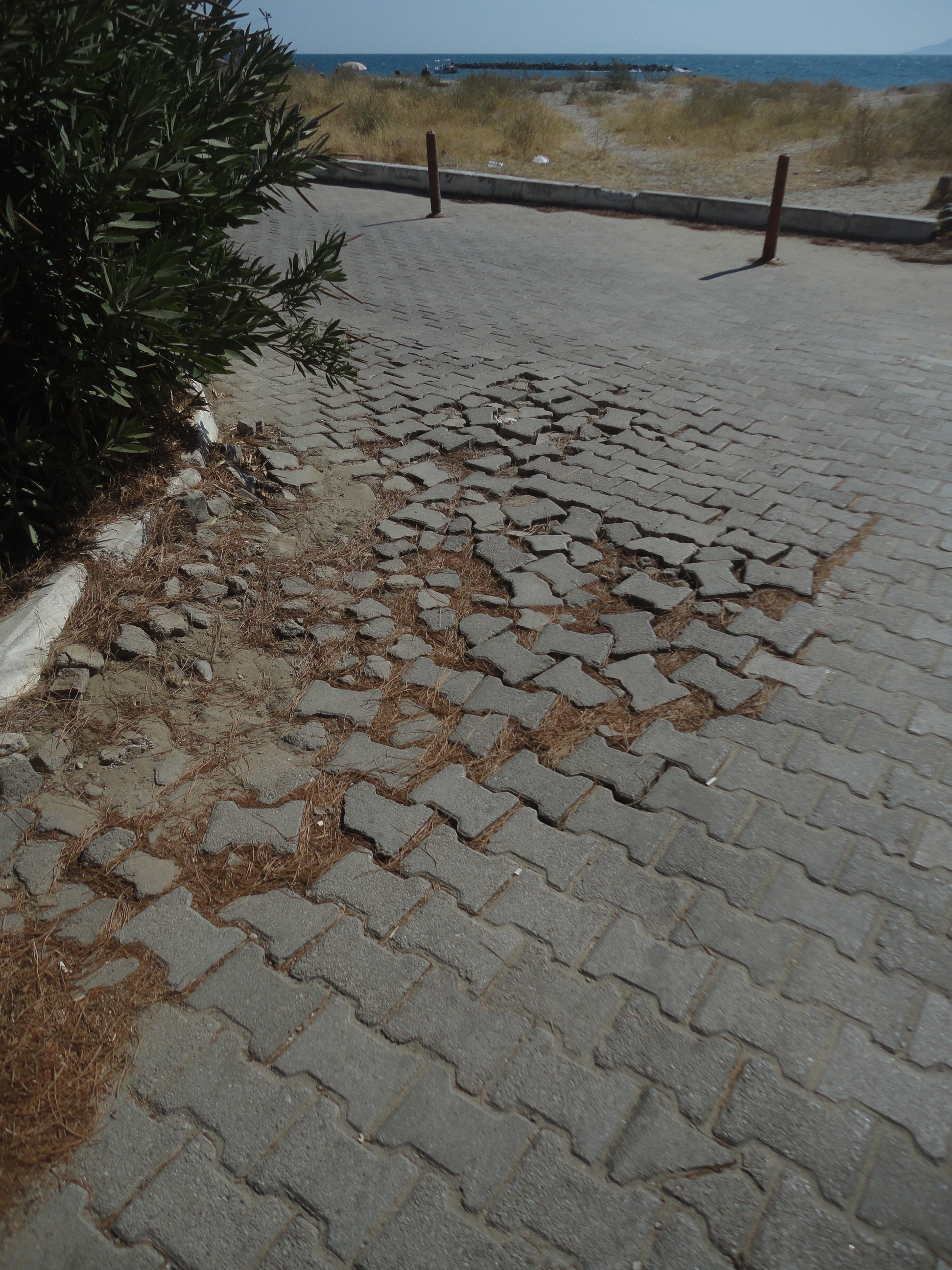
At the inner corner of a street, interlocking bricks break out of their pattern

Incomplete pavement
Altınova, Ayvalik, Balıkesir
September 9, 2025

Continue reading

Omniscience

I have been working on a post that could have been the result of the following prompt:

Write on Gödel’s Incompleteness Theorem and AI, using such thinkers as

  • Yuval Noah Harari (b. 1976),
  • William Deresiewicz (b. 1964),
  • Annie Dillard (b. 1945),
  • Roger Penrose (b. 1931),
  • Robert Pirsig (1928–2017),
  • George Orwell (1903–50),
  • E.B. White (1899–1985),
  • Michael Attaleiates (c. 1022–80), and
  • Plato (fl. 4th cent. b.c.e.).

Not until I had finished a first draft did I actually know that all of those people would feature. My real prompt had been more like,

In the style of David Pierce, write on Gödel’s Incompleteness Theorem and AI, as discussed by Roger Penrose in his “Précis of The Emperor’s New Mind.

So instructed, could an LLM have come up with the connections that I did? Well, sure. Anything that has happened, could have happened, even in some other way. The real question is whether I would want AI to write my next post.

The present post consists of things I wanted to say at the beginning of that other post, after I had a first draft.

          ⯅          

Note added September 27, 2025. The next post after this one was

  • Prairie Life,” comparing Robert Pirsig and Wendell Berry, because I was reading them both.

After that came the two posts that the draft mentioned above turned into:

After those came

  • The System,” on what was bothering Pirsig; this led me to the resurgence of fascism today.

I was trying to work all of this out in the place in the photo below.

          ⯆          

Two tall bushes, lit up by the sun, rise in front of a low wall, next to a pine trunk; crowns of pines behind

Laurels in the garden
Altınova, Ayvalik, Balıkesir
September 2, 2025

Continue reading

Courage

Below is my essay on courage, first drafted in April of last year (2024). A reason to think of it now is a recent pair of essays, coming from the United States:

The latter takes up all of the virtues that Socrates does.

Plato didn’t get everything right, but he remains one of the most widely studied philosophers in western history for a reason. In Book IV of The Republic, he discusses the four cardinal virtues. Hope didn’t make the list.

Here they are:

  • Wisdom (or prudence)
  • Self-control (or temperance)
  • Fairness (or justice)
  • Fortitude (or courage)

These four virtues feed a healthy society. We’re supposed to teach them to our young and practice them every day. Hope stems from an insufficient knowledge about the world, but fortitude grows out of wisdom.

We’re long on hope, but short on fortitude.

It would be good if we had more fortitude. As Wildfire writes more recently, in “Fighting Fascism at The End of The World: What nobody wants to say” (August 20, 2025),

It’s gotten popular to tell people to physically throw themselves in front of ICE agents to stop arrests. Allow me to pose a rude question: If someone won’t even wear a piece of cloth on their face for a few hours a day, are they going to get thrown in jail to protect someone they don’t even know?

For Aristotle at least, there is a distinction between the two qualities that could be meant by fortitude and courage respectively. The distinction is a theme of my own essay below.

Aristotle, Nichomachean Ethics, Crisp translation; behind it calm water, with wooded bluffs dotted with houses beyond

Aristotle, Nicomachean Ethics
Tuesday, July 11, 2023
I usually read Rackham’s translation in the Loeb edition
sometimes along the Bosphorus, as here

Continue reading

Just World

In “Biological History,” I talk about some stories by Somerset Maugham. The theme is a confusion between biological (or generally physical) facts and historical (or personal) facts.

I originally made the post on January 9, 2023. I have returned to it a few times since. I did this most recently when a friend told me of purchasing, in Toronto, Ontario, a two-volume edition of Maugham’s complete short stories. Probably this was the same edition that I had bought in Hamilton, Ontario, a quarter-century earlier.

Working again through “Biological History,” I wanted to spell out a remark about what is either the just-world hypothesis or the just-world fallacy. I am going to do that here, using verses of Parmenides of Elea. Parmenides will lead me in turn to Dr Seuss and the fallacy of artificial intelligence.

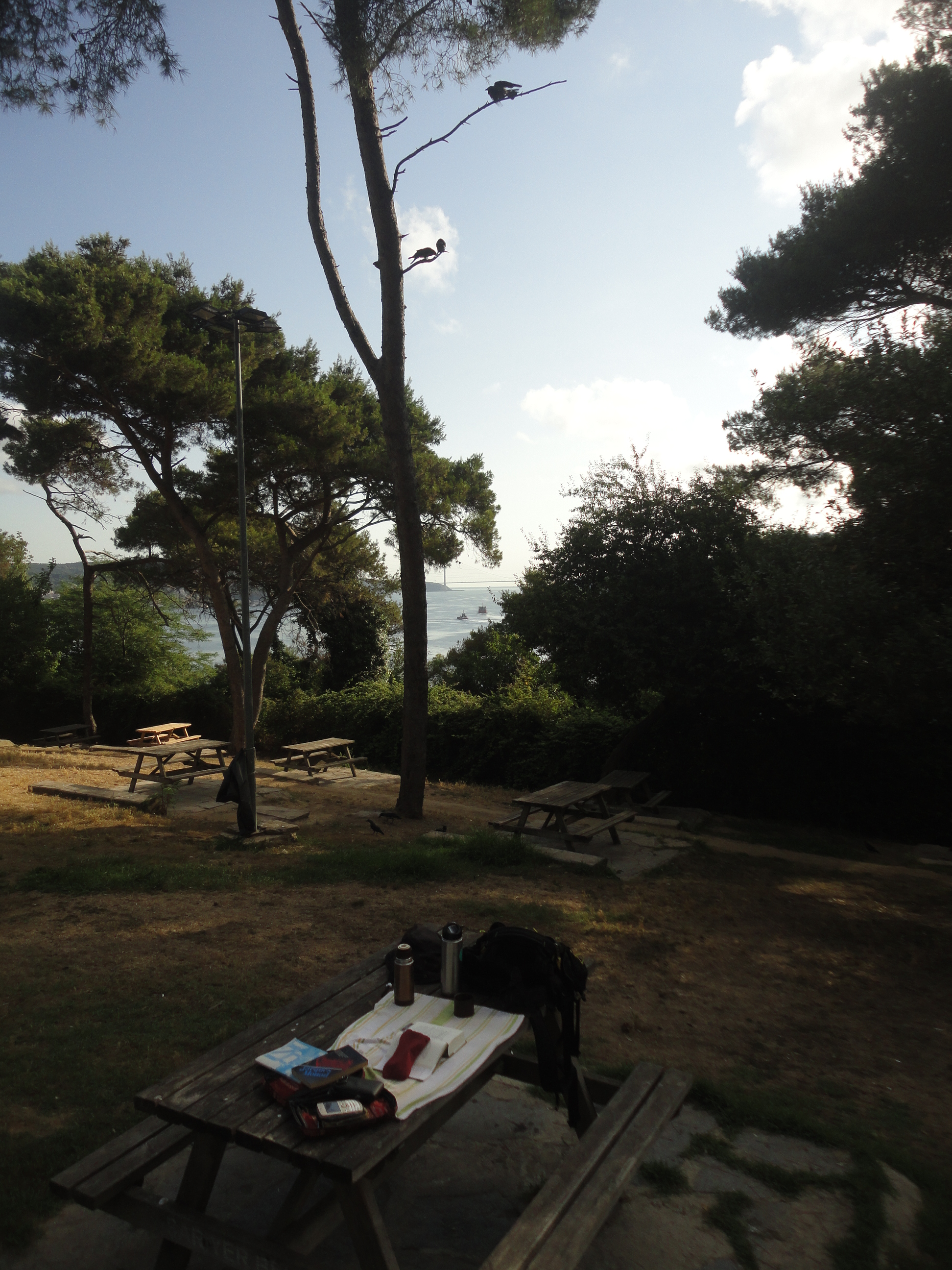
Book and paraphernalia on a picnic table below a pine tree with crows on the bare lower branches

Where I read Parmenides
Erguvantepe, Sarıyer, Istanbul
July 19, 2025

Continue reading