Category Archives: Art

Math, Maugham, and Man

Note added, August 28, 2023. The main purpose of this post of September 1, 2019, seems to have been to assemble some information about the etymologies of “man” and “woman,” because of ongoing controversy about what the words even mean today. I started to take up the controversy itself on December 30 of that year, in “Sex and Gender.” Meanwhile, this post suggests, or points out:

  • a generic “person” may still be male in people’s minds;
  • becoming a woman may be like becoming Jewish;
  • there are no gendered pronouns in Turkish;
  • the series freshman, sophomore, junior, senior is like pinkie, ring finger, middle finger;
  • Greek does not have such an interesting series for the fingers;
  • Greek mathematics includes Thales’s Theorem and Pappus’s Hexagon Theorem.

There does not seem to be any connection between the mathematics and the etymology here, except that I was studying both at the same time. I must have been reading The Razor’s Edge too, where Maugham

  • places himself in a tradition founded by Herodotus;
  • uses “he/him” for for somebody who can be a woman as well as a man.

More themes I took up:

  • what it means to be natural;
  • that I don’t consider myself ADHD;
  • the etymology of “squirrel”;
  • the Etymological Fallacy.

A dog lying in the shade of a beach umbrella looks at us; behind him are a woman and a man sitting facing away from us, towards the sea
Woman, man, and dog
Friday, August 18, 2023
Altınova, Balıkesir, Türkiye

Continue reading

On Being Given to Know

  1. What if we could upload books to our brains?
  2. What if a machine could tell us what was true?

We may speculate, and it is interesting that we do speculate, because I think the questions do not ultimately make sense – not the sense that seems to be intended anyway, whereby something can be got for nothing.

Trees, clearings, and houses in the foreground; mountains receding into the background; clouds above
View from Şavşat

Continue reading

On Causation

Causation seems commonly to be understood as a physical concept, like being a fossil. The paleontologist seeks the one right answer to the question of when a particular dinosaur bone became part of the fossil record; likewise readers of international news seem to think there is one right answer to the question of whether Donald Trump or Ali Khamenei caused the shooting down of Ukraine International Airlines Flight 752 on January 8, 2020.

There is not one right answer. If you are Trump, you caused 176 civilian deaths by attacking the Iranians and provoking their response. If you are Mitch McConnell, you caused the deaths by inhibiting the removal of Trump from office. If you are Khamenei, you did it by meeting Trump’s fire with fire.

Being a cause does not mean you deserve condemnation or praise: that is another matter.

Continue reading

We the Pears of the Wild Coyote Tree

This is a preliminary report on two recent films:

  • The Wild Pear Tree, by Nuri Bilge Ceylan;
  • We the Coyotes, by Marco La Via and Hanna Ladoul.

The report is preliminary, not because there is going to be another, but because I have seen each film only once, and I may see one of them again.

I remember that François Truffaut liked to see films at least twice. I believe I read this in The Washington Post, and I might have guessed it was in an appreciation published when Truffaut died; however, he died on October 21, 1984, during the first semester of my sophomore year at St John’s College in Santa Fe, and I would not have been reading the Post then.

While in college, I did enjoy seeing some films twice, or a second time; Truffaut’s own 400 Coups was an example, a French teacher having shown it to us in high school.

The two films that I am reviewing now concern young adults trying to find their own way in the world, in defiance of their elders. We all have to do this. In every generation, some will do it more defiantly than others. Heraclitus can be defiant, he of Ephesus and thus one of the Ionian philosophers, whose spirit I imagine to haunt the Nesin Mathematics Village. A further reason to bring up Heraclitus will be a theme that is explicit in Pear Tree, implicit (or metaphorical) in Coyotes: gold.

A book, whose cover shows a bonfire, sits on a rock dampened by waves of the sea, which laps on the sand beyond
A copy of The Logos of Heraclitus,
by Eva Brann,
on Marmara Island, July, 2012

Continue reading

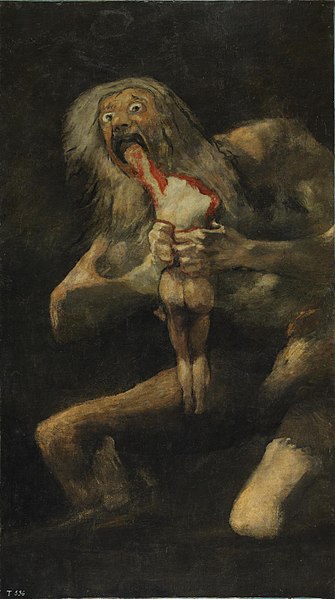
Piety

The post below is a way to record a passage in the Euthyphro where Socrates says something true and important about mathematics.

Crude depiction of bug-eyed figure grasping the torso of, and putting into his mouth the arm of, a smaller figure
Goya, [Cronus] Devouring His Son
(see below)

The passage is on a list of Platonic passages that I recently found, having written it in a notebook on May 23, 2018. The other passages are in the Republic; here they are, for the record, with some indication of why they are worth noting (translations are Shorey’s, originally from 1930 and 1935 in the old Loeb edition):

Continue reading

Logic of Elliptic Curves

In my 1997 doctoral dissertation, the main idea came as I was lying in bed one Sunday morning. Continue reading

On Gödel’s Incompleteness Theorem

This is an appreciation of Gödel’s Incompleteness Theorem of 1931. I am provoked by a depreciation of the theorem.

I shall review the mathematics of the theorem, first in outline, later in more detail. The mathematics is difficult. I have trouble reproducing it at will and even just confirming what I have already written about it below (for I am adding these words a year after the original publication of this essay).

The difficulty of Gödel’s mathematics is part of the point of this essay. A person who thinks Gödel’s Theorem is unsurprising is probably a person who does not understand it.

Next to a slice from a tree trunk, a worn copy of the book Frege and Gödel: Two Fundamental Texts in Mathematical Logic, edited by Jean van Heijenoort

Continue reading

NL XLII: The First Barbarism: The Saracens

Index to this series

Executive summary: The barbarians who overran the Western Roman Empire were not barbarists in Collingwood’s technical sense. However, “in the seventh century a movement inspired by hostility towards everything Roman … and everything Christian, flared up on the south-eastern frontier of the Roman world” (42. 22). This movement was therefore barbarist. Failing to conquer Europe, either from the east at Constantinople, or from the west at Tours, the movement settled down and ceased being barbarist—by the account in Chapter XLII, “The First Barbarism: The Saracens,” and later, in Collingwood’s New Leviathan. I check this account against more recent sources; it is barbarist to think that the “movement” in question, or indeed any movement, must always be barbarist; I look at the “civilization” of the British Empire as portrayed in a story of Maugham, and I compare a character of the story to Collingwood.


Collingwood’s historical account of barbarisms is a minefield, if one wishes not to sound like a barbarist oneself. The four examples will be

  1. the Saracens,
  2. the “Albigensian Heresy” (or the Bogomils),
  3. the Turks, and
  4. the Germans.

The very formula “the X”—definite article followed by national or quasi-national adjective—this has a barbaric use in branding a people with indelible features. A retort then is “not all X,” as in “not all men.” Collingwood issues such a proviso himself:

45. 68. Please observe, Reader, that I am not talking about all Germans. I do not say that all Germans are liars. I know of some who are not; those heroes, for example, who continue in spite of everything the Nazis can do to run their secret wireless station and keep on printing Das Wahre Deutschland.

Das wahre Deutschland, from a Swiss antiquarian bookshop, Antiquariat Peter Petrej

Continue reading

On Chapman’s Homer’s Iliad, Book XIV

Index to this series | Text of Chapman’s Homer’s Iliad

When Neptune was helping the Greeks stave off certain defeat, I tried to suggest that divine intervention in the course of events might be understood as human resolve to change that course. This was in Book XIII of the Iliad, where Neptune took the form of one of the Greeks – Calchas – in order to exhort the others. They would have listened to Calchas anyway; he was a prophet. Ajax Oileus said he could tell Calchas was “really” a god; we can read this to mean Calchas was inspiring. We can say this of somebody today, without meaning to suggest any supernatural influence.

Mostly a calm sea, with heads of two swimmers; behind, a strip of pink sky with setting sun

Continue reading

On Chapman’s Homer’s Iliad, Book XIII

Index to this series | Text of Chapman’s Homer’s Iliad

Usually when your defenses are breached, you are lost. Thus when the Ottoman Turks under Mehmet I found a way through the Theodosian Walls on Tuesday morning, May 29, 1453, the city of Constantinople was theirs.

Path to a gate in a crenellated stone wall; people gathered around the plaque next to the gate
The gate where the invasion of Constantinople is supposed to have been made

Continue reading