Category Archives: Art

NL XXVIII: The Forms of Political Action

Index to this series

Executive summary (added September 12, 2018), To condemn political discussion is to wish for tyranny: this continues a thought from the previous chapter. The ruling class need not share their deliberations with the ruled class, but it is better if they do. As our understanding of the reason for an action evolves—at first the action is merely useful, but later it conforms to a rule—, so ruling, originally by decree, has evolved to include legislation. However, to be enforced, law does not require a formal structure; international law is an example. The best reason for an action is duty. Though the German Treitschke says our highest duty is to the state, he gives the state no duty, and so his politics are entirely utilitarian.


In Plato’s Republic, Socrates seeks understanding of the just human being through examination of the just state. In Collingwood’s New Leviathan, the order is reversed. What we first considered in somebody, we now look at in the “body politic.”
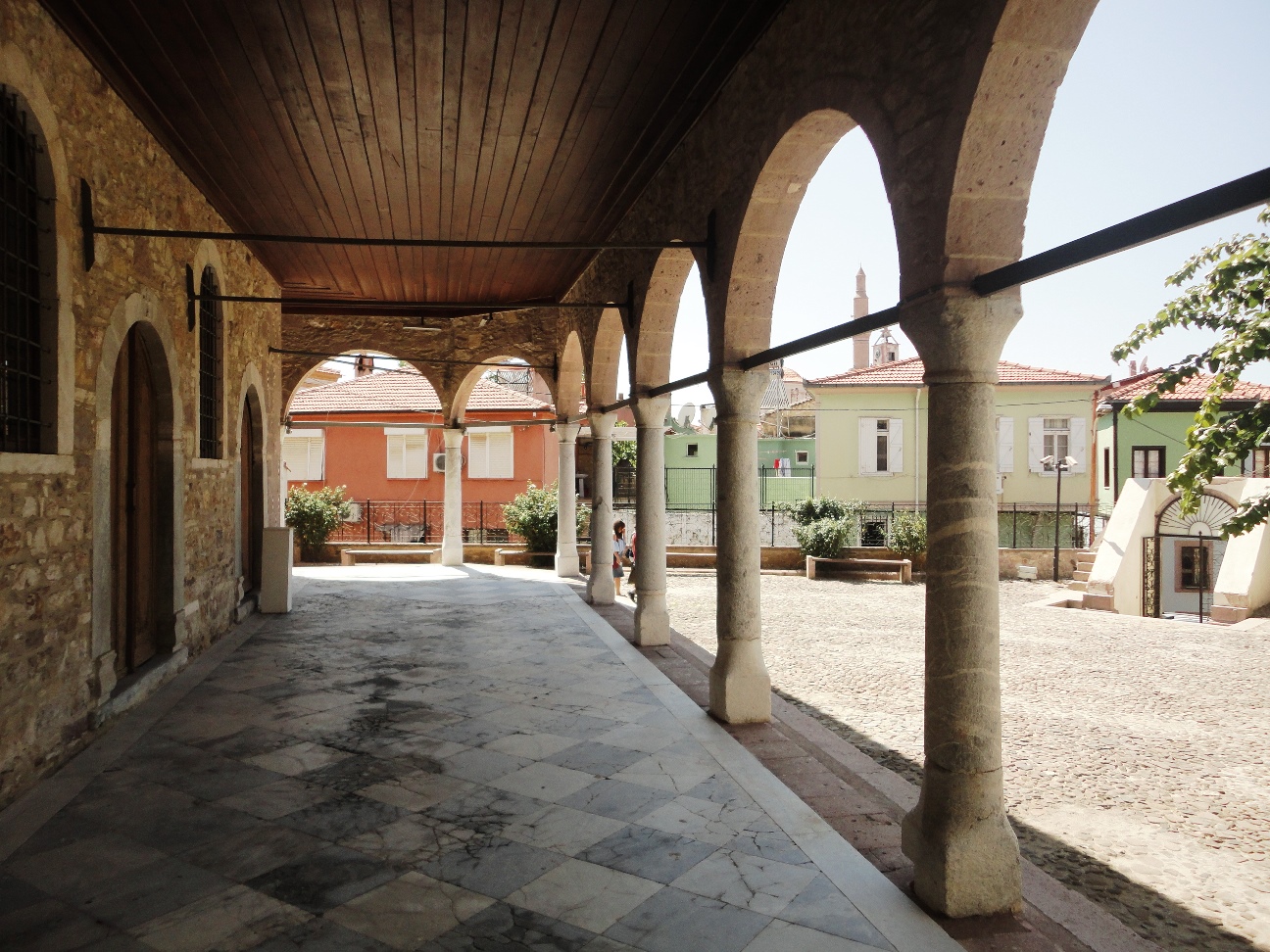
Narthex of the former Taksiyarhis Church (now museum), Ayvalık, Balıkesir, Turkey, August 30, 2018

Continue reading

On Chapman’s Homer’s Iliad, Book XII

Index to this series | Text of Chapman’s Homer’s Iliad

Both first and last place may be prominent in a narrative.

So may be the middle – perhaps I meant that to be implicit when first posting this review on September 1, 2018. Then I wrote an impressionistic account, as I did again in “Monism (Iliad Book XII)” in February, 2023. Or it is a moralistic account, looking mainly at the lesson taught by Sarpedon – also the severely monotheistic lesson of Hector, in the 2023 account. Below I add a systematic review of the action. Note added August 28, 2024.

Occurring three-quarters of the way into Book XII of the Iliad, but presented last below, Sarpedon’s great speech on leadership ought to be known by everybody with authority and power.

A child’s sand shovels on the beach; calm sea beyond

Continue reading

NL XXVII: Force in Politics

Index to this series

Executive summary (added September 12, 2018): When persons cannot rule themselves, they are ruled by force, as a duty, by other persons, for the benefit and pleasure of all. Force includes fraud and deceit; but their use must be limited, if those persons who are being ruled by force now will one day join the ruling class themselves. If a liberal and a conservative party take up respectively the ideals of democracy and aristocracy discussed in the last chapter, the parties must understand that each needs the other, in order to engage in the dialectic that aims for the best society. If somebody thinks the two parties waste energy, either in pretending to be in opposition to one another, or in actually being opposed, then that person is effectively wishing for tyranny.


In my last post on the New Leviathan (which was my first for this year), I said Collingwood would discuss the British parliament in Chapter XXVII. That chapter is now my subject.

The ruling class must incorporate new members from time to time, whether anybody thinks about it or not (27. 75). Anybody who does think about it may take up one of two goals (27. 77).

27. 79. To hasten the percolation of liberty throughout every part of the body politic was the avowed aim of the Liberal party; to retard it was the avowed aim of the Conservative party.

27. 8. The relation between them was consciously dialectical. They were not fundamentally in disagreement. Both held it as an axiom that the process of percolation must go on. Both held that given certain circumstances, which might very well change from time to time, there was an optimum rate for it, discoverable within a reasonable margin of error by experiment.

Continue reading

On Chapman’s Homer’s Iliad, Book XI

Index to this series | Text of Chapman’s Homer’s Iliad

After the active night of Book X comes the dawn of a thrilling day (lines 1 & 2).

AVrora, out of restfull bed, did from bright Tython rise,
To bring each deathlesse essence light, and vse, to mortall eyes.

The deathless essence called Jove sends Discord to the Greeks. She lights on the ship of Ulysses, in the middle of the fleet, so all can hear as she belts out her “Orthian song” (lines 13 & 14).

And presently was bitter warre, more sweet a thousand times
Then any choice in hollow keeles, to greet their natiu climes.

Continue reading

On Chapman’s Homer’s Iliad, Book X

Index to this series | Text of Chapman’s Homer’s Iliad

In Book X of the Iliad, Diomedes and Ulysses go to spy on the Trojan camp at night. When they return to the Greek camp (lines 482 & 3),

Then entred they the meere maine sea, to cleanse their honord sweate
From off their feet, their thighes and neckes: and when their vehement heate …

I can enter the same sea now. After more than ten months, I return to my reading of Homer, and Chapman’s Homer, as I have returned to the place where I was doing it last year, on the Aegean coast opposite Lesbos.

Continue reading

Writing and Inversion

Executive summary: The “voice” of a transitive verb may be active or passive. A piece of writing may be vigorous or torpid. There is not an exact correspondence between passive verbs and torpid writing. However, a passive verb is used to effect inversion of subject and object. One may also invert subject and auxiliary verb, subject and predicate, or two clauses, always adding new words. Each inversion may lead to torpid writing. This is what Strunk warned about in The Elements of Style, by issuing the command, “Use the active voice.” The command must be followed with discretion. Williams makes the same case, more elaborately, in Style: Towards Clarity and Grace. There is no foolproof executive summary of how to write well.


When E. B. White revised William Strunk’s original Elements of Style, he did not retain Strunk’s “Introductory,” whose first paragraph said of the book,

The experience of its writer has been that once past the essentials, students profit most by individual instruction based on the problems of their own work, and that each instructor has his own body of theory, which he may prefer to that offered by any textbook.

Perhaps many students today cannot receive individual instruction. They are just given textbooks that try to spell out everything. Continue reading

Re-enactment

Two whiteboards, one above the other, with geometrical diagrams and equations
My whiteboards from Tuesday, November 3, 2015,
concerning Pappus of Alexandria,
in the course “Geometriler


Executive summary (added October 6, 2018). Historian Niall Ferguson praises Collingwood as a philosopher of history, while showing no sign of understanding Collingwood’s actual philosophy. This provokes me. My comments are in the following sections.

Continue reading

Effectiveness

Preface

First posted May 17, 2018, this essay concerns Eugene Wigner’s 1960 article “The Unreasonable Effectiveness of Mathematics in the Natural Sciences.” I wrote a lot, which I now propose to summarize by section. (The meditations also continue in the next article.)

  • Some things are miraculous. Among Wigner’s examples are

    • that mathematics is possible at all, and
    • that “regularities” in the physical world can be discovered, as by Galileo and Newton.

    For Wigner, we should be grateful for the undeserved gift of a mathematial formulation of the laws of physics. This makes no sense theologically – and here I agree with the character Larry Darrell in Somerset Maugham’s novel The Razor’s Edge. Wigner’s idea that our mathematical reasoning power has been brought to perfection makes no sense to me either.

  • Everything is miraculous. Here I agree with Collingwood in Religion and Philosophy. A miracle cannot be the breaking of a natural law, since such a thing cannot be broken. A great artist like Beethoven follows no rules in the first place, or makes them up as he goes along; and he is like God in this way.

  • Natural law. That it cannot be broken is part of the very concept of natural law. Quantum phenomena and the theory of relativity have not in fact been brought under a single law; for Wigner, it may not be possible.

  • Mystery. Not only can we not define miracles, but (as we should have observed in the first place) we cannot even say when they happen. If like Wigner we call something miraculous, this means it cleanses our own doors of perception, in the sense of William Blake.

  • Definitions. In his treatment of miracle in Religion and Philosophy, Collingwood shows the futility of trying to define a term when you are not sure how to use it. He makes this futility explicit in The Principles of Art. If we are going to think about the use of mathematics in natural science, this means we ought to be mathematician, natural scientist, and philosopher; and not just “natural scientist,” but physicist and biologist, since if mathematics is effective in physics, it would seem to be ineffective in biology.

  • Being a philosopher. We are all philosophers, in the sense that Maugham describes in the story “Appearance and Reality,” if only we think. All thought is for the sake of action. This does not mean that thought occurs separately from an action and is to be judged by the action. We may value “pure” thought, such as doing mathematics or making music or living the contemplative life of a monk. This however moves me to a give a thought to the disaster of contemporary politics.

  • Philosophizing about science. For present purposes, compart­ment­al­ization of knowledge is a problem. So is the dominance of analytic philosophy, for suggesting (as one cited person seems to think) that big problems can be broken into little ones and solved independently. In mathematics, students should learn their right to question somebody else’s solutions to problems. In philosophy, the problems themselves will be our own. Philosophy as such cannot decide what the problems of physics or biology are, though it may help to understand the “absolute presuppositions” that underlie the problems. Philosophers quâ metaphysicians cannot determine once for all what the general structure of the universe is. This does not mean they should do “experimental philosophy,” taking opinion polls about supposedly philosophical questions. What matters is not what people say, but what they mean and are trying to mean. As Collingwood observes, metaphysics is an historical science.

For more on the last points, see a more recent article, “Re-enactment.” (This Preface added June 3, 2018.)


I am writing from the Math Village, and here I happen to have read that Abraham Lincoln kept no known diary as such, but noted his thoughts on loose slips of paper. Admired because he “could simply sit down and write another of his eloquent public letters,”

Lincoln demurred. “I had it nearly all in there,” he said, pointing to an open desk drawer. “It was in disconnected thoughts, which I had jotted down from time to time on separate scraps of paper.” This was how he worked, the president explained. It was on such scraps of paper, accumulating over the years into a diaristic density, that Lincoln saved and assembled what he described to the visitor as his “best thoughts on the subject.”

Thus Ronald C. White, “Notes to Self,” Harper’s, February 2018. My own notes to self are normally in bound notebooks, and perhaps later in blog articles such as the present one, which is inspired by the 1960 article called “The Unreasonable Effectiveness of Mathematics in the Natural Sciences,” by Eugene Wigner.

Papers on a table with a view of trees and a distant hill between stone columns

Continue reading

The Tree of Life

My two recent courses at the Nesin Mathematics Village had a common theme. I want to describe the theme here, as simply as I can—I mean, by using as little technical knowledge of mathematics as I can. But I shall talk also about related poetry and philosophy, of T. S. Eliot and R. G. Collingwood respectively.


An elaborate binary tree, with spirals

Continue reading

Some Say Poetry

In a poetry review, a remark on being a student has drawn my attention:

In My Poets, a work of autobiographical criticism with occasional ventriloquial interludes, McLane recalls two “early impasses in reading,” freshman-year encounters with Charles Olson and Frank O’Hara. She writes about not “getting it” but wanting to get it, about a desire to get it that was left wanting by code-breaking and analysis and satisfied by hearing and feeling.

This is from the second half of a “New Books” column by Christine Smallwood, in the Reviews section of Harper’s, July 2017. After quoting Smallwood’s review, I want to say something about learning and creating, in poetry and also in mathematics.

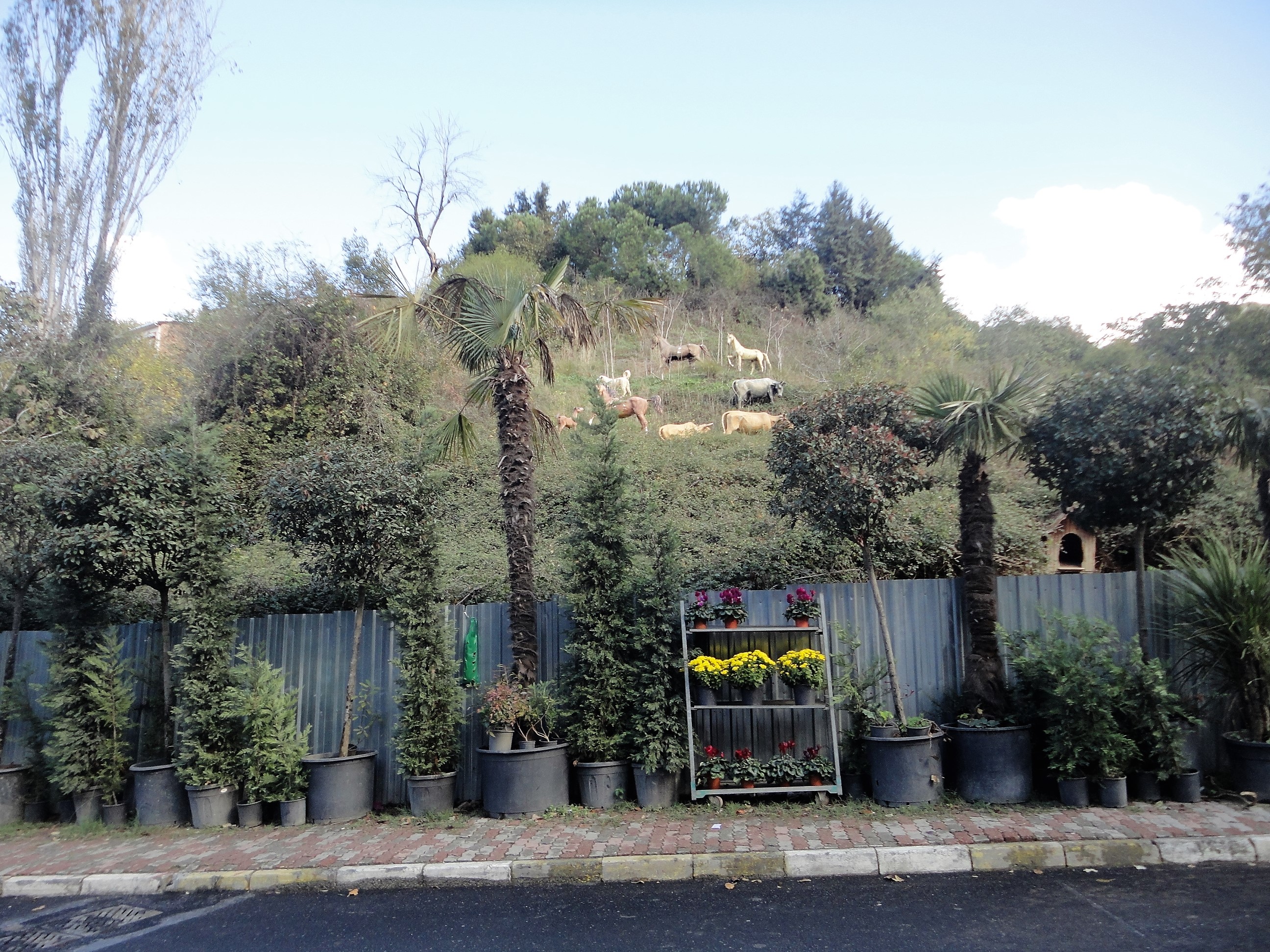
Potted palms with plaster farm animals on hillside behind
Kuzguncuk, 2017.11.05

Continue reading