After sitting behind his father on a motorcycle for a day, and riding through a thunderstorm, Chris Pirsig wants to tell and hear ghost stories. He asks whether his father believes in ghosts.

Altınova, September 10, 2025
After sitting behind his father on a motorcycle for a day, and riding through a thunderstorm, Chris Pirsig wants to tell and hear ghost stories. He asks whether his father believes in ghosts.
Altınova, September 10, 2025
In “Biological History,” I talk about some stories by Somerset Maugham. The theme is a confusion between biological (or generally physical) facts and historical (or personal) facts.
I originally made the post on January 9, 2023. I have returned to it a few times since. I did this most recently when a friend told me of purchasing, in Toronto, Ontario, a two-volume edition of Maugham’s complete short stories. Probably this was the same edition that I had bought in Hamilton, Ontario, a quarter-century earlier.
Working again through “Biological History,” I wanted to spell out a remark about what is either the just-world hypothesis or the just-world fallacy. I am going to do that here, using verses of Parmenides of Elea. Parmenides will lead me in turn to Dr Seuss and the fallacy of artificial intelligence.
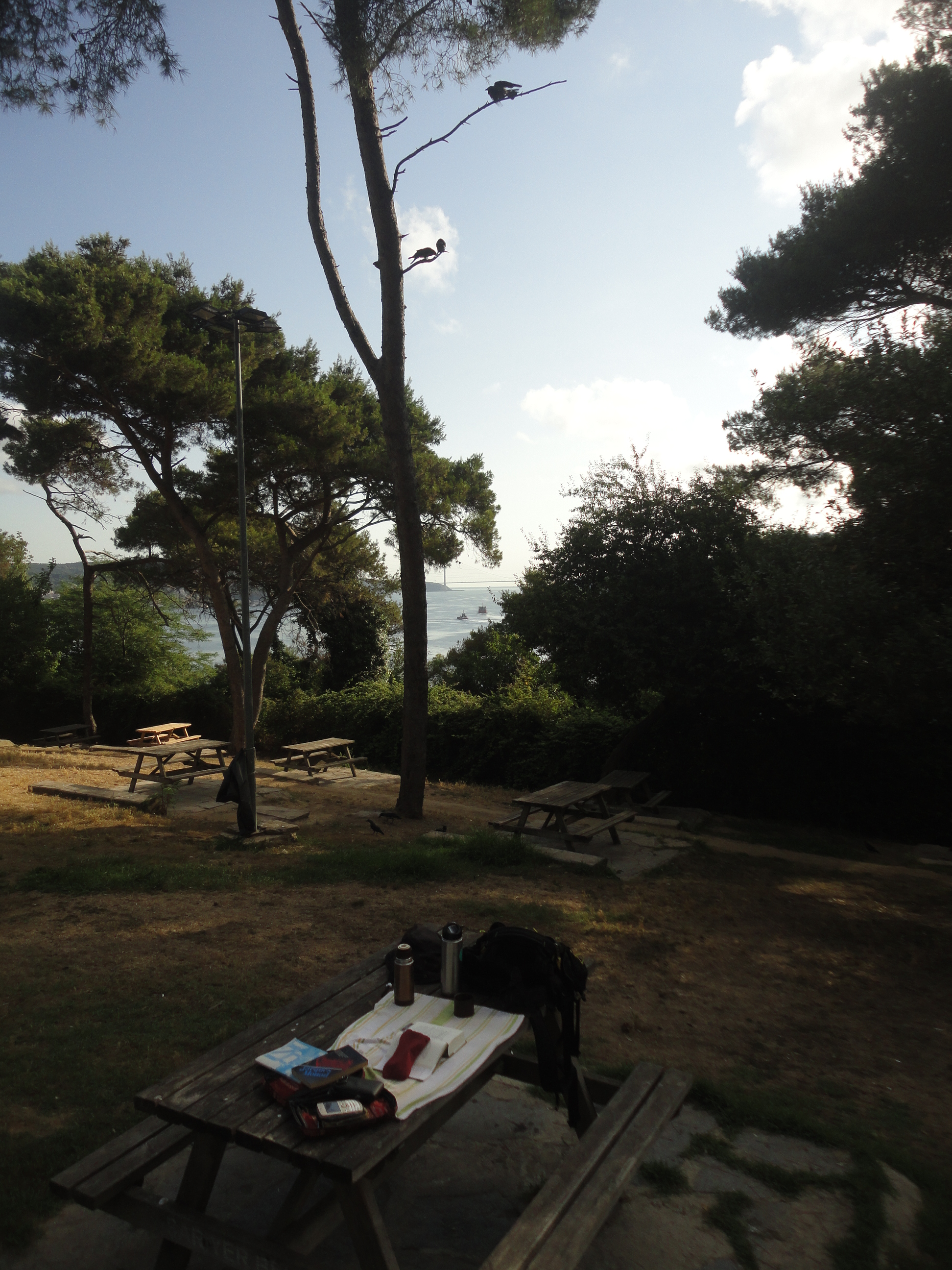
Where I read Parmenides
Erguvantepe, Sarıyer, Istanbul
July 19, 2025
From a walk around the neighborhood
Tarabya, Istanbul, Wednesday, October 9, 2024
There were a couple of tweets on the eve of Easter:
Just a reminder to make sure that you preach a doctrine of the resurrection tomorrow that is not reducible to that of the old IWW song “Joe Hill”
It’s a good song! I find it moving! But if that’s all we have to say about the resurrection (and I have heard many sermons that suggest that it is) – well, we should all be doing something else with our lives.
Fortunately, of course, it’s not all we have to say.
The son of the king of Persia wants to press the advantage, after the combined forces of Media, Persia, Armenia, and Chaldaea have
The king of Media is of another mind: he would rather quit while he is ahead. He has an argument for standing pat, by the account of Xenophon in the Cyropaedia (IV.i.11–18).
One may consider the argument of Cyaxares as an example of “motivated reasoning.” I think it is a specious argument: attractive, but ultimately unsound. Perhaps I say that, only because the king’s nephew Cyrus rejects the argument, but is nonetheless successful in what he goes on to do. With his Persian troops and as many Medians as wish to join them, along with the Hyrcanians, who have defected from Assyria, Cyrus pursues and defeats again the Assyrian army. He kills the kings of Cappadocia and Arabia, and he puts to flight both the king of Phrygia and Croesus, king of Lydia (IV.ii.28–31). Of course, this is not the end of the story; history never ends.
I have been reading and discussing the eight books of the Cyropaedia with a Catherine Project group, at the rate of half a book a week, since July 8 of this year (2024). Thus we shall have completed the sixth book (called “On the Eve of the Great Battle” in the Loeb edition) on September 23. It has astonished me that some of my fellow readers think well of the argument for taking it easy, even as they acknowledge that the man who makes it may be a fool. The argument does not seem to me like one that a king such as Cyaxares can afford to make.
Possibly Xenophon has an esoteric message, as Plato is thought to have. However, although these two writers had a common teacher in Socrates, he never went far from Athens. Xenophon helped lead a stranded army of ten thousand Greek mercenaries, from Babylon north to the Black Sea, after the failure of the coup for which they had been hired by Cyrus the Younger. Xenophon admires a practical man who can actually get things done. This being what Cyrus the Elder is, he is the hero of the Cyropaedia. I shall review my textual reasons for saying this. First I shall look at “motivated reasoning” today, along with the idea that we could have “evolved” to use it. (In short, the rest of this post has the three parts just linked to.)

Photo taken September 17, 2024, of Lesbos over the sea, from a beach in Lydia. Of this country, Chrysantas says to Cyrus, after the latter has pursued the Assyrians over the objections of his uncle Cyaxares (Cyropaedia VI.ii.21),
since it now appears that Syria is not to be the only prize – though there is much to be got in Syria, flocks and herds and corn and palm-trees yielding fruit – but Lydia as well, Lydia the land of wine and oil and fig-trees, Lydia, to whose shores the sea brings more good things than eyes can feast on, I say that once we realise this we can mope no longer, our spirits will rise apace, and we shall hasten to lay our hands on the Lydian wealth without delay.
This is in response to the suggestion of Cyrus that his army are intimidated by the alliance that Assyria has formed with Lydia.
Amity is equality, as Rackham translates it:
ΦΙΛΟΤΗΣ ΙΣΟΤΗΣ.
That’s what they say, anyway (§ v.5). Aristotle only refines it (§ viii.5):
ἡ δ᾽ ἰσότης καὶ ὁμοιότης φιλότης.
equality and similarity is amity.
Of eight readings on amity, or friendship, or love, or philia, we are in our second, comprising chapters v–viii of Book VIII of the Nicomachean Ethics.

Tarabya Marina
Sunday, March 10, 2024
Friendship is natural to most animals, especially human beings, and that’s why we praise the philanthropist. You will see, if you travel, that all of us are family and even friends.
Something like that is what Aristotle says, in this first of eight readings on friendship. I have trouble imagining where the Philosopher is going to go with his subject; or perhaps I am troubled to imagine what may be in store.

Crows in a tree
in the morning mist by the Bosphorus
Kireçburnu, Sarıyer, İstanbul
Sunday, March 10, 2024
At the beginning of the first post “On Dialectic,” I raised the question of why I put so much into such posts. I propose now a couple of answers.
I want to collect all evidence for what I am investigating – currently dialectic in Plato’s Republic. As Arthur Conan Doyle (1859–1930) has Sherlock Holmes say in A Study in Scarlet (1887; Wordsworth Classics, 2004),
It is a capital mistake to theorize before you have all the evidence. It biases the judgment.
And yet in Religion and Philosophy (1916), Collingwood states “the fundamental axiom of all thinking,”
namely that whatever exists stands in some definite relation to the other things that exist.
Thus “all the evidence” is everything in the world.
I am engaged in such self-defense as a certain Islamic philosopher is, by the account of Strauss in Persecution and the Art of Writing (1952):
Fārābī avails himself then of the specific immunity of the commentator or of the historian in order to speak his mind concerning grave matters in his “historical” works, rather than in the works in which he speaks in his own name.

View from our balcony
Sanatçılar Sitesi, Tarabya, Istanbul
Saturday, July 8, 2023
Book XIX of the Iliad is all talk. This annoys Achilles, but is important for Agamemnon and Odysseus, and they should know better – Odysseus even says so.

Achilles gets ready to fight while Patroclus lies dead
(or, one of two well-fed street-dogs goes through the motions of defense)
Şalcıkır Parkı, Tarabya
Sarıyer, Istanbul
Sunday morning, March 26, 2023
Book VII of the Iliad shows us the paradox of men at war who can still work together.
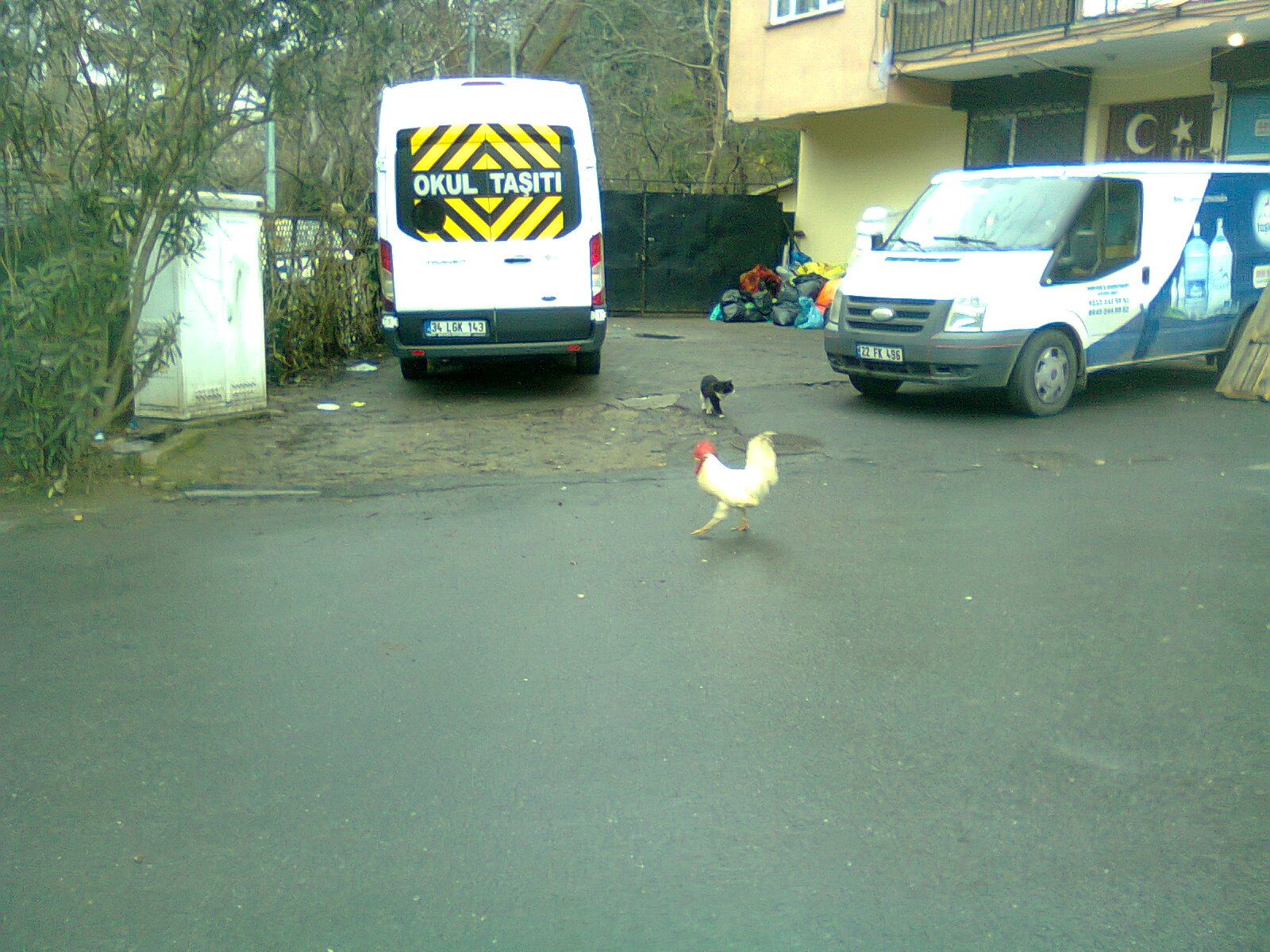
Cock and cat on a village street
near a stream channelled between concrete walls
Tarabya, Sarıyer, Istanbul
Wednesday, January 11, 2023

Tarabya Marina, Sarıyer, Istanbul
January 1, 2023
“As is the generation of leaves, so is that of humanity.” Glaucus says that to Diomedes in the Iliad, when the two warriors meet on the battlefield, and Diomedes wants to know whether he is facing man or god.
Humans are multitudinous and ephemeral, like the folia of trees, says Glaucus; why should his own tree be of interest to anybody else? It’s a pro forma question, perhaps, since Glaucus does proceed to describe his family.
 Polytropy